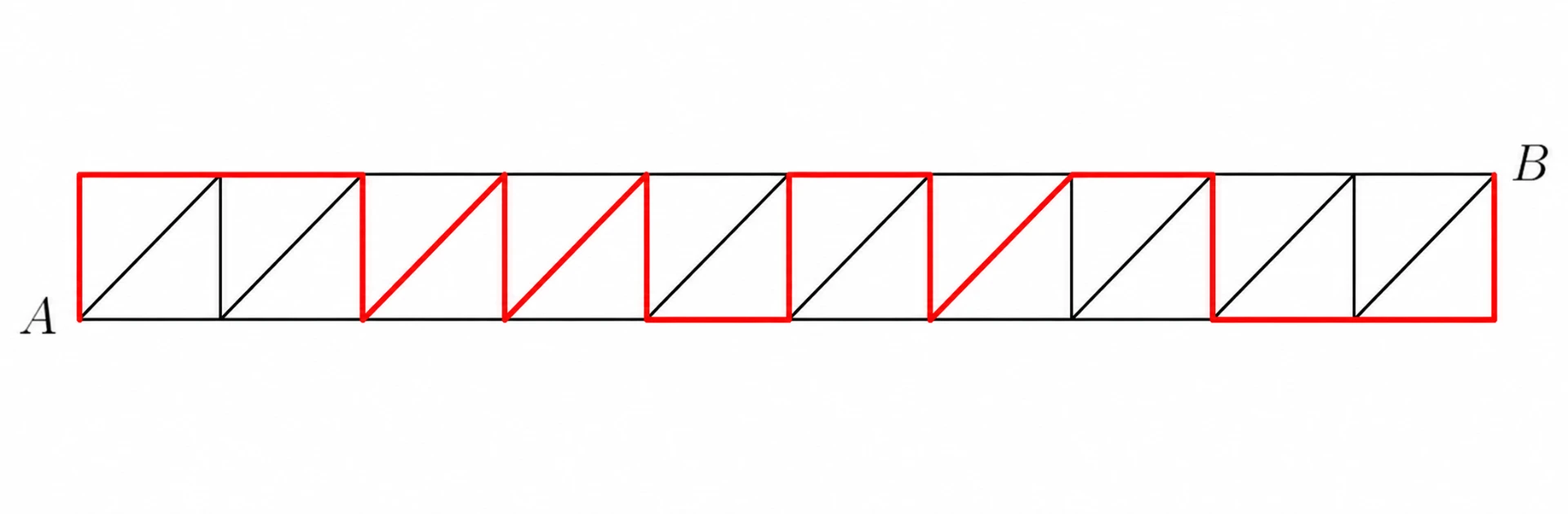
The figure below shows a grid of 10 squares in a row. Each square has a diagonal connecting its lower left vertex to its upper right vertex. A bug moves along the line segments from vertex to vertex, never traversing the same segment twice and never moving from right to left along a horizontal or diagonal segment. Let N be the number of paths the bug can take from the lower left corner (A) to the upper right corner (B). One such path from A to B is shown by the thick line segments in the figure. Find N.
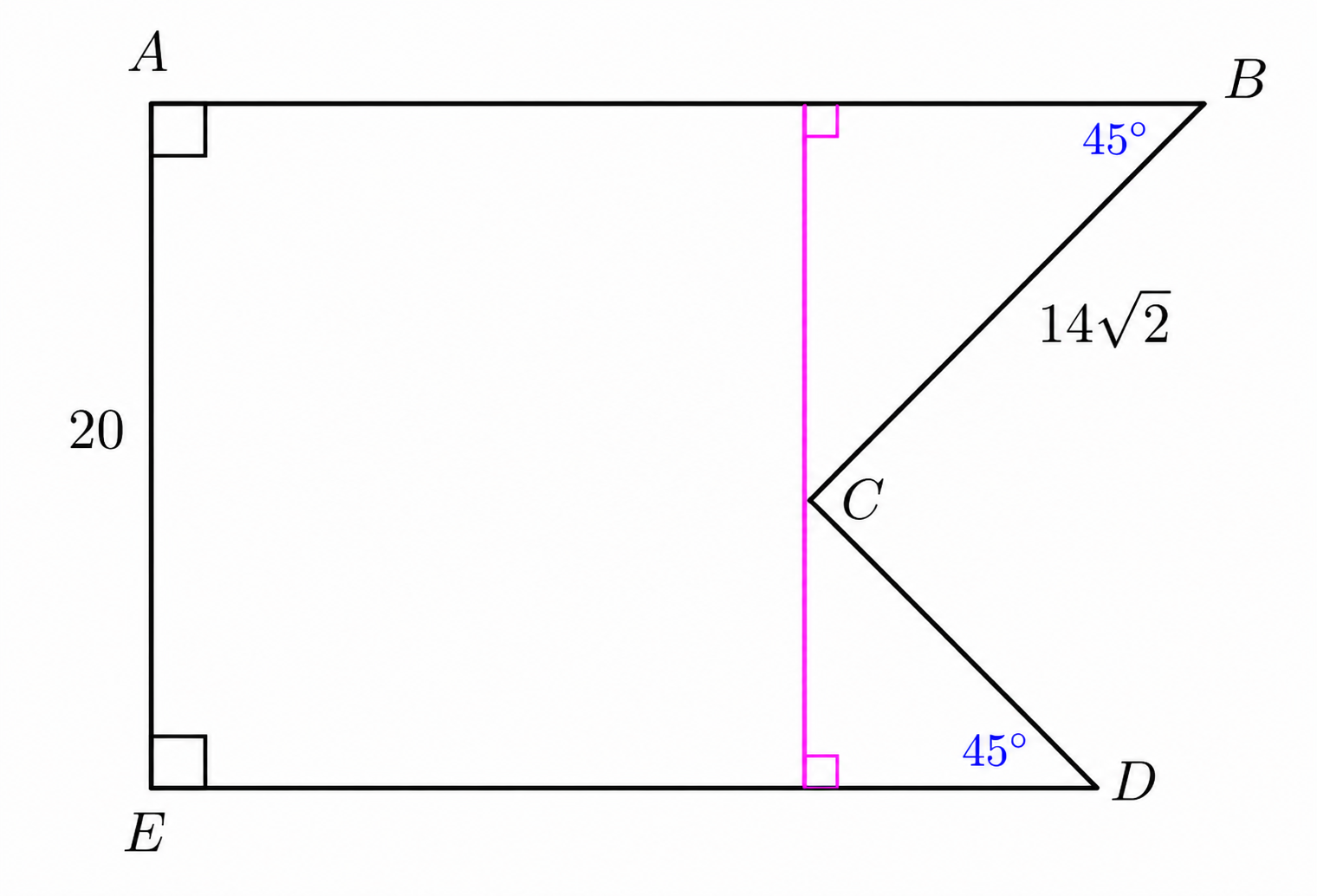
Let ABCDE be a nonconvex pentagon with internal angles ∠A=∠E=90∘ and ∠B=∠D=45∘. Suppose that DE<AB, AE=20, BC=142, and points B, C, and D lie on the same side of line AE. Suppose further that AB is an integer with AB<2026 and the area of pentagon ABCDE is an integer multiple of 16. Find the number of possible values of AB.
For each positive integer n let f(n) be the value of the base-ten numeral n viewed in base b, where b is the least integer greater than the greatest digit in n. For example, if n=72, then b=8, and 72 as a numeral in base 8 equals 7⋅8+2=58; therefore f(72)=58. Find the number of positive integers n less than 1000 such that f(n)=n.
An urn contains n marbles. Each marble is either red or blue, and there are at least 7 marbles of each color. When 7 marbles are drawn randomly from the urn without replacement, the probability that exactly 4 of them are red equals the probability that exactly 5 of them are red. Find the sum of the five least values of n for which this is possible.
Find the sum of all real numbers r such that there is at least one point where the circle with radius r centered at (4,39) is tangent to the parabola with equation 2y=x2−8x+12.
A standard fair six-sided die is rolled repeatedly. Each time the die reads 1 or 2, Alice gets a coin; each time it reads 3 or 4, Bob gets a coin; and each time it reads 5 or 6, Carol gets a coin. The probability that Alice and Bob each receive at least two coins before Carol receives any coins can be written as nm, where m and n are relatively prime positive integers. Find 100m+n.
Isosceles triangle △ABC has AB=BC. Let I be the incenter of △ABC. The perimeters of △ABC and △AIC are in the ratio 125:6, and all the sides of both triangles have integer lengths. Find the minimum possible value of AB.
Let S denote the value of the infinite sum 91+991+9991+99991+⋯ Find the remainder when the greatest integer less than or equal to 10100S is divided by 1000.
Let △ABC be a triangle with D on BC such that AD bisects ∠BAC. Let ω be the circle that passes through A and is tangent to segment BC at D. Let E=A and F=A be the intersections of ω with segments AB and AC, respectively. Suppose that AB=200, AC=225, and all of AE,AF,BD, and CD are positive integers. Find the greatest possible value of BC.
Find the greatest integer n such that the cubic polynomial x3−6nx2+(n−11)x−400 has roots α2,β2, and γ2, where α,β, and γ are complex numbers, and there are exactly seven different possible values for α+β+γ.
Consider a tetrahedron with two isosceles triangle faces with side lengths 510,510,10 and two isosceles triangle faces with side lengths 510,510,18. The four vertices of the tetrahedron lie on a sphere with center S, and the four faces of the tetrahedron are tangent to a sphere with center R. The distance RS can be written as nm, where m and n are relatively prime positive integers. Find m+n.
- S and T have the same number of elements, - S and T are disjoint, and - the elements of S can be paired with the elements of T so that the elements in each pair differ by exactly 1.
For example, {1,2,5} and {0,3,4} are cousins. Suppose that the set S has exactly 4040 cousins. Find the least number of elements the set S can have.
For integers a and b, let a∘b=a−b if a is odd and b is even, and a+b otherwise. Find the number of sequences a1,a2,a3,…,an of positive integers such that a1+a2+a3+⋯+an=12 and a1∘a2∘a3∘⋯∘an=0 where the operations are performed from left to right; that is, a1∘a2∘a3 means (a1∘a2)∘a3.