Toolkit 48

Logarithms: Definition and Properties

Definition

logbx=y    by=x\log_b x = y \iff b^y = x

Domain

x>0,b>0,b1x>0,\qquad b>0,\qquad b\ne 1

Range

(,+)(-\infty,+\infty)

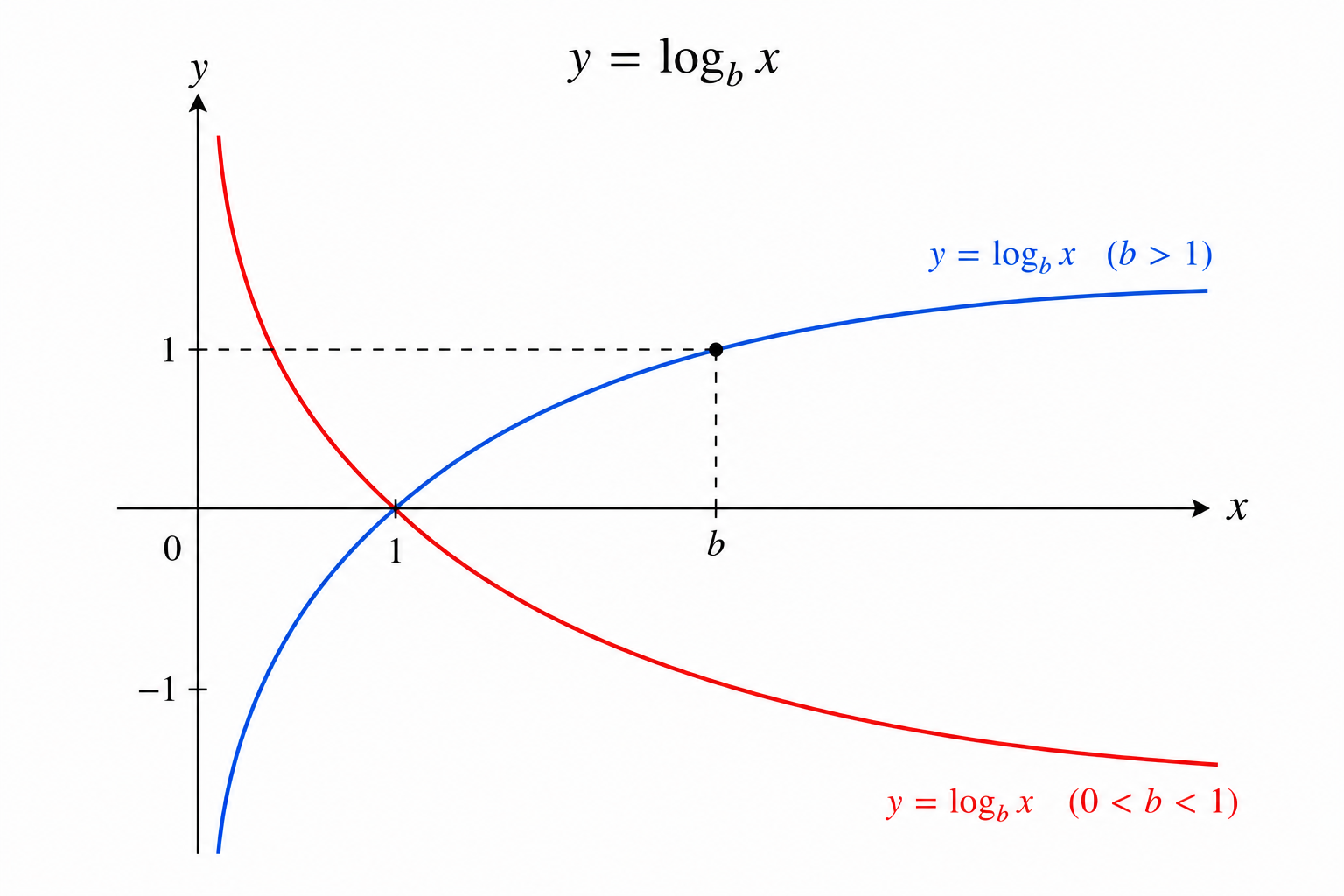
If b>1b>1, then y=logbxy=\log_b x is increasing.

If 0<b<10<b<1, then y=logbxy=\log_b x is decreasing.

Graph of y = log_b(x) for b>1 and 0<b<1, showing the increasing and decreasing cases.

Properties

1.logb1=01.\quad \log_b 1 = 0
2.logbb=12.\quad \log_b b = 1
3.logb(bm)=m3.\quad \log_b(b^m) = m
4.blogba=a4.\quad b^{\log_b a} = a
5.logba+logbc=logb(ac)5.\quad \log_b a + \log_b c = \log_b(ac)
6.logbalogbc=logb ⁣(ac)6.\quad \log_b a - \log_b c = \log_b\!\left(\frac{a}{c}\right)
7.logb(an)=nlogba7.\quad \log_b(a^n) = n\log_b a
8.logbma=1mlogba8.\quad \log_{b^m} a = \frac{1}{m}\log_b a
9.logb ⁣(1a)=logba9.\quad \log_b\!\left(\frac{1}{a}\right) = -\log_b a
10.logbalogac=logbc10.\quad \log_b a \cdot \log_a c = \log_b c
11.logba=logcalogcb11.\quad \log_b a = \frac{\log_c a}{\log_c b}
12.logba=lnalnb,where lnx=logex, e=2.7182812.\quad \log_b a = \frac{\ln a}{\ln b},\quad \text{where } \ln x = \log_e x,\ e=2.71828\ldots
13.logba=1logab13.\quad \log_b a = \frac{1}{\log_a b}
14.b(logax)(logba)=x14.\quad b^{(\log_a x)(\log_b a)} = x
15.logbx=logby    x=y15.\quad \log_b x = \log_b y \iff x = y

Proof

1.

logb1=0\log_b 1 = 0

Proof. By the definition of a logarithm, logb1=0    b0=1.\log_b 1 = 0 \iff b^0 = 1.

2.

logbb=1\log_b b = 1

Proof. By the definition of a logarithm, logbb=1    b1=b.\log_b b = 1 \iff b^1 = b.

3.

logb(bm)=m\log_b(b^m) = m

Proof. By the definition of a logarithm, logb(bm)=m    bm=bm.\log_b(b^m) = m \iff b^m = b^m.

4.

blogba=ab^{\log_b a} = a

Proof.

Let

logba=m.\log_b a = m.

Then

bm=a,b^m = a,

so

blogba=a.b^{\log_b a} = a.

5.

logba+logbc=logb(ac)\log_b a + \log_b c = \log_b(ac)

Proof.

Let

logba=m,logbc=n.\log_b a = m, \qquad \log_b c = n.

Then

a=bm,c=bn.a = b^m, \qquad c = b^n.

Therefore,

ac=bm+n,ac = b^{m+n},

which implies

logb(ac)=m+n=logba+logbc.\log_b(ac) = m+n = \log_b a + \log_b c.

6.

logbalogbc=logb ⁣(ac)\log_b a - \log_b c = \log_b\!\left(\frac{a}{c}\right)

Proof.

Let

logba=m,logbc=n.\log_b a = m, \qquad \log_b c = n.

Then

a=bm,c=bn.a = b^m, \qquad c = b^n.

Hence

ac=bmn,\frac{a}{c} = b^{m-n},

so

logb ⁣(ac)=mn=logbalogbc.\log_b\!\left(\frac{a}{c}\right) = m-n = \log_b a - \log_b c.

7.

logb(an)=nlogba\log_b(a^n) = n\log_b a

Proof.

Let

logba=m.\log_b a = m.

Then

a=bm,a = b^m,

so

an=bnm.a^n = b^{nm}.

Therefore,

logb(an)=nm=nlogba.\log_b(a^n) = nm = n\log_b a.

8.

logbma=1mlogba\log_{b^m} a = \frac{1}{m}\log_b a

Proof.

Let

logba=n.\log_b a = n.

Then

a=bn=(bm)n/m.a = b^n = (b^m)^{\,n/m}.

Hence

logbma=nm=1mlogba.\log_{b^m} a = \frac{n}{m} = \frac{1}{m}\log_b a. \quad\square

9.

logb ⁣(1a)=logba\log_b\!\left(\frac{1}{a}\right) = -\log_b a

Proof.

Let

logba=m.\log_b a = m.

Then

a=bm,a = b^m,

so

1a=bm.\frac{1}{a} = b^{-m}.

Therefore,

logb ⁣(1a)=m=logba.\log_b\!\left(\frac{1}{a}\right) = -m = -\log_b a.

10.

logbalogac=logbc\log_b a \cdot \log_a c = \log_b c

Proof.

Let

logba=m.\log_b a = m.

Then

a=bm.a = b^m.

Also let

logac=n.\log_a c = n.

Then

c=an=(bm)n=bmn.c = a^n = (b^m)^n = b^{mn}.

Therefore,

logbc=mn=logbalogac.\log_b c = mn = \log_b a \cdot \log_a c.

11.

logba=logcalogcb\log_b a = \frac{\log_c a}{\log_c b}

Proof.

Using Property 10,

logbalogcb=logca.\log_b a \cdot \log_c b = \log_c a.

Dividing both sides by logcb\log_c b,

logba=logcalogcb.\log_b a = \frac{\log_c a}{\log_c b}.

12.

logba=lnalnb\log_b a = \frac{\ln a}{\ln b}

where lnx=logex.\ln x = \log_e x.

Proof.

Applying Property 10,

logbalnb=logbalogeb=lna.\log_b a \cdot \ln b = \log_b a \cdot \log_e b = \ln a.

Hence,

logba=lnalnb.\log_b a = \frac{\ln a}{\ln b}.

13.

logba=1logab\log_b a = \frac{1}{\log_a b}

Proof.

Using Properties 10 and 2,

logbalogab=logbb=1.\log_b a \cdot \log_a b = \log_b b = 1.

Therefore,

logba=1logab.\log_b a = \frac{1}{\log_a b}.

14.

b(logax)(logba)=xb^{(\log_a x)(\log_b a)} = x

Proof.

Using Properties 4 and 10,

b(logax)(logba)=(blogba)logax=alogax=x.b^{(\log_a x)(\log_b a)} = \left(b^{\log_b a}\right)^{\log_a x} = a^{\log_a x} = x.

15.

logbx=logby    x=y\log_b x = \log_b y \iff x = y

Proof.

If

logbx=logby,\log_b x = \log_b y,

then

blogbx=blogby,b^{\log_b x} = b^{\log_b y},

which implies

x=y.x = y.

Conversely, if

x=y,x = y,

then

logbx=logby.\log_b x = \log_b y.

Thus,

logbx=logby    x=y.\log_b x = \log_b y \iff x = y. \quad\square