Let
f(x)=ax2+bx+c,a=0, and let
Δ=b2−4ac. We consider three cases.
Case 1: Δ>0
The quadratic has two distinct real roots
r1=2a−b−Δ,r2=2a−b+Δ, where r1<r2. Thus,
f(x)=a(x−r1)(x−r2). 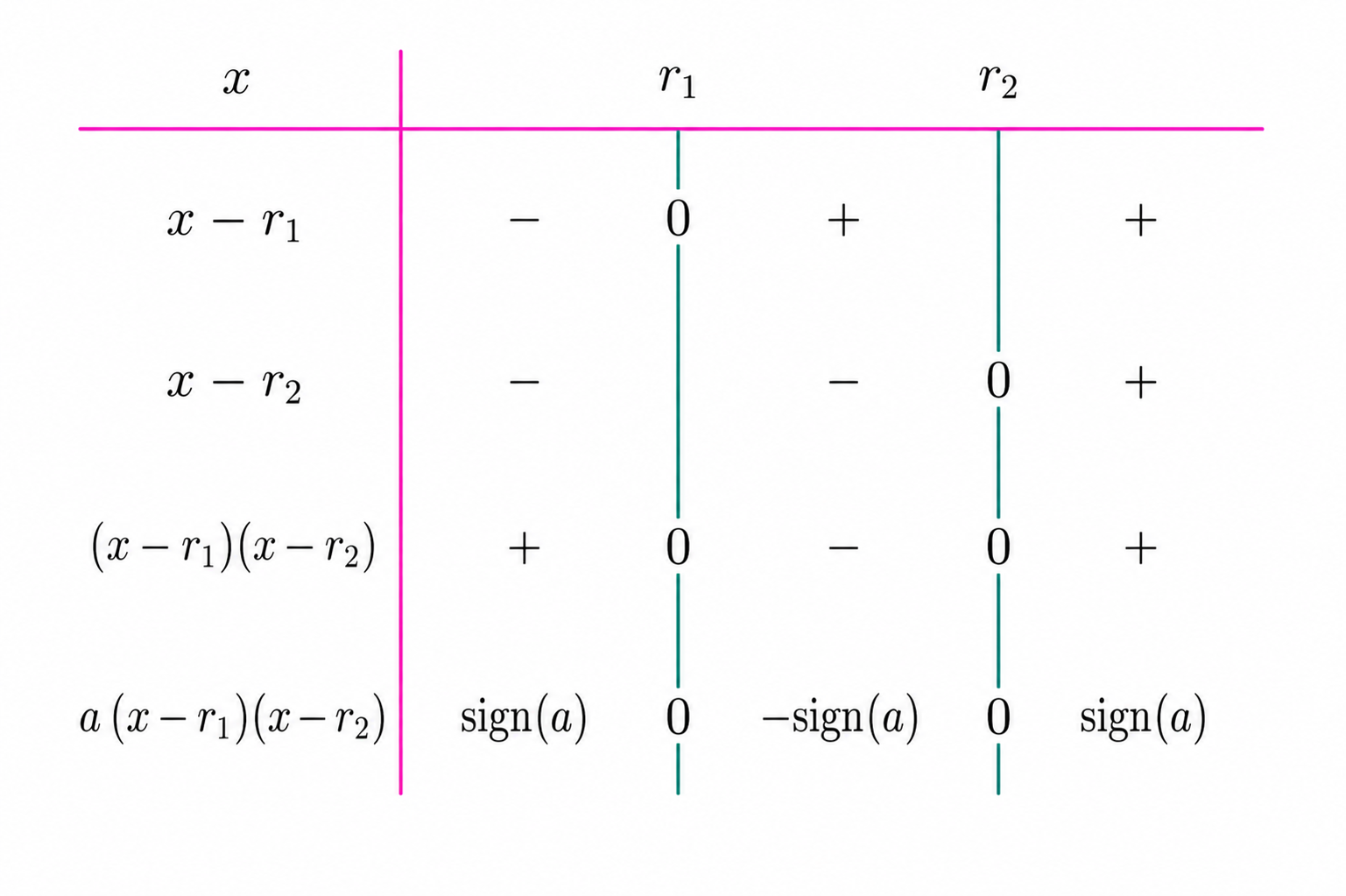
From the sign chart above, we immediately obtain
sgn(f(x))=⎩⎨⎧sgn(a),0,−sgn(a),0,sgn(a),x<r1,x=r1,r1<x<r2,x=r2,x>r2. Case 2: Δ=0
The quadratic has one repeated real root
r=−2ab. Hence,
f(x)=a(x−r)2. 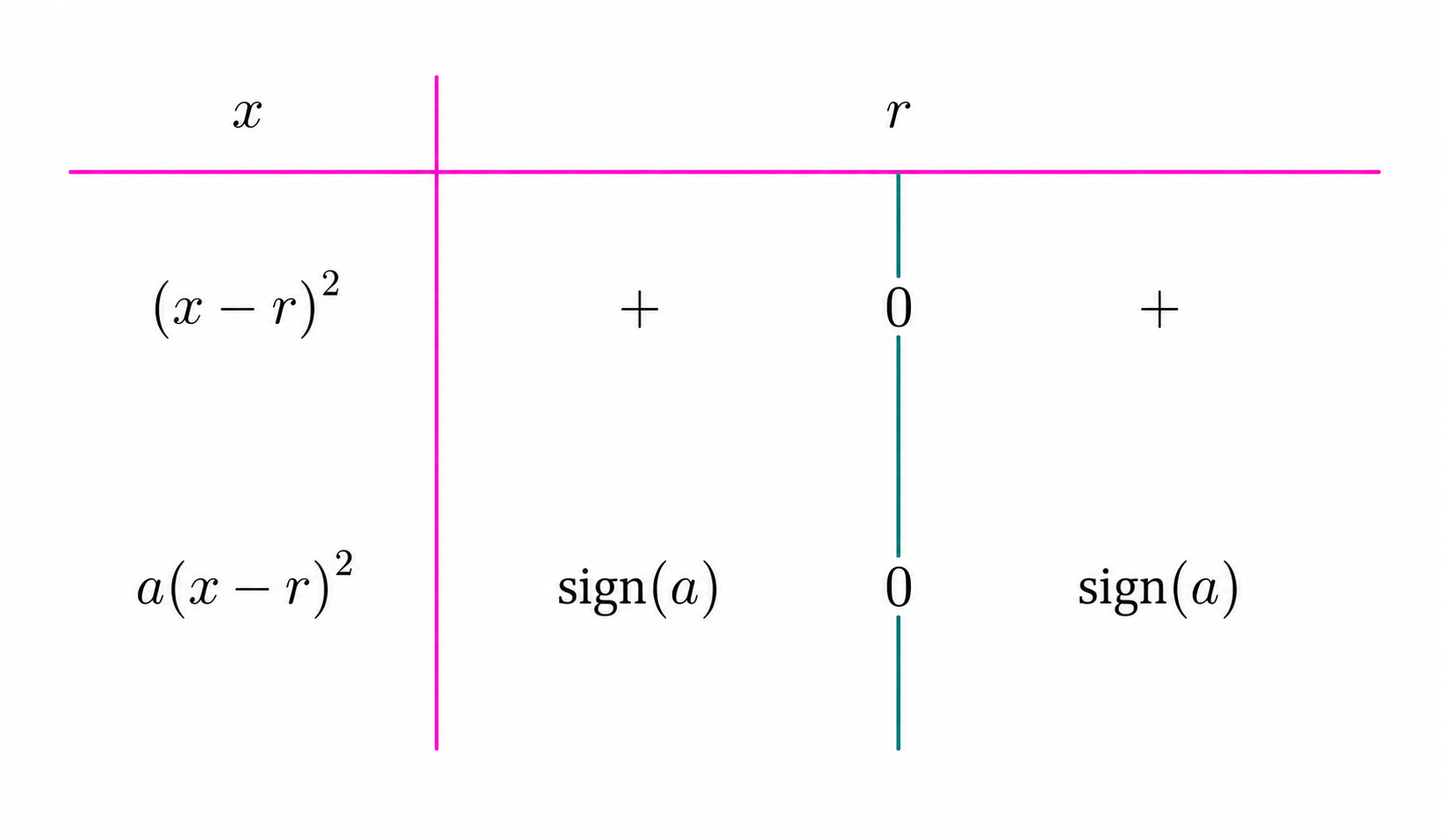
From the sign chart above, we immediately obtain
sgn(f(x))=sgn(a) for x=r, while
Case 3: Δ<0
Completing the square,
f(x)=a(x2+abx+ac)=a((x+2ab)2+4a24ac−b2). Since Δ=b2−4ac<0, we have 4ac−b2>0. Therefore,
(x+2ab)2+4a24ac−b2>0 for every real x. Thus,
sgn(f(x))=sgn(a) for every real x. These three cases give the complete root and sign classification of a quadratic polynomial.