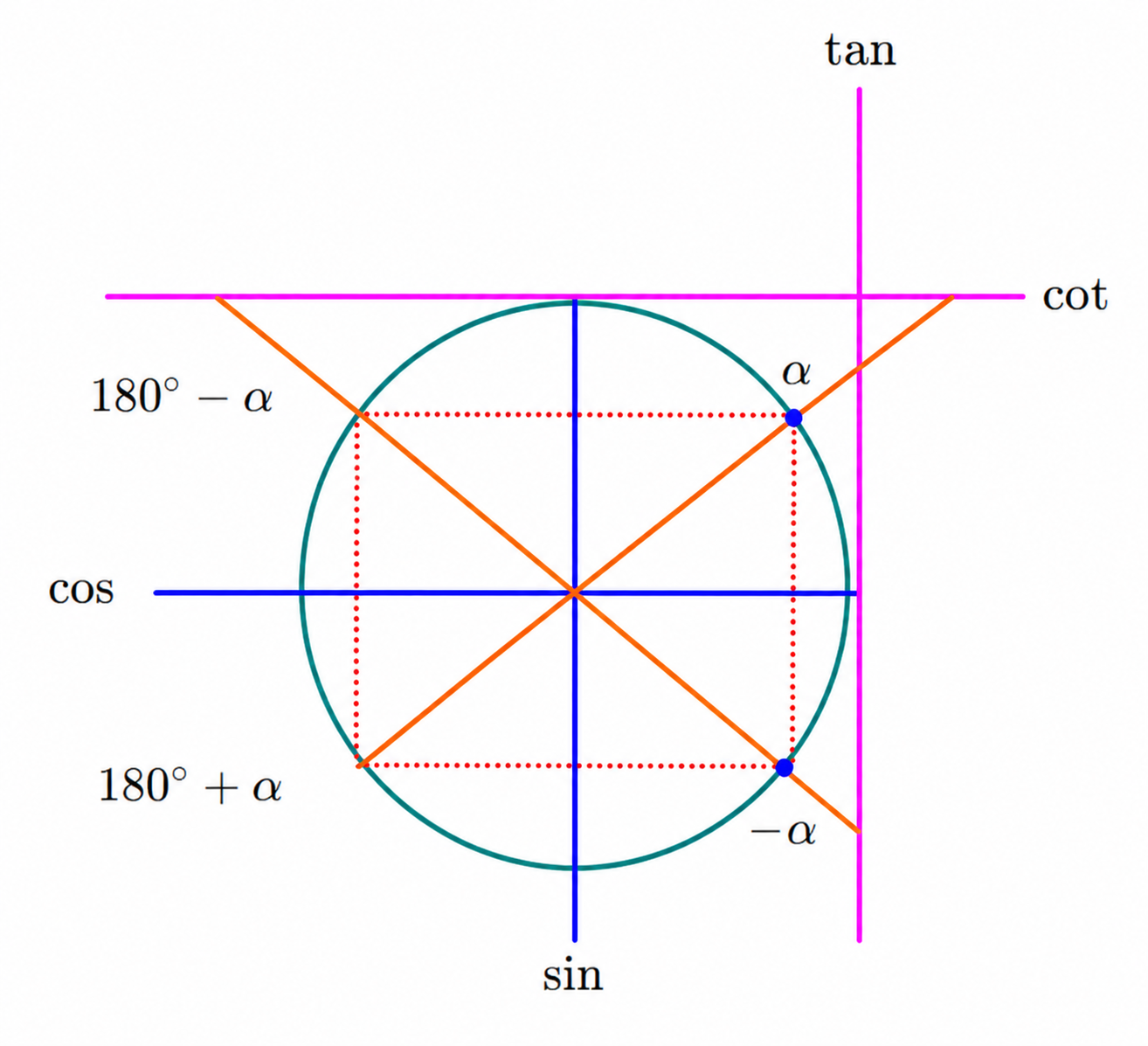
From the unit-circle diagram above, we immediately obtain, whenever the expressions are defined,
sin ( 180 ∘ − α ) = sin α , cos ( 180 ∘ − α ) = − cos α , tan ( 180 ∘ − α ) = − tan α , cot ( 180 ∘ − α ) = − cot α , \begin{aligned} \sin(180^\circ-\alpha) &= \sin\alpha, & \cos(180^\circ-\alpha) &= -\cos\alpha, \\ \tan(180^\circ-\alpha) &= -\tan\alpha, & \cot(180^\circ-\alpha) &= -\cot\alpha, \end{aligned} sin ( 18 0 ∘ − α ) tan ( 18 0 ∘ − α ) = sin α , = − tan α , cos ( 18 0 ∘ − α ) cot ( 18 0 ∘ − α ) = − cos α , = − cot α , sin ( 180 ∘ + α ) = − sin α , cos ( 180 ∘ + α ) = − cos α , tan ( 180 ∘ + α ) = tan α , cot ( 180 ∘ + α ) = cot α , \begin{aligned} \sin(180^\circ+\alpha) &= -\sin\alpha, & \cos(180^\circ+\alpha) &= -\cos\alpha, \\ \tan(180^\circ+\alpha) &= \tan\alpha, & \cot(180^\circ+\alpha) &= \cot\alpha, \end{aligned} sin ( 18 0 ∘ + α ) tan ( 18 0 ∘ + α ) = − sin α , = tan α , cos ( 18 0 ∘ + α ) cot ( 18 0 ∘ + α ) = − cos α , = cot α , sin ( − α ) = − sin α , cos ( − α ) = cos α , tan ( − α ) = − tan α , cot ( − α ) = − cot α . \begin{aligned} \sin(-\alpha) &= -\sin\alpha, & \cos(-\alpha) &= \cos\alpha, \\ \tan(-\alpha) &= -\tan\alpha, & \cot(-\alpha) &= -\cot\alpha. \end{aligned} sin ( − α ) tan ( − α ) = − sin α , = − tan α , cos ( − α ) cot ( − α ) = cos α , = − cot α . For the transformations involving 90 ∘ 90^\circ 9 0 ∘ , we use the following figure.
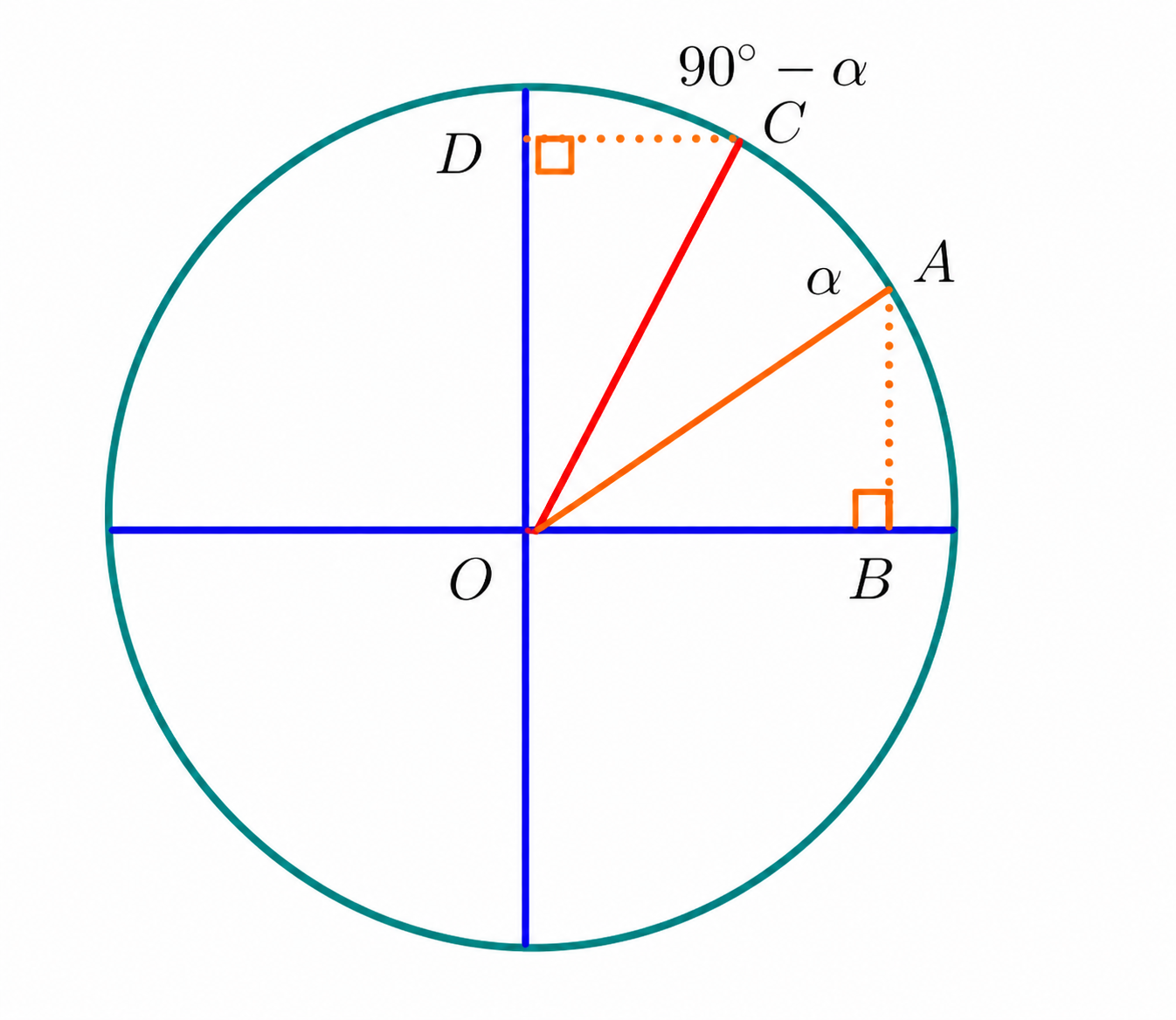
Let A = ( cos α , sin α ) A=(\cos\alpha,\sin\alpha) A = ( cos α , sin α ) be the point on the unit circle corresponding to α \alpha α , and let C C C be the point corresponding to 90 ∘ − α 90^\circ-\alpha 9 0 ∘ − α . Drop perpendiculars from A A A and C C C to the x x x - and y y y -axes at B B B and D D D respectively. The right triangles O A B OAB O A B and O C D OCD O C D share the hypotenuse O A = O C = 1 OA=OC=1 O A = O C = 1 and have equal acute angles α \alpha α at O O O , so they are congruent. Hence O D = O B = cos α OD = OB = \cos\alpha O D = O B = cos α and D C = A B = sin α DC = AB = \sin\alpha D C = A B = sin α , which are the coordinates of C C C :
( cos ( 90 ∘ − α ) , sin ( 90 ∘ − α ) ) = ( sin α , cos α ) . (\cos(90^\circ-\alpha), \sin(90^\circ-\alpha)) = (\sin\alpha, \cos\alpha). ( cos ( 9 0 ∘ − α ) , sin ( 9 0 ∘ − α )) = ( sin α , cos α ) . Therefore,
sin ( 90 ∘ − α ) = cos α , cos ( 90 ∘ − α ) = sin α . \sin(90^\circ-\alpha) = \cos\alpha, \qquad \cos(90^\circ-\alpha) = \sin\alpha. sin ( 9 0 ∘ − α ) = cos α , cos ( 9 0 ∘ − α ) = sin α . Using the definitions of tangent and cotangent, whenever the expressions are defined,
tan ( 90 ∘ − α ) = sin ( 90 ∘ − α ) cos ( 90 ∘ − α ) = cos α sin α = cot α , \tan(90^\circ-\alpha) = \frac{\sin(90^\circ-\alpha)}{\cos(90^\circ-\alpha)} = \frac{\cos\alpha}{\sin\alpha} = \cot\alpha, tan ( 9 0 ∘ − α ) = cos ( 9 0 ∘ − α ) sin ( 9 0 ∘ − α ) = sin α cos α = cot α , cot ( 90 ∘ − α ) = cos ( 90 ∘ − α ) sin ( 90 ∘ − α ) = sin α cos α = tan α . \cot(90^\circ-\alpha) = \frac{\cos(90^\circ-\alpha)}{\sin(90^\circ-\alpha)} = \frac{\sin\alpha}{\cos\alpha} = \tan\alpha. cot ( 9 0 ∘ − α ) = sin ( 9 0 ∘ − α ) cos ( 9 0 ∘ − α ) = cos α sin α = tan α . Finally, writing 90 ∘ + α = 180 ∘ − ( 90 ∘ − α ) 90^\circ+\alpha = 180^\circ-(90^\circ-\alpha) 9 0 ∘ + α = 18 0 ∘ − ( 9 0 ∘ − α ) and combining the identities already proved gives, whenever the expressions are defined,
sin ( 90 ∘ + α ) = sin ( 180 ∘ − ( 90 ∘ − α ) ) = sin ( 90 ∘ − α ) = cos α , cos ( 90 ∘ + α ) = cos ( 180 ∘ − ( 90 ∘ − α ) ) = − cos ( 90 ∘ − α ) = − sin α . \begin{aligned} \sin(90^\circ+\alpha) &= \sin\bigl(180^\circ-(90^\circ-\alpha)\bigr) = \sin(90^\circ-\alpha) = \cos\alpha, \\ \cos(90^\circ+\alpha) &= \cos\bigl(180^\circ-(90^\circ-\alpha)\bigr) = -\cos(90^\circ-\alpha) = -\sin\alpha. \end{aligned} sin ( 9 0 ∘ + α ) cos ( 9 0 ∘ + α ) = sin ( 18 0 ∘ − ( 9 0 ∘ − α ) ) = sin ( 9 0 ∘ − α ) = cos α , = cos ( 18 0 ∘ − ( 9 0 ∘ − α ) ) = − cos ( 9 0 ∘ − α ) = − sin α . Dividing then yields
tan ( 90 ∘ + α ) = − cot α , cot ( 90 ∘ + α ) = − tan α . □ \begin{aligned} \tan(90^\circ+\alpha) &= -\cot\alpha, \\ \cot(90^\circ+\alpha) &= -\tan\alpha. \quad\square \end{aligned} tan ( 9 0 ∘ + α ) cot ( 9 0 ∘ + α ) = − cot α , = − tan α . □