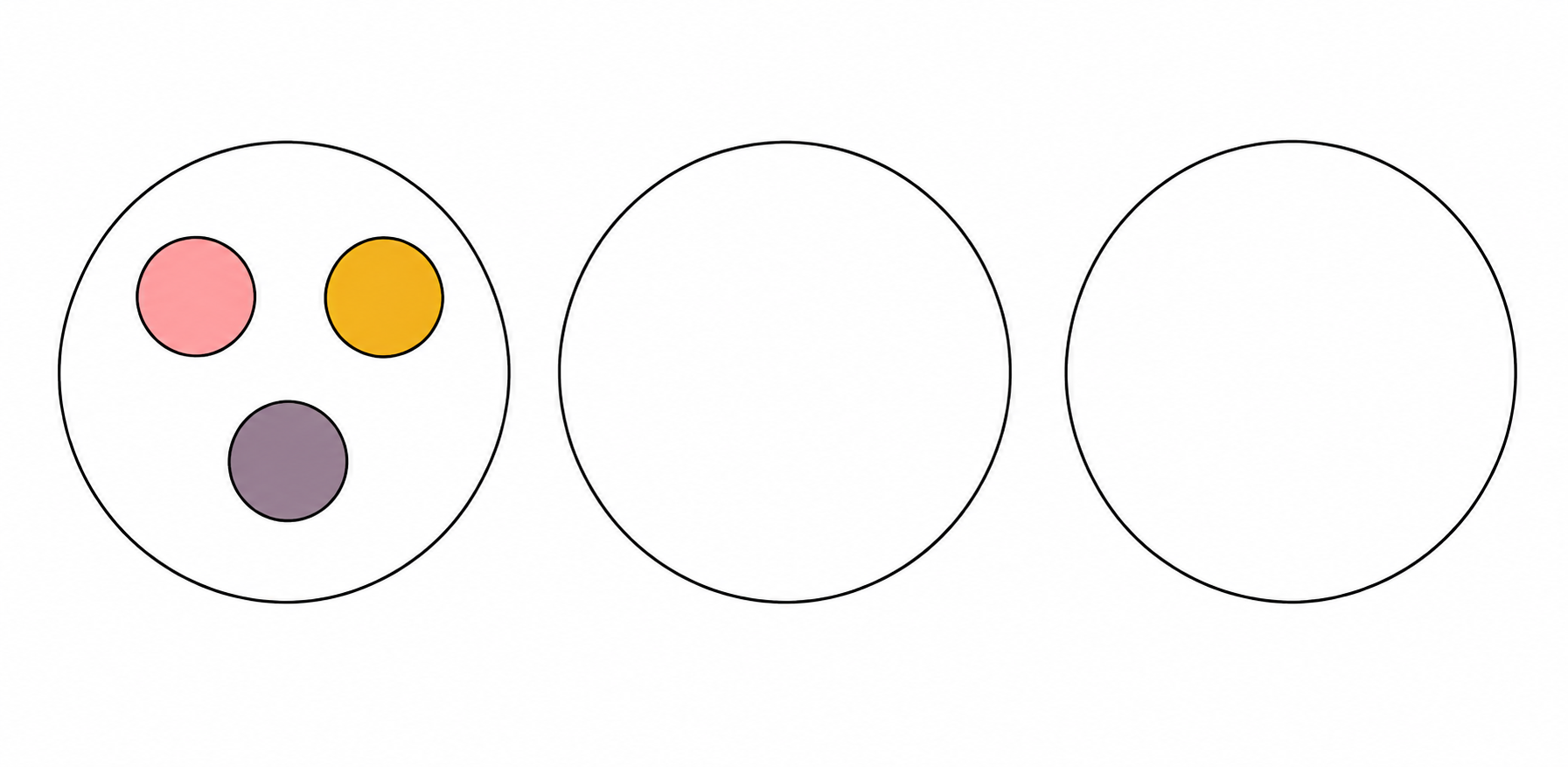
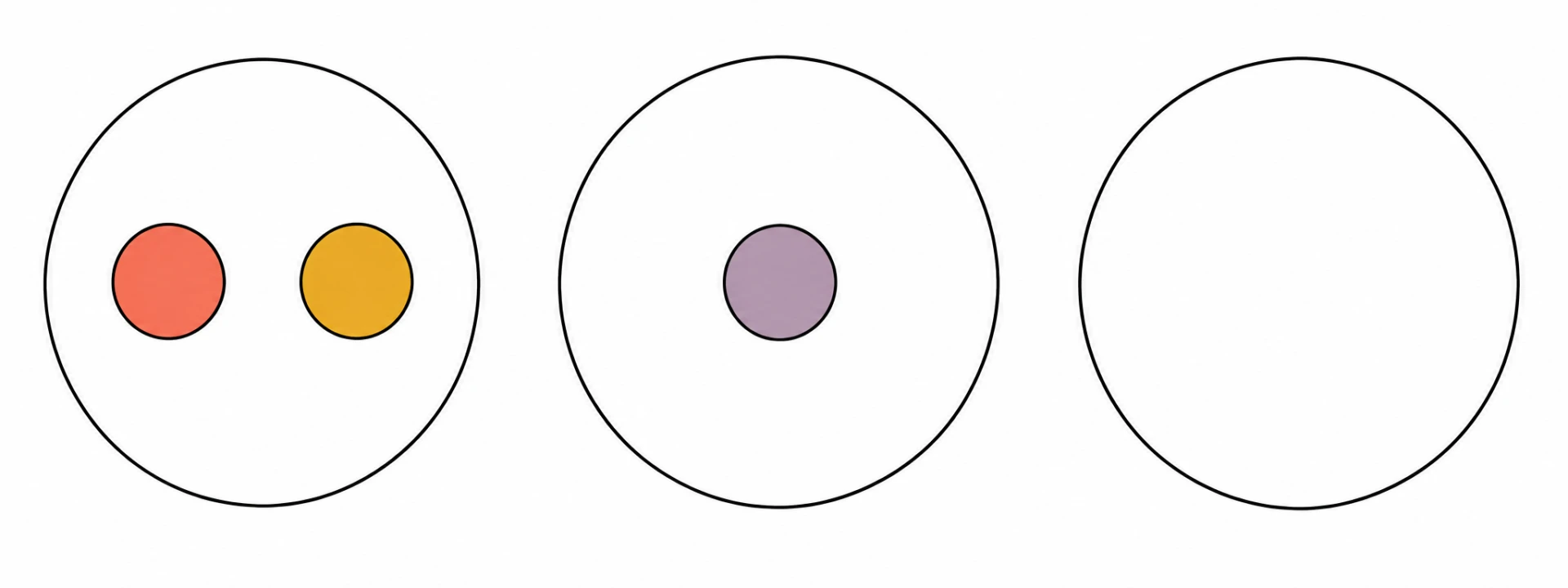
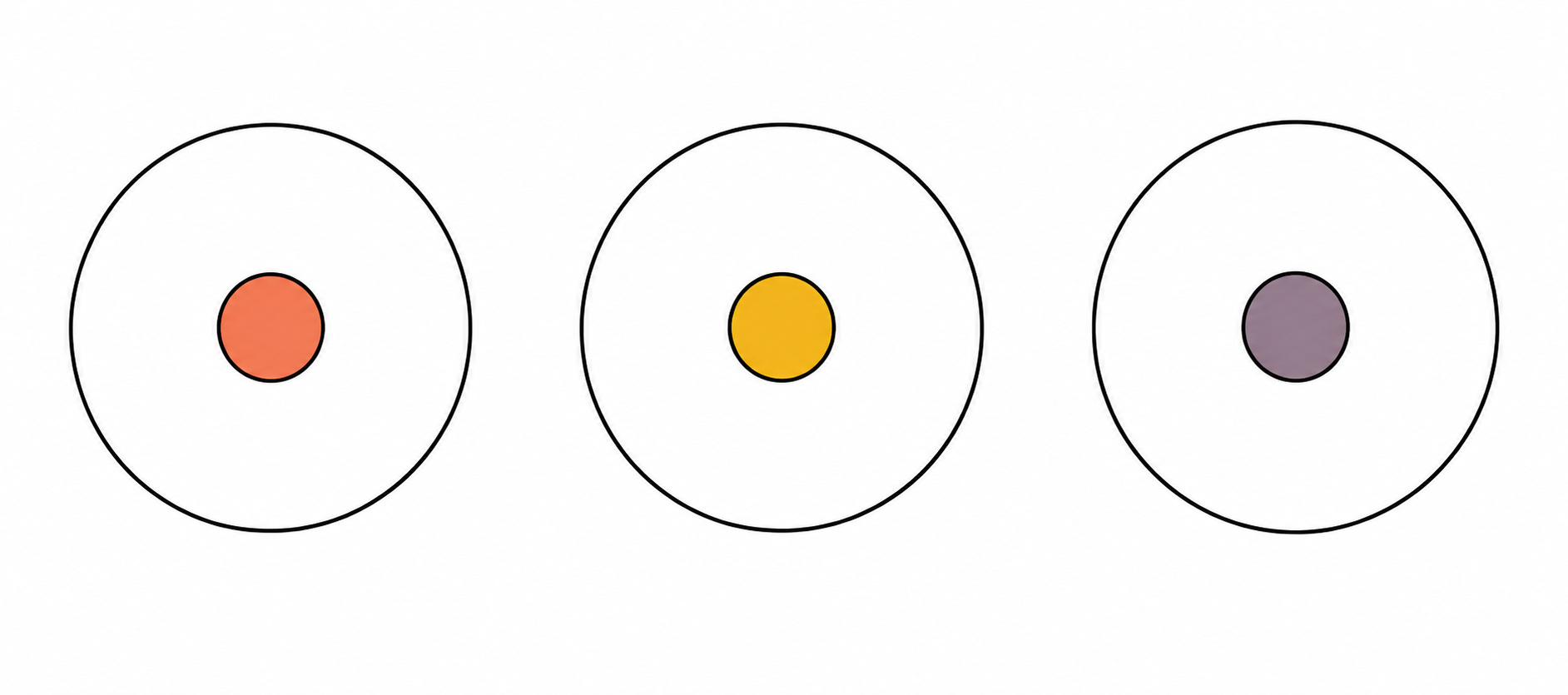
There are three jars. Each of three coins is placed in one of the three jars, chosen at random and independently of the placements of the other coins. What is the expected number of coins in a jar with the most coins?
(A) 4 3 \text{(A)}\;\frac{4}{3} (A) 3 4 (B) 13 9 \text{(B)}\;\frac{13}{9} (B) 9 13 (C) 5 3 \text{(C)}\;\frac{5}{3} (C) 3 5 (D) 17 9 \text{(D)}\;\frac{17}{9} (D) 9 17 (E) 2 \text{(E)}\;2 (E) 2 Hints (8) Hint 1 N ( total ) = 3 3 N(\text{total})=3^3 N ( total ) = 3 3 Hint 3 Use casework based on the number of coins in a jar with the most coins ( = x ) (=x) ( = x ) Hint 4 Expected number: E ( x ) = ∑ x P ( X = x ) = 1 ⋅ P ( X = 1 ) + 2 ⋅ P ( X = 2 ) + 3 ⋅ P ( X = 3 ) E(x)=\sum xP(X=x)=1\cdot P(X=1)+2\cdot P(X=2)+3\cdot P(X=3) E ( x ) = ∑ x P ( X = x ) = 1 ⋅ P ( X = 1 ) + 2 ⋅ P ( X = 2 ) + 3 ⋅ P ( X = 3 ) Hint 5 Case 1: X = 3 X=3 X = 3 3 × P ( X = 3 ) = 3 × ( 3 3 3 ) = 1 3 3\times P(X=3)=3\times\left(\frac{3}{3^3}\right)=\frac13 3 × P ( X = 3 ) = 3 × ( 3 3 3 ) = 3 1 Hint 6 Case 2: X = 2 X=2 X = 2 2 × P ( X = 2 ) = 2 × ( ( 3 2 ) × 3 × 2 3 3 ) = 4 3 2\times P(X=2)=2\times\left(\frac{\binom32\times3\times2}{3^3}\right)=\frac43 2 × P ( X = 2 ) = 2 × ( 3 3 ( 2 3 ) × 3 × 2 ) = 3 4 Hint 7 Case 3: X = 1 X=1 X = 1 1 × P ( X = 1 ) = 1 × ( 3 ! 3 3 ) = 2 9 1\times P(X=1)=1\times\left(\frac{3!}{3^3}\right)=\frac29 1 × P ( X = 1 ) = 1 × ( 3 3 3 ! ) = 9 2 Hint 8 From Hints 4, 5, 6, and 7: \text{From Hints 4, 5, 6, and 7:} From Hints 4, 5, 6, and 7: E ( X ) = 1 3 + 4 3 + 2 9 = 17 9 E(X)=\frac13+\frac43+\frac29=\frac{17}{9} E ( X ) = 3 1 + 3 4 + 9 2 = 9 17 Related Problems (11) View all related problems →