Conditional Probability
Lesson · Intermediate
Probability
Suppose A and B are events and P(B) > 0.
The conditional probability of A given B is
Originally, the entire sample space has probability 1.
After we are told that B occurred, B becomes our new sample space. The part of B for which A also occurs is A ∩ B.
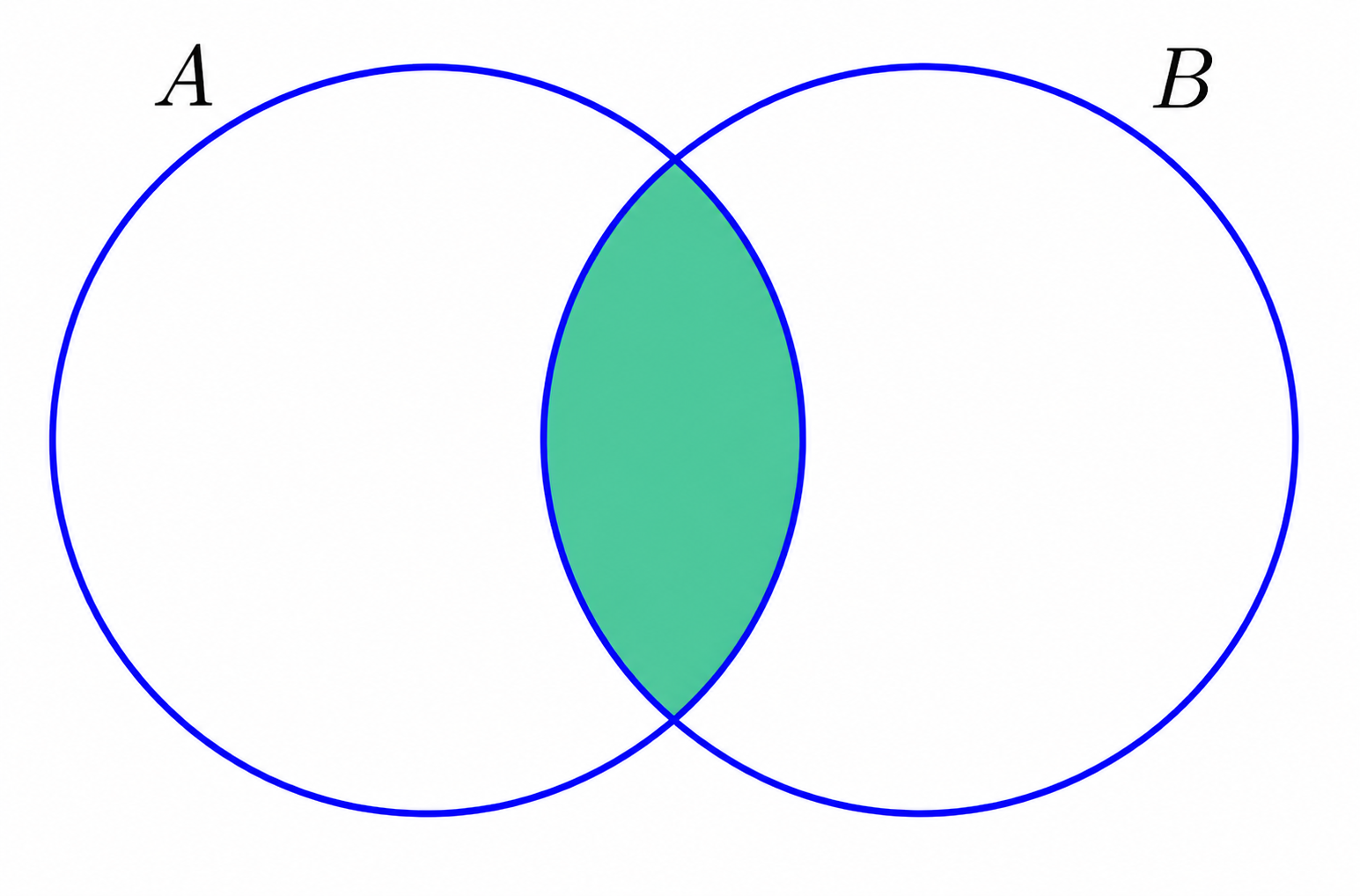
Therefore, the fraction of B that lies in A is
Hence
Events A and B are independent if knowing that one occurred does not change the probability of the other.
Thus,
Equivalently,
Using the multiplication rule,
So these are equivalent ways of expressing independence.
From
and
we obtain
This is Bayes' Theorem.
If A₁, A₂, ..., Aₙ partition the sample space, then
so
Two distinct integers are selected uniformly at random from
Given that their sum is even, what is the probability that both numbers are even?
Their sum is even exactly when the two numbers have the same parity.
There are 5 even and 5 odd numbers, so the number of pairs with even sum is
The number with both numbers even is
Therefore,
Box I contains 2 red balls and 3 blue balls. Box II contains 4 red balls and 1 blue ball.
A box is chosen uniformly at random, and then a ball is chosen uniformly from that box. Given that the ball is red, what is the probability that Box II was chosen?
Let R denote choosing a red ball.
Then
and
Thus
A 5-element subset is chosen uniformly at random from
Given that the subset contains at least one of 1, 2, 3, what is the probability that it contains exactly two of 1, 2, 3?
The total number of 5-element subsets is
Those containing none of 1, 2, 3 can be chosen entirely from the other 9 numbers:
Thus the number satisfying the given condition is
To contain exactly two of 1, 2, 3, choose two of these three and three of the remaining nine:
Therefore the probability is
There are three boxes:
• Box A: 4 red and 1 blue
• Box B: 3 red and 2 blue
• Box C: 2 red and 3 blue
A box is chosen uniformly at random, and two balls are drawn without replacement. Given that both balls are red, what is the probability that Box A was chosen?
Let R denote drawing two red balls.
Since the three boxes are equally likely, their common factor 1/3 cancels. Therefore