Dot Product
Lesson · Intermediate
Algebra: Vectors
For vectors
the dot product is
The result is a number, not a vector.
Geometric Interpretation
If θ is the angle between the two vectors, then
Therefore,
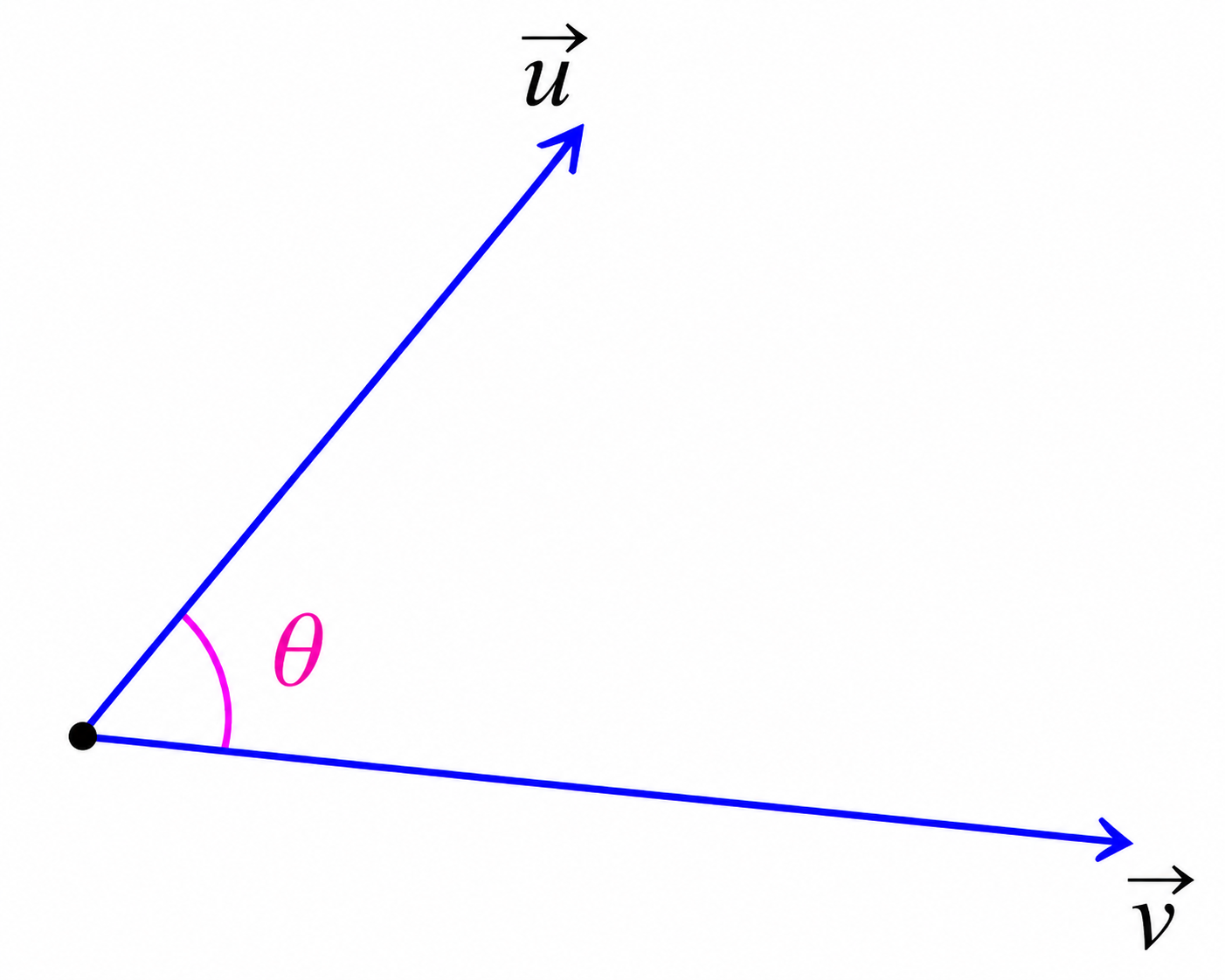
Consider vectors u and v with angle θ between them.
The vector joining their endpoints is
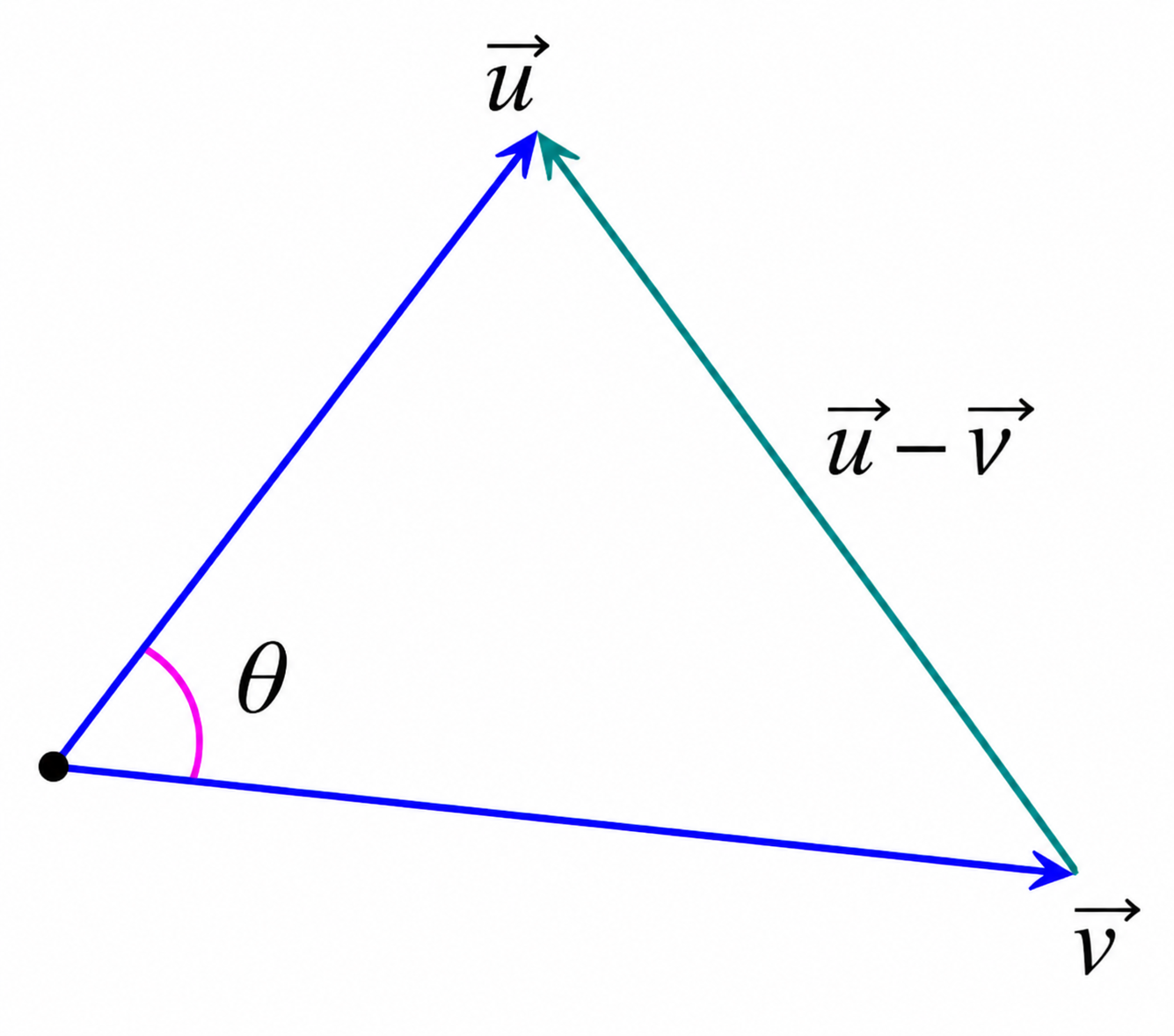
so
Expanding,
By the Law of Cosines,
Comparing the two expressions gives
1. Commutative Property
2. Distributive Property
More generally,
3. Dot Product with Itself
Perpendicular Vectors
For nonzero vectors,
Same Direction
If u and v point in the same direction,
Opposite Directions
If they point in opposite directions,
This is worth including because it gives a quick way to classify angles:
for nonzero vectors.
The scalar projection of u onto v is
and the vector projection is
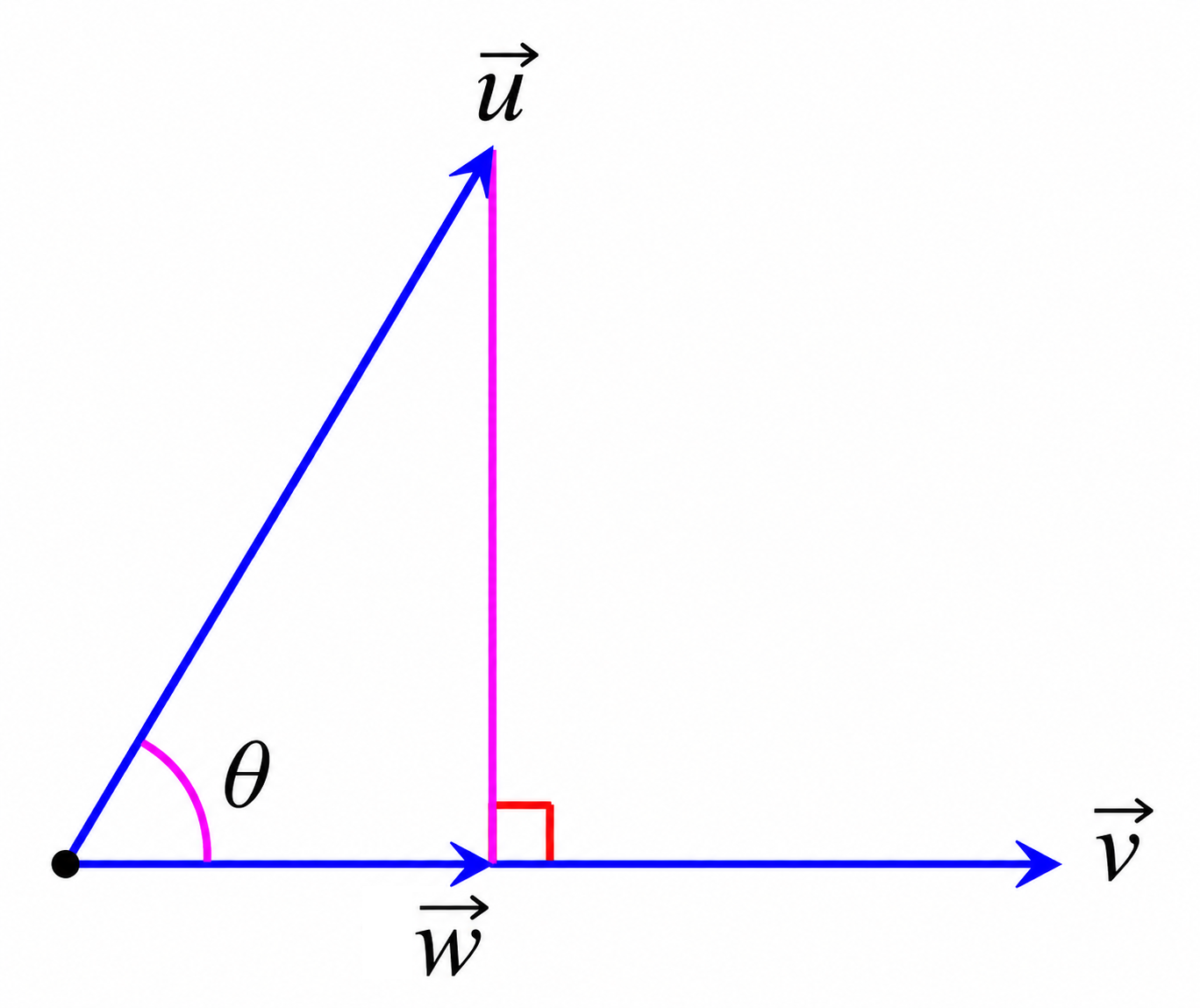
So
and
From these,
This last identity is the Parallelogram Law.
Using the distributive property of the dot product,
Expanding,
Since
we get
Similarly,
so
Adding the two identities,
This is the Parallelogram Law.
Let
Find the angle between them.
We have
Therefore,
so the angle between them is
Suppose
are perpendicular. Find k.
Since the vectors are perpendicular,
Thus
so
Let
and suppose the angle between them is 60°. Find k.
Using
we get
so
Squaring,
Thus
Since the original equation requires 2k > 0,
Let
Determine whether ∠BAC is acute, right, or obtuse.
Then
Since the dot product is positive,
so ∠BAC is acute.
In △ABC,
Find the length of the median from A.
Let
Then
and
Using
we get
so
If M is the midpoint of BC, then
Hence
and
Therefore,
so
A parallelogram has side lengths 6 and 10, and one diagonal has length 14. Find the length of the other diagonal.
Let the side vectors be u and v.
The diagonals have lengths
and
By the Parallelogram Law,
Thus
so
Therefore,
A parallelogram has side vectors u, v with
and
Find the angle between its diagonals.
The diagonals are
and
Their dot product is
so
Also,
and
Therefore,
so
Find the locus of points P=(x,y) such that
where
We have
and
The condition is
so
Completing the square,
Thus the locus is the circle with diameter AB.
Suppose
Prove that
Compute
Using distributivity,
Since
the middle terms cancel, giving
Therefore,