Intermediate Value Theorem (IVT)
Lesson · Intermediate
Calculus
Suppose f is continuous on [a,b]
If L is any number between f(a) and f(b), then there exists some c ∈ [a,b] such that
In other words:
A continuous function cannot skip any value between f(a) and f(b).
If f is continuous on [a,b] and f(a)f(b) < 0, then there exists c ∈ (a,b) such that
Why?
The condition f(a)f(b) < 0 means f(a) and f(b) have opposite signs.
Therefore, 0 lies between them.
Since f is continuous, it must take the value 0 somewhere between a and b.
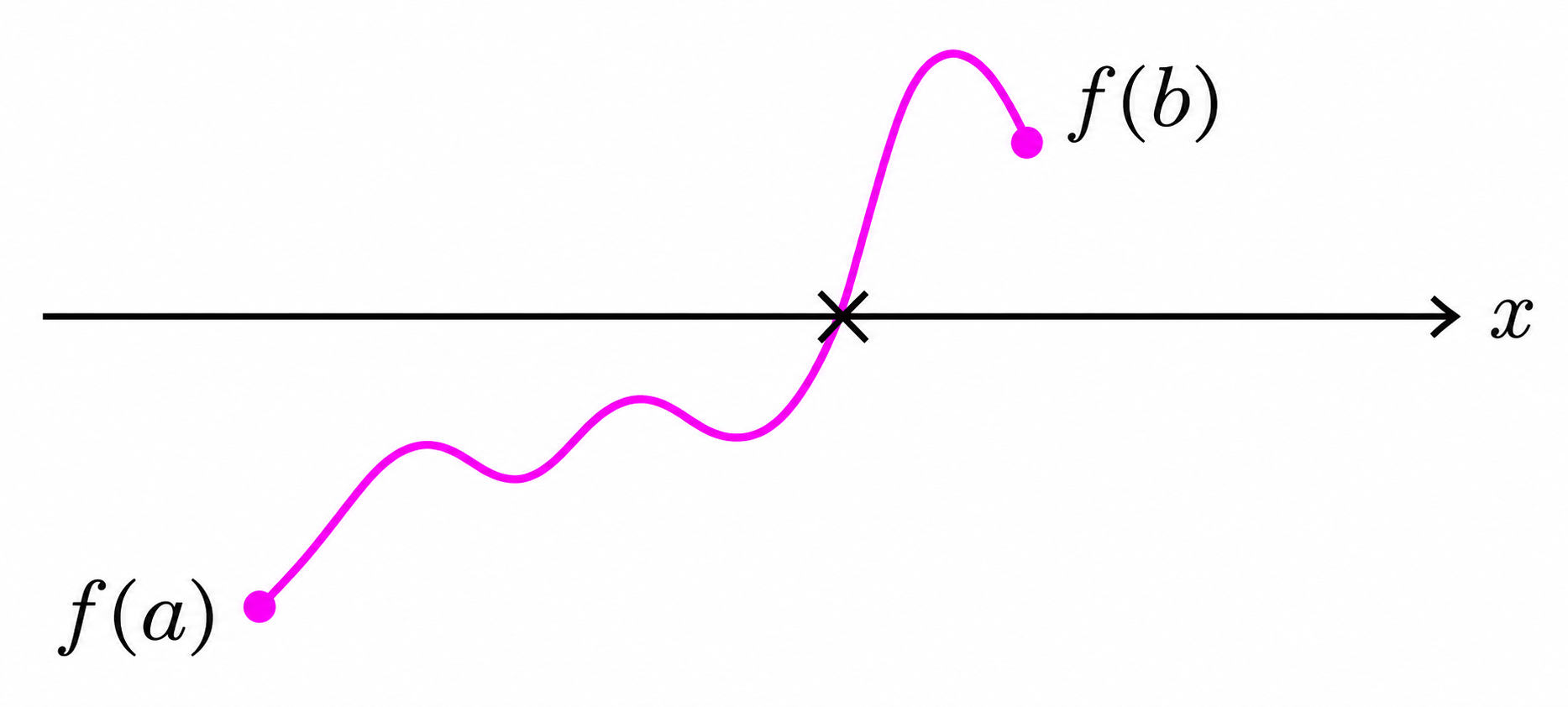
If f(a) < 0 and f(b) > 0, then the graph begins below the x-axis and ends above it.
Since the graph is continuous, it must cross the x-axis somewhere.
Similarly, if f(a) > 0 and f(b) < 0, it must also cross.
Prove that 2^x = 5 - x has a real solution.
Define
This function is continuous.
Now
while
Thus
By IVT, there exists c ∈ (1,2) such that
Therefore,
Prove that every polynomial of odd degree with real coefficients has at least one real root.
Let
where n is odd and a_n ≠ 0.
For sufficiently large |x|, the leading term a_nx^n determines the sign of P(x).
Since n is odd, x^n has opposite signs for large positive and negative x.
Therefore, for sufficiently large M,
Polynomials are continuous.
Hence, by IVT, there exists c ∈ (-M,M) such that
Suppose f : [0,1] → [0,1] is continuous.
Prove that there exists c ∈ [0,1] such that f(c) = c.
Define
Since f is continuous, g is continuous.
Because f(0) ≥ 0, we have
And because f(1) ≤ 1, we have
If either endpoint gives equality, we already have a fixed point.
Otherwise, g(0) > 0 and g(1) < 0, so IVT gives some c ∈ (0,1) such that
Therefore,