Mathematical Induction
Lesson · Intermediate
Problem Solving
Mathematical induction is a method for proving a statement for every integer in a specified range.
The most familiar form has two steps.
Base Case
Prove the statement for the first value:
Inductive Step
Assume that for some arbitrary integer ,
is true, and use this assumption to prove
That is,
Therefore,
are all true.
In particular, if , the first cases are
The assumption is called the inductive hypothesis.
Prove that
for every positive integer .
Base Case
For ,
So the statement is true for .
Inductive Hypothesis
Assume that for some positive integer ,
Inductive Step
Then
This is exactly the required formula for .
Therefore, by induction,
for every positive integer .
Prove that
for every integer .
Base Case
For ,
Inductive Hypothesis
Assume
Inductive Step
Then
Since
for ,
Therefore,
for all .
Suppose
Prove that
Base Case
Inductive Hypothesis
Assume
Then
Thus the formula holds for .
Therefore,
Let be nonnegative integers. Prove that
We prove the identity by induction on .
Base Case
For ,
The right-hand side is
So the identity holds for .
Inductive Hypothesis
Assume that the identity holds for :
Inductive Step
For , add the next term:
This is exactly the required formula for .
Therefore, by induction,
for all nonnegative integers .
For every nonnegative integer , prove that
is divisible by
We prove the statement by induction on .
Base Case
For ,
which is divisible by
So the statement holds for .
Inductive Hypothesis
Assume that for some nonnegative integer ,
Thus, for some integer ,
Inductive Step
We need to prove
Let
Then
Factor:
By the inductive hypothesis,
Also, since is odd,
Therefore,
Hence
So one factor is divisible by and the other is divisible by . Therefore,
Thus,
Therefore, by induction,
for every nonnegative integer .
For every positive integer , prove that
We prove the inequality by induction on .
Base Case
For ,
which is true.
Inductive Hypothesis
Assume that for some positive integer ,
Inductive Step
For ,
It remains to show that
Equivalently,
Since both sides are positive, we may square:
But
Therefore,
Hence, by induction,
for every positive integer .
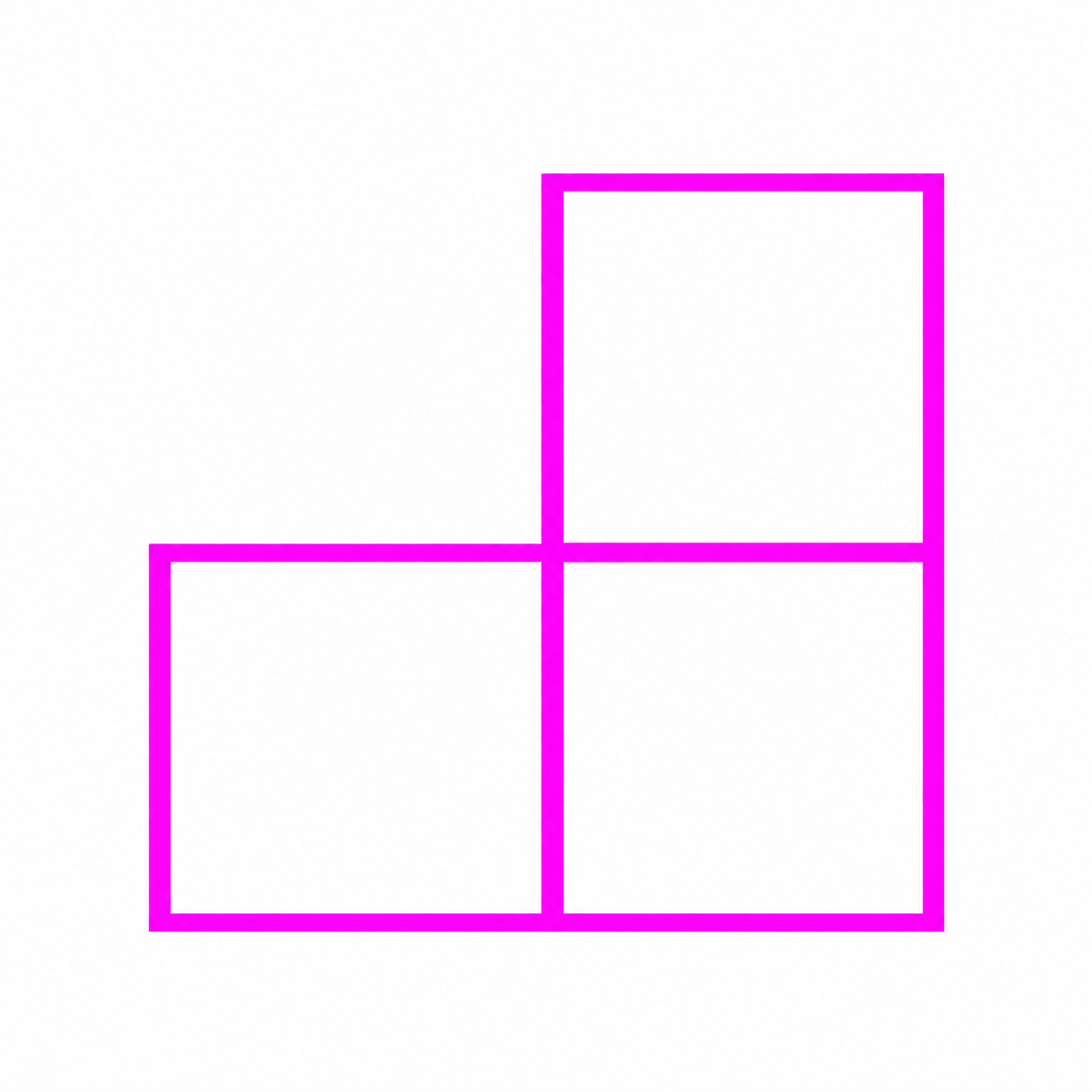
One cell is removed from a board. Prove that the remaining board can be tiled with the L-shaped tromino shown below.
Base Case
For , the board is
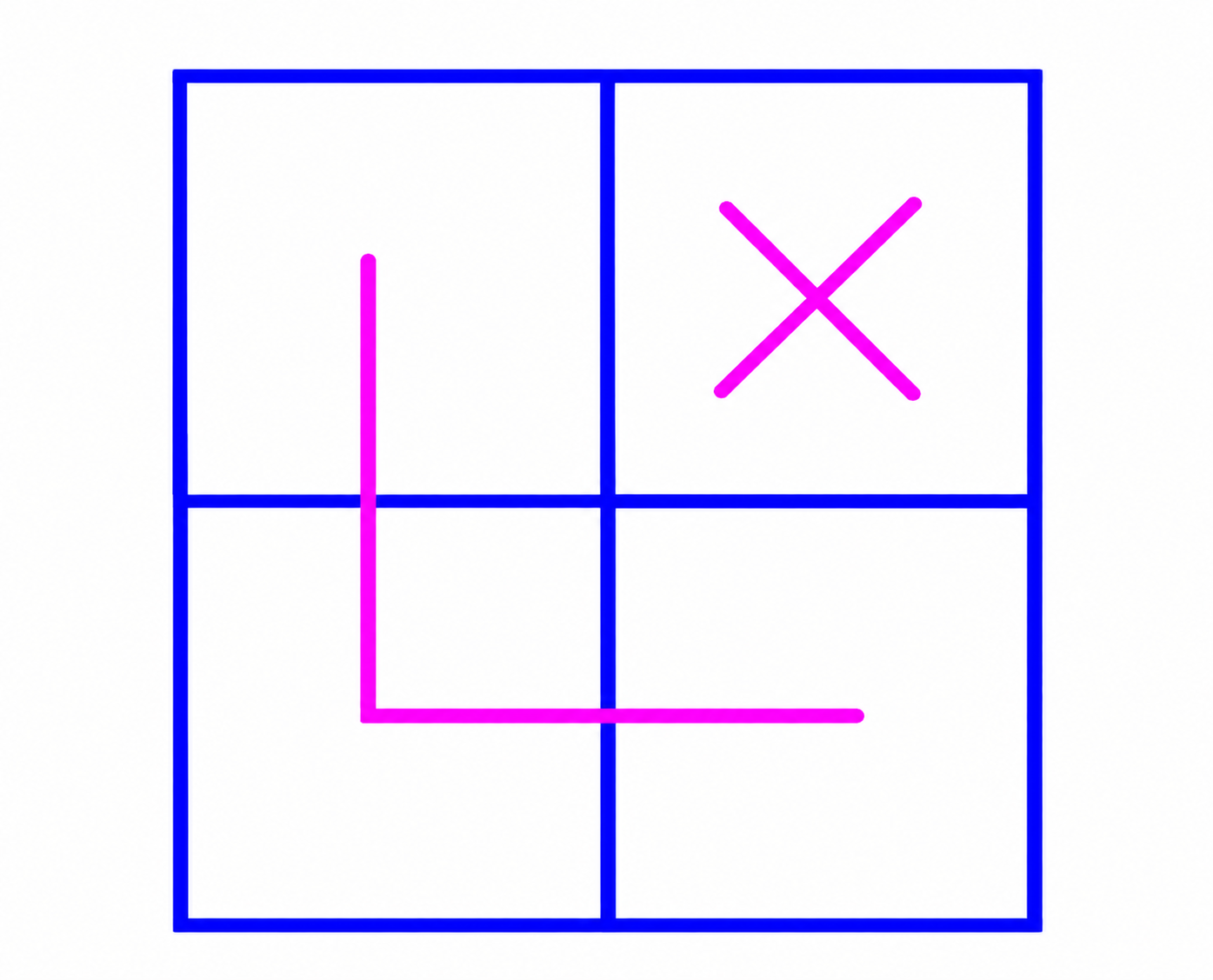
Inductive Hypothesis
Assume that any
board with one cell removed can be tiled with L-shaped trominoes.
Inductive Step
Consider a
board with one cell removed.
Divide the board into four
quadrants.
The missing cell lies in one of these four quadrants.
Place one L-shaped tromino at the center of the board so that it covers one central cell from each of the other three quadrants.
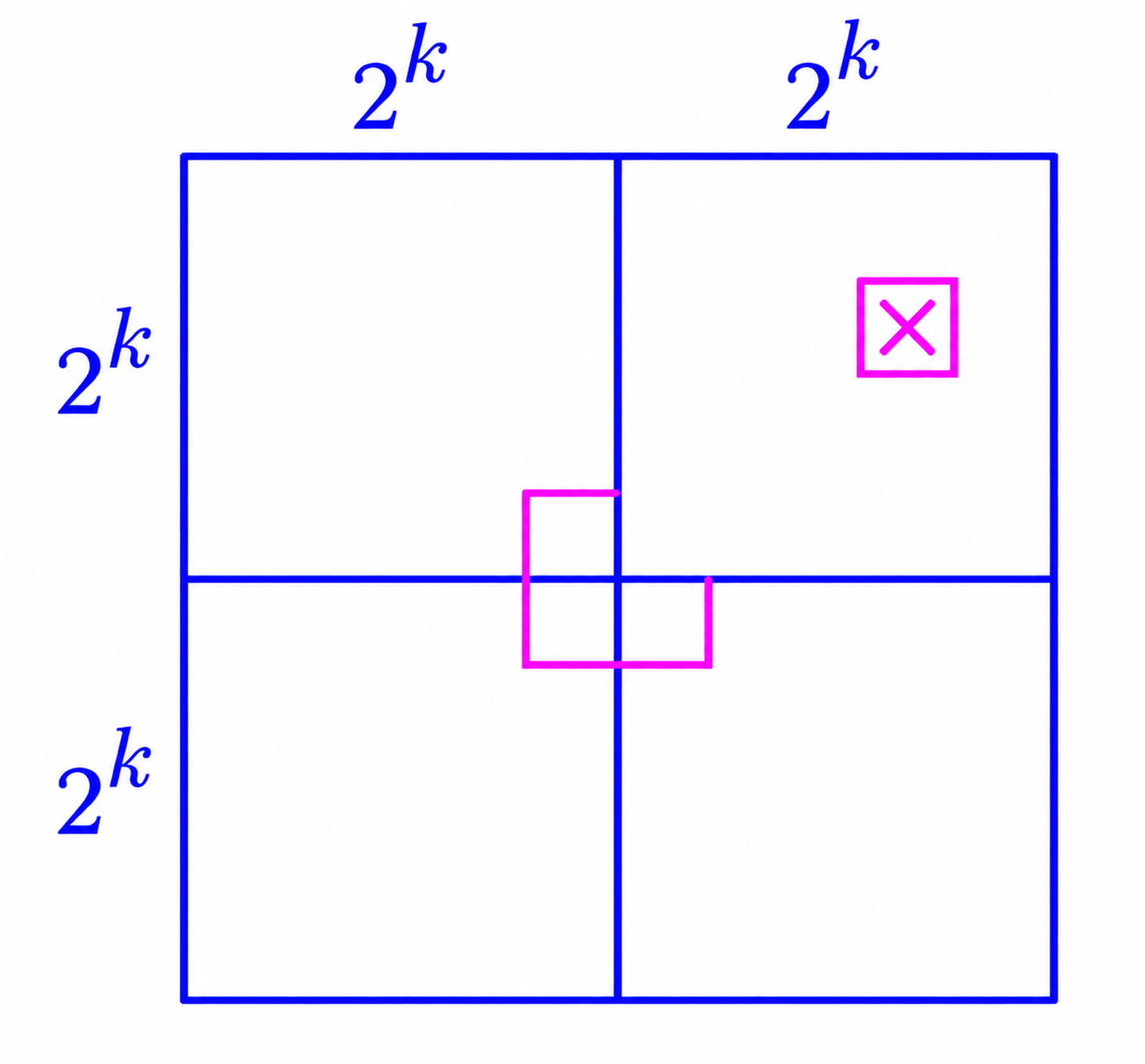
Now each quadrant has exactly one missing cell:
• The quadrant containing the original missing cell already has one missing cell.
• Each of the other three quadrants has one cell covered by the central tromino.
Thus each quadrant is a
board with one cell missing.
By the inductive hypothesis, each of the four quadrants can be tiled with L-shaped trominoes.
Together with the central tromino, this tiles the entire board except for the originally removed cell.
Therefore, by induction, any
board with one cell removed can be tiled with L-shaped trominoes for every positive integer .
For each of the integers
consider its largest odd factor. Prove that the sum of these largest odd factors is
Let denote the largest odd factor of the positive integer .
We prove by induction that
Base Case
For , the only integer is , whose largest odd factor is . Hence
So the statement holds for .
Inductive Hypothesis
Assume that for some positive integer ,
Inductive Step
For , we need the largest odd factors of
Compared with the previous sum, we remove and add
Since is odd,
Also, multiplying a number by does not change its largest odd factor, so
Therefore,
Thus the statement holds for .
Therefore, by induction,
for every positive integer .
Base Case:
Inductive Step:
Then: is true for every positive integer .
Base Cases:
Inductive Step:
Then: is true for every positive integer .
For example, for step size :
and
The two chains are
and
Together they cover every positive integer.
Here the next case depends on the previous two cases.
Base Cases:
Inductive Step:
Then: is true for every positive integer .
This is useful for recurrences such as the Fibonacci sequence, where a term depends on the previous two terms.
More generally, we can use any fixed number of previous cases.
Base Case:
Inductive Steps:
and
Then: is true for every positive integer .
Base Case:
Inductive Steps:
and
Then: is true for every positive integer .
To reach any positive integer , first choose such that
Repeated doubling gives
and then repeated subtraction gives
Thus every positive integer is covered.
Assume that
is an integer. Prove that for every positive integer ,
is also an integer.
Let
We know that
Also,
We use induction.
Base Cases
and, by assumption,
Inductive Step
Assume that
Observe that
Therefore,
By assumption,
and by the inductive hypothesis,
Hence
Therefore, by induction,
is an integer for every positive integer .
Prove that for every integer , a square can be divided into exactly smaller squares.
We use induction with the step
Therefore, we need three consecutive base cases.
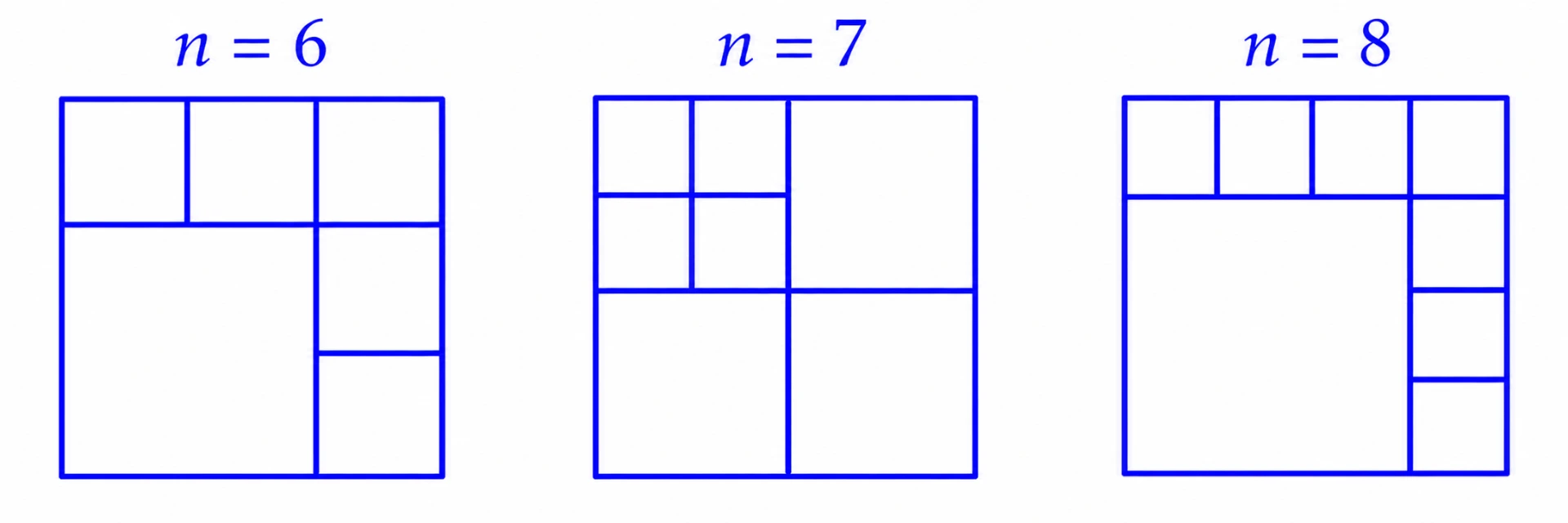
Base Cases
For
a square can be divided into exactly , , and smaller squares, respectively, as shown in the corresponding constructions.
Inductive Step
Assume that a square can be divided into exactly smaller squares.
Choose any one of these smaller squares and divide it into four equal squares.
One square has been replaced by four squares, so the total number of squares increases by
Thus, a division into smaller squares gives a division into
smaller squares.
Therefore,
Since the three base cases
are true, the induction produces
and
These three sequences cover every integer .
Hence a square can be divided into exactly smaller squares for every integer
Prove that for every positive integer , there exists a permutation of
such that for any two elements and , their arithmetic mean
is not an element appearing between and in the permutation.
For example,
does not satisfy the condition, since appears between and , and
On the other hand,
satisfies the condition.
We prove the result using Cauchy induction.
Base Case
For , the result is immediate.
Forward Step: $n o2n$
Assume there is a suitable permutation
of .
Construct the following permutation of :
The first half contains all the odd numbers, and the second half contains all the even numbers.
Consider two elements.
If they have different parity, their arithmetic mean is not an integer, so it cannot be an element of the permutation.
If both are odd, say
then their mean is
If this is odd, say , then
But cannot occur between and in the original permutation. Therefore cannot occur between and .
The same argument works for two even numbers.
Hence
Backward Step: $n o n-1$
Suppose we have a suitable permutation of
Simply remove .
The remaining sequence is a permutation of
Deleting an element cannot create a new element between two existing elements. Therefore the required property is preserved.
Hence
By Cauchy induction, a suitable permutation exists for every positive integer .
Suppose the induction hypothesis is the following implication, where are nonnegative real numbers:
A common mistake is to simply write
when proving the case.
You cannot do this unless you first know that
The induction hypothesis is an implication, not an assumption that its conclusion is always true:
When we assume , we are assuming
not and not .
So in the case, you must first establish the relevant hypothesis before you can use the conclusion .