Optimization by Equalization
Idea · Intermediate
Algebra
| Fixed quantity | Quantity optimized | Minimum | Occurs when | Maximum | Occurs when |
|---|---|---|---|---|---|
| are as far apart as possible | are as close as possible | ||||
| are as close as possible | are as far apart as possible | ||||
| are as close as possible | No maximum | become arbitrarily far apart | |||
| are as close as possible | No maximum | become arbitrarily far apart | |||
| are as far apart as possible | are as close as possible | ||||
| are as far apart as possible | are as close as possible |
Key Idea
For optimization problems involving two nonnegative numbers:
If a and b are real numbers, as close as possible often means
If a and b are integers, equality may be impossible. In that case, choose them as close as possible.
For example, if
the closest possible pair is
not 7.5, 7.5.
If b > a, move the two numbers closer together by choosing
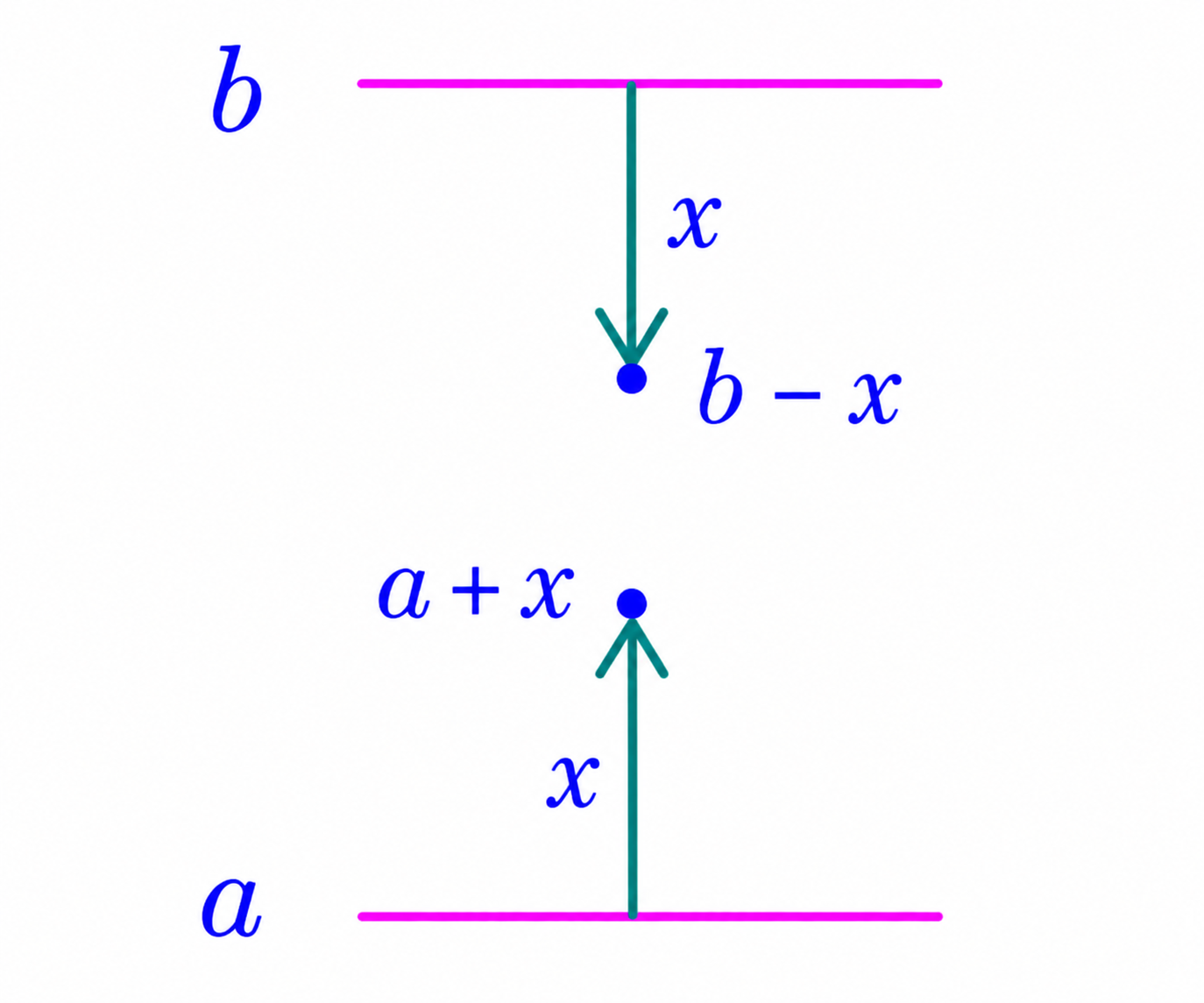
We need to prove
So,
We also need to prove
So,
If b > a > 0, move the two numbers closer together by choosing
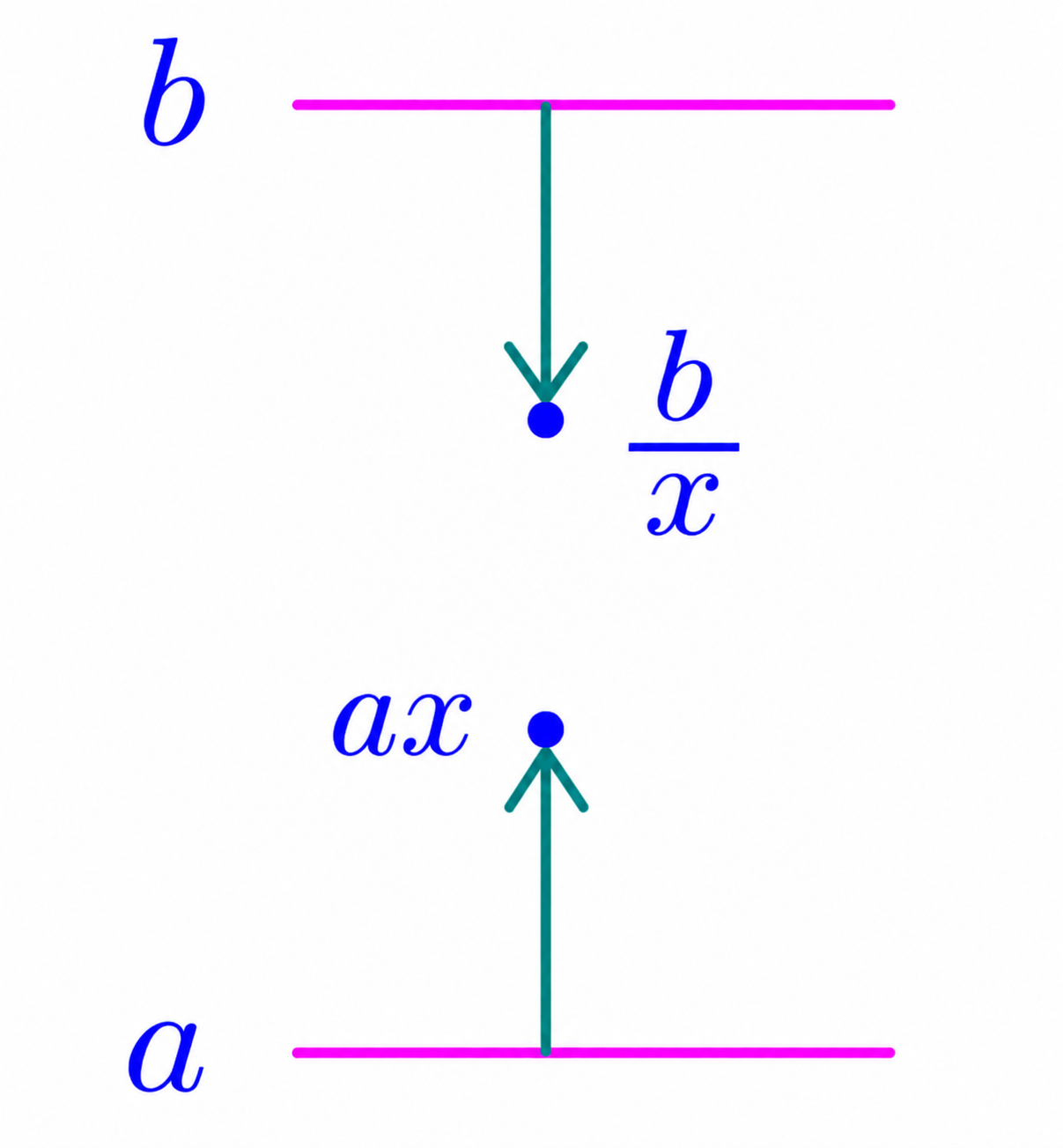
We need to prove
So,
We also need to prove
So,
If b > a, move the two numbers closer together by choosing
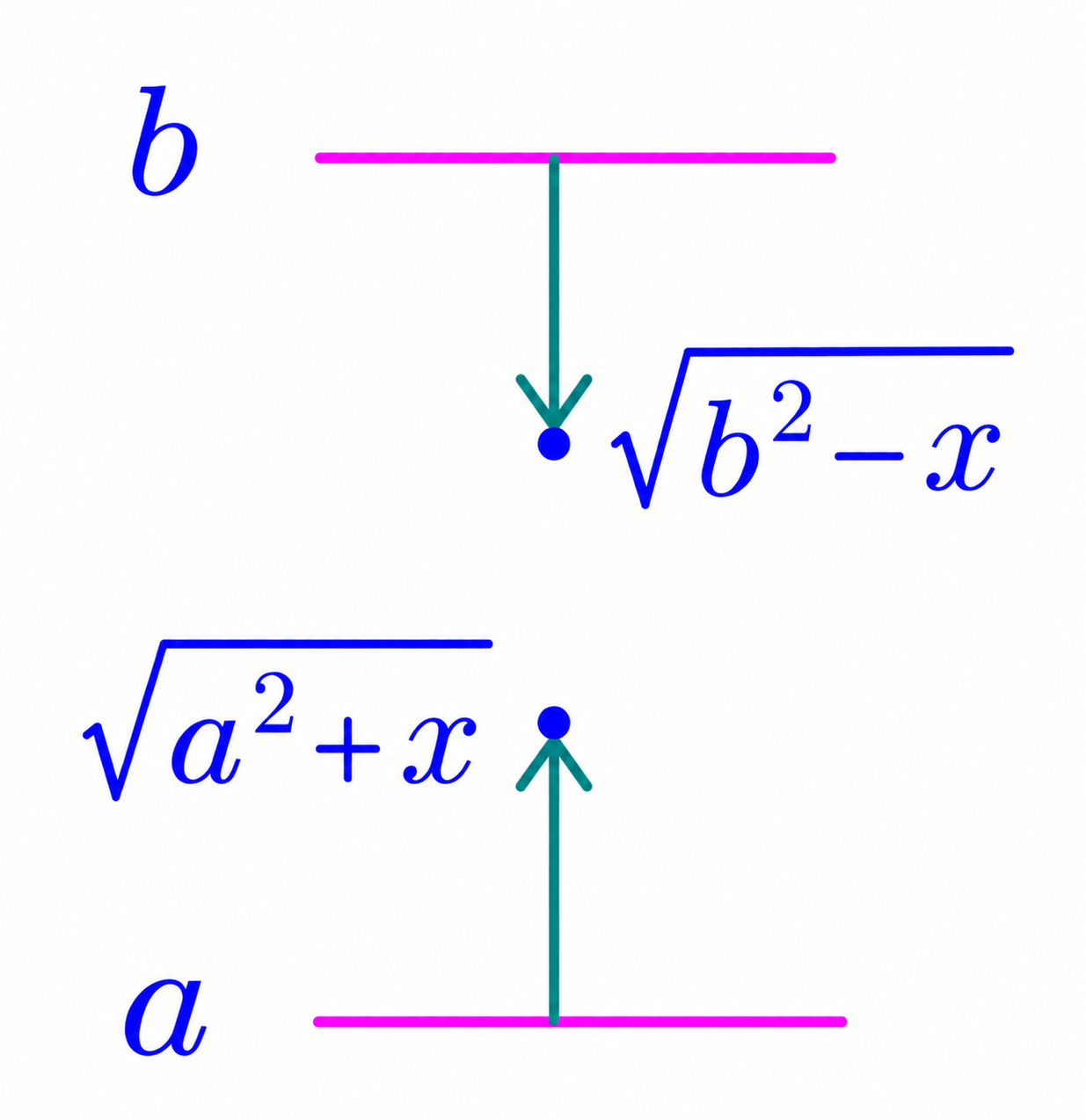
We need to prove
So,
We also need to prove
So,
Let a, b be nonnegative integers such that
Find the maximum value of ab.
For a fixed sum, the product is largest when the two numbers are as close as possible.
Since a, b are integers, the closest pair is
Therefore,
Let a, b be positive integers such that
Find the minimum value of a+b.
For a fixed product, the sum is smallest when the two numbers are as close as possible.
The factor pair of 72 with the closest factors is
Therefore,
Let a, b be positive integers such that
Find the maximum value of ab.
For a fixed sum of squares, the product is largest when a and b are as close as possible.
The possible positive integer pairs, up to order, are
The pair giving the larger product is
Therefore,
Let x, y ≥ 0 and
Find the minimum value of
Since x+y is fixed, x²+y² is minimized when x and y are as close as possible.
Thus,
and
Therefore, the minimum value is
Let a, b be positive integers satisfying
Find the minimum value of
Since ab is fixed, both
and
decrease as a and b become closer.
Therefore, the whole expression
is minimized when a and b are as close as possible.
The closest factor pair of 180 is
Hence,
If a, b must be integers, equality may not be possible.
For example, if
then a=b=8.5 is not allowed.
The closest possible integers are
Thus, in discrete problems, replace
with
The opposite extreme often occurs at the boundary.
For example, if
the smallest product is
at
But if a,b>0 and S>0, this pair is not allowed, and the product has no attained minimum.
For n positive integer and nonnegative real variables a₁, a₂, ..., aₙ, the following generalizations hold. When the product is fixed at P > 0, all variables are positive.
| Fixed quantity | Quantity optimized | Minimum | Occurs when | Maximum | Occurs when |
|---|---|---|---|---|---|
| Variables are as far apart as possible | Variables are as close as possible | ||||
| Variables are as close as possible | Variables are as far apart as possible | ||||
| Variables are as close as possible | No maximum | Variables become arbitrarily far apart | |||
| Variables are as close as possible | No maximum | Variables become arbitrarily far apart | |||
| Variables are as far apart as possible | Variables are as close as possible | ||||
| Variables are as far apart as possible | Variables are as close as possible |
The optimum occurs when the variables are as close as possible, not necessarily equal.
For integers with
the optimal pair is
not 7.5, 7.5.
For
the statement
requires a,b ≥ 0.
If negative values are allowed, the behavior can be completely different.
Making two variables farther apart does not always lead to an attainable maximum or minimum.
For example, if
then we may take
while keeping ab=P.
Therefore, a+b and a²+b² have no maximum.