Proving Existence by Contradiction
Idea · Intermediate
Combinatorics
Proving existence by contradiction is a method used to show that at least one object or configuration satisfies a given property.
Instead of constructing such an object directly, we assume that no such object exists and show that this assumption leads to a contradiction.
A particularly useful technique is to consider all possible configurations, derive an inequality for each one, and add these inequalities to obtain a contradiction.
A building has many lights and switches. Each switch is connected to some of the lights, and pressing it changes the state of all the lights connected to it (turning on the lights that are off and turning off the lights that are on). We also know that each light is connected to at least one switch. Prove that if all the lights are initially off, it is possible to press some of the switches so that more than half of the lights are on.
Let and be the numbers of switches and lights, respectively.
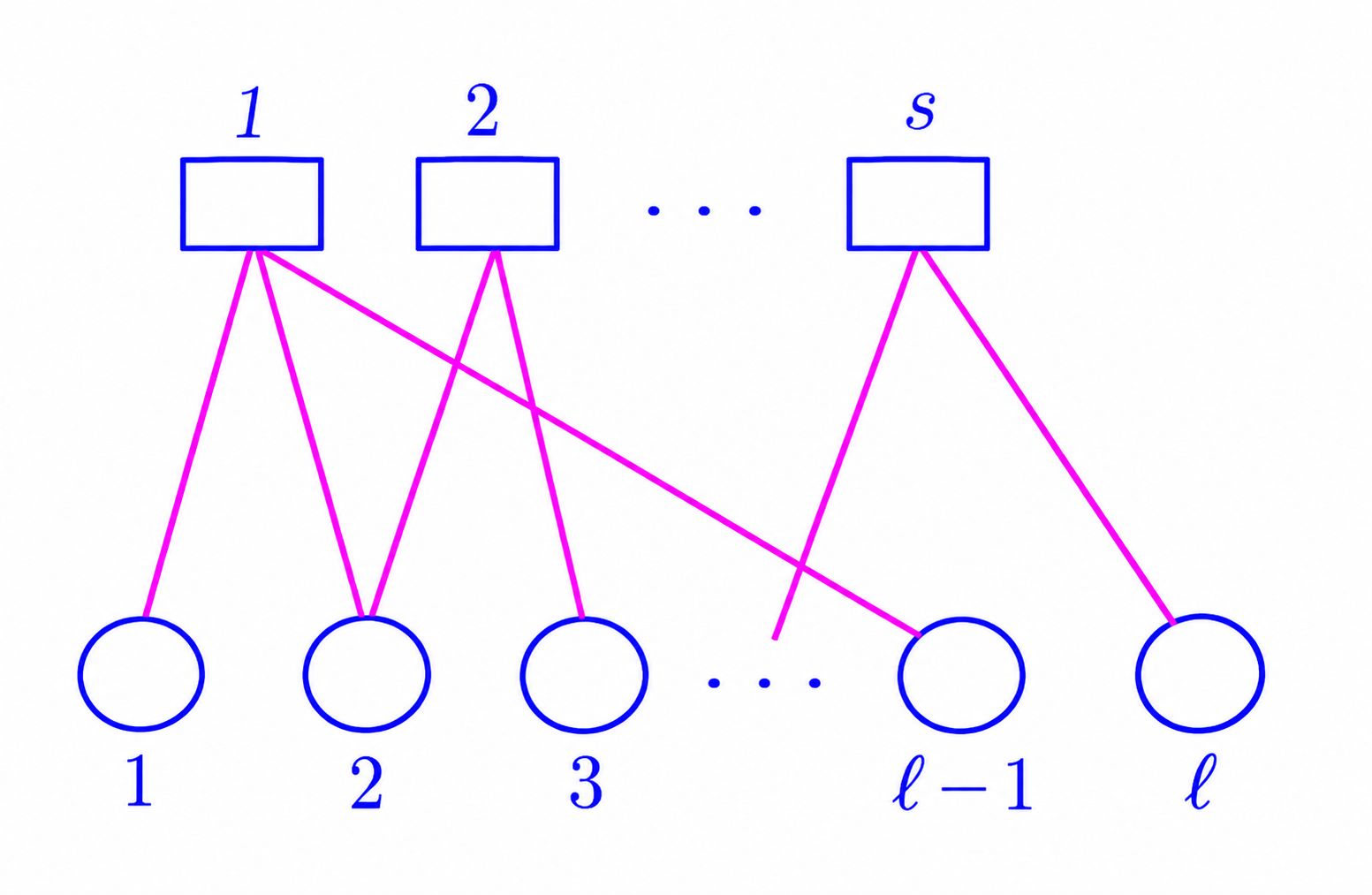
Assume, on the contrary, that there is no way to turn on more than half of the lights. There are ways to press the switches, including the initial case in which no switch is pressed.
Assume that in these cases the numbers of lights that are on are . We know that in the initial case all lights are off, so
For each light, if it is connected to switches, the number of cases in which it is on is obtained by selecting an odd number of switches from these switches and any subset of the remaining switches, which is
So,
By (1) and (2),
The distance between two permutations of the same length is defined as the number of positions at which their entries differ. For example, the distance between and is , since they differ at the second, third, fourth, and fifth positions.
Let be a set of permutations of length , denoted by . The distance from a permutation of length to the set is defined as the sum of its distances to all the permutations in . Among all permutations of length , let be the minimum distance to . Prove that there exists a permutation in (one of the ) whose distance to is at most .
Assume, on the contrary, that there is no permutation in whose distance to is at most .
So,
In , we are counting in and .
So,
We know
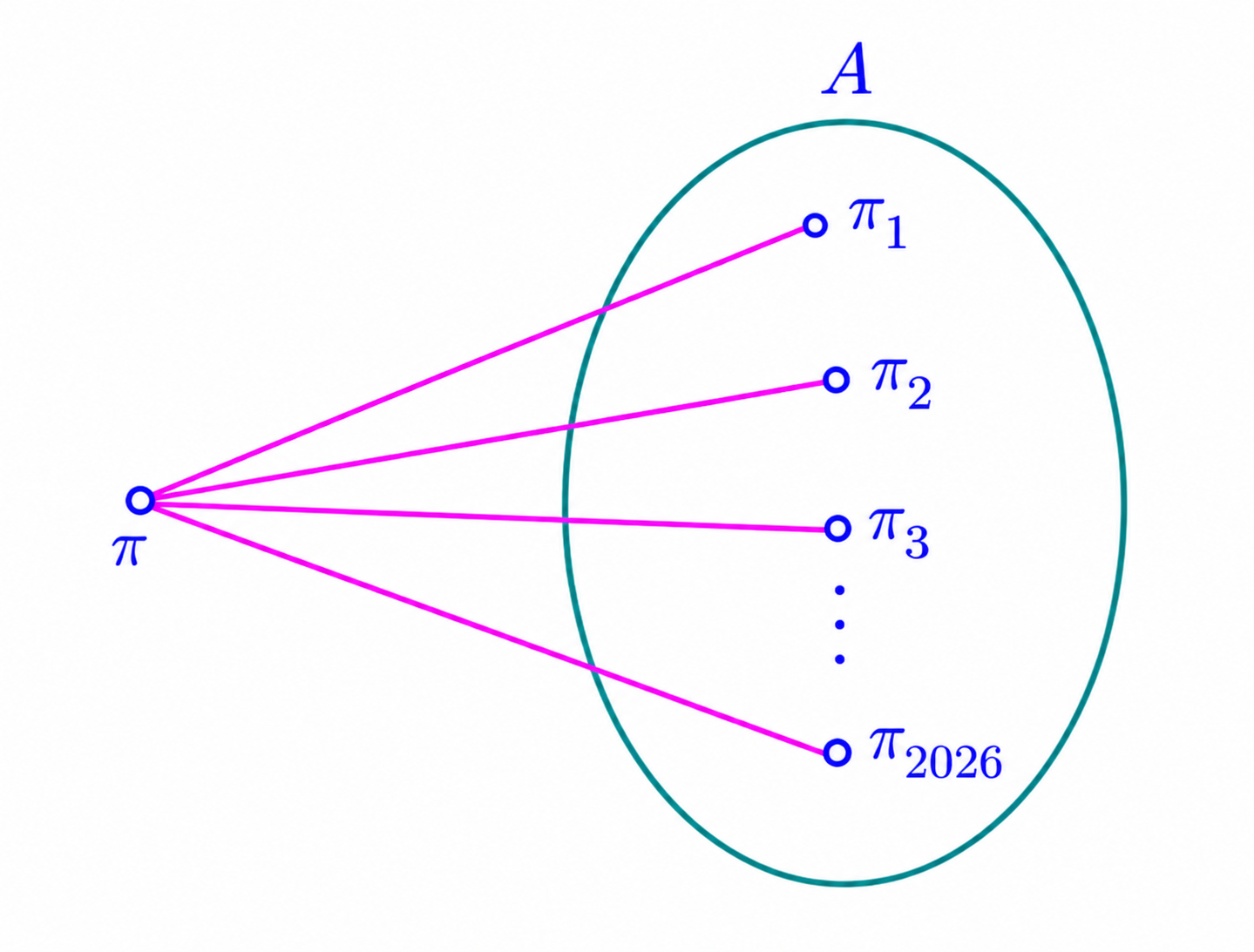
By the triangle inequality for strings,
Adding them,
Combining,