Radical Axis
Lesson · Intermediate
Geometry: Plane Geometry
For two circles ω₁ and ω₂, the radical axis is the locus of points P having equal power with respect to the two circles:
If two circles intersect at A and B, then their radical axis is
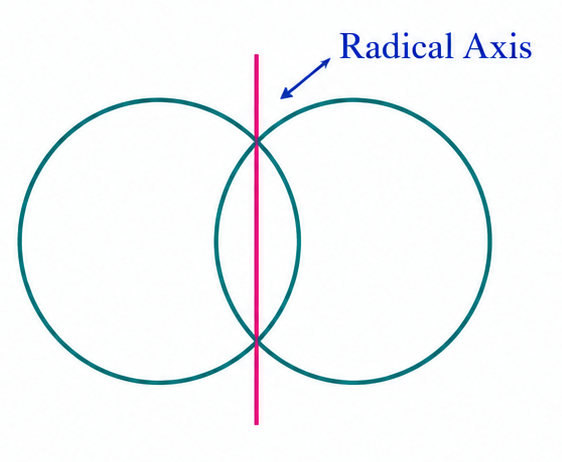
When two circles intersect, draw the radical axis. It is usually useful in angle chasing.
The radical axis is the line passing through the intersection points of the two circles.
Take any point P on AB.
Since P, A, B are collinear and both A and B lie on each circle, by Power of a Point,
and
Therefore,
so P lies on the radical axis.
Hence the radical axis is the line
If two circles are tangent at T, their radical axis is their common tangent at T.
For any point P on that tangent,
and
Therefore,
Suppose the circles have centers O₁, O₂ and radii r₁, r₂.
For a point P on the radical axis,
so
The right-hand side is constant.
The locus of points for which the difference of the squared distances to two fixed points is constant is a line perpendicular to
Therefore,
Suppose
and
Subtract the equations:
This is the equation of the radical axis.
Given three circles, their three pairwise radical axes are either parallel or pass through a common point.
When they meet, that point is called the radical center.
Suppose the radical axes of ω₁, ω₂ and ω₂, ω₃ intersect at P.
Then
and
Therefore,
so P also lies on the radical axis of ω₁ and ω₃.
Thus the three radical axes are concurrent.
Find the radical axis of
and
Subtract the equations:
Therefore,
is the radical axis.
Two circles are
and
A third circle
has its radical axis with ω₁ equal to
and its radical axis with ω₂ equal to
Find a, b, c.
1. Radical axis of ω₁ and ω₃
Subtract their equations:
We are told this is
so for some constant λ,
Hence
2. Radical axis of ω₂ and ω₃
Subtracting gives
and this must be the same line as
Thus for some μ,
Substitute a = λ - 4 and b = λ - 6:
From the second,
so
Therefore