AMC 12A 2024

Problems, Step-by-Step Hints, and Solutions

1.
What is the value of 9901⋅101−99⋅101019901\cdot101-99\cdot10101?
(A)  2\text{(A)}\;2(B)  20\text{(B)}\;20(C)  200\text{(C)}\;200(D)  202\text{(D)}\;202(E)  2020\text{(E)}\;2020
2.
A model used to estimate the time it will take to hike to the top of the mountain on a trail is of the form T=aL+bGT=aL+bG, where aa and bb are constants, TT is the time in minutes, LL is the length of the trail in miles, and GG is the altitude gain in feet. The model estimates that it will take 6969 minutes to hike to the top if a trail is 1.51.5 miles long and ascends 800800 feet, as well as if a trail is 1.21.2 miles long and ascends 11001100 feet. How many minutes does the model estimate it will take to hike to the top if the trail is 4.24.2 miles long and ascends 40004000 feet?
(A)  240\text{(A)}\;240(B)  246\text{(B)}\;246(C)  252\text{(C)}\;252(D)  258\text{(D)}\;258(E)  264\text{(E)}\;264
3.
The number 20242024 is written as the sum of not necessarily distinct two-digit numbers. What is the least number of two-digit numbers needed to write this sum?
(A)  20\text{(A)}\;20(B)  21\text{(B)}\;21(C)  22\text{(C)}\;22(D)  23\text{(D)}\;23(E)  24\text{(E)}\;24
4.
What is the least value of nn such that n!n! is a multiple of 20242024?
(A)  11\text{(A)}\;11(B)  21\text{(B)}\;21(C)  22\text{(C)}\;22(D)  23\text{(D)}\;23(E)  253\text{(E)}\;253
5.
A data set containing 2020 numbers, some of which are 66, has mean 4545. When all the 66s are removed, the data set has mean 6666. How many 66s were in the original data set?
(A)  4\text{(A)}\;4(B)  5\text{(B)}\;5(C)  6\text{(C)}\;6(D)  7\text{(D)}\;7(E)  8\text{(E)}\;8
6.
The product of three integers is 6060. What is the least possible positive sum of the three integers?
(A)  2\text{(A)}\;2(B)  3\text{(B)}\;3(C)  5\text{(C)}\;5(D)  6\text{(D)}\;6(E)  13\text{(E)}\;13
7.
In △ABC\triangle ABC, ∠ABC=90∘\angle ABC=90^\circ and BA=BC=2BA=BC=\sqrt{2}. Points P1,P2,…,P2024P_1,P_2,\ldots,P_{2024} lie on hypotenuse AC‾\overline{AC} so that AP1=P1P2=P2P3=⋯=P2023P2024=P2024CAP_1=P_1P_2=P_2P_3=\cdots=P_{2023}P_{2024}=P_{2024}C. What is the length of the vector sum BP1→+BP2→+BP3→+⋯+BP2024→?\overrightarrow{BP_1}+\overrightarrow{BP_2}+\overrightarrow{BP_3}+\cdots+\overrightarrow{BP_{2024}}?
(A)  1011\text{(A)}\;1011(B)  1012\text{(B)}\;1012(C)  2023\text{(C)}\;2023(D)  2024\text{(D)}\;2024(E)  2025\text{(E)}\;2025
8.
How many angles θ\theta with 0≤θ≤2π0\le \theta\le 2\pi satisfy log⁡(sin⁡(3θ))+log⁡(cos⁡(2θ))=0?\log(\sin(3\theta))+\log(\cos(2\theta))=0?
(A)  0\text{(A)}\;0(B)  1\text{(B)}\;1(C)  2\text{(C)}\;2(D)  3\text{(D)}\;3(E)  4\text{(E)}\;4
9.
Let MM be the greatest integer such that both M+1213M+1213 and M+3773M+3773 are perfect squares. What is the units digit of MM?
(A)  1\text{(A)}\;1(B)  2\text{(B)}\;2(C)  3\text{(C)}\;3(D)  6\text{(D)}\;6(E)  8\text{(E)}\;8
10.
Let α\alpha be the radian measure of the smallest angle in a 3−4−53-4-5 right triangle. Let β\beta be the radian measure of the smallest angle in a 7−24−257-24-25 right triangle. In terms of α\alpha, what is β\beta?
(A)  α3\text{(A)}\;\frac{\alpha}{3}(B)  α−π8\text{(B)}\;\alpha-\frac{\pi}{8}(C)  π2−2α\text{(C)}\;\frac{\pi}{2}-2\alpha(D)  α2\text{(D)}\;\frac{\alpha}{2}(E)  π−4α\text{(E)}\;\pi-4\alpha

Solution 1

Solution 2

11.
There are exactly KK positive integers 5≤b≤20245\le b\le2024 such that the base-bb integer 2024b2024_b is divisible by 1616 (where 1616 is in base ten). What is the sum of the digits of KK?
(A)  16\text{(A)}\;16(B)  17\text{(B)}\;17(C)  18\text{(C)}\;18(D)  20\text{(D)}\;20(E)  21\text{(E)}\;21
12.
The first three terms of a geometric sequence are the integers aa, 720720, and bb, where a<720<ba<720<b. What is the sum of the digits of the least possible value of bb?
(A)  9\text{(A)}\;9(B)  12\text{(B)}\;12(C)  16\text{(C)}\;16(D)  18\text{(D)}\;18(E)  21\text{(E)}\;21
13.
The graph of y=ex+1+e−x−2y=e^{x+1}+e^{-x}-2 has an axis of symmetry. What is the reflection of the point (−1,12)\left(-1,\frac{1}{2}\right) over this axis?
(A)  (−1,−32)\text{(A)}\;\left(-1,-\frac{3}{2}\right)(B)  (−1,0)\text{(B)}\;(-1,0)(C)  (−1,12)\text{(C)}\;\left(-1,\frac{1}{2}\right)(D)  (0,12)\text{(D)}\;\left(0,\frac{1}{2}\right)(E)  (3,12)\text{(E)}\;\left(3,\frac{1}{2}\right)
14.
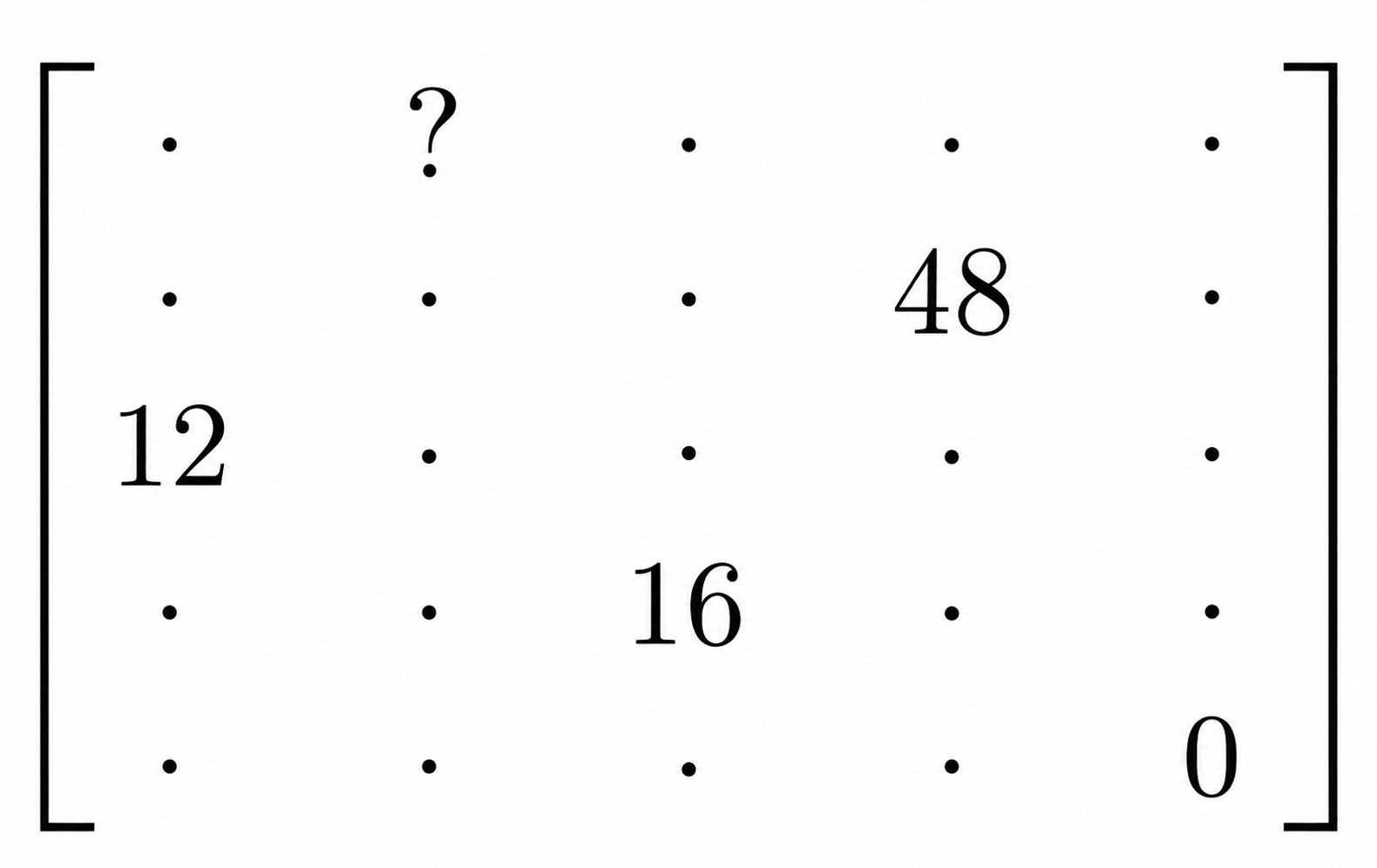
The numbers, in order, of each row and the numbers, in order, of each column of a 5×55\times5 array of integers form an arithmetic progression of length 55. The numbers in positions (5,5)(5,5), (2,4)(2,4), (4,3)(4,3) and (3,1)(3,1) are 00, 4848, 1616, and 1212, respectively. What number is in position (1,2)(1,2)?
A 5 by 5 array with entries 0, 48, 16, and 12 in the given positions and a question mark in position (1,2)
(A)  19\text{(A)}\;19(B)  24\text{(B)}\;24(C)  29\text{(C)}\;29(D)  34\text{(D)}\;34(E)  39\text{(E)}\;39
15.
The roots of x3+2x2−x+3x^3+2x^2-x+3 are pp, qq, and rr. What is the value of (p2+4)(q2+4)(r2+4)(p^2+4)(q^2+4)(r^2+4)?
(A)  64\text{(A)}\;64(B)  75\text{(B)}\;75(C)  100\text{(C)}\;100(D)  125\text{(D)}\;125(E)  144\text{(E)}\;144
16.
A set of 1212 tokens --- 33 red, 22 white, 11 blue, and 66 black --- is to be distributed at random to 33 game players, 44 tokens per player. The probability that some player gets all the red tokens, another gets all the white tokens, and the remaining player gets the blue token can be written as mn\frac{m}{n}, where mm and nn are relatively prime positive integers. What is m+nm+n?
(A)  387\text{(A)}\;387(B)  388\text{(B)}\;388(C)  389\text{(C)}\;389(D)  390\text{(D)}\;390(E)  391\text{(E)}\;391
17.
Integers aa, bb, and cc satisfy ab+c=100ab+c=100, bc+a=87bc+a=87, and ca+b=60ca+b=60. What is ab+bc+caab+bc+ca?
(A)  212\text{(A)}\;212(B)  247\text{(B)}\;247(C)  258\text{(C)}\;258(D)  276\text{(D)}\;276(E)  284\text{(E)}\;284
18.
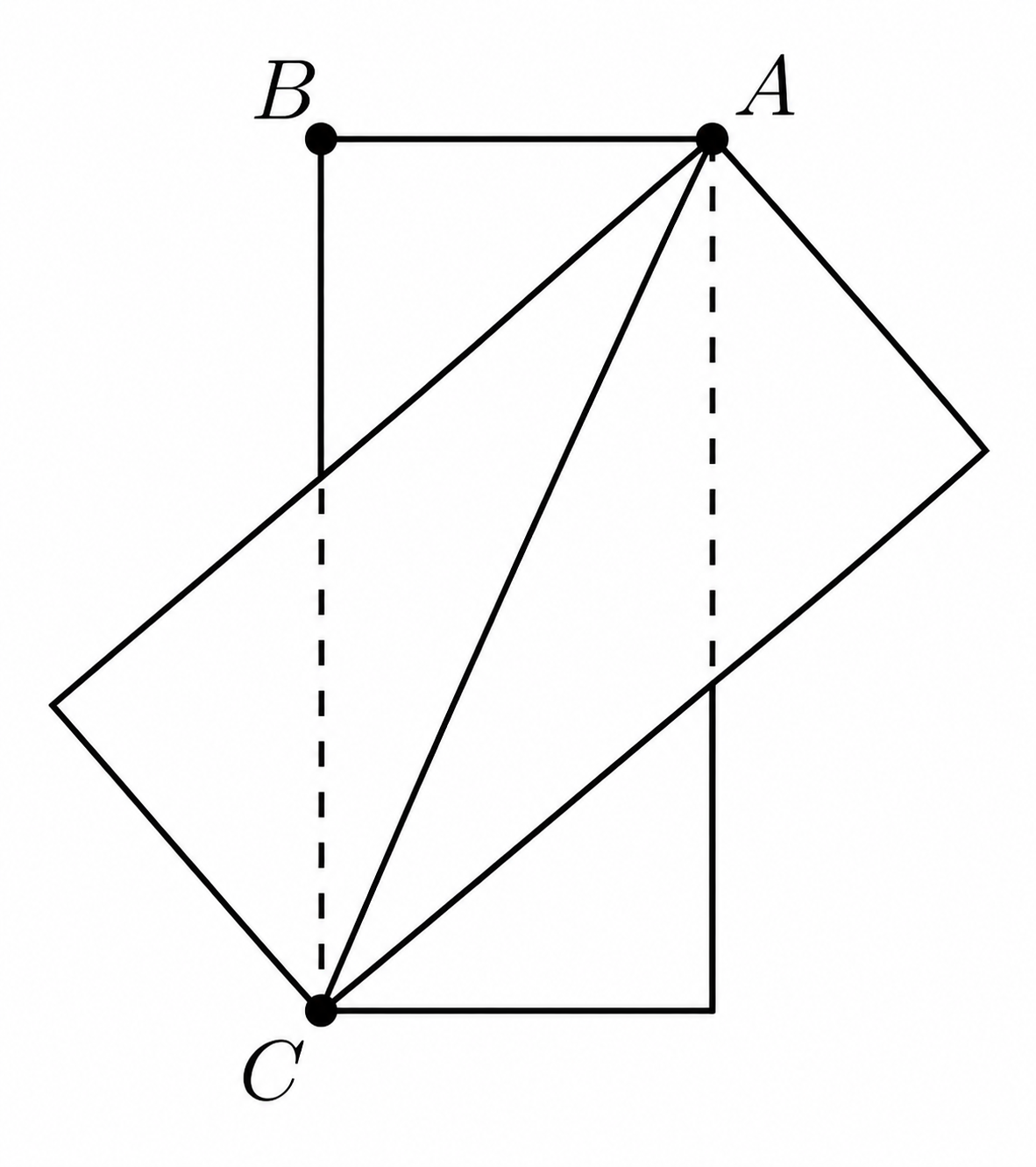
On top of a rectangular card with sides of length 11 and 2+32+\sqrt{3}, an identical card is placed so that two of their diagonals line up, as shown (AC‾\overline{AC}, in this case). Continue the process, adding a third card to the second, and so on, lining up successive diagonals after rotating clockwise. In total, how many cards must be used until a vertex of a new card lands exactly on the vertex labeled BB in the figure?
Two identical rectangular cards with successive diagonals aligned along AC
(A)  6\text{(A)}\;6(B)  8\text{(B)}\;8(C)  10\text{(C)}\;10(D)  12\text{(D)}\;12(E)  No new vertex will land on B.\text{(E)}\;\text{No new vertex will land on B.}
19.
Cyclic quadrilateral ABCDABCD has lengths BC=CD=3BC=CD=3 and DA=5DA=5 with ∠CDA=120∘\angle CDA=120^\circ. What is the length of the shorter diagonal of ABCDABCD?
(A)  317\text{(A)}\;\frac{31}{7}(B)  337\text{(B)}\;\frac{33}{7}(C)  5\text{(C)}\;5(D)  397\text{(D)}\;\frac{39}{7}(E)  417\text{(E)}\;\frac{41}{7}
20.
Points PP and QQ are chosen uniformly and independently at random on sides AB‾\overline{AB} and AC‾\overline{AC}, respectively, of equilateral triangle △ABC\triangle ABC. Which of the following intervals contains the probability that the area of △APQ\triangle APQ is less than half the area of △ABC\triangle ABC?
(A)  [38,12]\text{(A)}\;\left[\frac{3}{8},\frac{1}{2}\right](B)  (12,23]\text{(B)}\;\left(\frac{1}{2},\frac{2}{3}\right](C)  (23,34]\text{(C)}\;\left(\frac{2}{3},\frac{3}{4}\right](D)  (34,78]\text{(D)}\;\left(\frac{3}{4},\frac{7}{8}\right](E)  (78,1]\text{(E)}\;\left(\frac{7}{8},1\right]
21.
Suppose that a1=2a_1=2 and the sequence (an)(a_n) satisfies the recurrence relation an−1n−1=an−1+1(n−1)+1\frac{a_n-1}{n-1}=\frac{a_{n-1}+1}{(n-1)+1} for all n≥2n\ge2. What is the greatest integer less than or equal to ∑n=1100an2 ?\displaystyle\sum_{n=1}^{100} a_n^2\ ?
(A)  338,550\text{(A)}\;338,550(B)  338,551\text{(B)}\;338,551(C)  338,552\text{(C)}\;338,552(D)  338,553\text{(D)}\;338,553(E)  338,554\text{(E)}\;338,554
22.
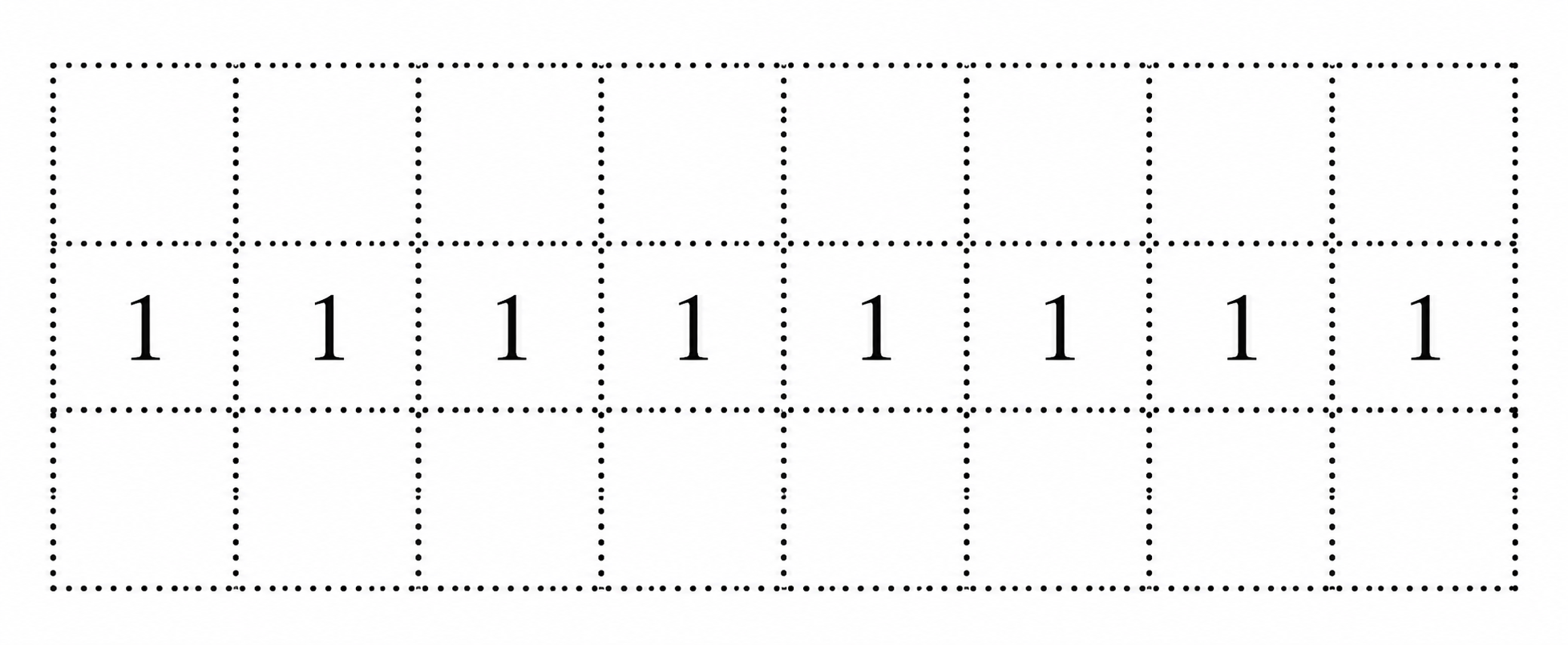
The figure below shows a dotted grid 8 cells wide and 3 cells tall consisting of 1′′×1′′1''\times1'' squares. Carl places 1-inch toothpicks along some of the sides of the squares to create a closed loop that does not intersect itself. The numbers in the cells indicate the number of sides of that square that are to be covered by toothpicks, and any number of toothpicks are allowed if no number is written. In how many ways can Carl place the toothpicks?
Dotted grid 8 cells wide and 3 cells tall with eight 1s in the middle row
(A)  130\text{(A)}\;130(B)  144\text{(B)}\;144(C)  146\text{(C)}\;146(D)  162\text{(D)}\;162(E)  196\text{(E)}\;196
23.
What is the value of
tan⁡2π16tan⁡23π16+tan⁡2π16tan⁡25π16+tan⁡23π16tan⁡27π16+tan⁡25π16tan⁡27π16?\tan^2\frac{\pi}{16}\tan^2\frac{3\pi}{16}+\tan^2\frac{\pi}{16}\tan^2\frac{5\pi}{16}+\tan^2\frac{3\pi}{16}\tan^2\frac{7\pi}{16}+\tan^2\frac{5\pi}{16}\tan^2\frac{7\pi}{16}?
(A)  28\text{(A)}\;28(B)  68\text{(B)}\;68(C)  70\text{(C)}\;70(D)  72\text{(D)}\;72(E)  84\text{(E)}\;84
24.
A disphenoid is a tetrahedron whose triangular faces are congruent to one another. What is the least total surface area of a disphenoid whose faces are scalene triangles with integer side lengths?
(A)  3\text{(A)}\;\sqrt{3}(B)  315\text{(B)}\;3\sqrt{15}(C)  15\text{(C)}\;15(D)  157\text{(D)}\;15\sqrt{7}(E)  246\text{(E)}\;24\sqrt{6}
25.
A graph is symmetric about a line if the graph remains unchanged after reflection in that line. For how many quadruples of integers (a,b,c,d)(a,b,c,d), where ∣a∣,∣b∣,∣c∣,∣d∣≤5|a|,|b|,|c|,|d|\le5 and cc and dd are not both 00, is the graph of
y=ax+bcx+dy=\frac{ax+b}{cx+d}
symmetric about the line y=xy=x?
(A)  1282\text{(A)}\;1282(B)  1292\text{(B)}\;1292(C)  1310\text{(C)}\;1310(D)  1320\text{(D)}\;1320(E)  1330\text{(E)}\;1330