A graph is symmetric about a line if the graph remains unchanged after reflection in that line. For how many quadruples of integers (a,b,c,d), where ∣a∣,∣b∣,∣c∣,∣d∣≤5 and c and d are not both 0, is the graph of y=cx+dax+b symmetric about the line y=x?
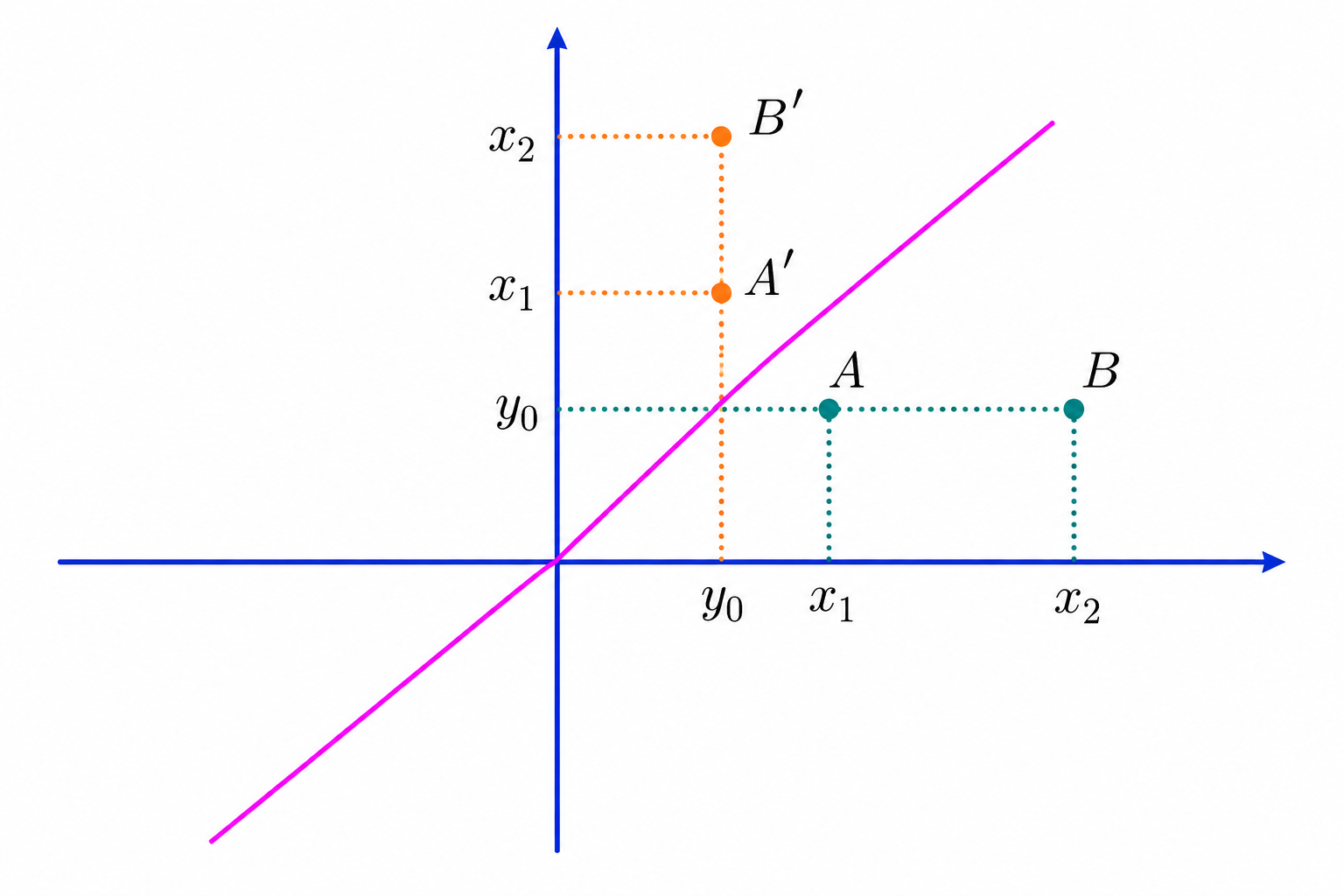
If f is not one-to-one, then there exist x1,x2 such that x1=x2,f(x1)=f(x2)=y0 Since f is symmetric about y=x, then (x1,f(x1)=y0)∈f⇒(y0,x1)∈f(x2,f(x2)=y0)∈f⇒(y0,x2)∈f Then f is not a function. ×
Since f is one-to-one, if f(x1)=f(x2), then x1=x2.
If f(x1)=f(x2), then cx1+dax1+b=cx2+dax2+b(ax1+b)(cx2+d)=(ax2+b)(cx1+d)acx1x2+adx1+bcx2+bd=acx1x2+adx2+bcx1+bdadx1+bcx2=adx2+bcx1x1(ad−bc)+x2(bc−ad)=0(ad−bc)(x1−x2)=0
If ad−bc=0, then x1−x2=0⇒x1=x2✓
If ad−bc=0, then ad=bc c,d are not both 0.
Case 1) c=0: b=cadf(x)=cx+dax+b=cx+dax+cad=c(cx+d)acx+ad=c(cx+d)a(cx+d)=ca So, f(x) is constant and is not one-to-one. ×
Case 2) c=0, d=0: ad=bc⇒ad=0⇒a=0f(x)=cx+dax+b=db So, f(x) is constant and is not one-to-one. × ⇒ad−bc=0
f:y=cx+dax+bf−1:x=cy+day+bxcy+dx=ay+by(cx−a)=−dx+bf−1:y=cx−a−dx+b So, cx+dax+b=cx−a−dx+b
cx+dax+b=cx−a−dx+b So, (c,d)=(0,0)(c,−a)=(0,0)(ax+b)(cx−a)=(cx+d)(−dx+b)acx2+x(−a2+bc)−ab=−cdx2+x(bc−d2)+bdx2:ac=−cd⇒c(a+d)=0x:−a2+bc=bc−d2⇒a2=d2⇒a=±dconstant:−ab=bd⇒b(a+d)=0
Case 1) c=0 (c,d)=(0,0)⇒d=0(c,−a)=(0,0)⇒a=0a=±d Case 1-1) b=0 b(a+d)=0⇒a=−d So, c=0,a,b,d=0,a=−d Then ad−bc=ad=0✓a10×d1×b10×c1=100 Case 1-2) b=0
So, b=c=0,a,d=0,a=±d Then ad−bc=ad=0a10×b1×c1×d2=20
Case 2) c=0 c(a+d)=0⇒a+d=0⇒d=−a Here we calculate the total number of cases and then subtract the cases that ad−bc=0. Total=c10×a11×d1×b11=1210 Try to find the number of unfavorable cases that ad−bc=0
For counting unfavorable cases (ad−bc=0) in Hint 9, base your casework on a. d=−a⇒ad−bc=−a2−bc=0⇒bc=−a2 We know c=0. a=0⇒bc=0⇒b=0a1×b1×c10×d1=10a=±1⇒bc=−1=(1)(−1)a2×b2×c1×d1=4a=±2⇒bc=−4=(1)(−4)=(−1)(4)=(2)(−2)a2×b6×c1×d1=12a=±3⇒bc=−9=(3)(−3)a2×b2×c1×d1=4a=±4⇒bc=−16=(4)(−4)a2×b2×c1×d1=4a=±5⇒bc=−25=(5)(−5)a2×b2×c1×d1=4Unfavorable=10+4+12+4+4+4=38 By Hints 8 and 9: Ans=100+20+1210−38=1292