Geometric Transformations
Lesson · Beginner
Coordinate Geometry
A geometric transformation maps every point in the plane to another point.
If
we denote its image by
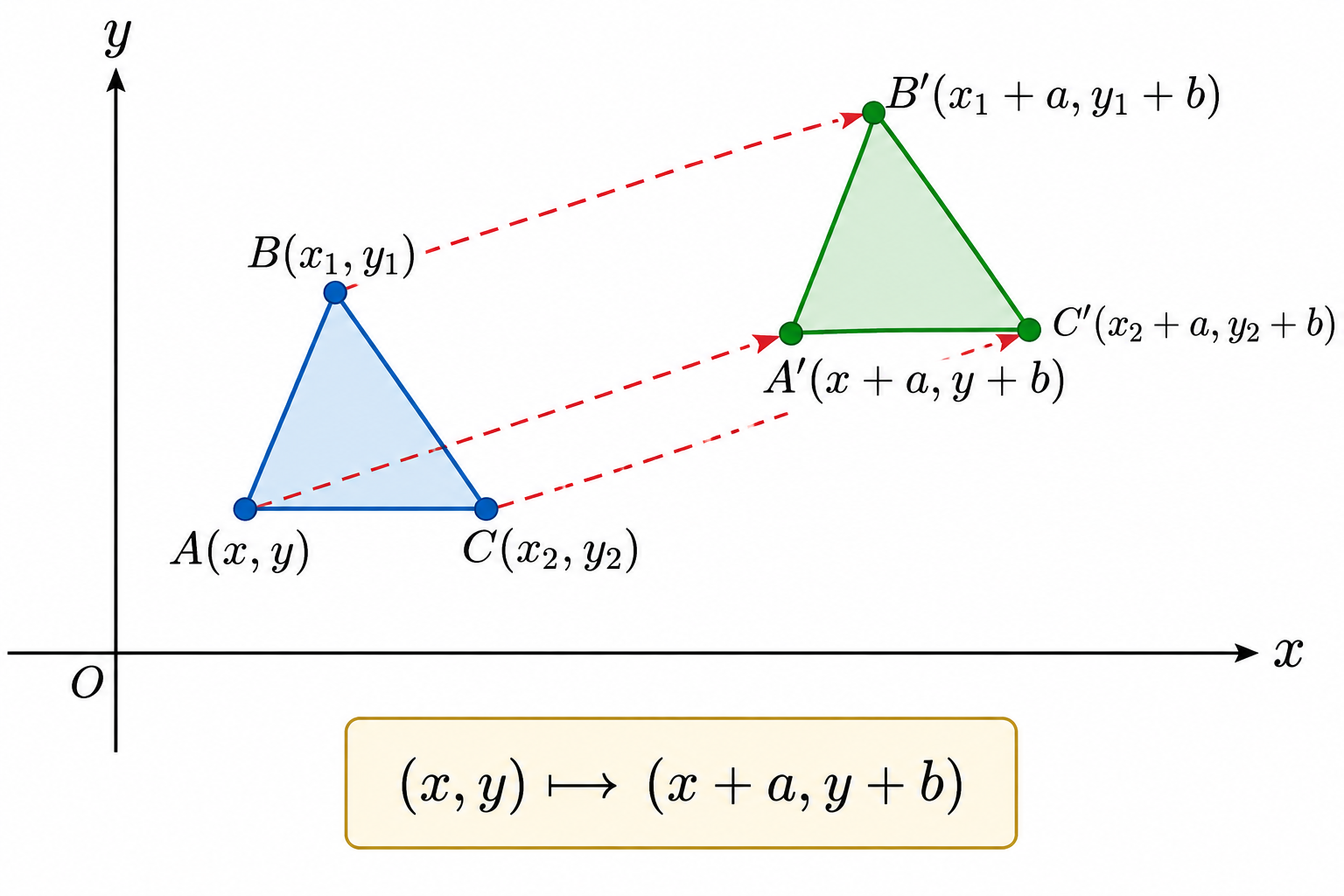
Translation
A translation by the vector sends
It preserves lengths, angles, areas, and orientation.
Rotation
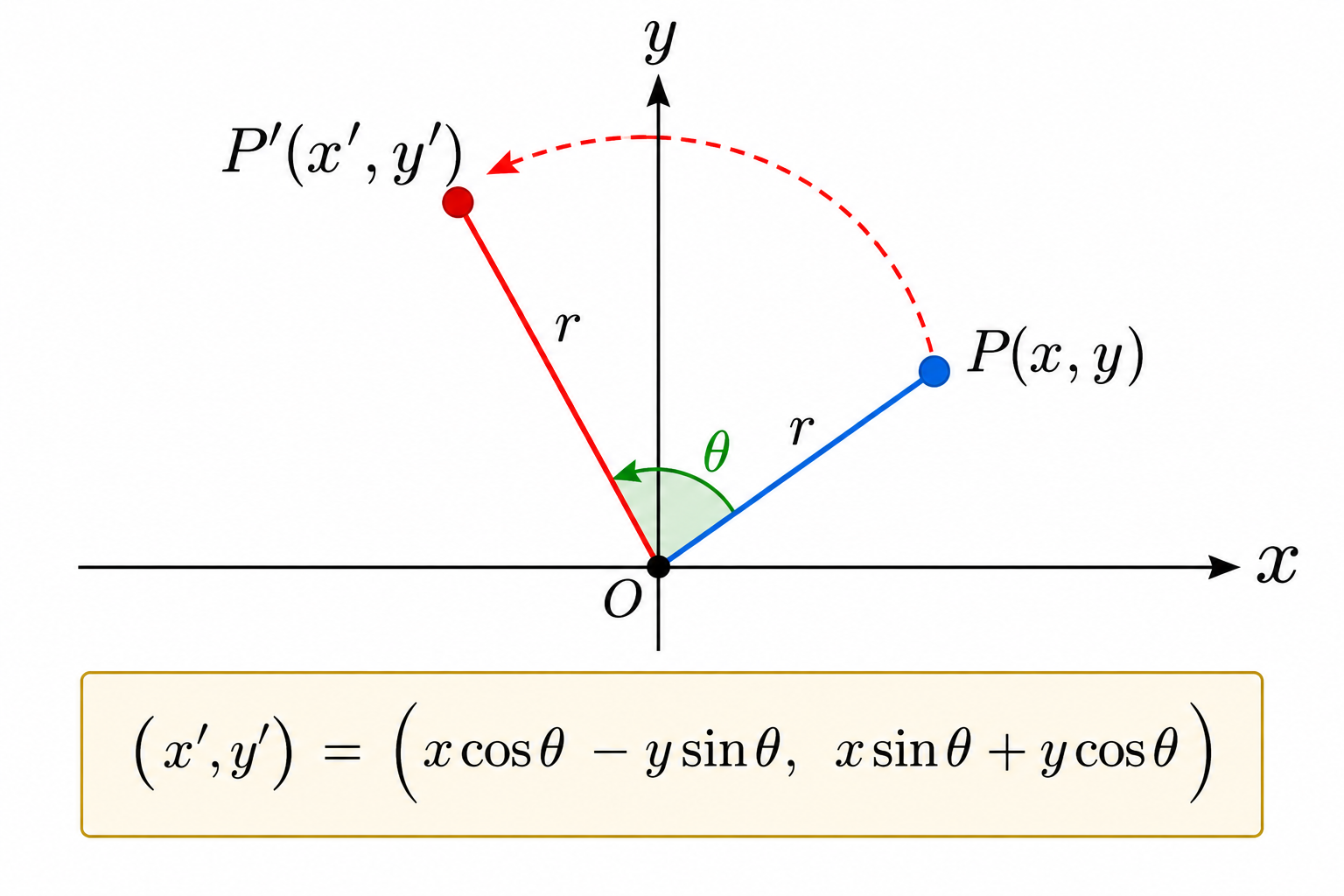
A counterclockwise rotation by angle about the origin sends
Important special cases:
Reflection
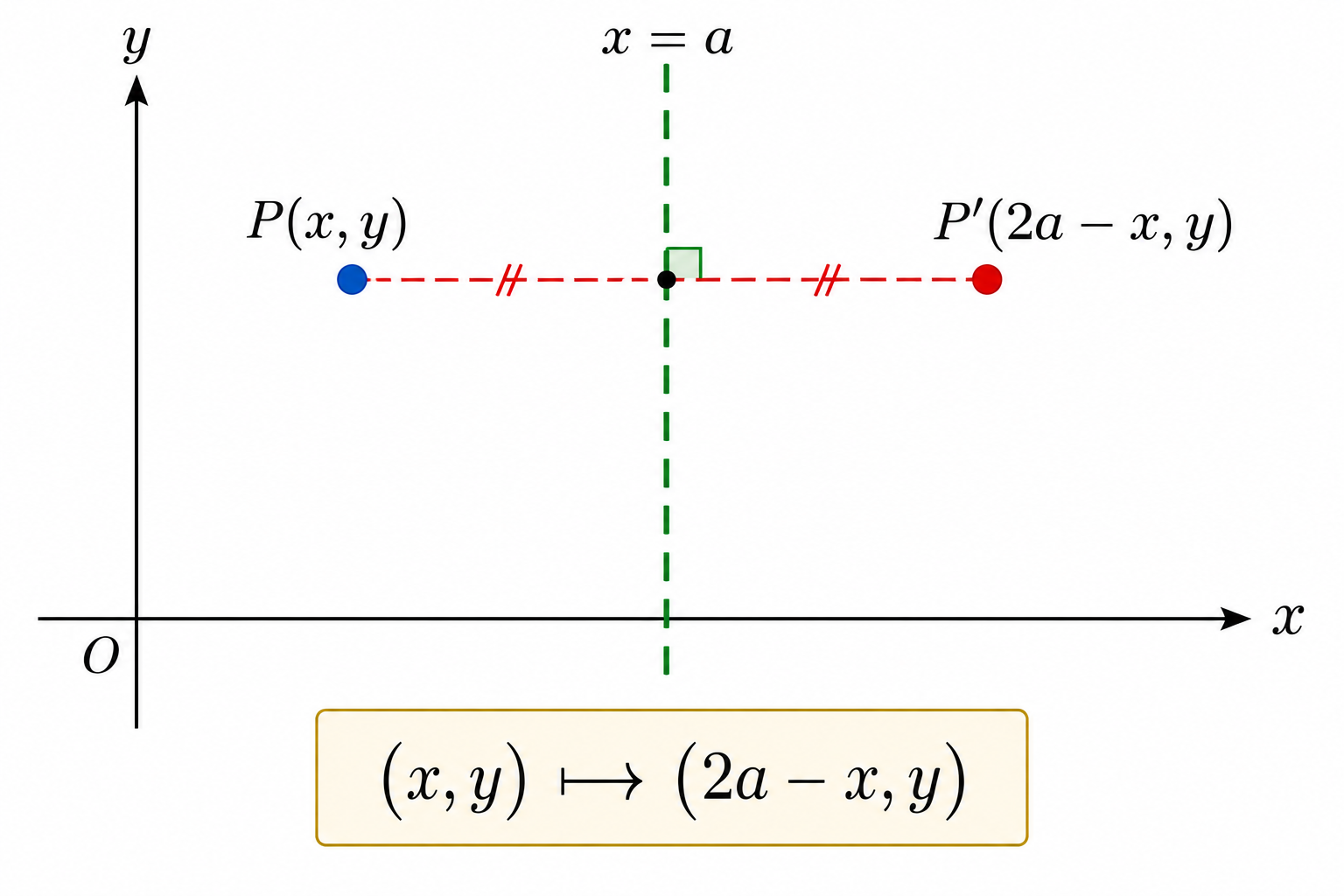
A reflection flips a figure across a line called the line of reflection.
Each point and its image are the same distance from the line of reflection.
Reflection Across the x-Axis
Reflection Across the y-Axis
Reflection Across y=x
Reflection Across y=-x
Reflection Across x=a
The -coordinates of a point and its image are symmetric about :
Reflection Across y=b
The -coordinates of a point and its image are symmetric about :
Reflection of a Graph
If
then reflection across the -axis gives
and reflection across the -axis gives
Reflection across gives
Reflection across interchanges and . If is one-to-one, the reflected graph is
Dilation
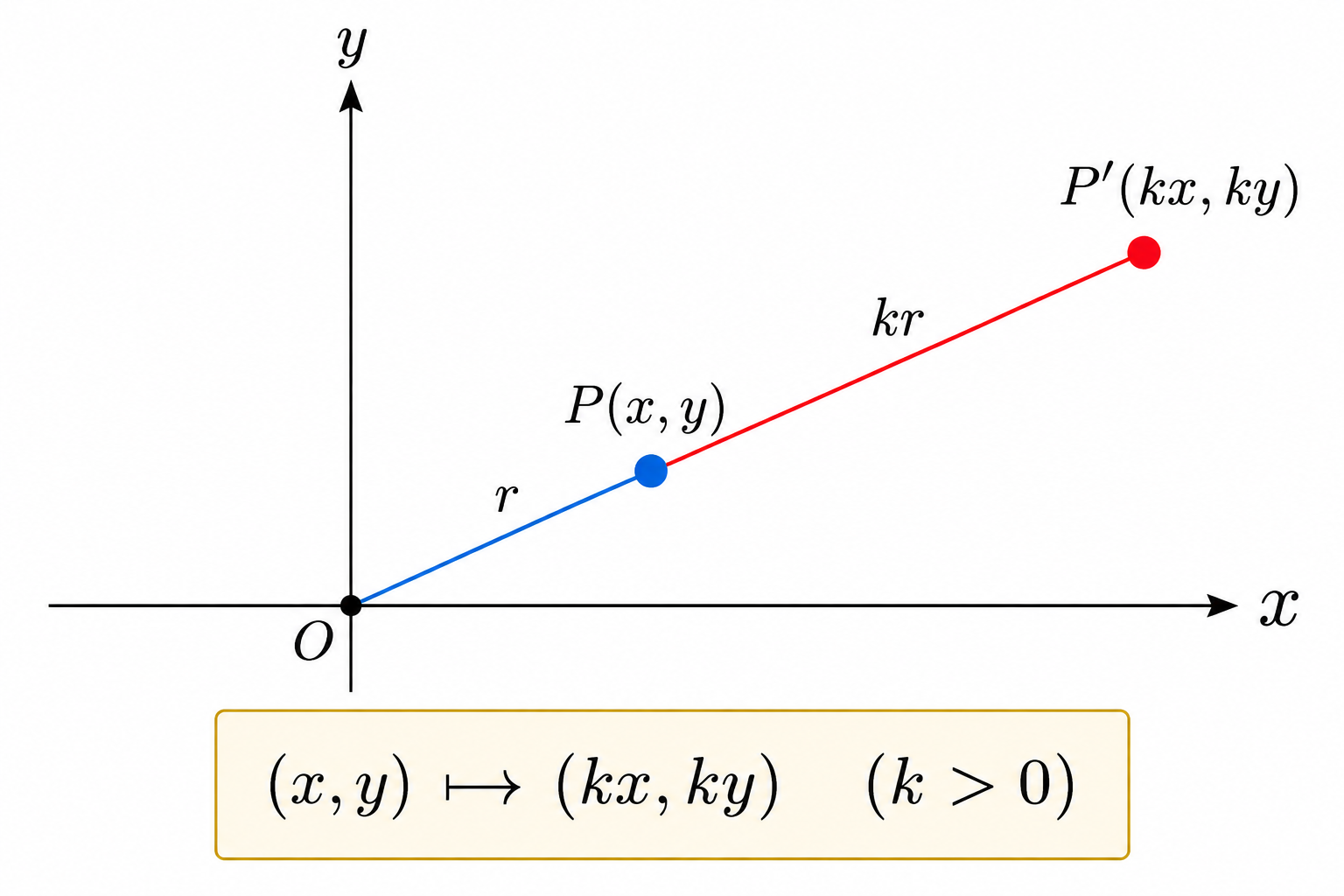
A dilation centered at the origin with scale factor sends
Lengths are multiplied by
and areas are multiplied by
Composition of Transformations
Transformations can be performed successively.
If is followed by , then
means
Point is rotated counterclockwise about the origin, reflected across the -axis, and then translated 5 units to the left and 2 units upward.
Find the final coordinates of .
After the rotation,
After reflection across the -axis,
Finally, translating 5 units left and 2 units up gives
Therefore, the final point is
A point is reflected across the line , then reflected across the -axis, and finally rotated about the origin.
Find the final coordinates in terms of and .
Reflection across gives
Reflection across the -axis gives
A rotation gives
Therefore, the final coordinates are
A transformation consists of the following operations, in order:
• reflection across the line y = x
• translation 3 units to the right and 4 units downward
• rotation 90° clockwise about the origin
The final image of a point is
Find the original point.
Work backward and undo each transformation in reverse order.
Undo the clockwise rotation by rotating counterclockwise:
Undo the translation by moving 3 units left and 4 units up:
Finally, reflection across is its own inverse:
Therefore, the original point is
A triangle has vertices
The triangle is rotated counterclockwise about the point
and then reflected across the line .
Find the vertices of the final triangle.
If P = (x, y), after the rotation it goes to
and then reflected across the line y = x
So