Functions
Lesson · Beginner
Algebra
Definition
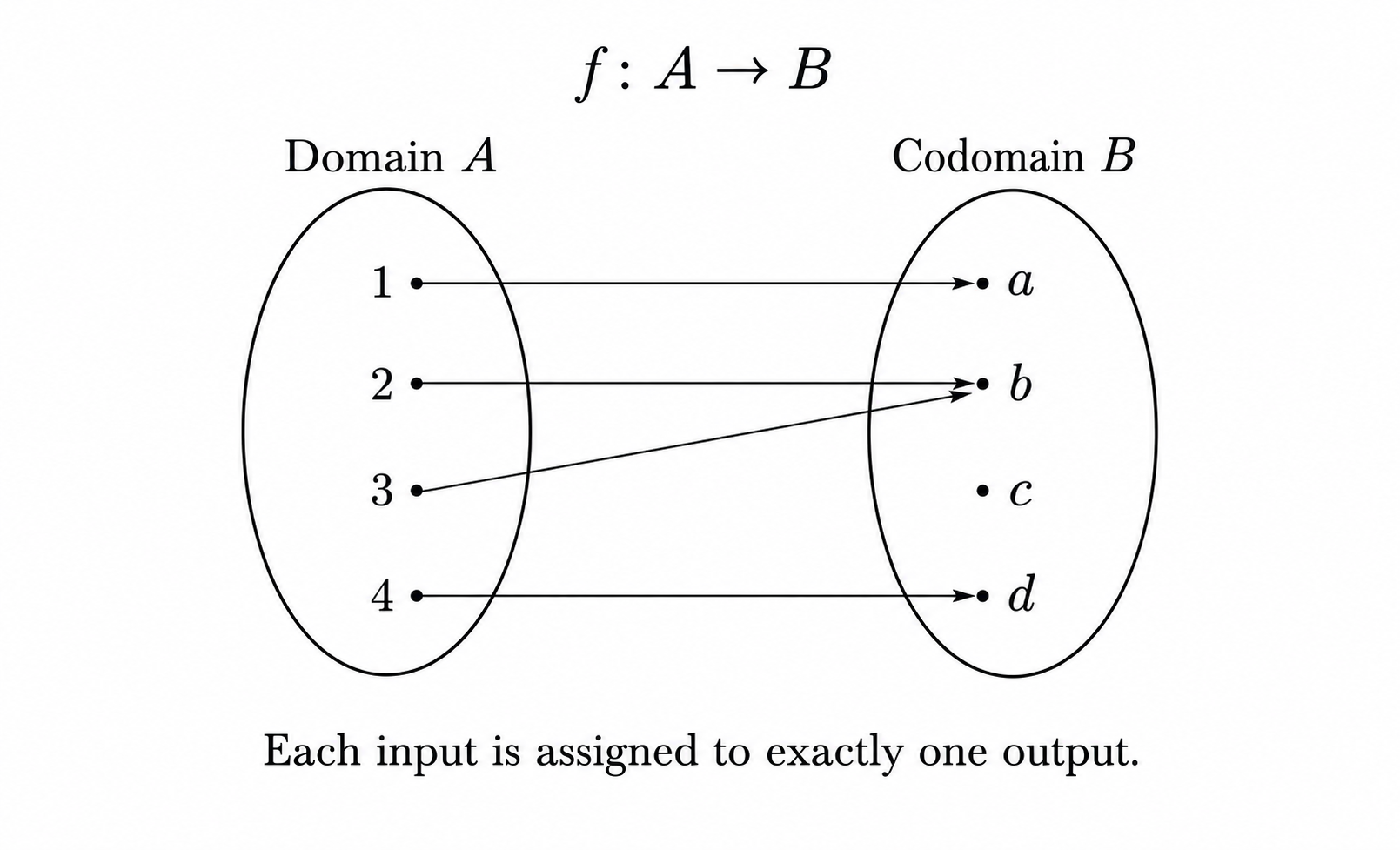
A function assigns exactly one output to each input.
If
then x is the input and y is the output.
Domain and Range
The domain is the set of all allowed inputs.
The range is the set of all outputs actually produced by the function.
For example,
has
and
One-to-One Functions
A function is one-to-one (injective) if different inputs always give different outputs.
Equivalently,
Horizontal Line Test
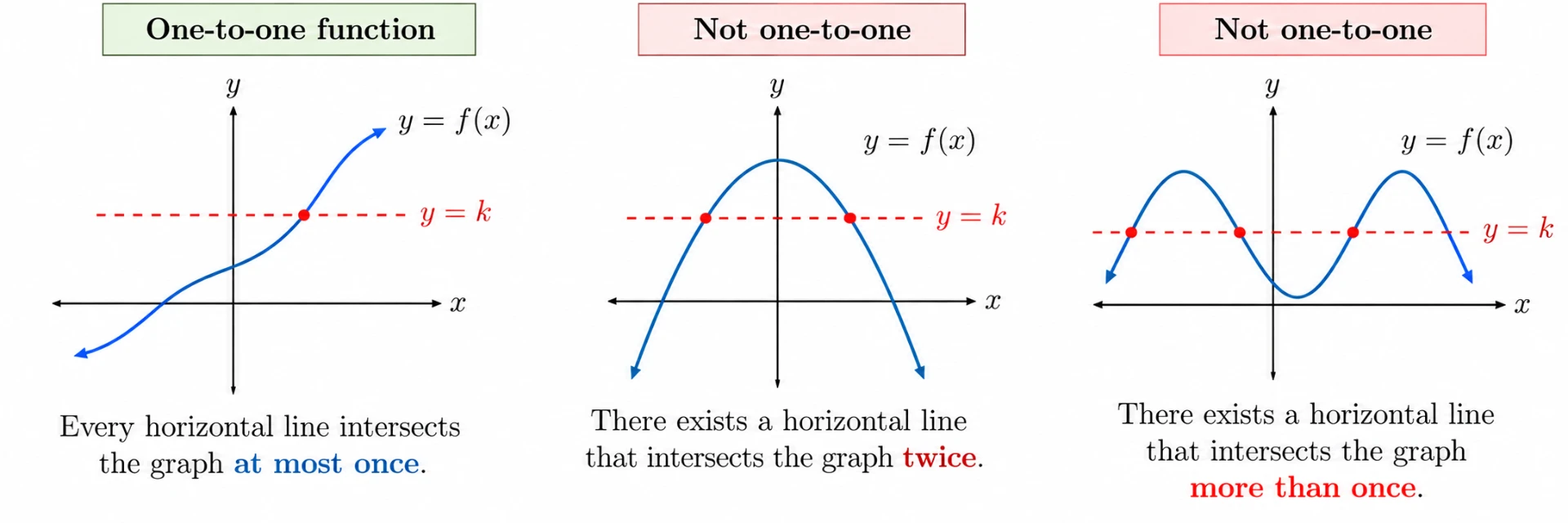
A function is one-to-one exactly when every horizontal line intersects its graph at most once.
This is called the horizontal line test.
Inverse Functions
If f is one-to-one, we can reverse the correspondence between inputs and outputs.
The resulting function is called the inverse function and is denoted by
If
then
Thus,
and
Finding an Inverse
To find :
1.
2. Interchange and
3. Solve for
4. Replace by
For example, if
then
Interchange x and y:
so
Therefore,
Composition of a Function and Its Inverse
A function and its inverse undo each other:
and
whenever the expressions are defined.
Graph of an Inverse
The graphs of and are reflections of each other across the line
because if
then
Thus, if is a point on the graph of , then is a point on the graph of .
Suppose
for two different inputs .
If were a function, then
and
But , so the same input to would have two different outputs.
Therefore, would not be a function.
Hence, a function must be one-to-one in order to have an inverse function.
Determine whether
is one-to-one on ℝ.
Since
the function is not one-to-one.
Therefore, it does not have an inverse function on all of ℝ.
Let
Find .
Complete the square:
Let
Then
Since x ≥ 3,
Thus
so
The domain of the inverse is
Suppose f is one-to-one and
Find
Since
we have
Also,
so
Therefore,
Let
Solve
First we prove that f is one-to-one.
The second bracket is positive, so
So f is one-to-one.
Hence
implies
Thus
The vertical line test determines whether a graph represents a function.
Do not confuse
with
Before finding an inverse, check whether the function is one-to-one on the given domain.