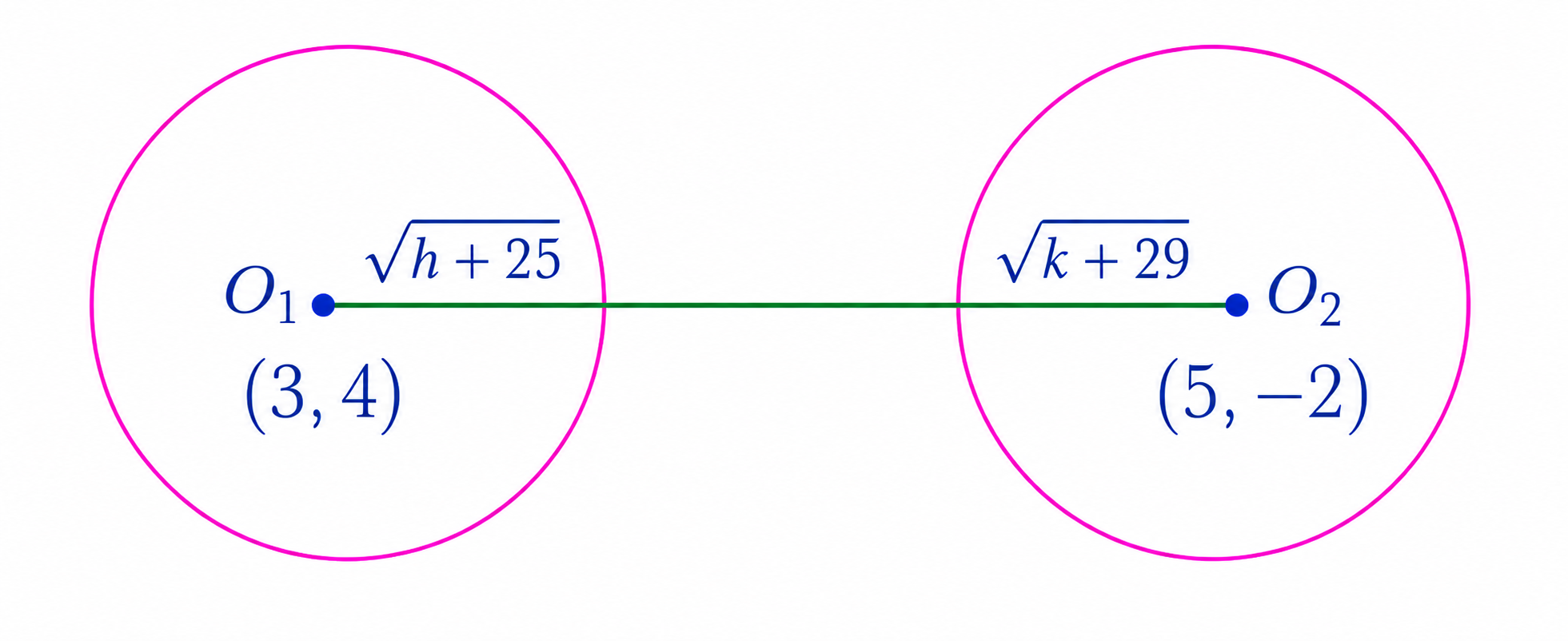
Completing the square in each equation, we get x2+y2−6x−8y=h(x−3)2+(y−4)2=h+25. Similarly, x2+y2−10x+4y=k(x−5)2+(y+2)2=k+29.
Each equation represents a circle (or a point when its radius is zero).
For the first circle, (x−3)2+(y−4)2=h+25, its center and radius are O1=(3,4),r1=h+25. For the second circle, (x−5)2+(y+2)2=k+29, its center and radius are O2=(5,−2),r2=k+29.
Since the two equations must have a common solution, the two circles must intersect.
Therefore, the distance between their centers cannot exceed the sum of their radii: O1O2≤h+25+k+29.
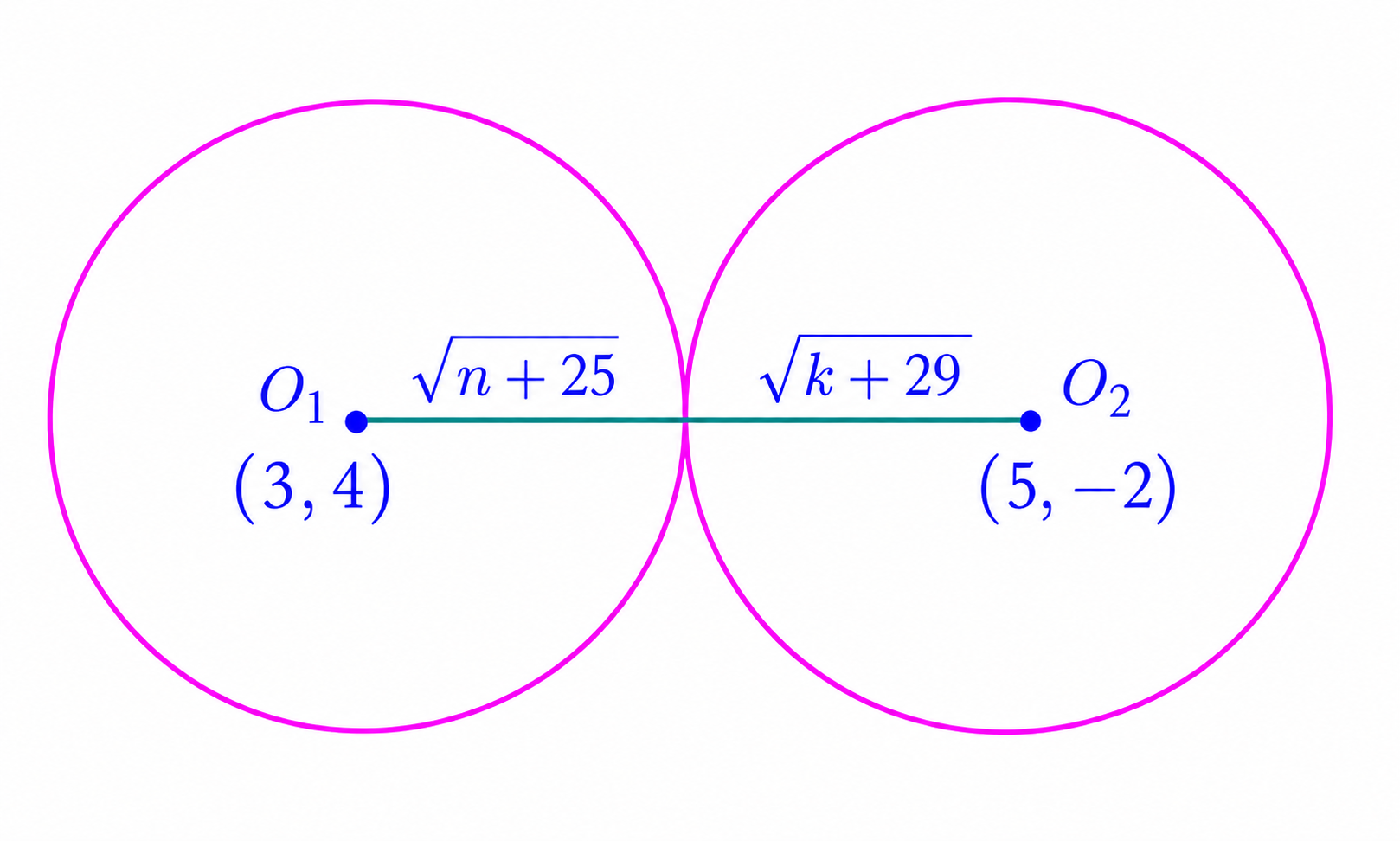
The minimum possible value of h+k occurs when the two circles are externally tangent. In this case, the sum of their radii equals the distance between their centers.
The distance between the centers is O1O2=(5−3)2+(−2−4)2=40. By Hints 3 and 4, at the minimum, h+25+k+29=40. By the QM-AM inequality, 2(h+25)+(k+29)≥2h+25+k+29=240=10. Thus, 2h+25+k+29≥10, so h+k+54≥20, and hence h+k≥−34. Equality holds when h+25=k+29=10. Therefore, h=−15,k=−19, and h+k=−34.