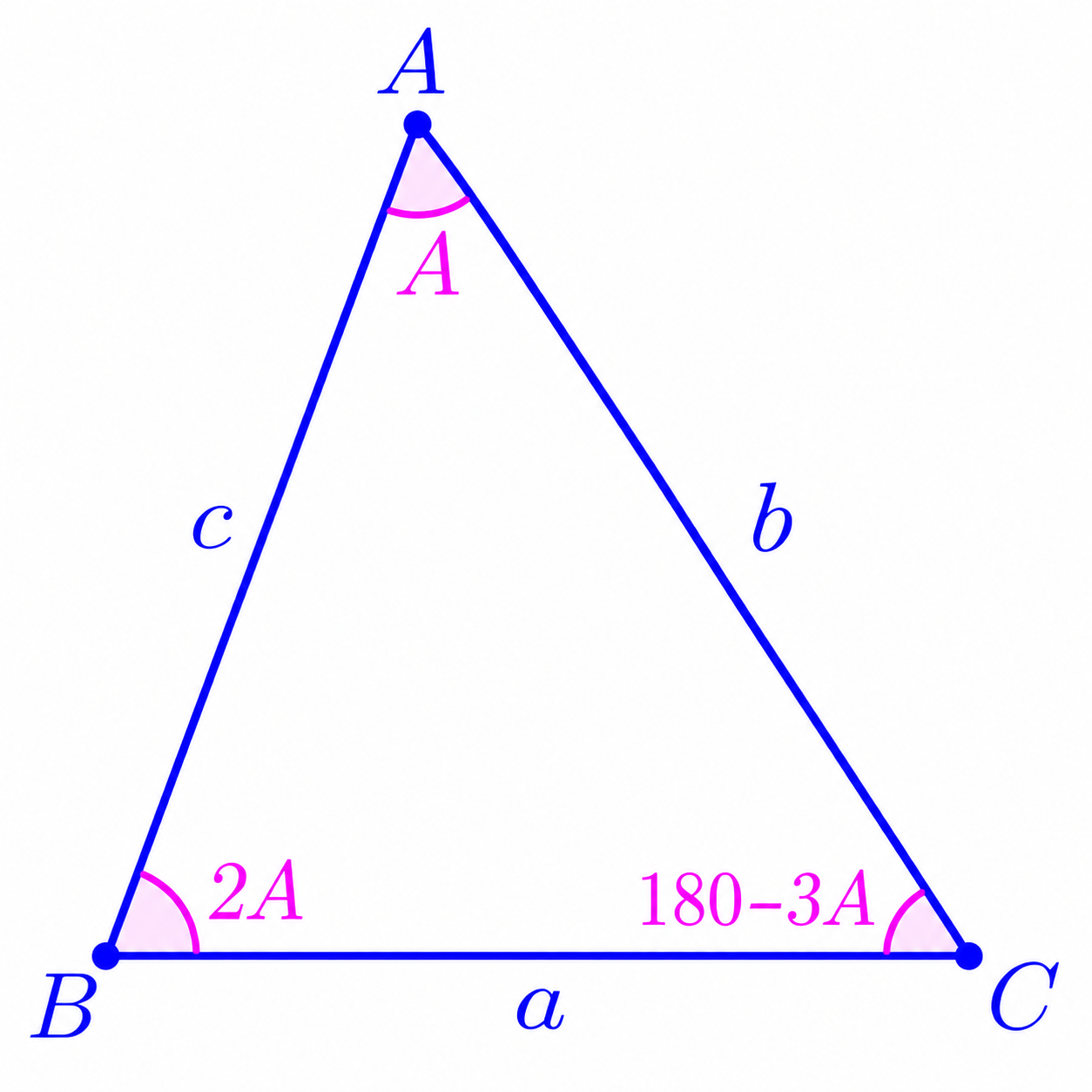
To cancel c−a from both sides, we first need to prove that c−a=0.Suppose c=a. Since equal sides have equal opposite angles,
∠C=∠A.
180∘−3A=A
A=45∘
B=2A=90∘.
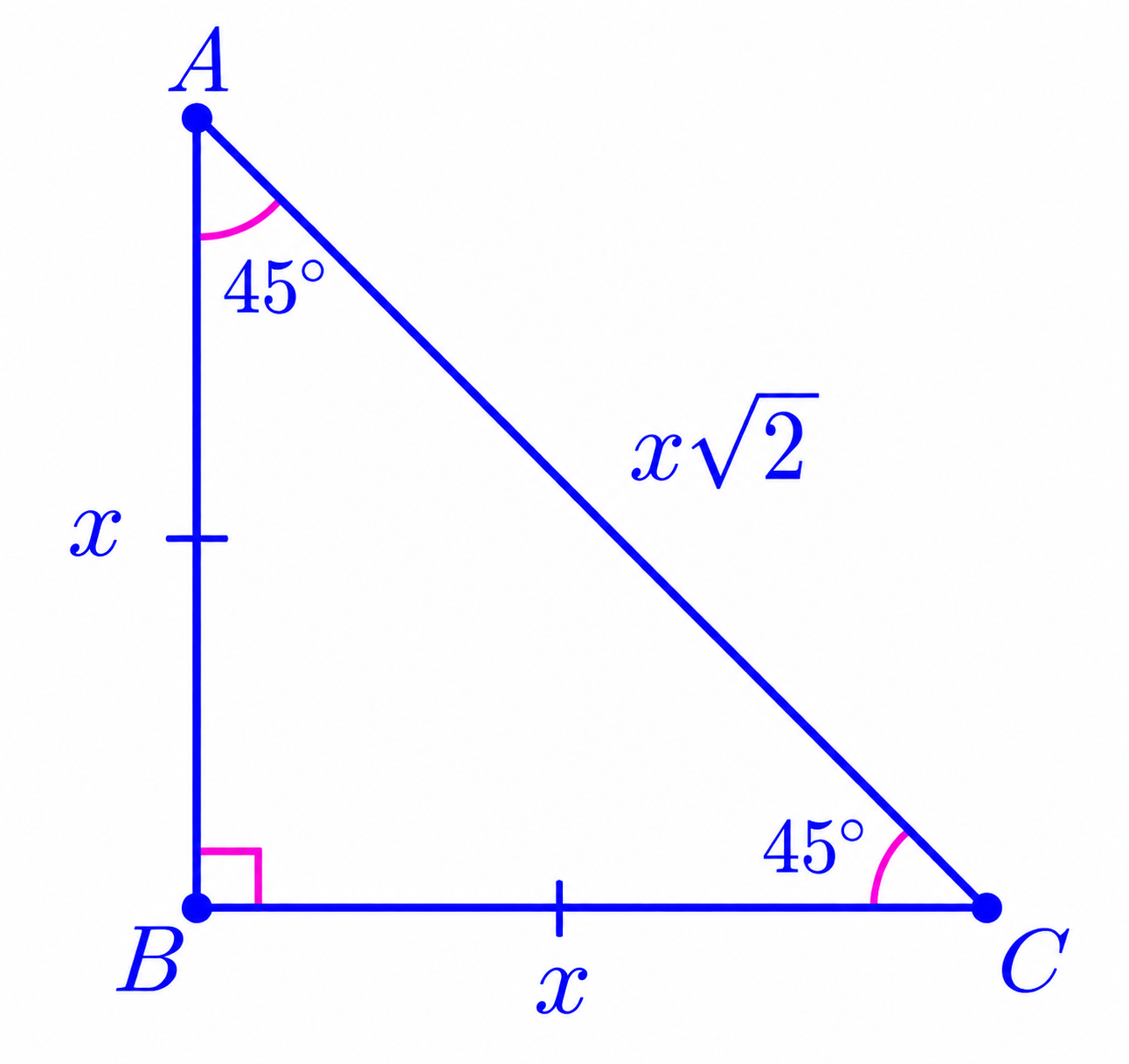
The two legs would have length x, and the hypotenuse would have length x2. Since x is a positive integer, x2 cannot be an integer. This contradicts the condition that all three side lengths are integers. ✗
c−a=0.
By Hints 5 and 6,
b2(c−a)=a(c−a)(c+a)
b2=a(c+a).
Use casework, starting with the smallest possible values of b.
Base the casework on b.
Case 1: b=1.
12=a(c+a)
a=1,c+a=1
c=0✗
This is impossible because every side length must be positive.
Case 2: b=2.
4=a(c+a)
The possible factor pairs are:
1×4:a=1,c=3⟹a+b=c✗
This does not satisfy the Triangle Inequality. ✗
2×2:a=2,c=0✗
Case 3: b=3.
9=a(c+a)
1×9:a=1,c=8⟹a+b<c✗
3×3:a=3,c=0✗
Case 4: b=4.
16=a(c+a)
1×16:a=1,c=15⟹a+b<c✗
2×8:a=2,c=6⟹a+b<c✗
4×4:a=4,c=0✗
Case 5: b=5.
25=a(c+a)
1×25:a=1,c=24⟹a+b<c✗
5×5:a=5,c=0✗
Case 6: b=6.
36=a(c+a)
1×36:a=1,c=35⟹a+b<c✗
2×18:a=2,c=16⟹a+b<c✗
3×12:a=3,c=9⟹a+b=c✗
4×9:a=4,c=5
a+c=4+5=9>6=b✓
This gives a valid triangle. ✓
Perimeter=a+b+c=4+6+5=15.
6×6:a=6,c=0✗
Case 7: b≥7.By the Triangle Inequality,
a+c>b≥7.
Since a and c are integers,
a+c≥8.
Therefore,
Perimeter=a+b+c=b+(a+c)≥7+8=15.
By Hint 15, a triangle with perimeter 15 exists. Therefore, the least possible perimeter is