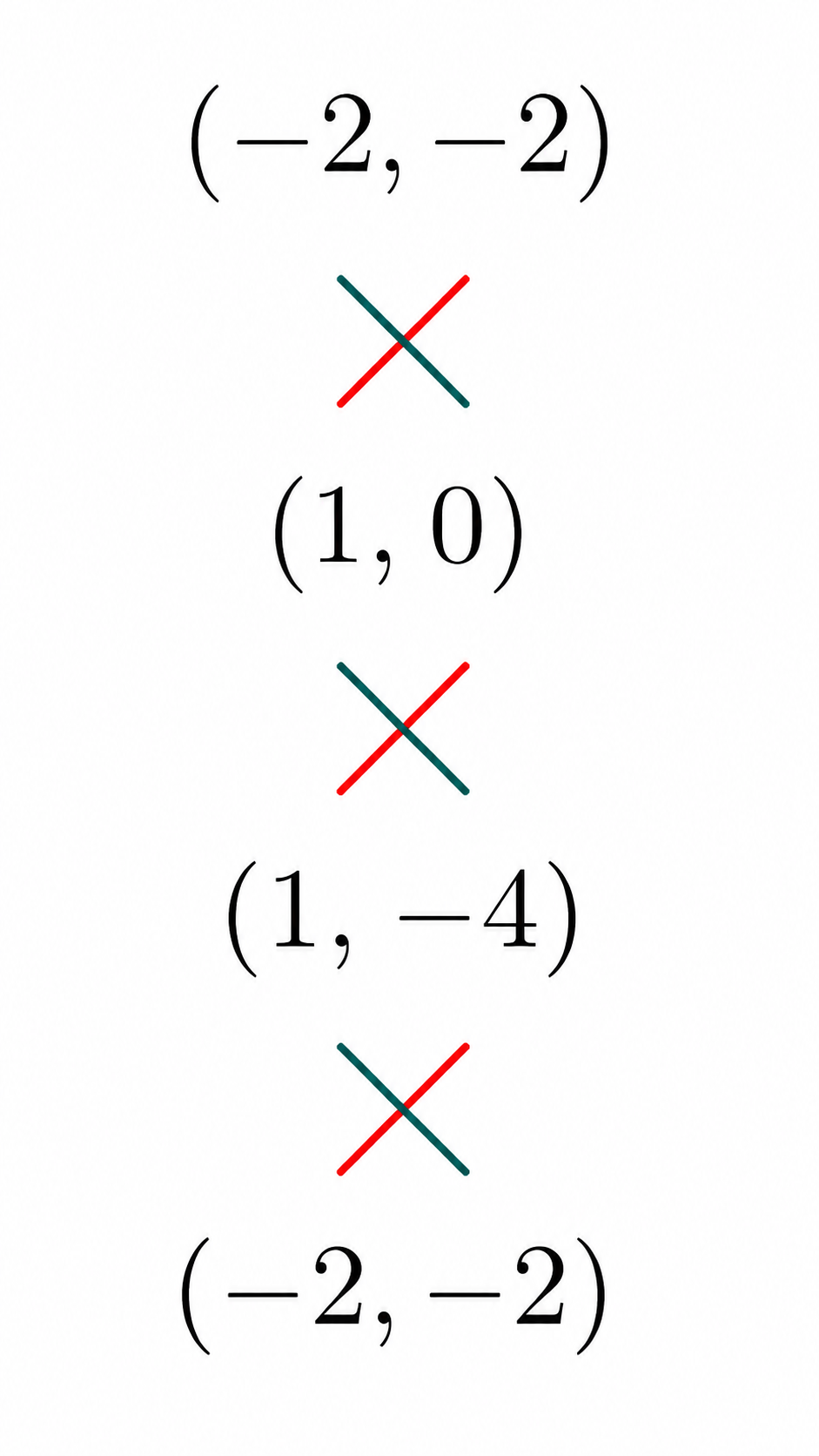
AMC 12A 2025 (Problem 17)The polynomial (z+i)(z+2i)(z+3i)+10(z+i)(z+2i)(z+3i)+10(z+i)(z+2i)(z+3i)+10 has three roots in the complex plane, where i=−1i=\sqrt{-1}i=−1. What is the area of the triangle formed by these three roots?(A) 6\text{(A)}\;6(A)6(B) 8\text{(B)}\;8(B)8(C) 10\text{(C)}\;10(C)10(D) 12\text{(D)}\;12(D)12(E) 14\text{(E)}\;14(E)14Related TopicsCoreBasic Complex NumbersMajorFactor TheoremShoelace TheoremMinorQuadratic FunctionsCheck AnswerYour answer:ABCDECheckHints (6)Hint 1Let w=z+2iw=z+2iw=z+2i.Hint 2(z+i)(z+2i)(z+3i)+10=0(z+i)(z+2i)(z+3i)+10=0(z+i)(z+2i)(z+3i)+10=0⇒(w−i)(w)(w+i)+10=0\Rightarrow (w-i)(w)(w+i)+10=0⇒(w−i)(w)(w+i)+10=0⇒w(w2+1)+10=0\Rightarrow w(w^2+1)+10=0⇒w(w2+1)+10=0⇒w3+w+10=0\Rightarrow w^3+w+10=0⇒w3+w+10=0Hint 3Factorize w3+w+10w^3+w+10w3+w+10.Hint 4If w=−2w=-2w=−2:(−2)3+(−2)+10=0(-2)^3+(-2)+10=0(−2)3+(−2)+10=0By Factor Theorem, w+2w+2w+2 is a factor of w3+w+10w^3+w+10w3+w+10.Hint 5w3+w+10=(w+2)(w2−2w+5)=0w^3+w+10=(w+2)(w^2-2w+5)=0w3+w+10=(w+2)(w2−2w+5)=0⇒w=−2\Rightarrow w=-2⇒w=−2 or w2−2w+5=0w^2-2w+5=0w2−2w+5=0By Quadratic Functions:w=−(−2)±(−2)2−4(1)(5)2(1)=2±−162w=\frac{-(-2)\pm\sqrt{(-2)^2-4(1)(5)}}{2(1)}=\frac{2\pm\sqrt{-16}}{2}w=2(1)−(−2)±(−2)2−4(1)(5)=22±−16⇒w=2±4i2=1±2i\Rightarrow w=\frac{2\pm4i}{2}=1\pm2i⇒w=22±4i=1±2i⇒w=−2, 1±2i\Rightarrow w=-2,\ 1\pm2i⇒w=−2, 1±2i⇒z+2i=−2, 1±2i\Rightarrow z+2i=-2,\ 1\pm2i⇒z+2i=−2, 1±2i⇒z=−2−2i, 1, 1−4i\Rightarrow z=-2-2i,\ 1,\ 1-4i⇒z=−2−2i, 1, 1−4iHint 6By Shoelace Theorem, Shoelace Theorem:Area=12∣(−2)(0)+(1)(−4)+(1)(−2)−[(−2)(1)+(0)(1)+(−4)(−2)]∣\text{Area}=\frac12\left|(-2)(0)+(1)(-4)+(1)(-2)-\left[(-2)(1)+(0)(1)+(-4)(-2)\right]\right|Area=21∣(−2)(0)+(1)(−4)+(1)(−2)−[(−2)(1)+(0)(1)+(−4)(−2)]∣=12∣−4−2−(−2+8)∣=6=\frac12|-4-2-(-2+8)|=6=21∣−4−2−(−2+8)∣=6Final Answer(A) 666Related Problems (5)AMC 12A 2025 (Problem 9)AMC 12B 2025 (Problem 3)AMC 12B 2024 (Problem 15)AMC 10B 2025 (Problem 10)AIME I 2026 (Problem 10)