USAJMO 2026 (Problem 3)
Let be an acute scalene triangle with no angle equal to . Let be the circumcircle of . Let be the equilateral triangle with three vertices on , one of which is . Let be the line through the other two vertices of . Define and analogously. Let and . Suppose the circumcircle of intersects again at . Let and . Prove that .
Prove that .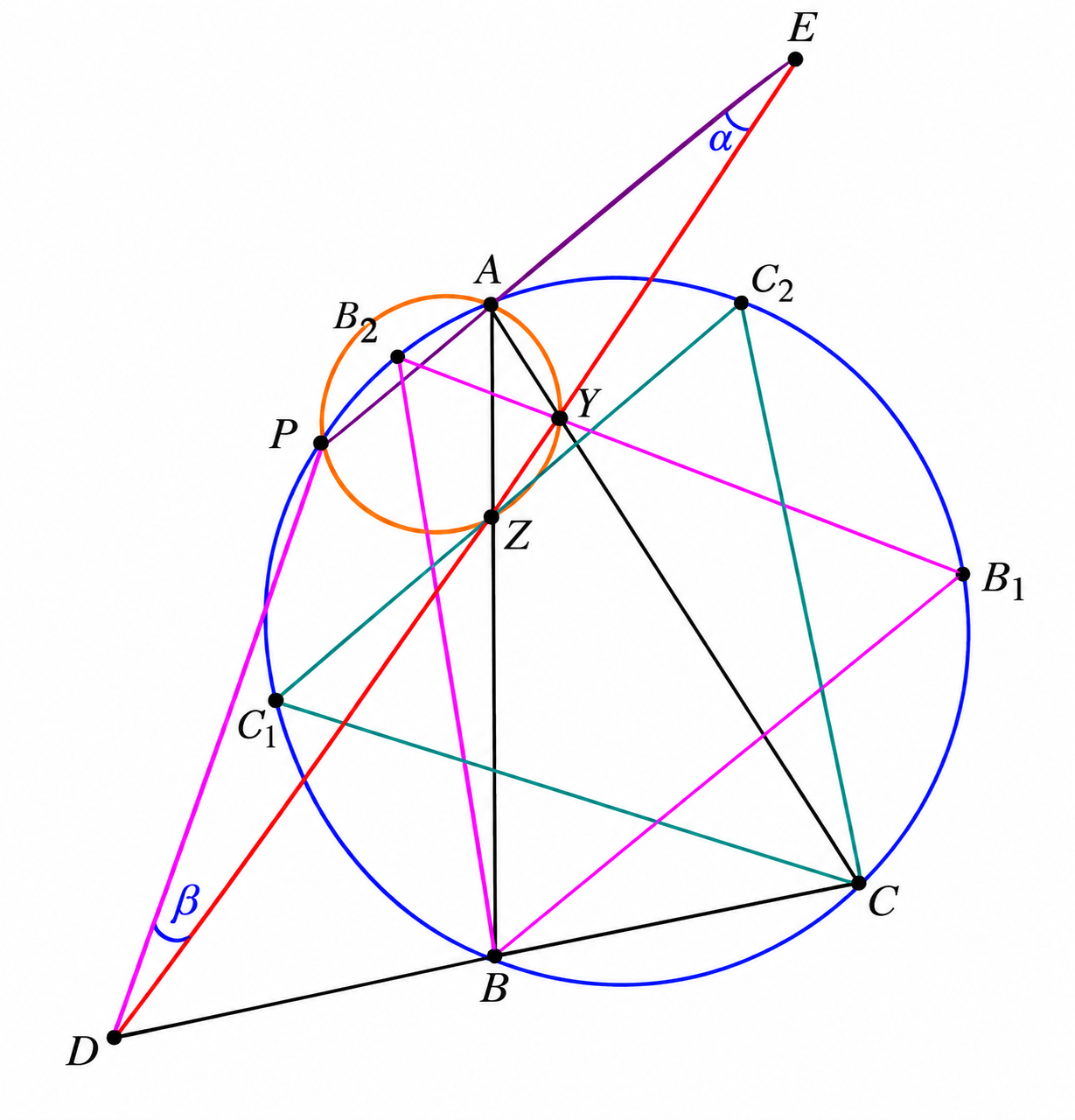
Prove that is cyclic.
Prove that is cyclic.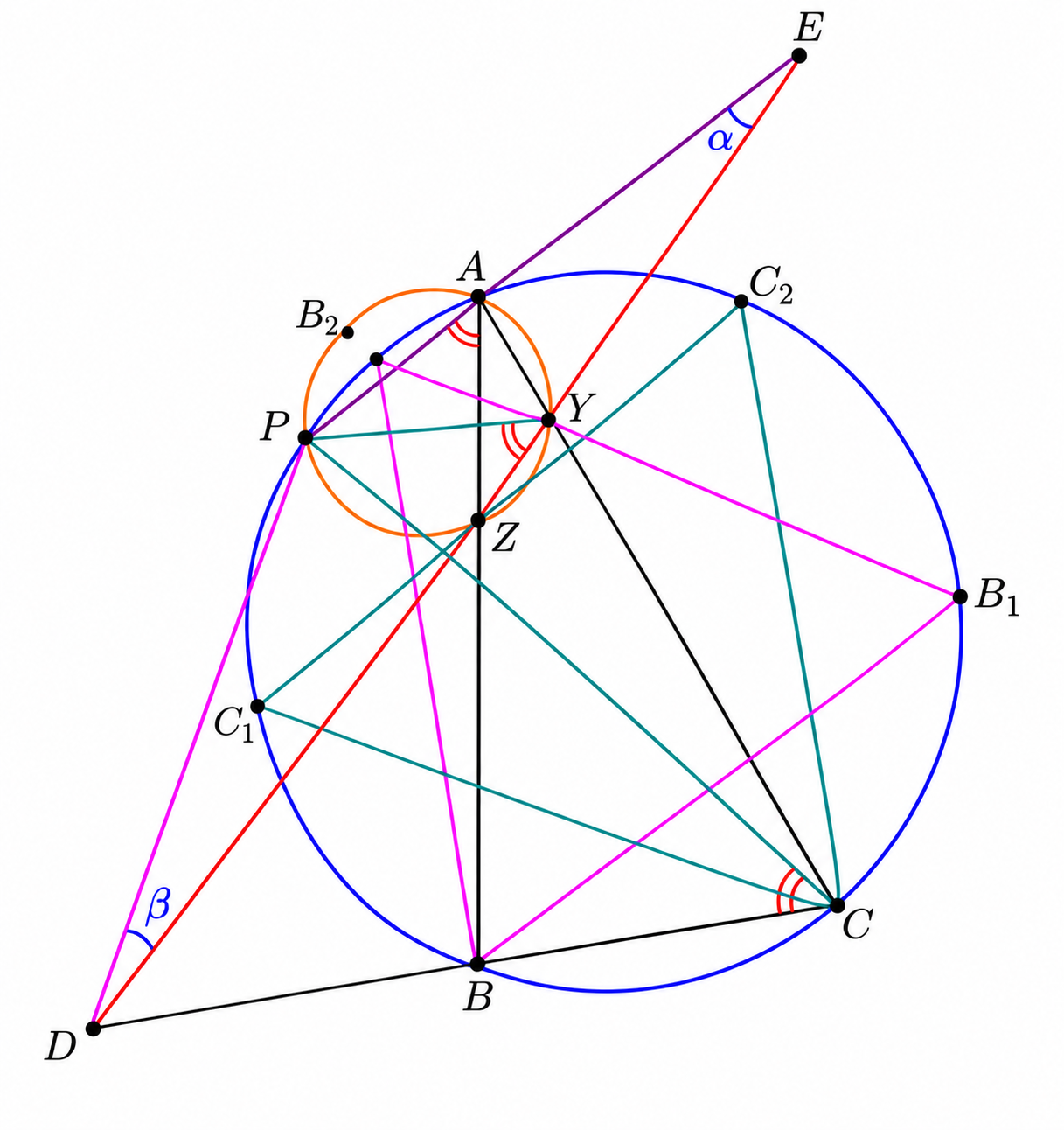
Since are cyclic,
Therefore, using the collinearities in the diagram,
Hence is cyclic.
Prove that is cyclic.
Prove that is cyclic.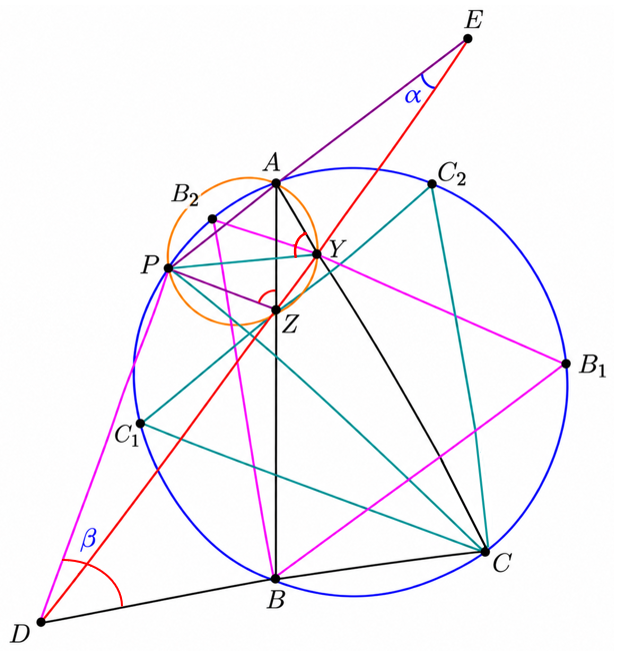
By Hint 3, is cyclic, so
Therefore, using directed angles modulo ,
Hence is cyclic.
Prove that .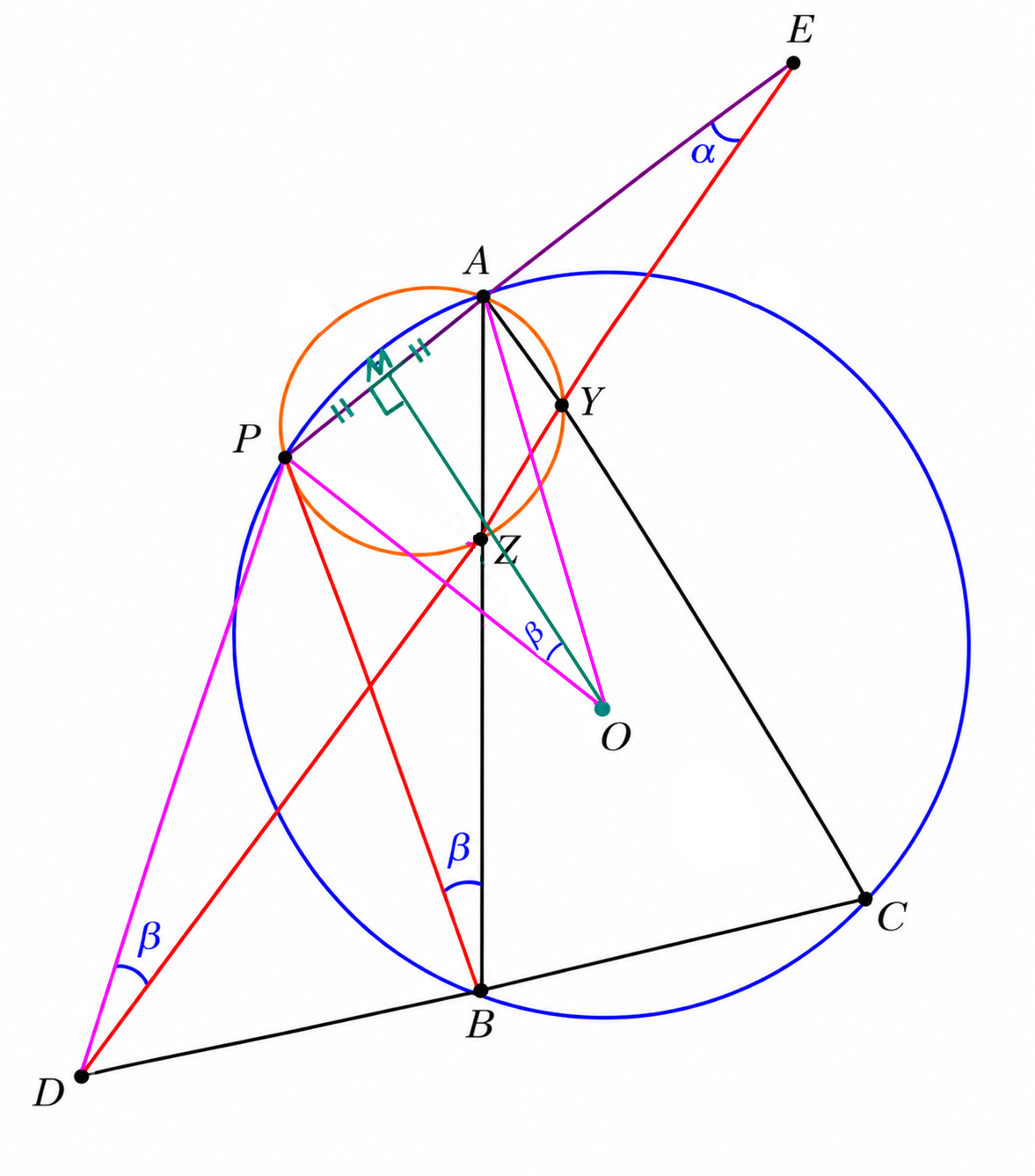
By Hint 5, is cyclic, so
By Hint 5, is cyclic, so
Since lie on the circle centered at ,
Since and is the midpoint of , bisects the relevant central angle.
Assume that the circumcenter of is the origin and its circumradius is .
Equivalently,
Since is the midpoint of , its complex coordinate is .Therefore, we need to prove
Find and .Let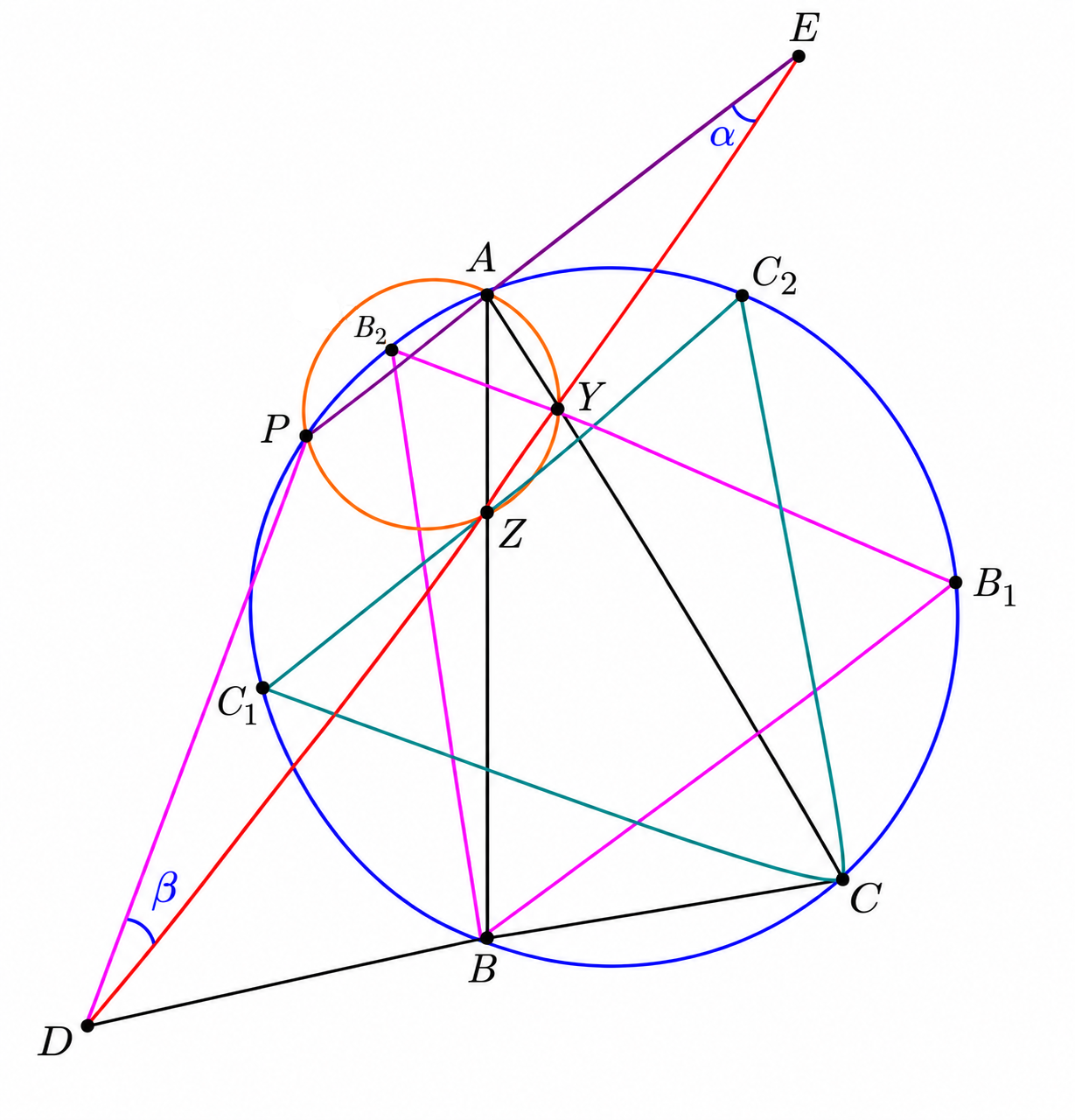
by Complex Numbers in Geometry,
The other two vertices of have coordinates
by Complex Numbers in Geometry,
Since
Therefore,
Similarly,
Prove that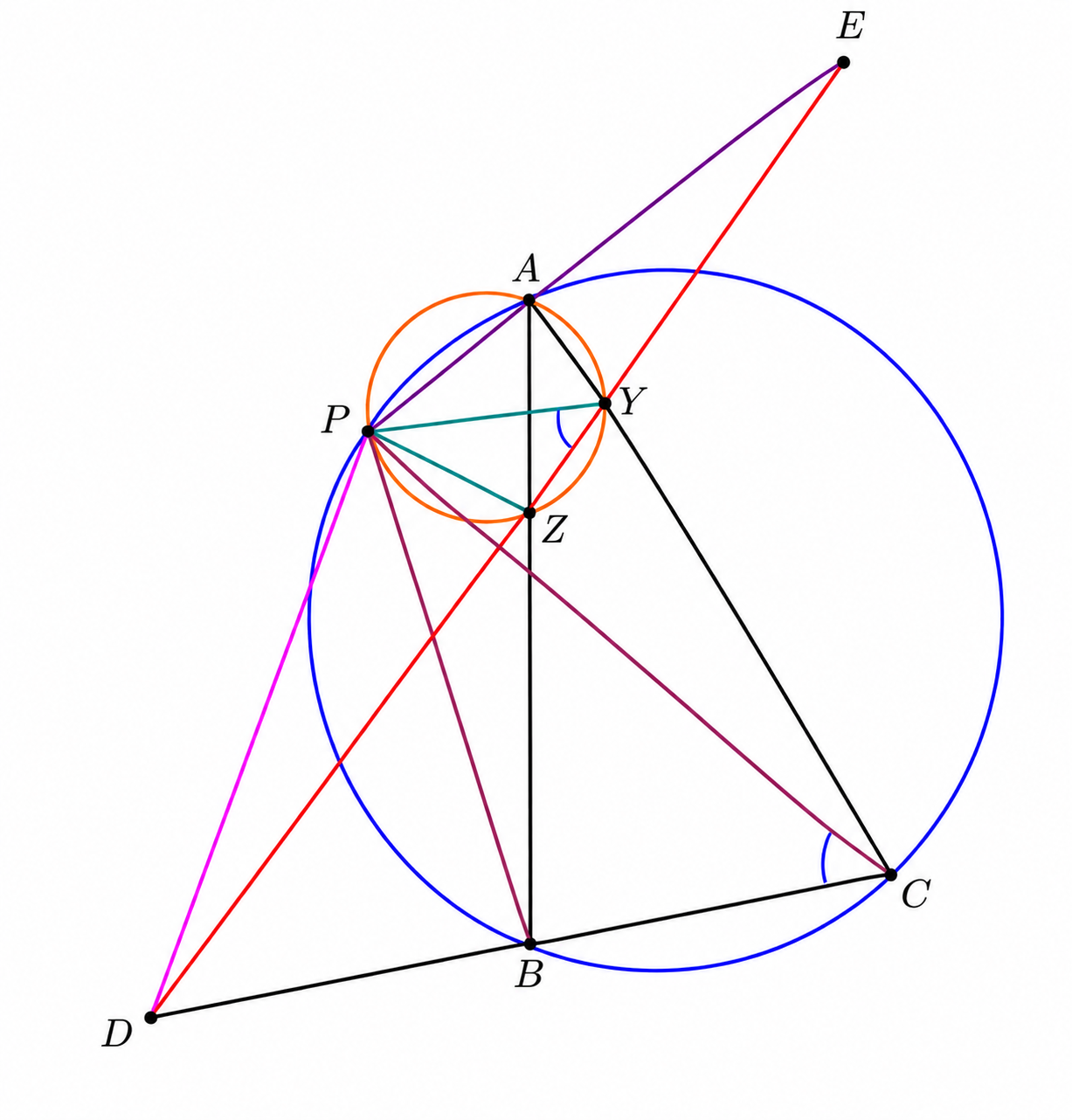
Using the cyclic quadrilateral and the collinearities in the diagram,
By Hint 3, is cyclic, so
Thus, by AA similarity,
Find .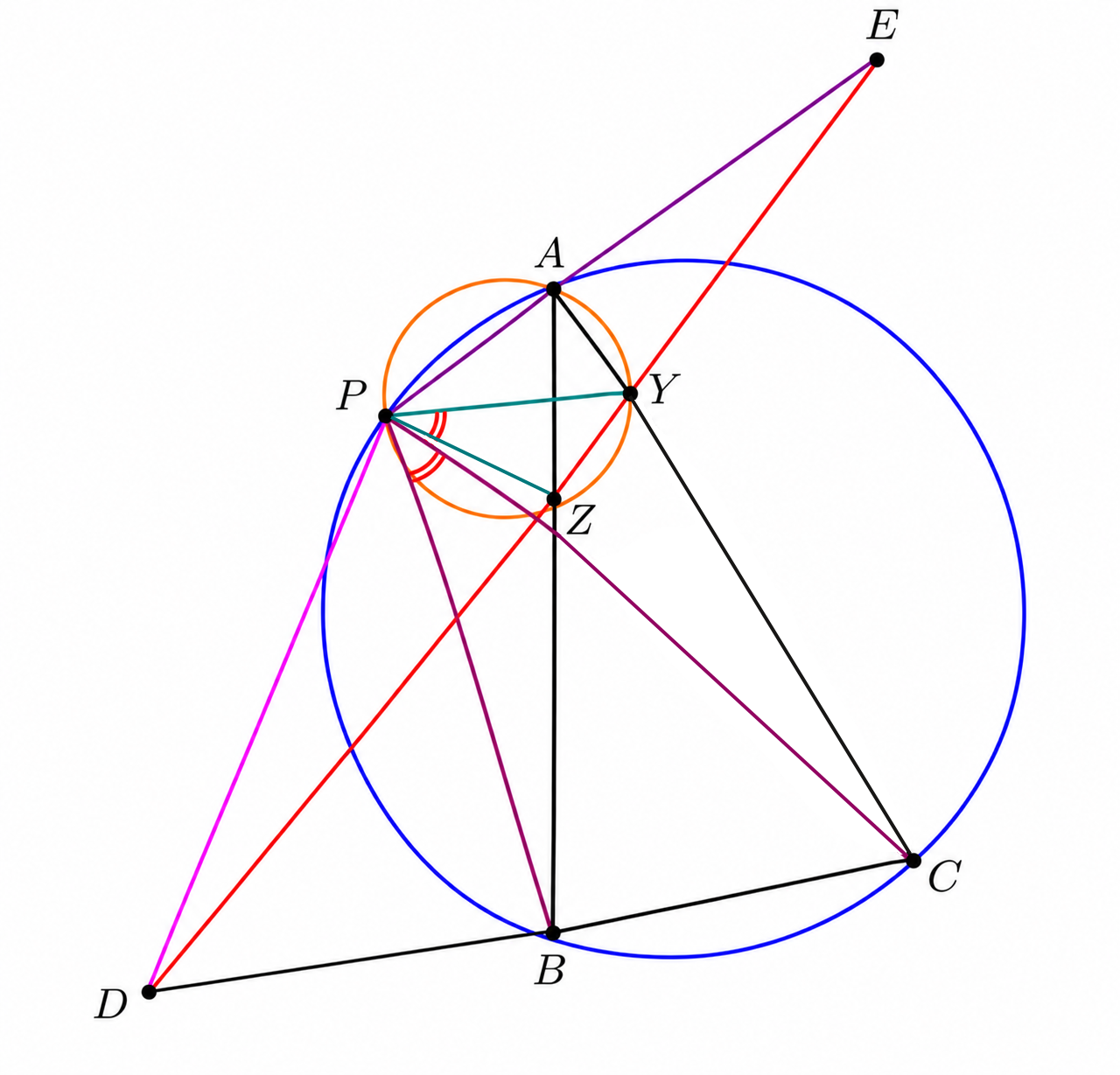
Using the corresponding directed angles,
Prove that
By Hints 9 and 11,
The numerator is
The denominator of is
Now expand the expression in brackets:
Therefore,
Hence,
By Hints 8 and 12, we need to prove
We know
Also,
Therefore,
Prove that
Recall that
Since lie on the unit circle centered at the origin,
By Hint 13,
Therefore,
By Hints 7 and 8, the required angle relation follows.
Consequently,