Emily has a red sheet of paper. She draws 2026 circles (not necessarily of equal size) on the piece of paper. She chooses a circle to color black, then cuts the paper around the circumference of all 2026 circles. She then separates the pieces of paper into at least 2 black pieces and some number of red pieces. Is it possible that all black pieces are congruent?
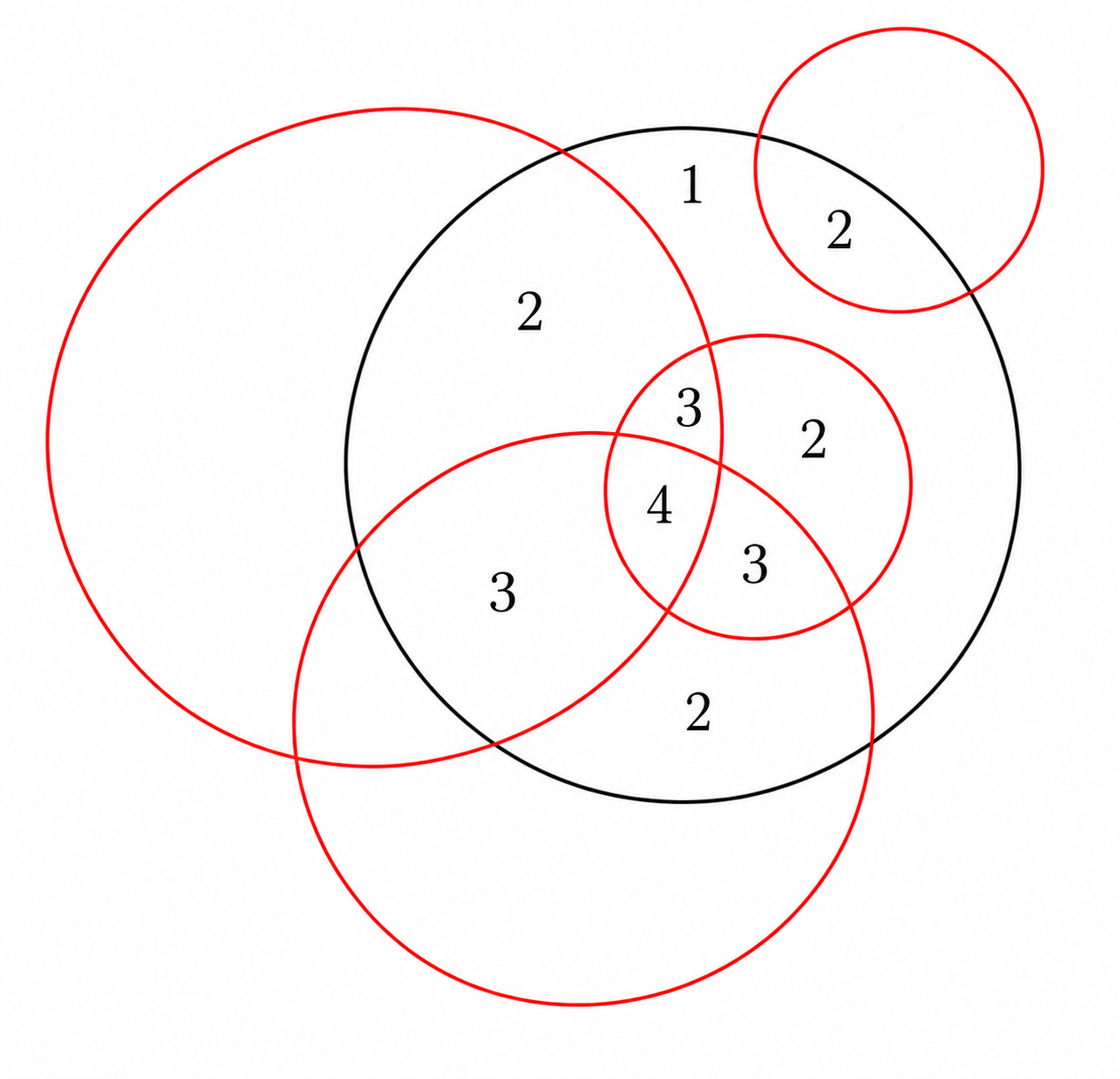
For each black piece R, define f(R) to be the number of the 2026 open disks that contain an interior point of R. Since no cutting circumference passes through the interior of R, this number is independent of the chosen point.For example, in the figure below, the numbers indicate the values of f for the corresponding black pieces.
Choose a black piece A for which f(A) is maximal. Consider the circular arcs forming its boundary. What can you say about which side of each arc contains A?
Prove that A lies inside the disk corresponding to every circular arc of its boundary, except possibly arcs of the original black circle.Otherwise, choose a point in the interior of an offending arc, away from all intersections of cutting circumferences. Crossing this arc into the adjacent black piece B changes membership in exactly one disk, giving
f(B)=f(A)+1,
a contradiction. ×
Since the black circle is divided into at least two pieces, at least one of the other circles must cut through its interior.Consider a small arc of such a circle inside the black circle, away from intersections with other circles.There are two black pieces on opposite sides of this arc. One of them lies inside the disk corresponding to the arc, while the other lies outside it.Therefore, at least one black piece has a boundary arc belonging to a circle whose interior does not contain that piece.
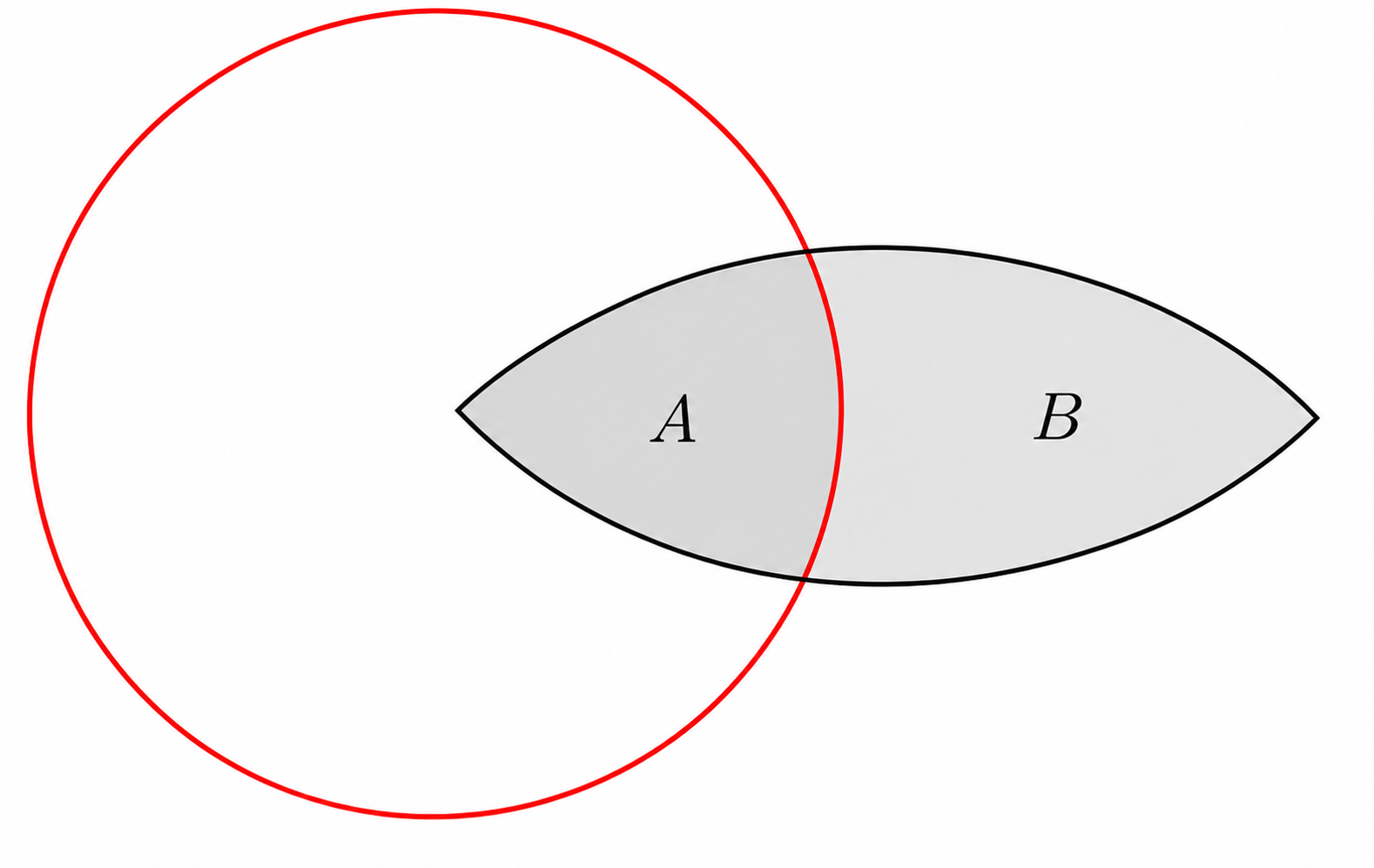
By Hint 3, the piece A with maximum f(A) lies inside every circle that contributes an arc to its boundary, except possibly the original black circle.By Hint 4, there is another piece B that lies outside at least one circle contributing an arc to its boundary.These two pieces cannot be congruent: along that arc of B, the corresponding circle bends toward the piece, whereas every circular boundary arc of A bends away from the piece.Since congruent pieces must have the same boundary shape, A and B cannot be congruent.Therefore, it is impossible for all the black pieces to be congruent.