Spiral Similarity
Lesson · Advanced
Geometry
A spiral similarity is a geometric transformation combining a rotation and a dilation (scaling) about the same fixed point. The fixed point is called the center of spiral similarity.
A spiral similarity preserves shape but may change size and orientation. A direct spiral similarity preserves orientation; an indirect spiral similarity also involves reflection and reverses orientation.
We use the following signed similarity notation when orientation matters:
Direct Spiral Similarity
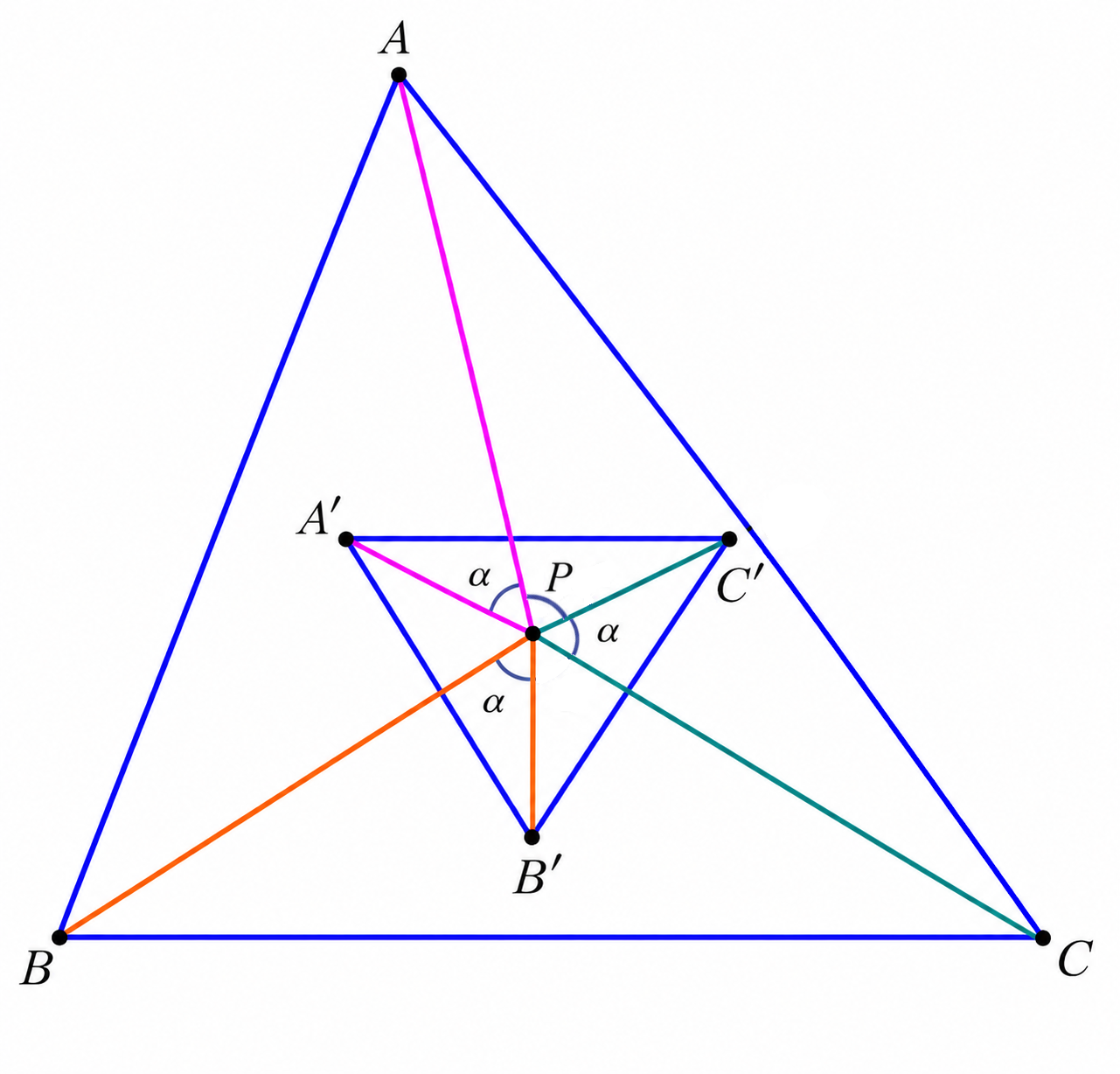
A direct spiral similarity centered at maps
All three vertices are rotated through the same directed angle, and their distances from are multiplied by the same positive factor.
1. Equal ratios
Here is the scaling factor.
2. Equal directed rotation angles
All three directed angles are measured with the same orientation.
3. Similar triangles
The transformation preserves angles and multiplies every length by the same factor. Hence
with corresponding sides satisfying
Important Observation
The fact that alone does not prove that a given point is their spiral similarity center. We must verify that the corresponding vertices are related by one common rotation angle and one common scaling factor about .
Indirect Spiral Similarity
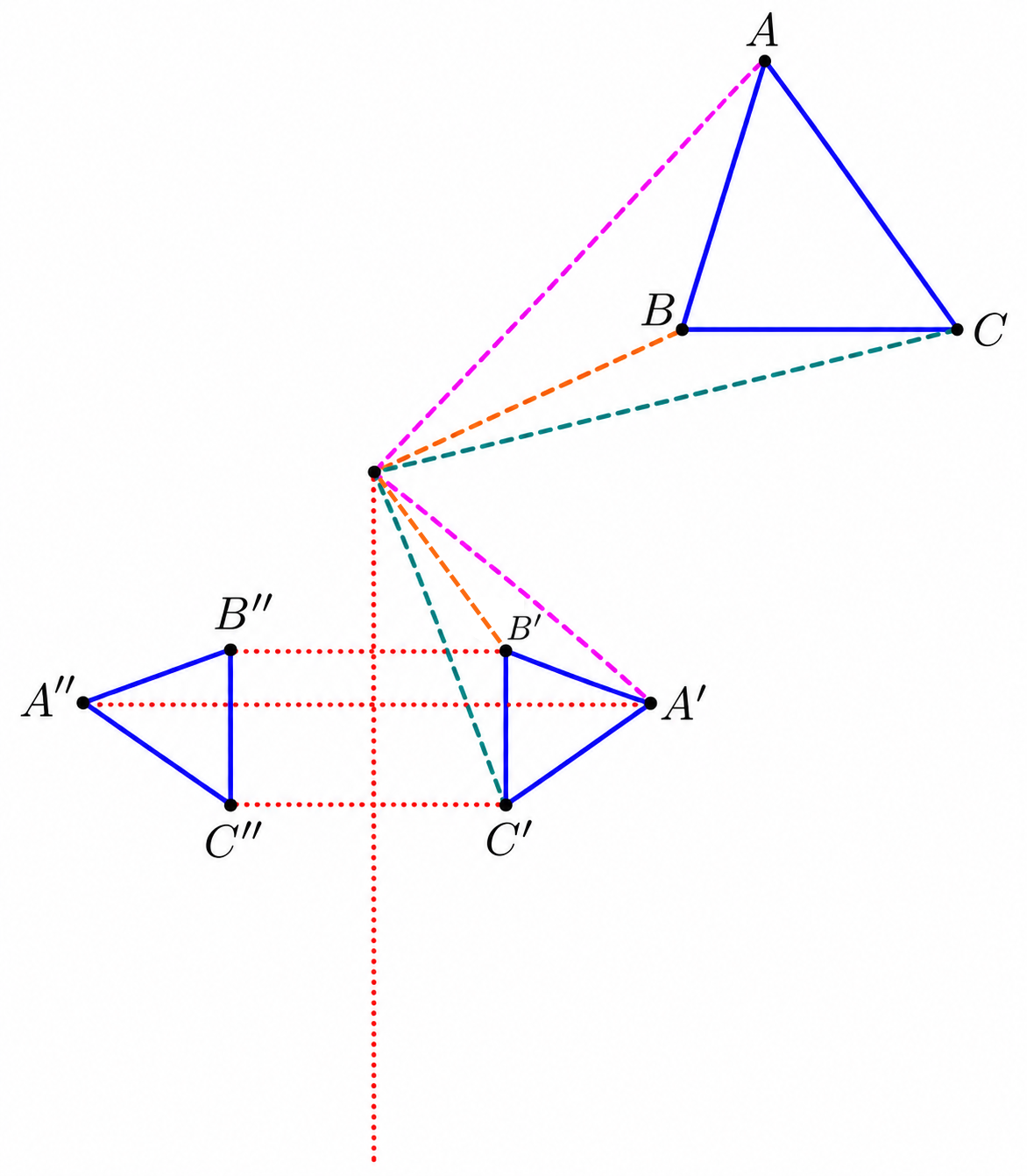
Consider triangles , , and , with as the fixed point. First, a direct spiral similarity centered at maps
Next, reflection across the dotted vertical line through maps
The composition is an indirect similarity fixing and mapping
This transformation reverses orientation while preserving shape.
1. Equal ratios
2. Reversed directed angles
Unlike direct similarity, indirect similarity reverses directed angles:
Corresponding angles have equal magnitudes but opposite orientations.
3. Similar triangles
with corresponding sides satisfying
Important Observation
An indirect similarity does not generally rotate all points through the same angle. Instead, it combines scaling, rotation, and reflection.
1. Direct similarity (orientation-preserving)
Here and is the center of similarity.
• Scaling factor:
• Rotation angle:
• Fixed point: , unique unless (in which case the map is the identity).
2. Indirect similarity (orientation-reversing)
Here and is a fixed point of the similarity.
• Scaling factor:
• Reflection axis through : a line making an angle with the positive real axis (modulo )
• Fixed point: (not necessarily unique).
If , then is the unique fixed point. If , the map is a reflection, and every point on its reflection axis is fixed.
The composition of two direct spiral similarities is another direct similarity. It need not have a fixed center: it can be a nontrivial translation.
Suppose the first similarity has rotation angle and scaling factor , while the second has rotation angle and scaling factor . Their composition has:
1. Rotation angle
2. Scaling factor
Important: The center of the resulting similarity is not necessarily the center of either original transformation. If the composition is a nontrivial translation, it has no fixed center.
Take any two distinct points . Suppose the first similarity maps
and the second maps
1. Scaling factor
Since the first transformation has scaling factor ,
Similarly, the second transformation has scaling factor , so
Therefore,
Hence the composition has scaling factor
2. Rotation angle
The first transformation rotates every directed segment through angle :
Similarly,
Adding these directed angles gives
Therefore, the composition has rotation angle
Both transformations preserve orientation, so their composition also preserves orientation. Thus, the composition is a direct similarity with the required scaling factor and rotation angle.
Important Observation
If and , the resulting transformation is either a translation or the identity. Otherwise, it has a unique fixed point and is a direct spiral similarity centered at that point.
The composition of two similarities is always another similarity. Its orientation depends on the orientations of the original transformations:
• Direct (+) followed by direct (+): Direct (+)
• Direct (+) followed by indirect (−): Indirect (−)
• Indirect (−) followed by direct (+): Indirect (−)
• Indirect (−) followed by indirect (−): Direct (+).
On sides and of triangle , construct externally the isosceles right triangles and , respectively, such that
If is the midpoint of , prove that triangle is an isosceles right triangle.
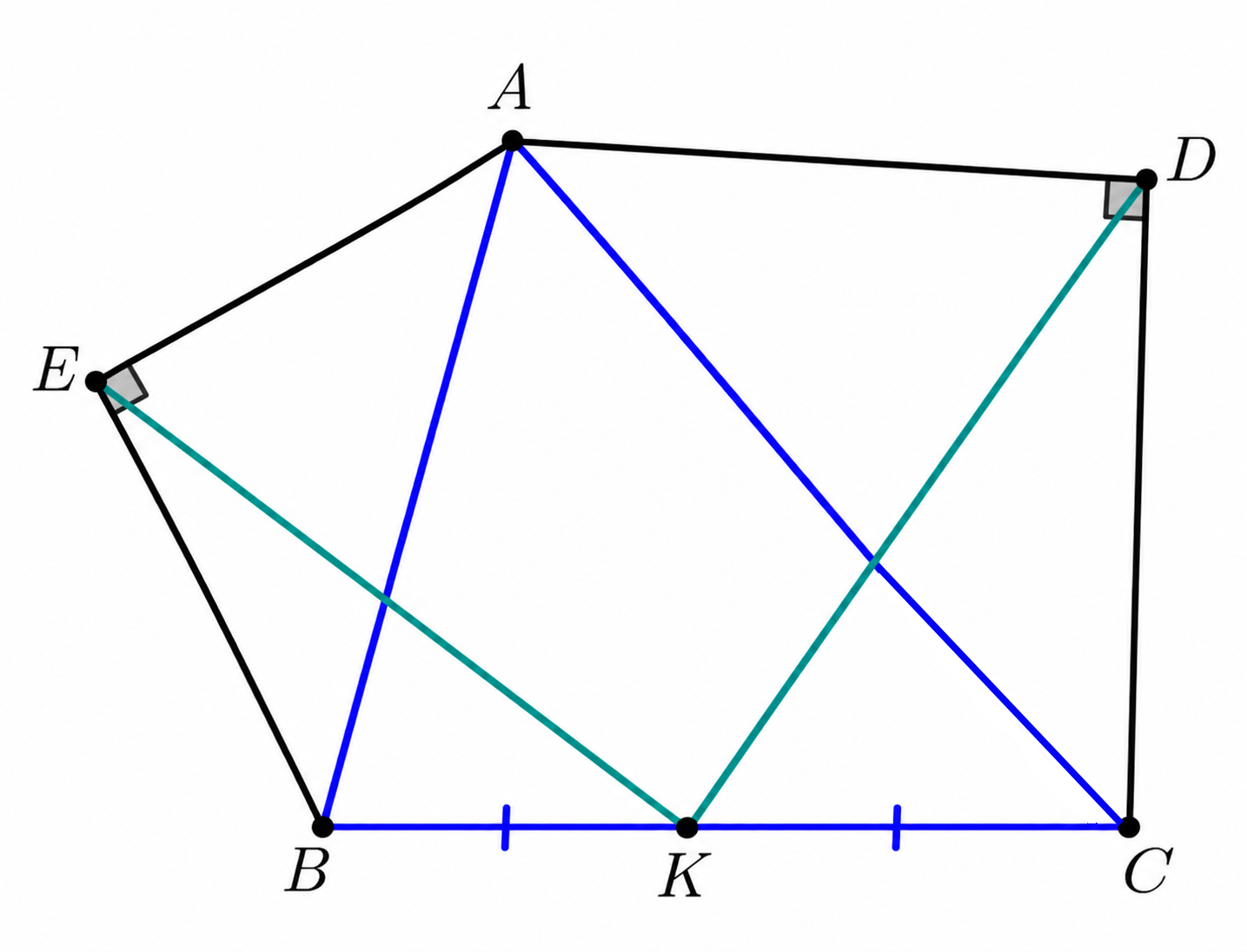
Construct an isosceles right triangle externally to triangle , such that
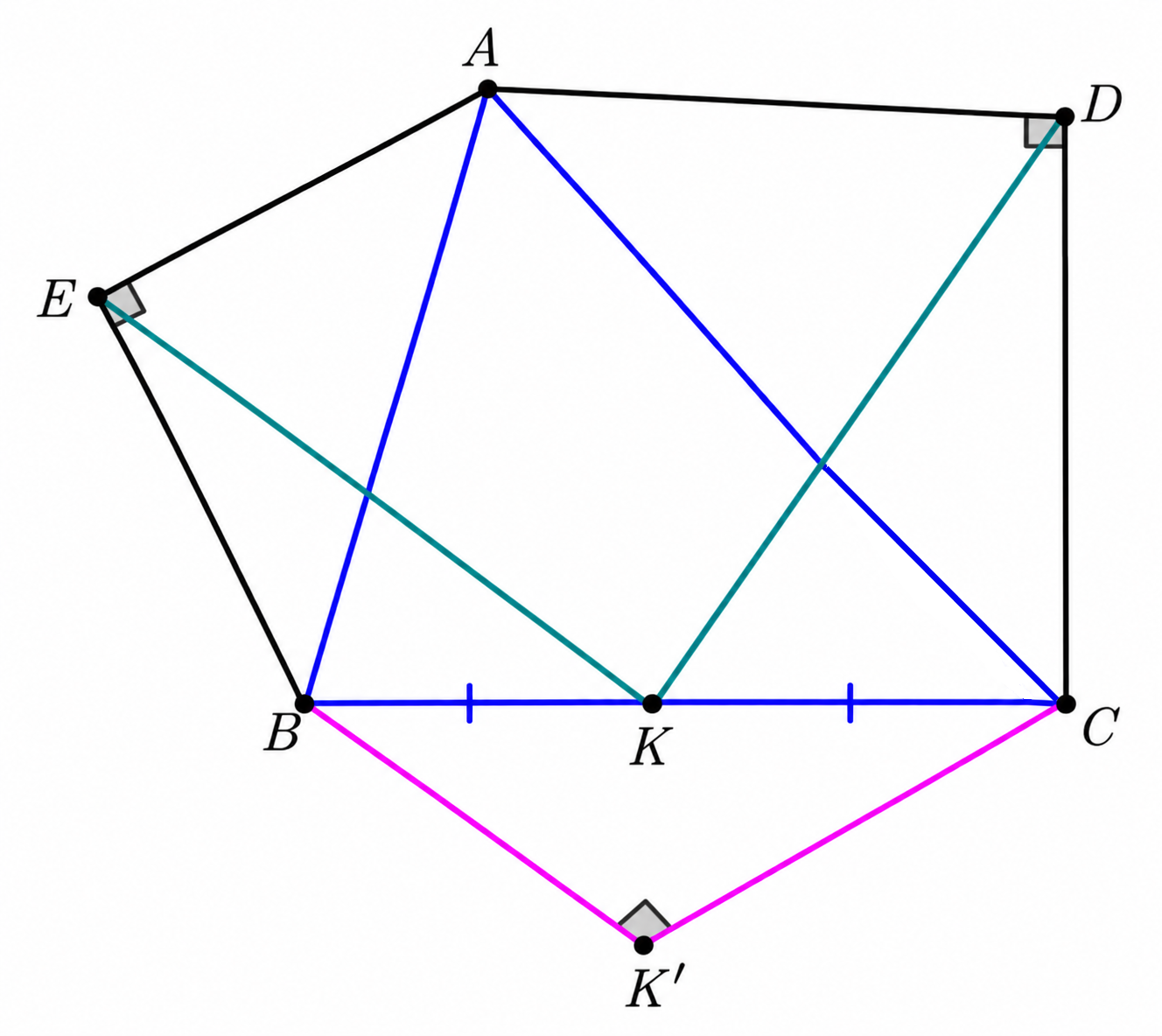
Consider a counterclockwise spiral similarity centered at , with rotation angle and scaling factor . Under this transformation,
Next, consider a counterclockwise spiral similarity centered at , with rotation angle and scaling factor . Under this transformation,
The composition of these two spiral similarities is itself a direct similarity. Its rotation angle is
and its scaling factor is
Thus, the composition is a counterclockwise rotation through mapping
To identify its center, observe that the same composition sends first to and then to , so it sends to , not to . Instead, use the explicit center formula for the two rotations/dilations, or equivalently the midpoint-vector relation below.
Let denote counterclockwise rotation through about the origin, and write points as vectors. Because the triangles are external and isosceles right triangles,
The signs depend on the orientation of the figure; in the displayed configuration these are the correct outward choices. With , direct subtraction gives
Therefore the composition rotating to is the counterclockwise quarter-turn about , and consequently
Hence triangle is an isosceles right triangle.
On sides and of triangle , construct externally two isosceles right triangles and , such that
On side , construct an isosceles right triangle , with and lying on the same side of , such that
Prove that are the vertices of an isosceles right triangle.
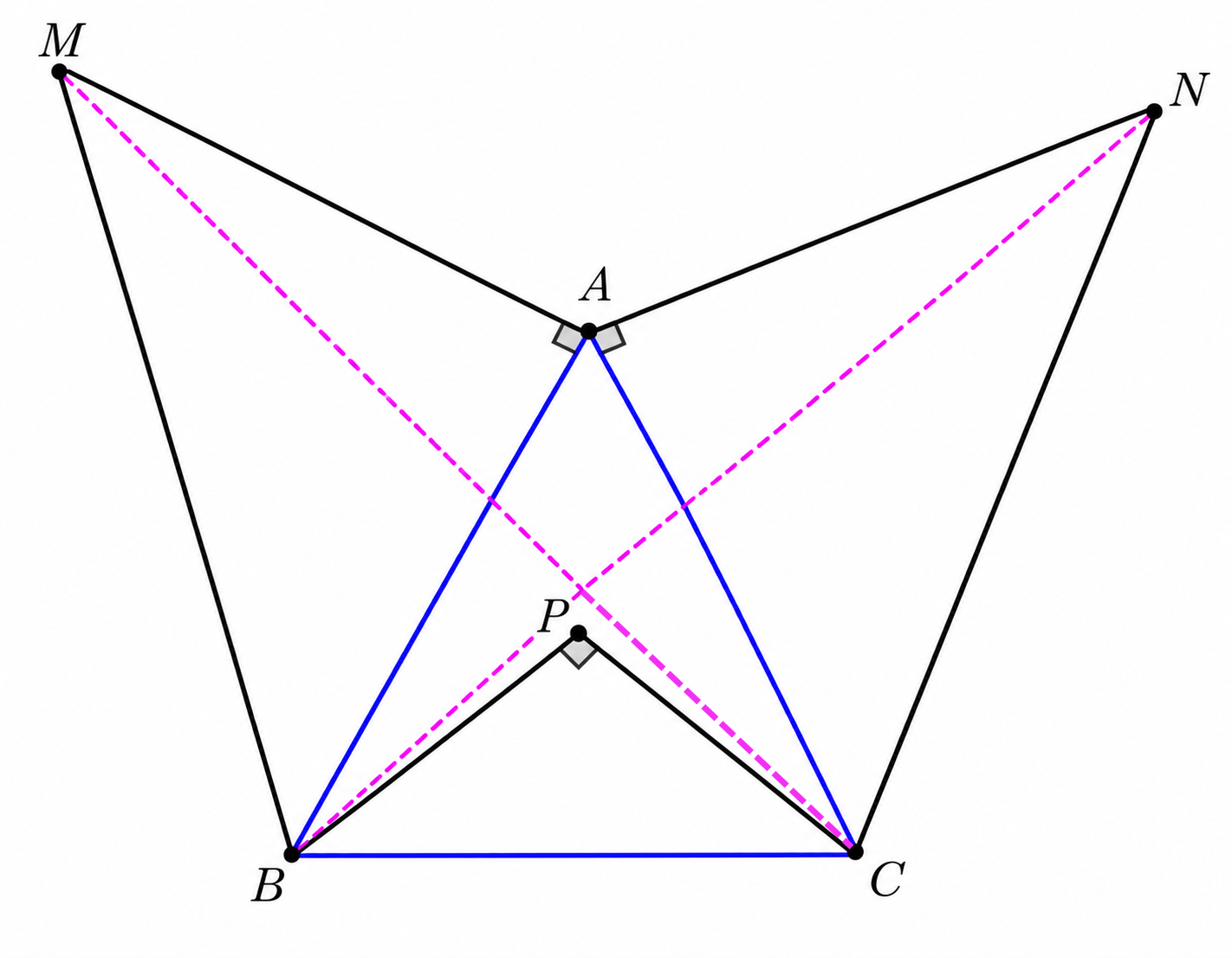
Consider a counterclockwise rotation of about . Under this rotation,
Therefore, segment is mapped to segment . Consequently,
Now consider a counterclockwise rotation of about . Because and , this rotation maps to . Since and the directed segments and differ by a counterclockwise quarter-turn, the image of is .
Therefore are vertices of an isosceles right triangle. In particular,
A point lies inside square . Its distances from vertices are , respectively. Find the area of square .
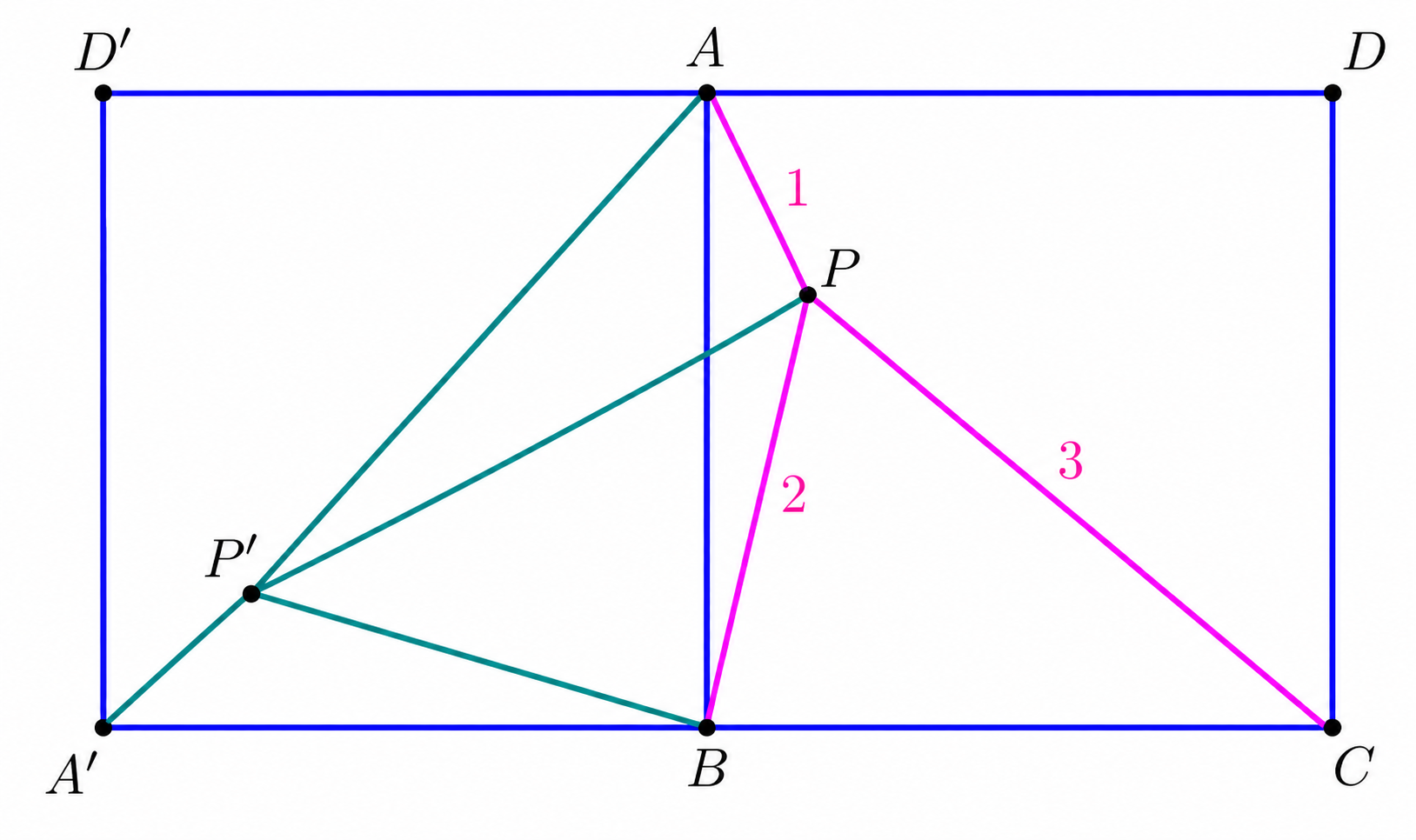
Rotate points counterclockwise through about . They are mapped to , respectively.
Then triangle is an isosceles right triangle, and
Since
the converse of the Pythagorean theorem shows that is right-angled at . We also know
Consequently, from the configuration,
Applying the Law of Cosines in triangle , we obtain
Thus,
Therefore, the area of square is