Circumcenters and Perpendicular Bisectors
Lesson · Intermediate
Geometry
Perpendicular Bisector Theorem
For two distinct points and , a point lies on the perpendicular bisector of segment if and only if
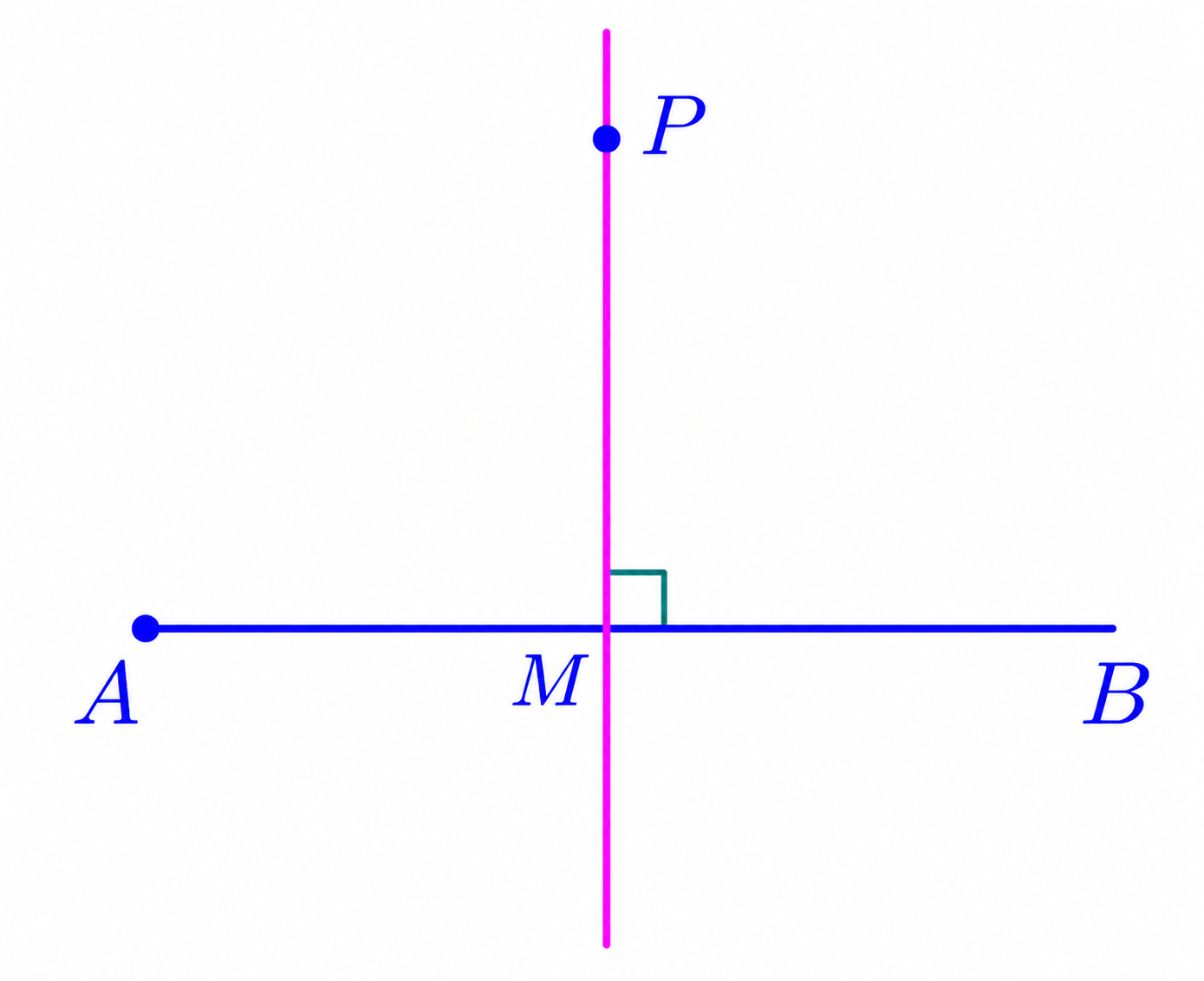
Here is the midpoint of . Thus if and only if , provided .
Circumcenter and Circumcircle
The perpendicular bisectors of the three sides of a nondegenerate triangle are concurrent at a point , called the circumcenter.
Since lies on all three perpendicular bisectors,
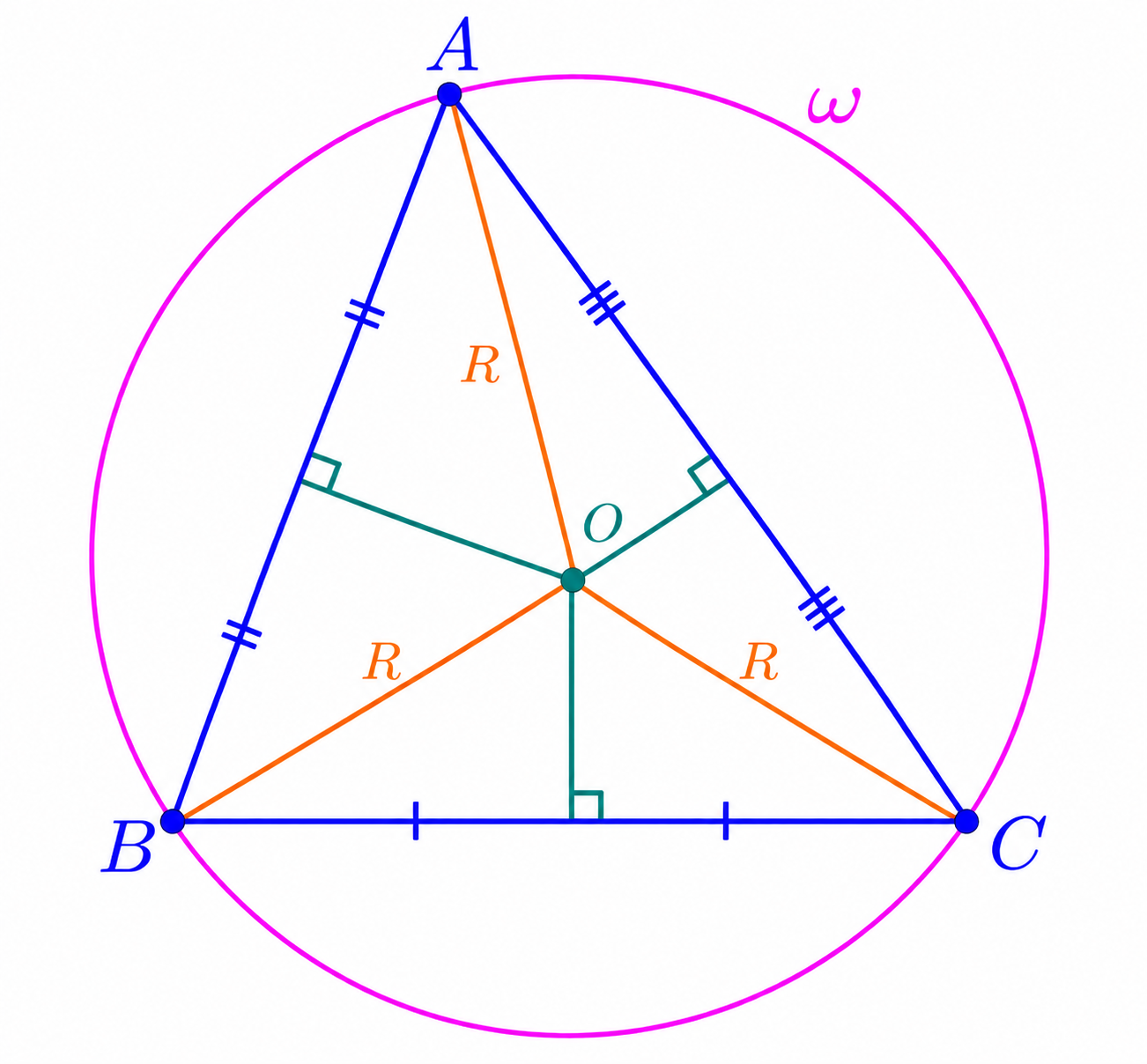
The circle with center and radius passes through all three vertices and is called the circumcircle.
The radius is called the circumradius.
Location of the Circumcenter
The circumcenter’s location depends on the type of triangle.
• Acute triangle: Inside the triangle.
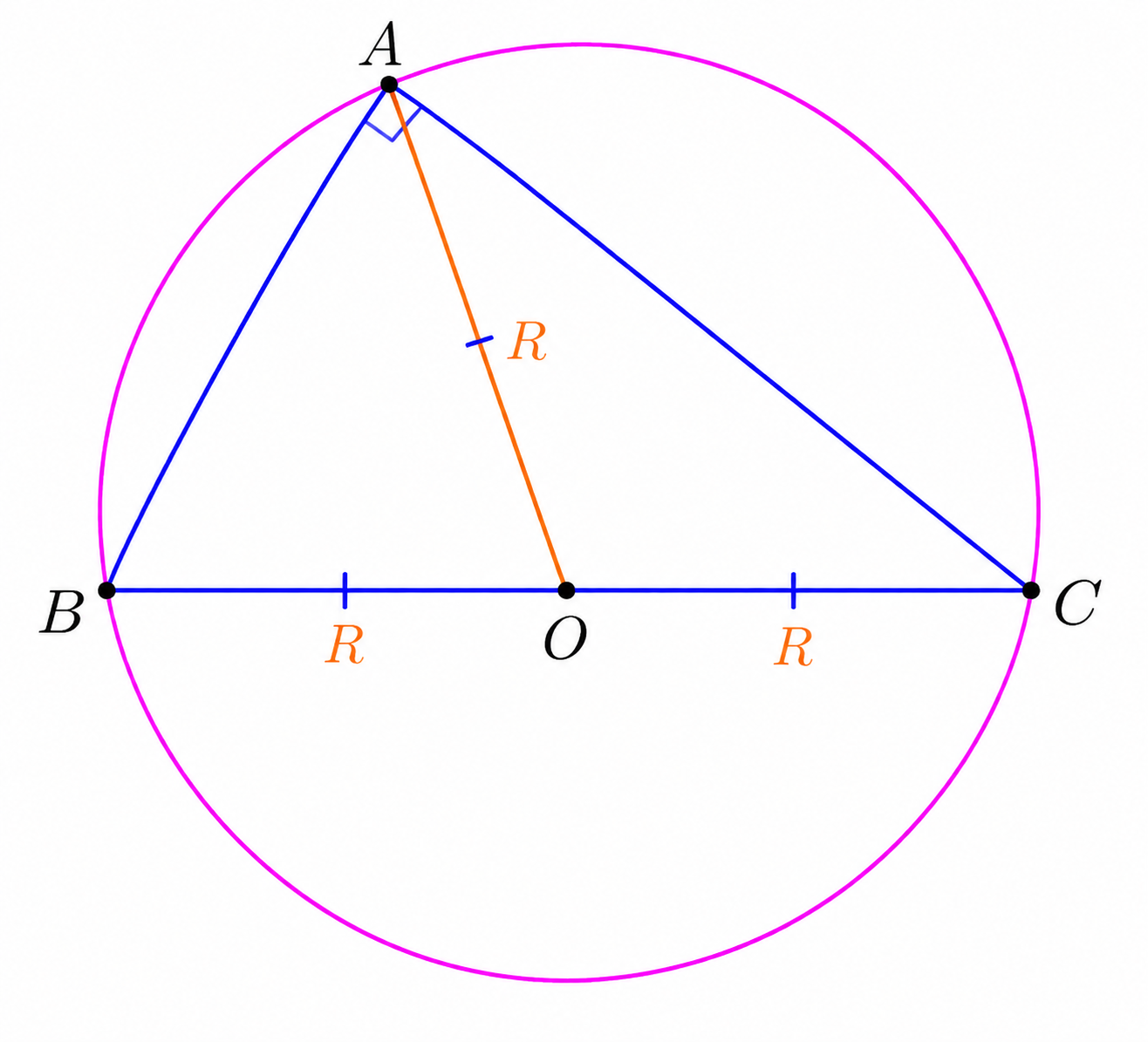
• Right triangle: At the midpoint of the hypotenuse.
• Obtuse triangle: Outside the triangle.
Angle Relations
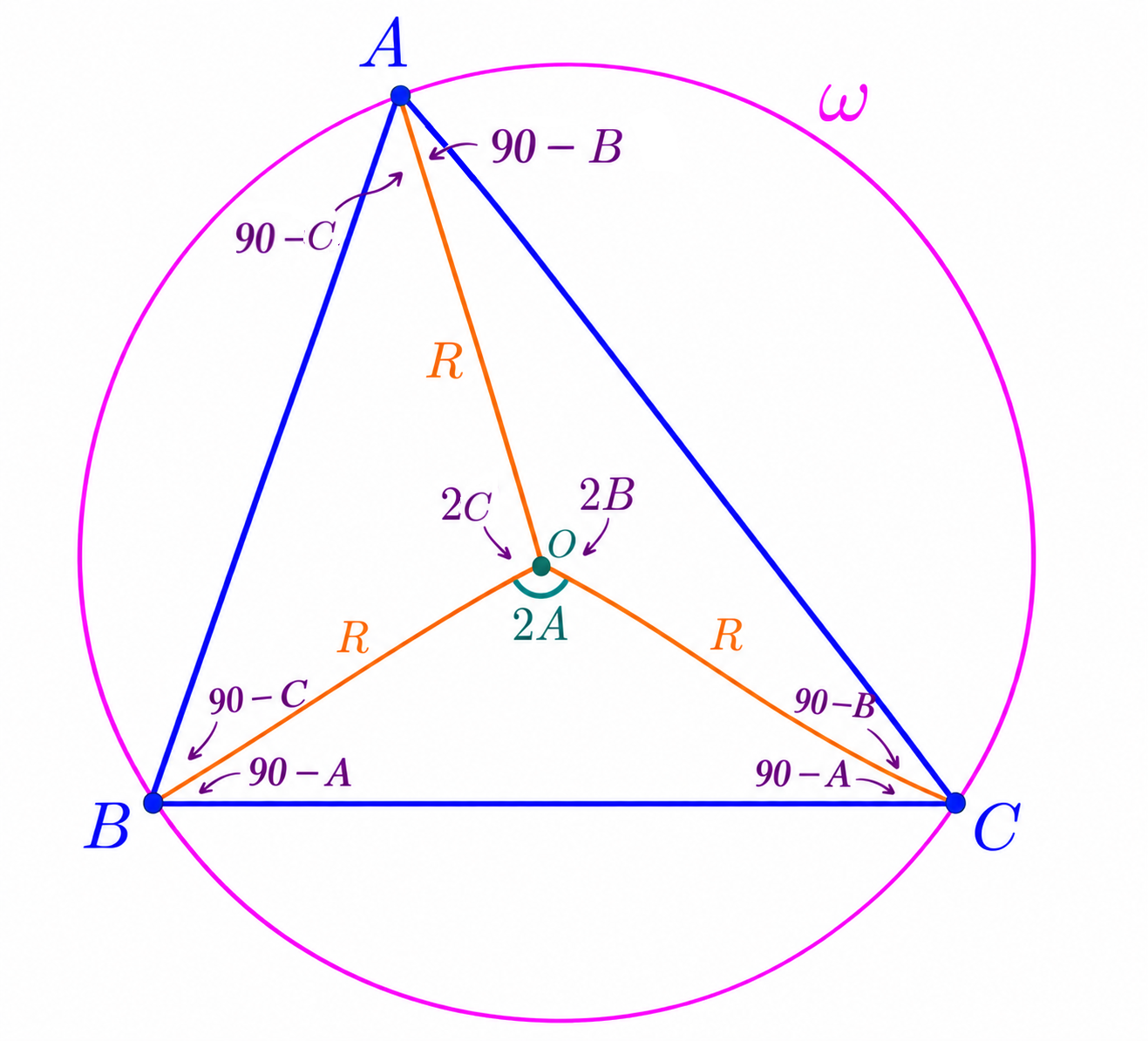
For an acute triangle:
For an obtuse triangle:
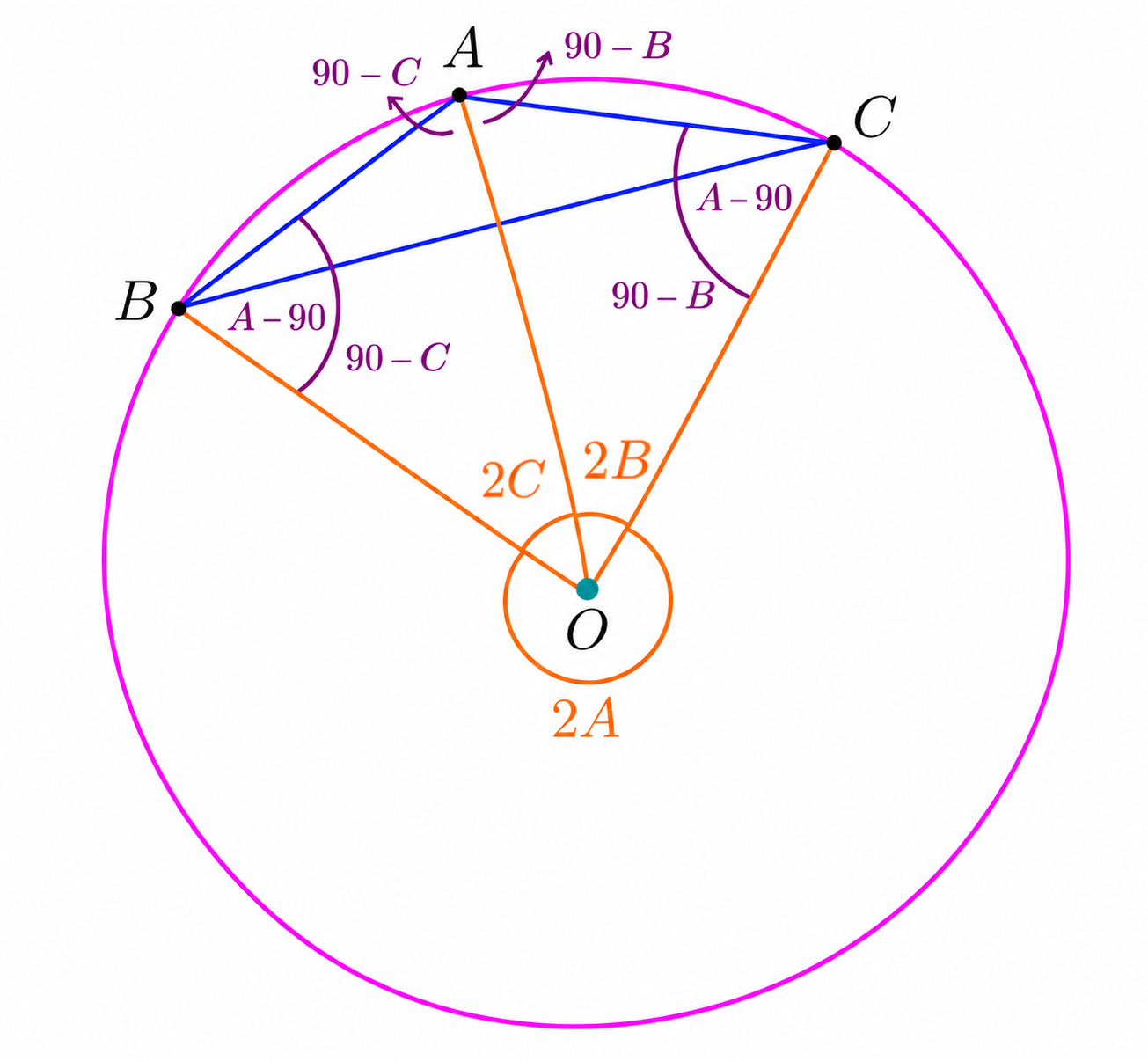
For the ordinary (non-reflex) central angle, the formula depends on whether is acute or obtuse.
The reflex angle subtended by arc not containing is when .
Circumradius Formula and Distance from the Circumcenter to a Side
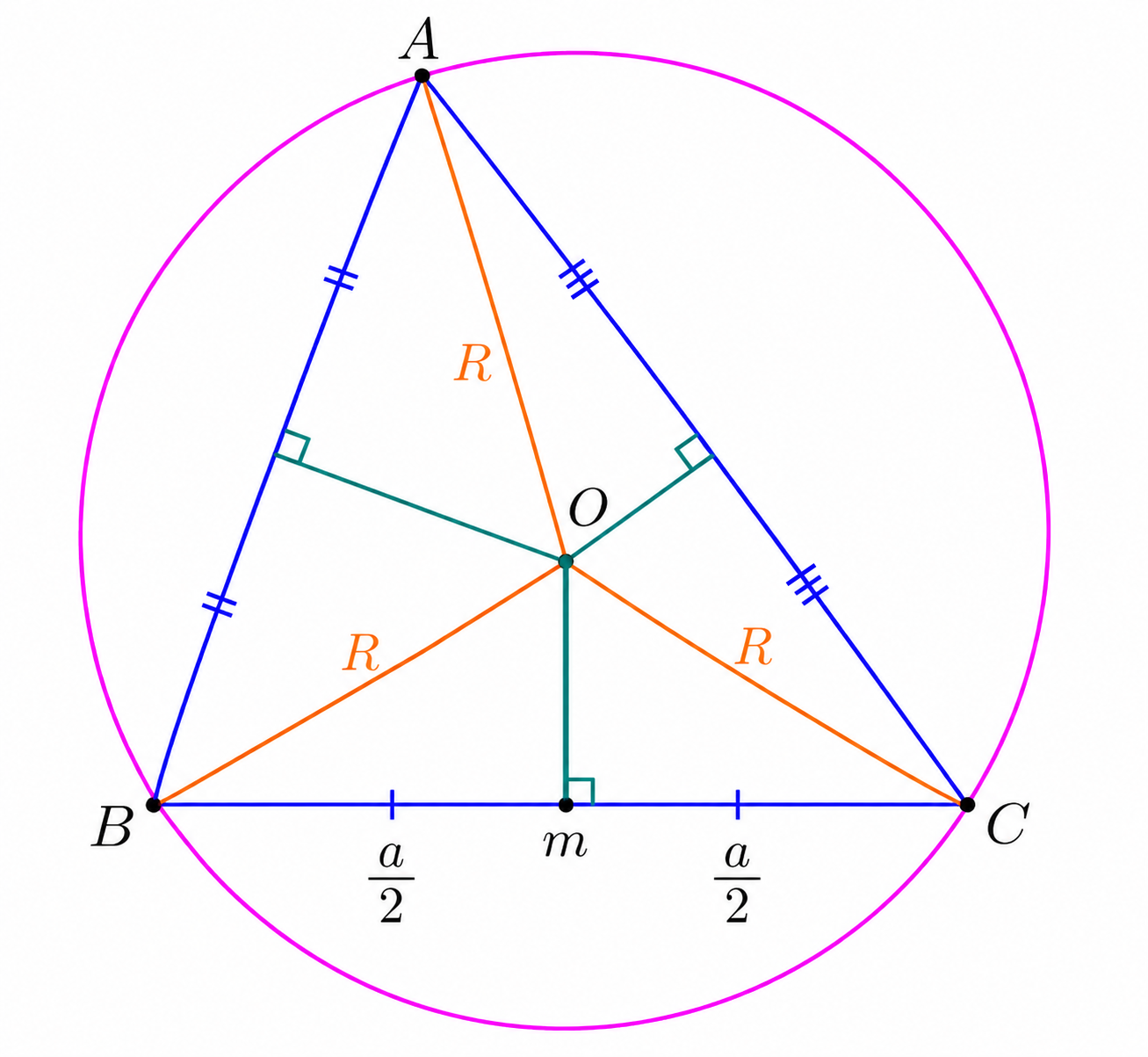
If is the midpoint of , then the distance from to the line is
() Suppose lies on the perpendicular bisector of , meeting at . Then , , and .
so .
() Suppose . Let be the midpoint of . Since and ,
Thus . These angles are supplementary, so both equal . Hence , and lies on the perpendicular bisector.
Concurrency
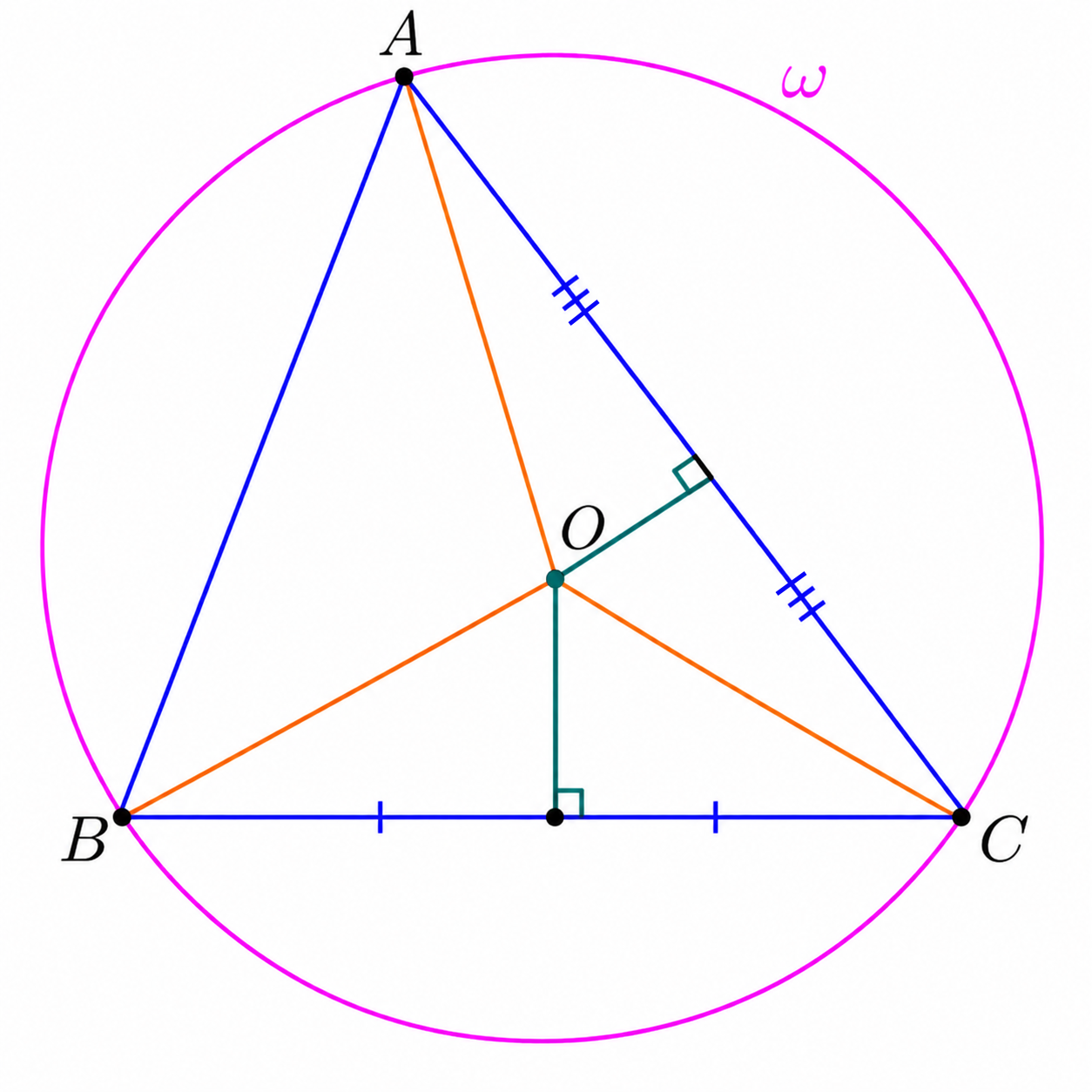
Draw the perpendicular bisectors of and , and let them intersect at . We must prove that also lies on the perpendicular bisector of .
Since lies on the perpendicular bisector of ,
Since lies on the perpendicular bisector of ,
Therefore,
By the converse of the perpendicular bisector theorem, lies on the perpendicular bisector of . Thus all three perpendicular bisectors are concurrent at , and
For an acute triangle:
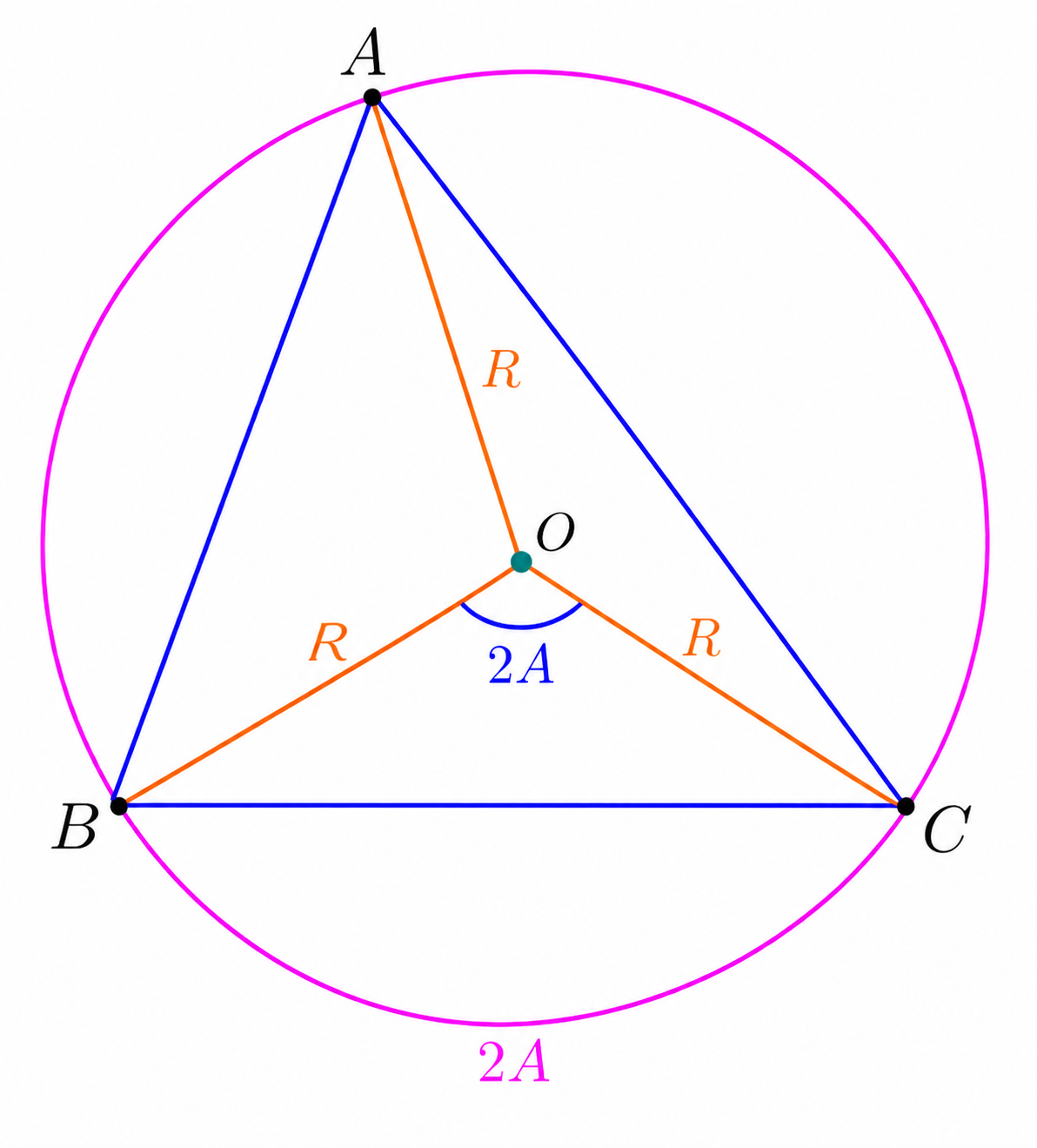
By the inscribed angle theorem, the minor arc has measure when . Hence
In isosceles triangle , , so
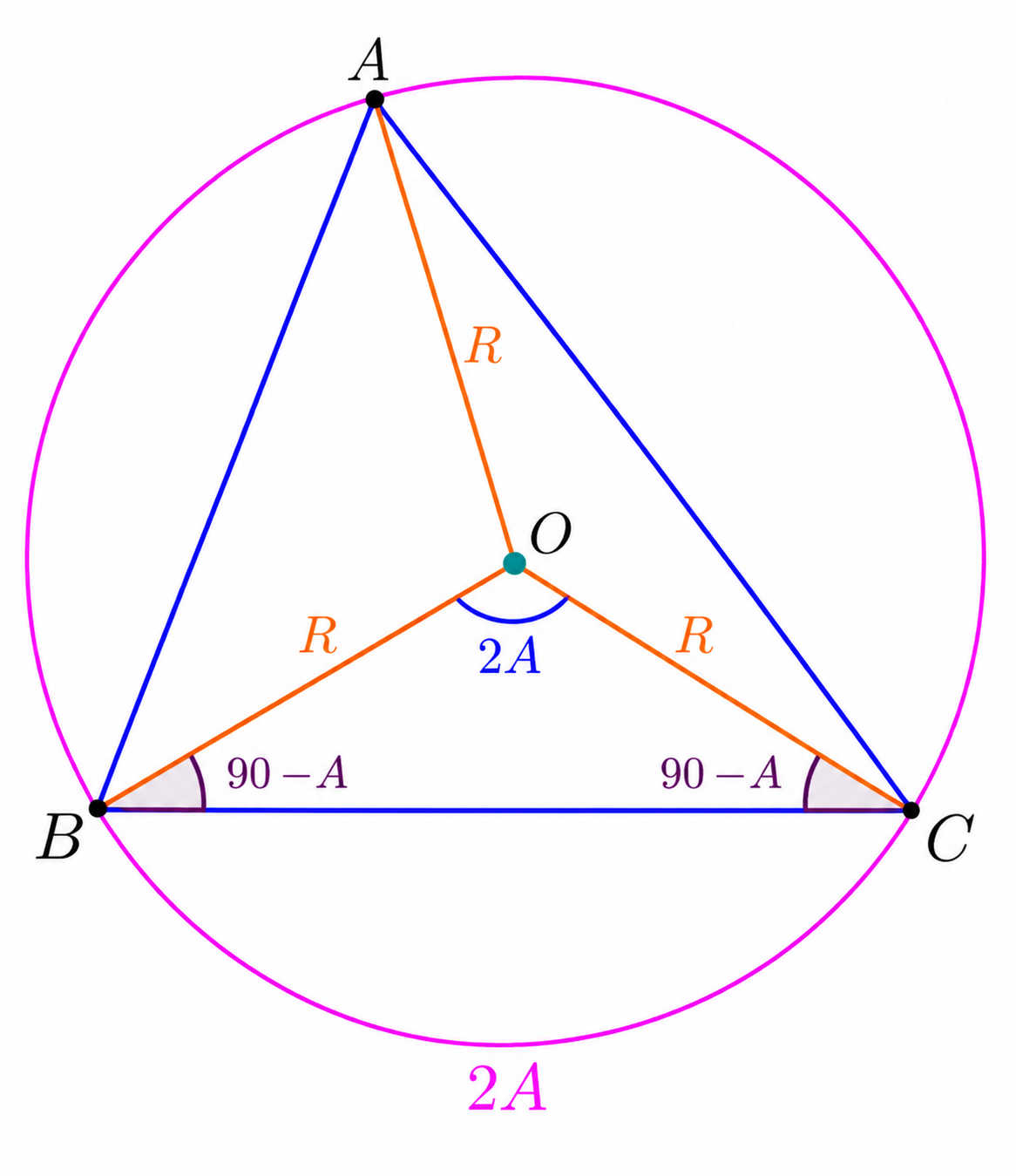
Similarly, the minor arcs and have measures and , respectively, when the corresponding angles are acute.
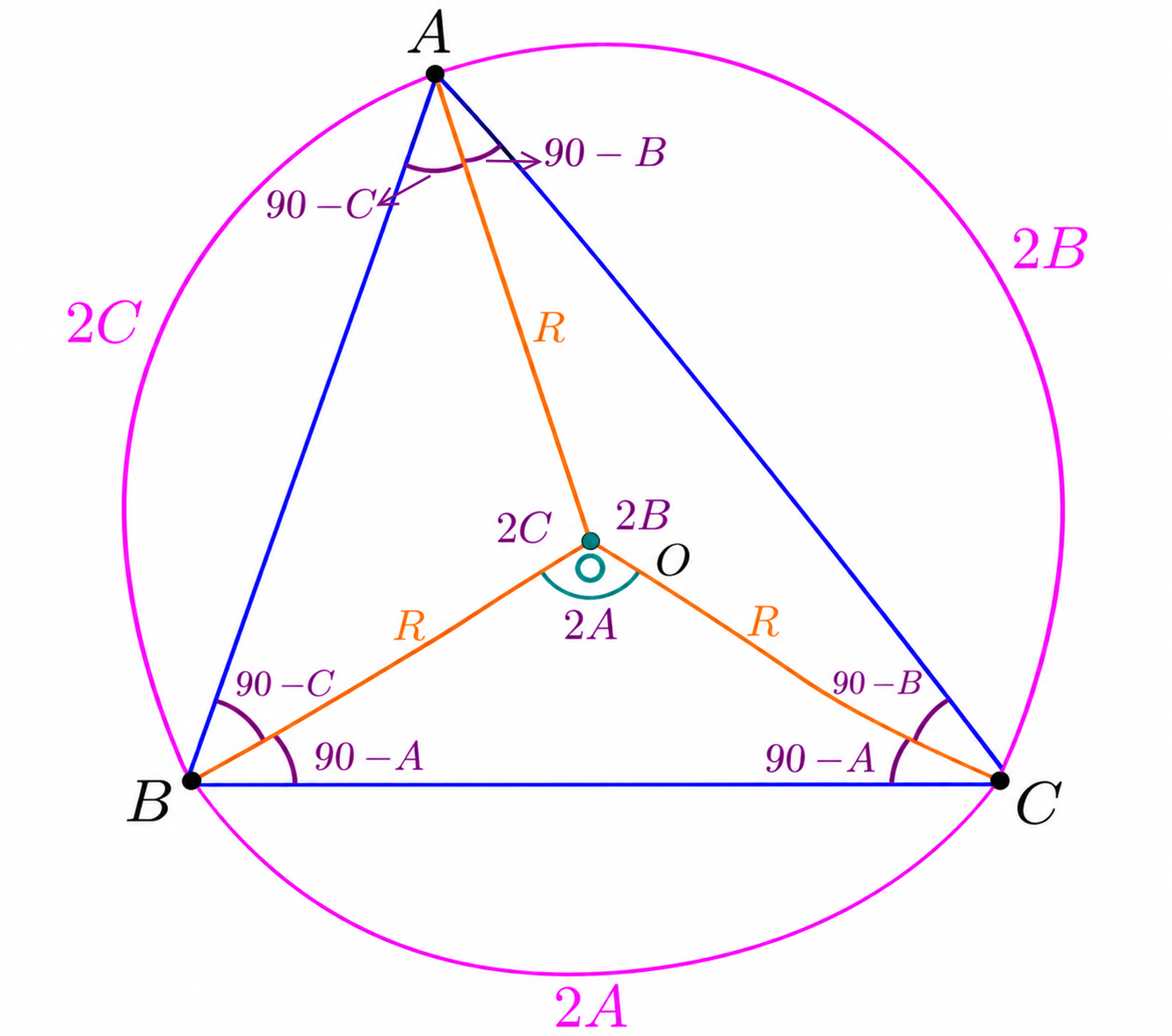
For an obtuse triangle, suppose . The arc not containing is the major arc , so
Therefore the reflex angle is , while the ordinary smaller angle is
Similarly, because ,
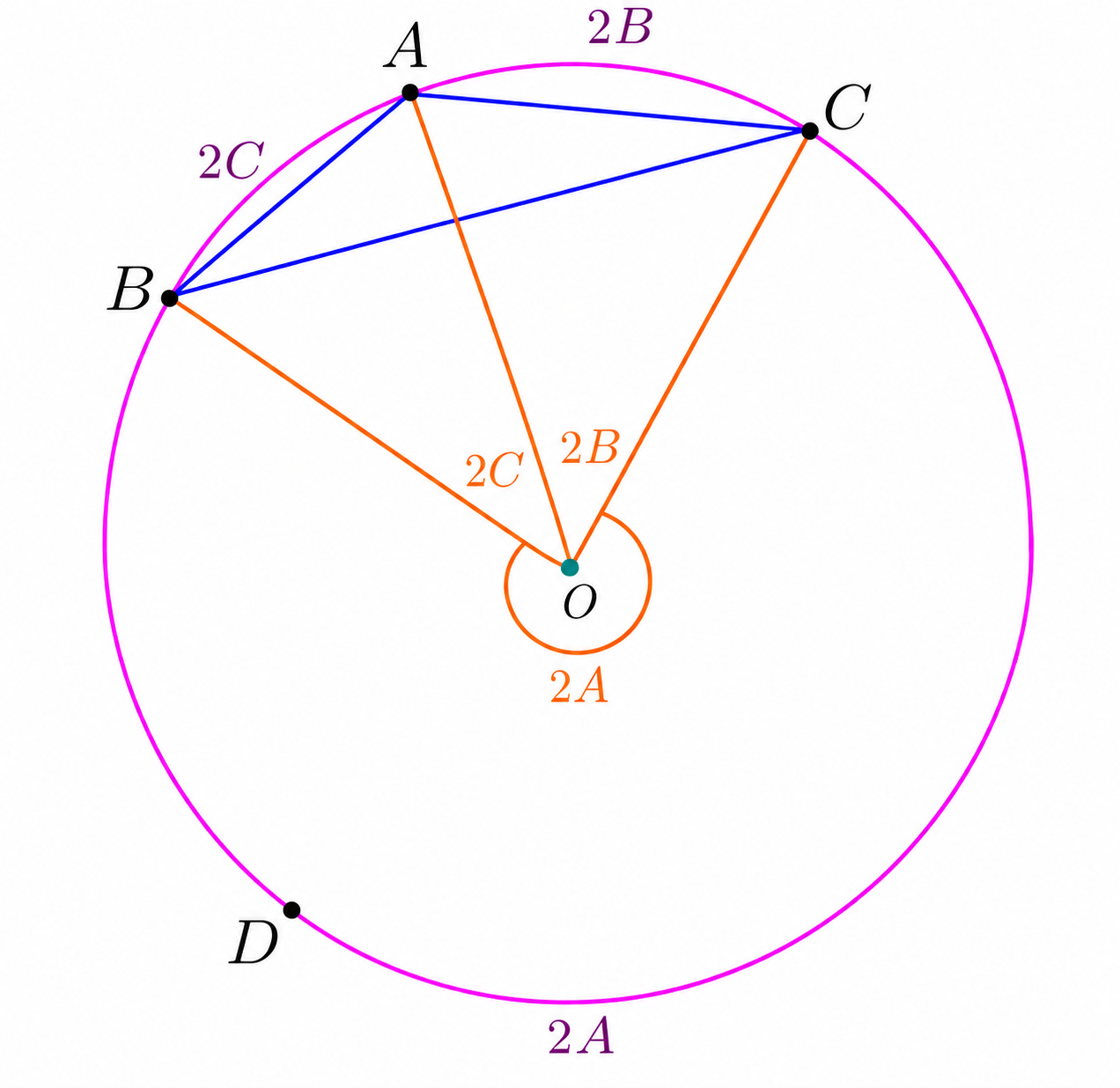
In isosceles triangle ,
In isosceles triangles and ,
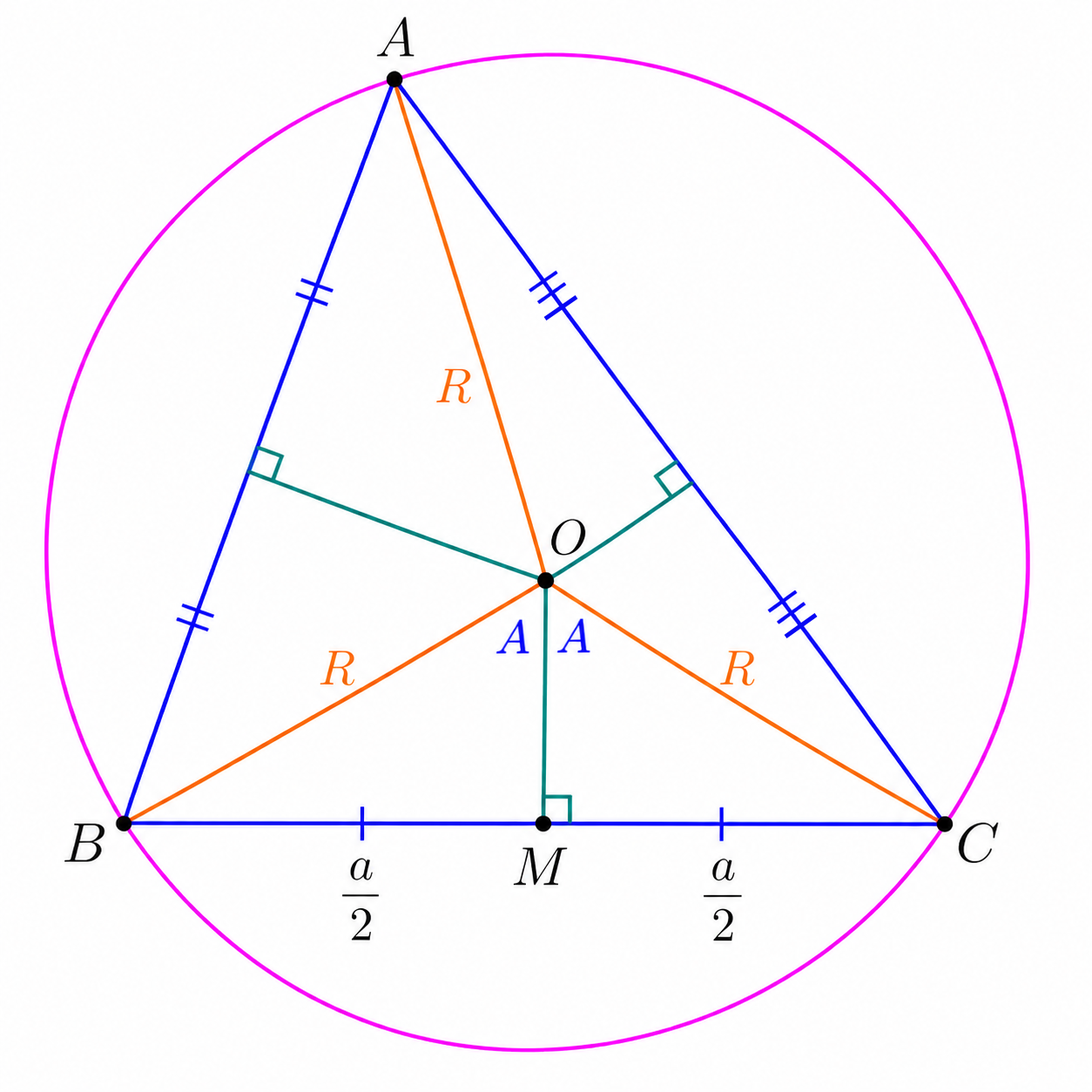
For the illustrated acute triangle, and . Since , we have .
In right triangle ,
Thus
Similarly,
Since , we obtain
In right triangle ,
for acute . Also, by the Pythagorean theorem,
For obtuse , but is a nonnegative distance. Therefore the general formula is
In triangle , prove that if is acute, where is the orthocenter, the circumcenter, and the midpoint of .
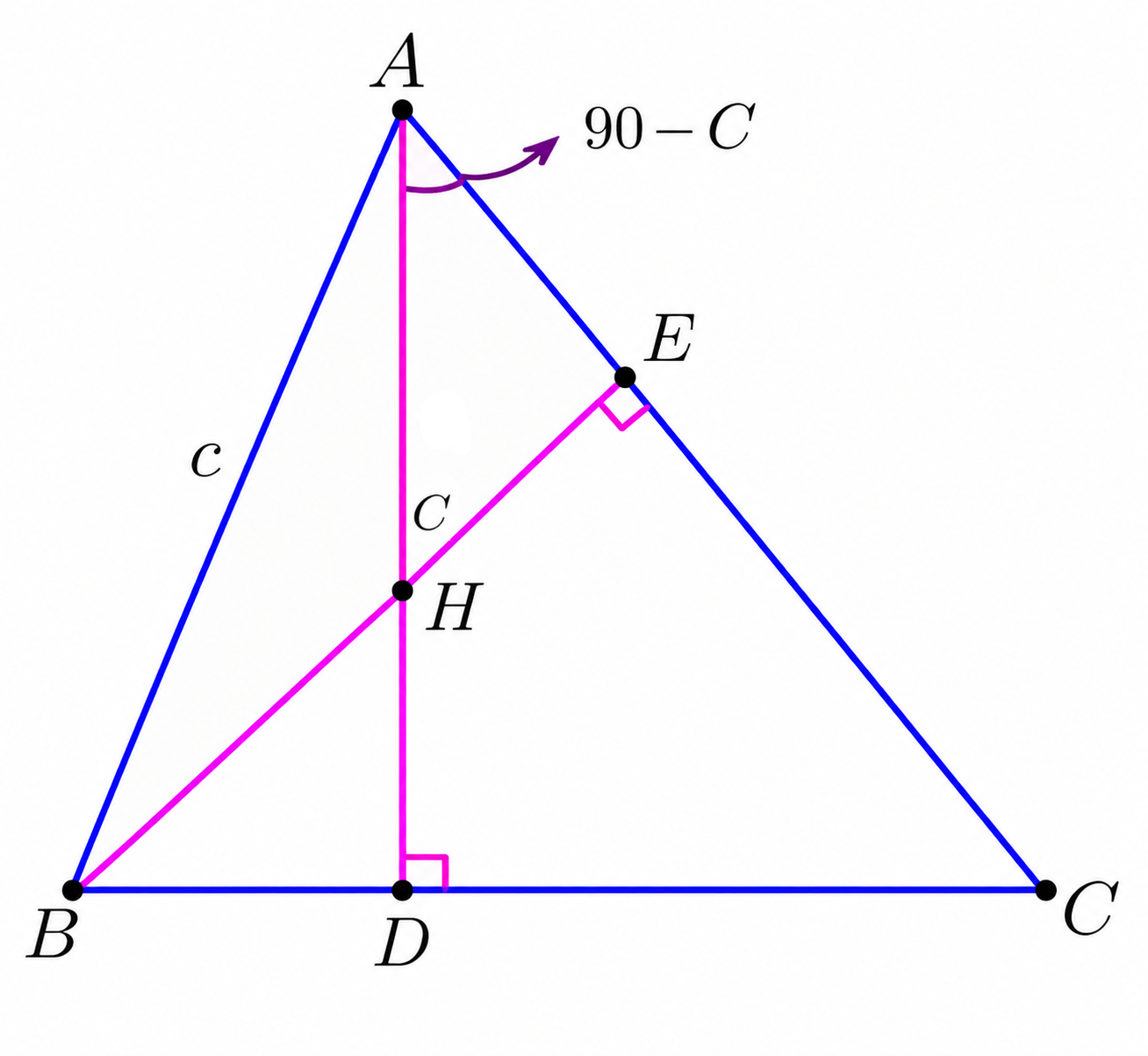
Let and , with .
In right triangle ,
In right triangle ,
Therefore,
In right triangle ,
By (1) and (2),
By the law of sines in triangle ,
We know that
By (3) and (4),
A triangle has side lengths , , and . Find its circumradius and the distance from its circumcenter to the side of length .
Let be a triangle with circumcenter . Suppose
Find the circumradius, the distance from to , and .
Since is obtuse, the ordinary central angle is
By the extended law of sines,
The distance from to is
The circumcenter is the midpoint of the hypotenuse.
If , then
In particular, the midpoint of the hypotenuse is equidistant from all three vertices.
For an equilateral triangle of side length , the circumcenter, incenter, centroid, and orthocenter coincide.
The circumradius is
The circumcenter lies outside the triangle, on the opposite side of the longest side from the obtuse vertex.
If , then
where is the midpoint of .
For
the circumcenter satisfies
Subtracting the squared-distance equations gives a linear system:
The circumcenter is inside an acute triangle, at the midpoint of the hypotenuse of a right triangle, and outside an obtuse triangle.
Incorrect as a general formula:
Correct for every nondegenerate triangle:
The relation
does not always hold for the ordinary, smaller central angle.
If , then
Three noncollinear points determine exactly one circle.
If three distinct points are collinear, no circle passes through all three.