Cross Sections in 3D Geometry
Lesson · Intermediate
Geometry: Solid Geometry
In many 3D geometry problems, one of the most useful approaches is to consider cross sections from different directions.
A cross section is the 2D figure formed when a plane intersects a 3D solid.
The key strategy is:
Choose a plane that contains the important points, lines, or lengths in the problem.
Instead of working directly in three dimensions, look for a cross section where you can use familiar 2D tools such as:
• Pythagorean Theorem
• similar triangles
• triangle area
• circle geometry
• trigonometry
• coordinate geometry
Different cross sections may reveal different information, so it can be useful to consider the solid from more than one direction.
For solids with an axis of symmetry, a plane through the axis is often the most useful choice.
A plane through the axis gives a rectangle with dimensions 2r × h
A plane through the axis gives an isosceles triangle with base 2r and height h
The slant height l appears directly in this triangle:
Every plane through the center gives a circle of radius R.
For a cylinder, a plane perpendicular to the axis gives a circle.
For a cone, it also gives a circle, but its radius depends on the height.
Similar triangles then become very useful.
If a cone has height H, base radius R, and a cross section at distance x from the apex has radius r, then
A right circular cone has radius 5 and height 12. Find its slant height.
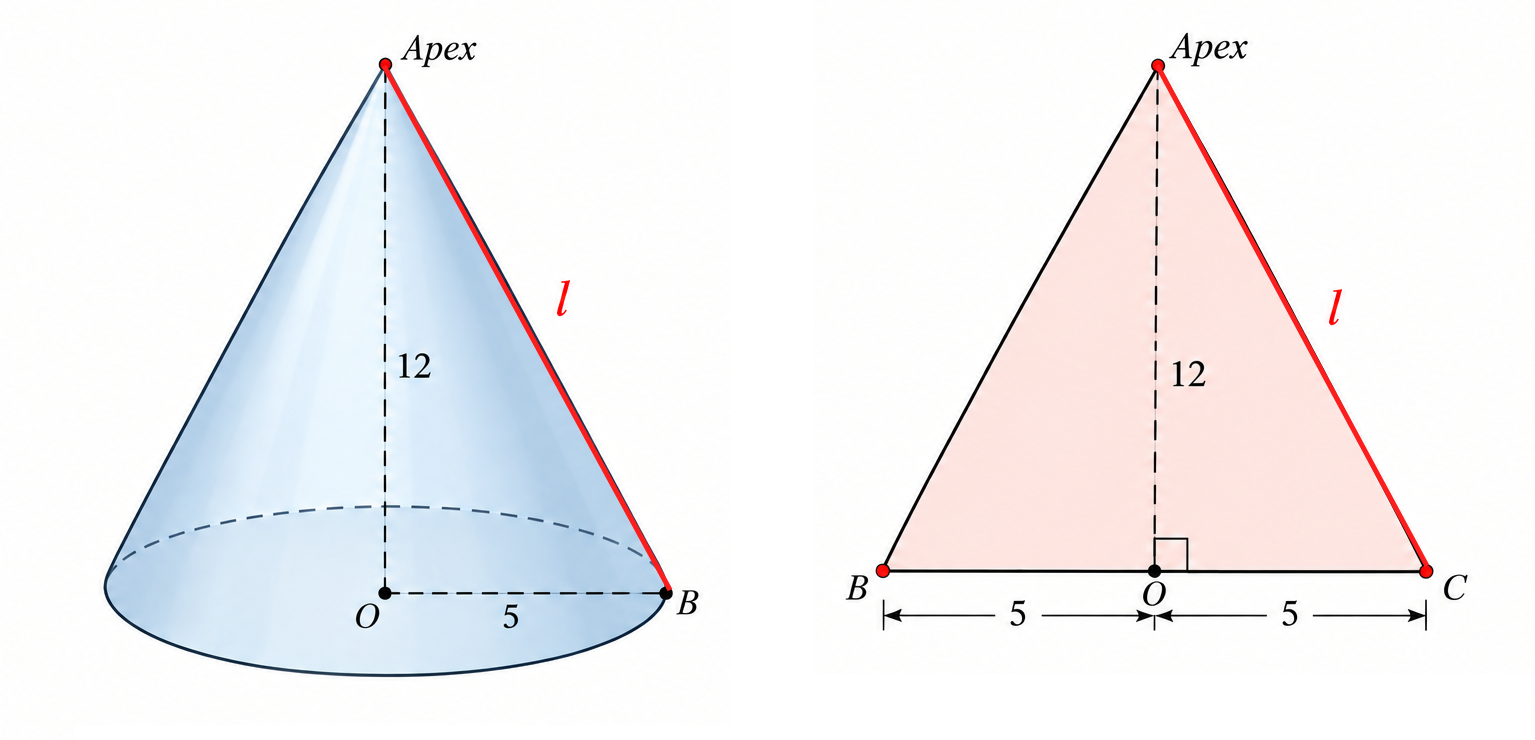
Take a plane through the axis of the cone.
The cross section is an isosceles triangle.
Half of it is a right triangle with legs 5, 12 and hypotenuse l.
Therefore,
so
A sphere has radius 13. A plane is 5 units from the center of the sphere.
Find the area of the circular cross section.
Take a plane through the center of the sphere and perpendicular to the cutting plane.
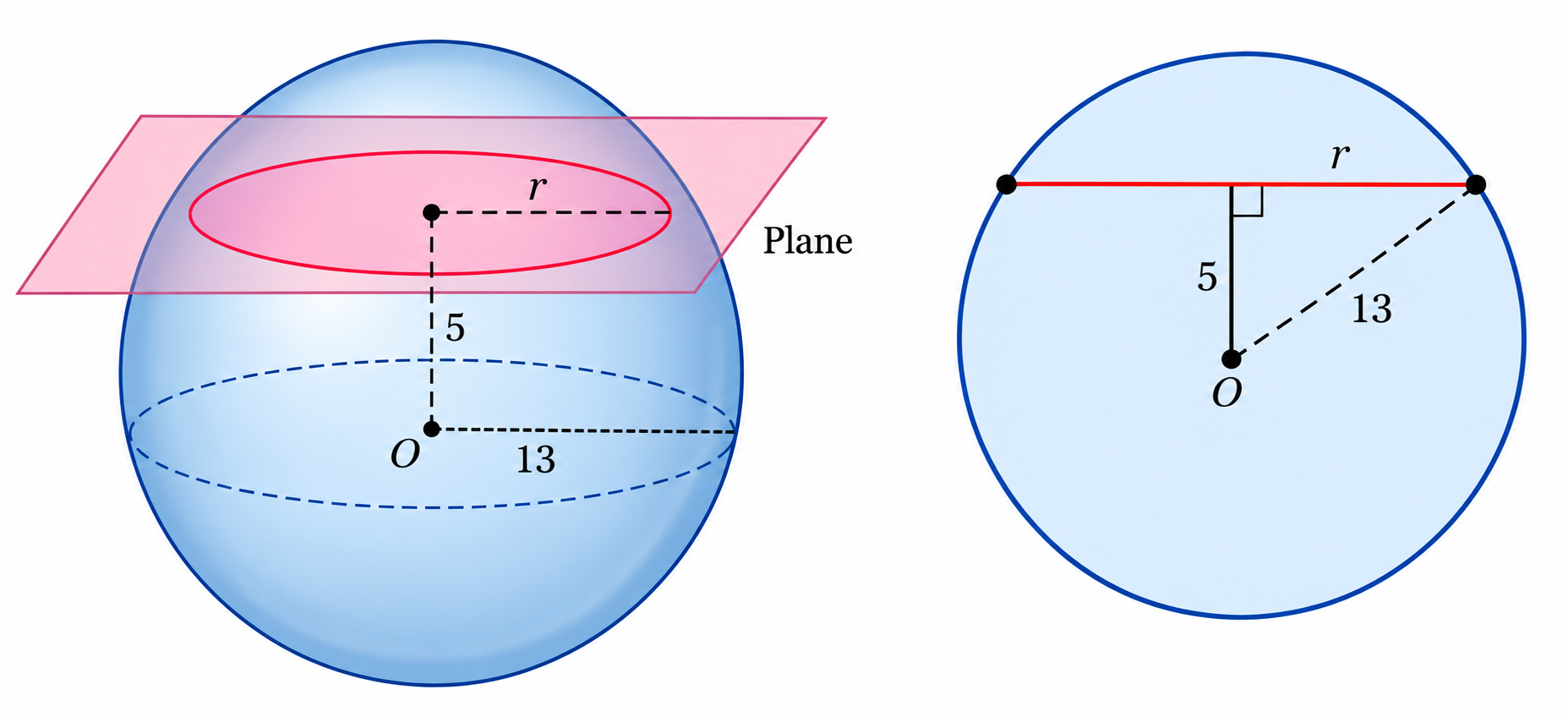
The relevant cross section gives a right triangle with hypotenuse 13, one leg 5, and the other leg r.
Thus
so
and
Therefore the area of the circular cross section is