Ellipses
Lesson · Intermediate
Geometry: Coordinate Geometry
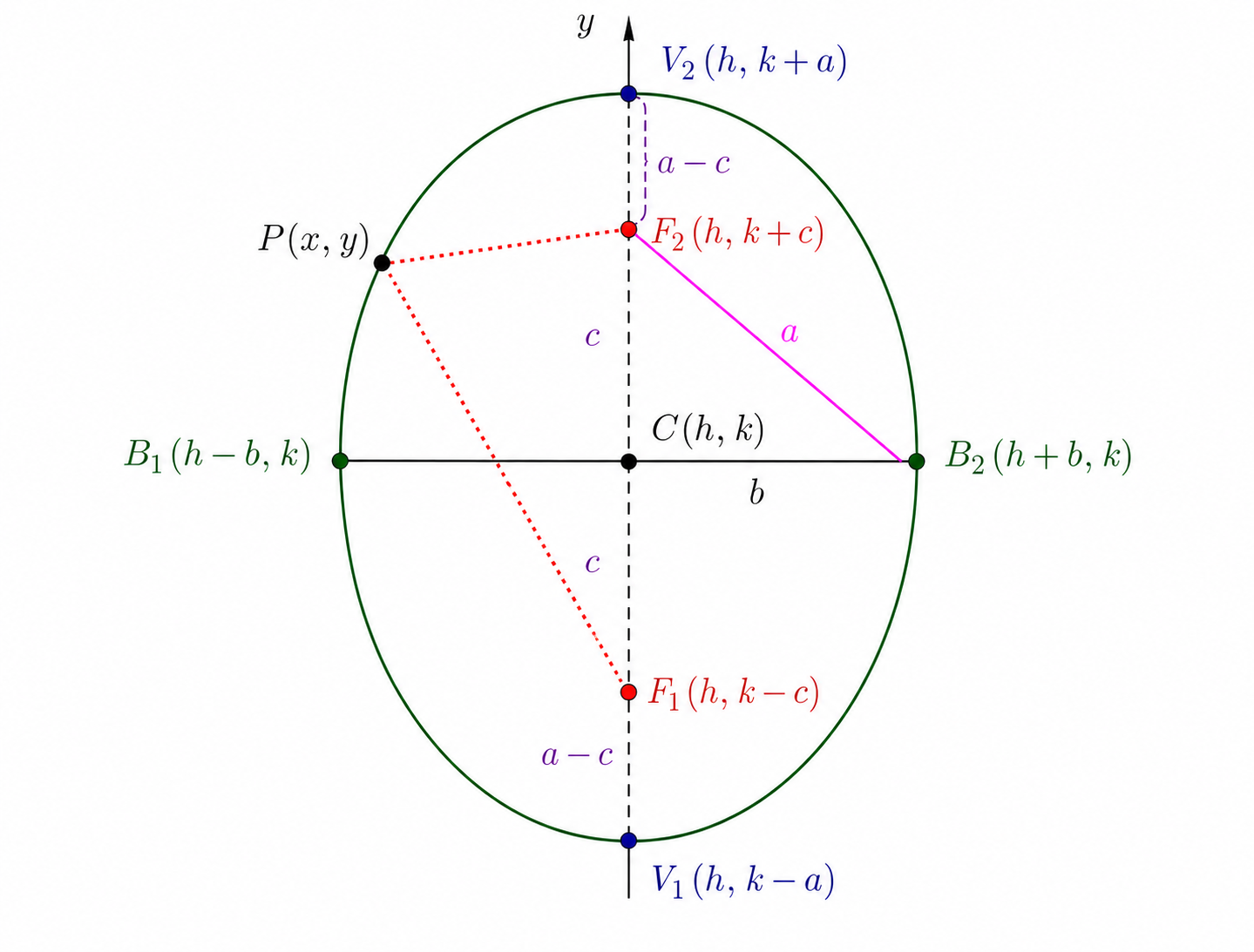
An ellipse is the set of points P in the plane such that the sum of the distances from two fixed points (the foci) is constant.
Horizontal Major Axis
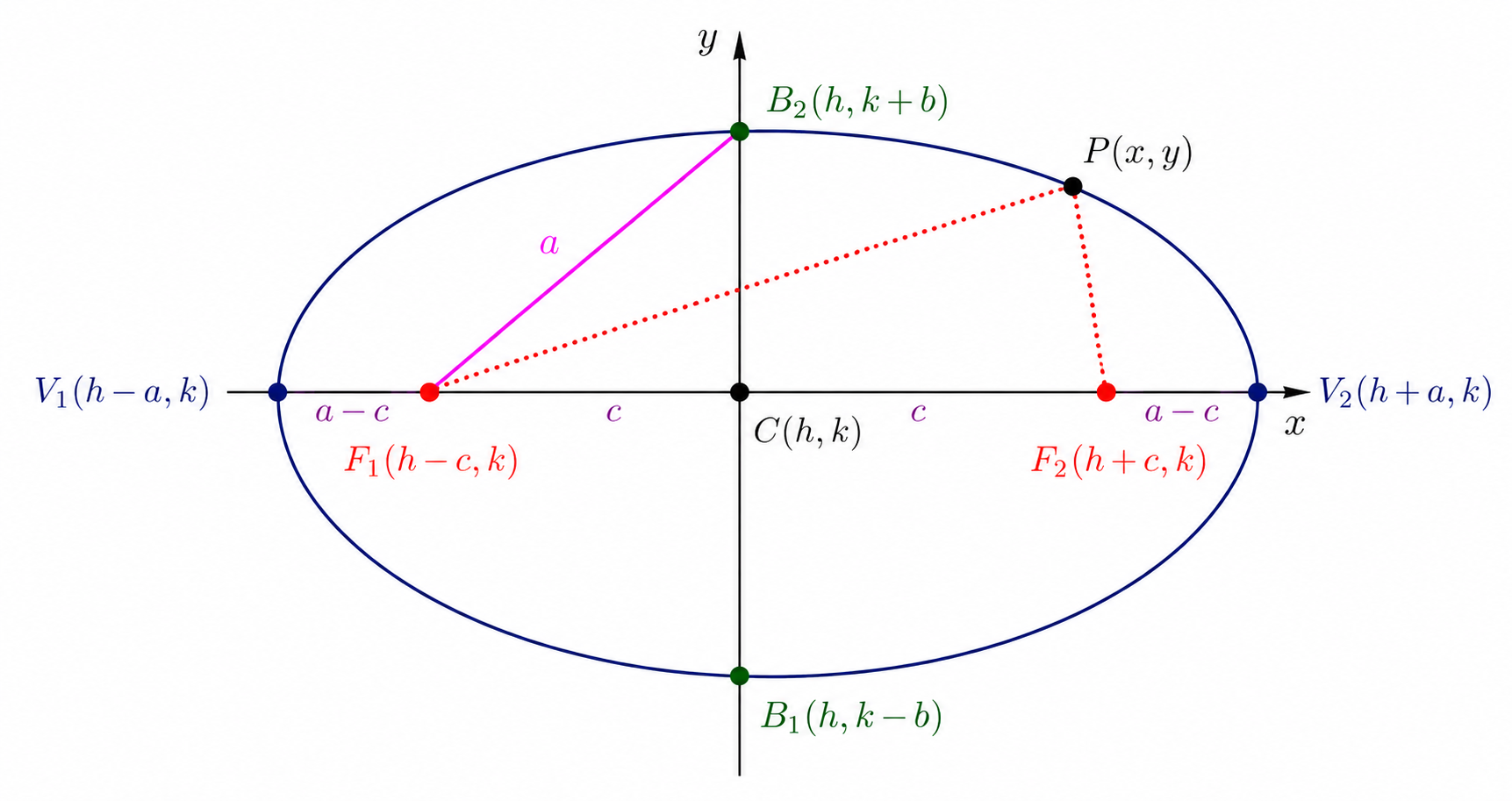
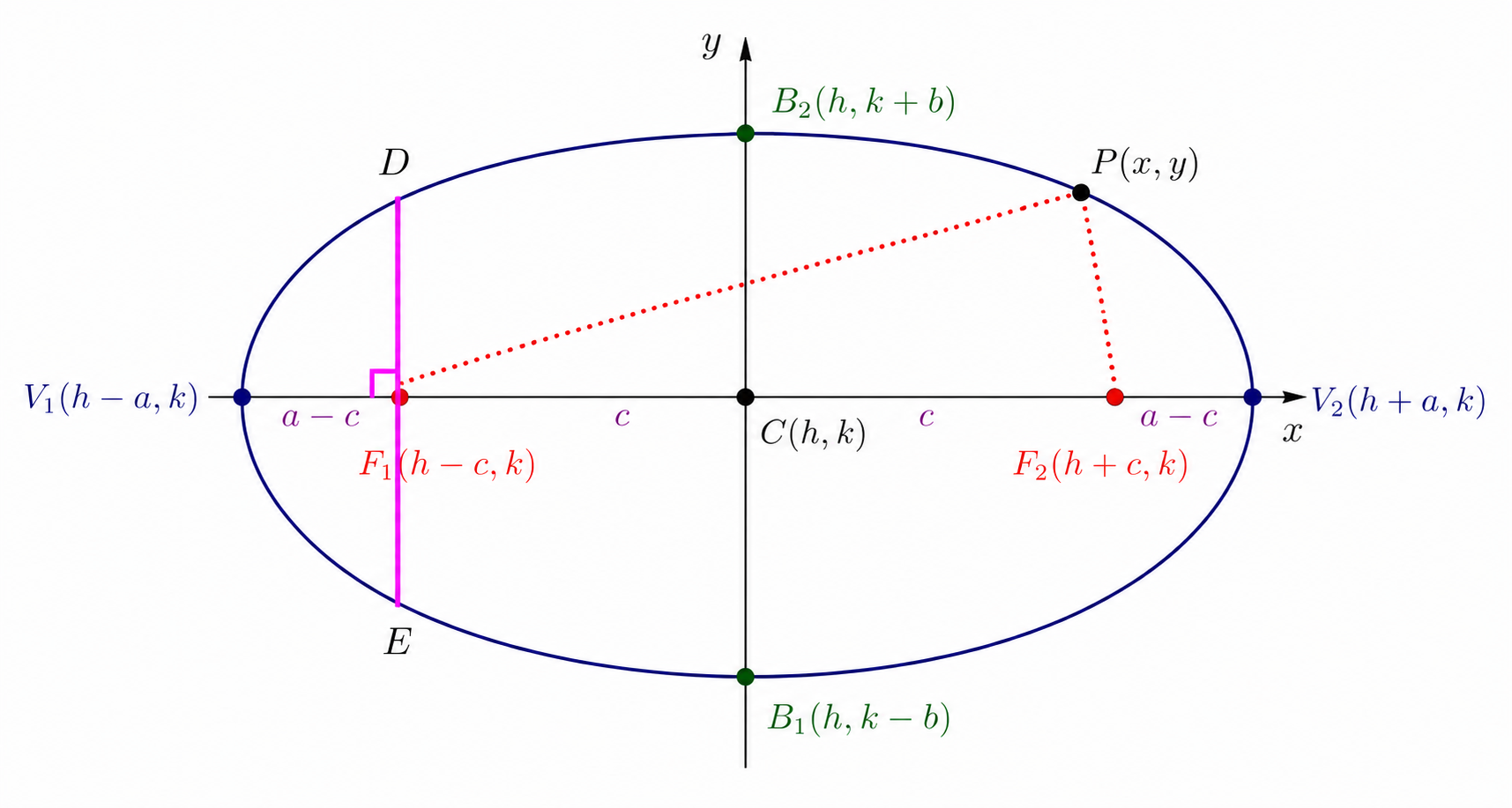
Latus Rectum
Vertical Major Axis
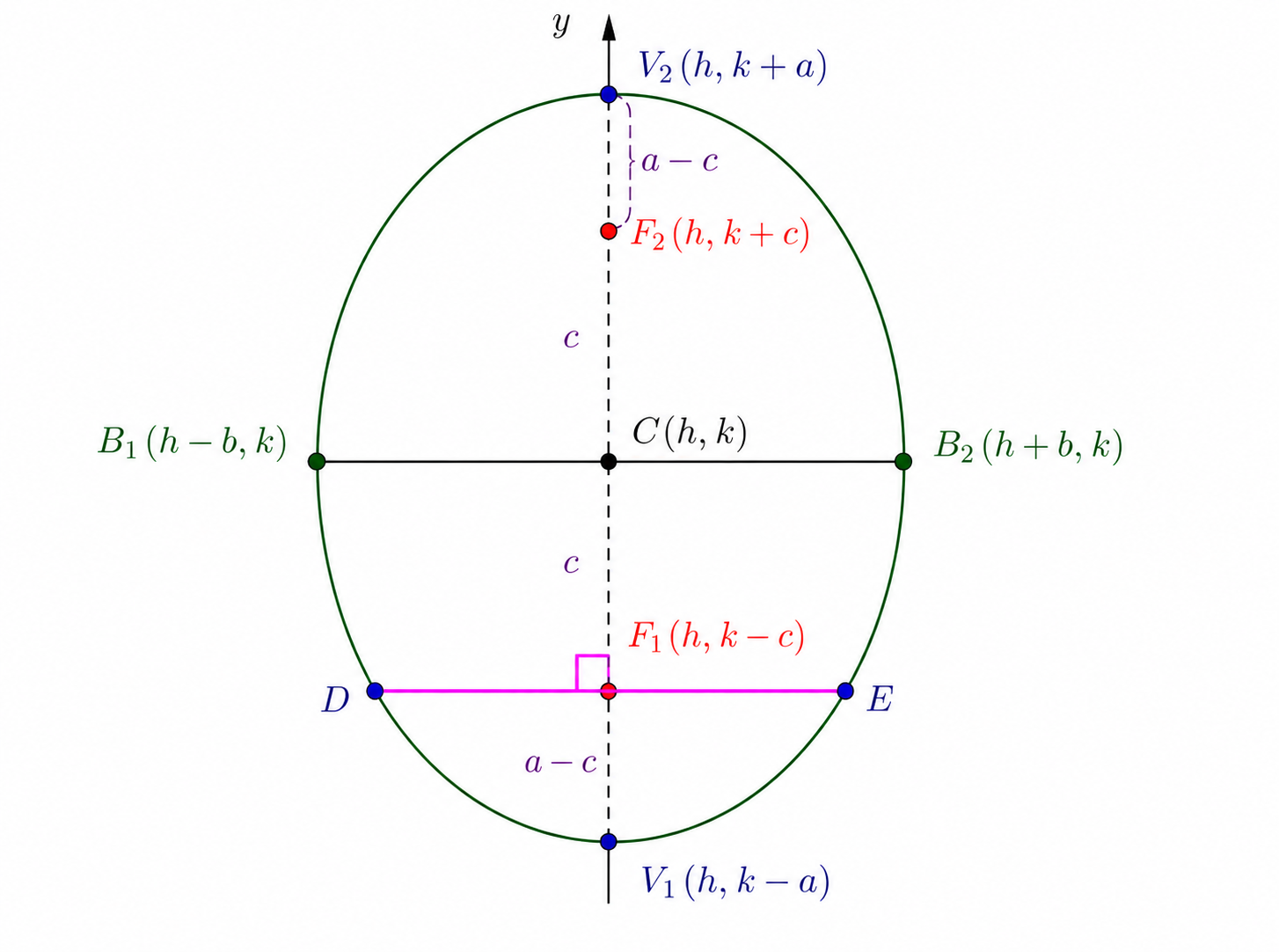
Latus Rectum (Vertical Ellipse)
Shape and Similar Ellipses
Smaller eccentricity gives a more circular ellipse, while larger eccentricity gives a more elongated ellipse.
Two ellipses are similar if and only if they have the same eccentricity.
Consider an ellipse centered at the origin with foci
For a point P(x,y) on the ellipse,
Therefore,
Move one radical to the other side:
Square:
Simplifying,
so
Square again:
Simplifying,
Thus
Let
Then
Therefore,
For center (h,k), replace x by x-h and y by y-k:
Take a vertex on the major axis:
Then
and
Therefore,
Since the sum of the focal distances is constant throughout the ellipse,
For
a focus is (c,0)
The latus rectum is perpendicular to the major axis, so substitute x=c into the ellipse:
Since
we get
Thus
so
Therefore the semi-latus rectum is
and the full latus rectum is
Find the center, vertices, foci, eccentricity, and area of
The center is (h,k)=(2,-3)
Since a²=25 and b²=9, we have a=5 and b=3
The larger denominator is under the x-term, so the major axis is horizontal.
Also,
so c=4
The vertices are (2±5,-3), so
The foci are (2±4,-3), so
The eccentricity is
and the area is
An ellipse has foci (-4,0), (4,0), and the sum of the distances from any point on the ellipse to the two foci is 10.
Find its equation.
Since 2a=10, we have a=5
Also, c=4
Using
gives
so b²=9
Therefore,
An ellipse centered at the origin has a horizontal major axis. One vertex is (13,0) and one focus is (5,0).
Find its equation.
We have a=13 and c=5, so
Therefore,
The foci of an ellipse are (-6,0), (6,0), and the point (0,8) lies on the ellipse.
Find its area.
At P=(0,8),
so
Hence 2a=20 and a=10
Also, c=6
Thus
so b=8
Therefore,
An ellipse has major axis length 26 and foci 10 units apart.
Find the length of its latus rectum.
Since 2a=26, we have a=13
The distance between the foci is 2c=10, so c=5
Hence
The latus rectum has length
so
Find the area enclosed by
Group the terms:
Complete the squares:
Thus
Divide by 36:
Therefore, a=3 and b=2
and the area is 6π
Horizontal:
Vertical:
If a=b, then
so c=0 and the two foci coincide at the center.
The equation becomes
Thus a circle can be viewed as the limiting/special case of an ellipse with e=0
As e→1, the ellipse becomes increasingly elongated.
For every nondegenerate ellipse, 0≤e<1
For
a convenient parametrization is
because