Excenters and External Angle Bisectors
Lesson · Intermediate
Geometry
Let be a triangle.
The internal angle bisector of and the external angle bisectors of and are concurrent at a point , called the -excenter.
Similarly, we define the -excenter and the -excenter .
Every triangle has exactly three excenters.
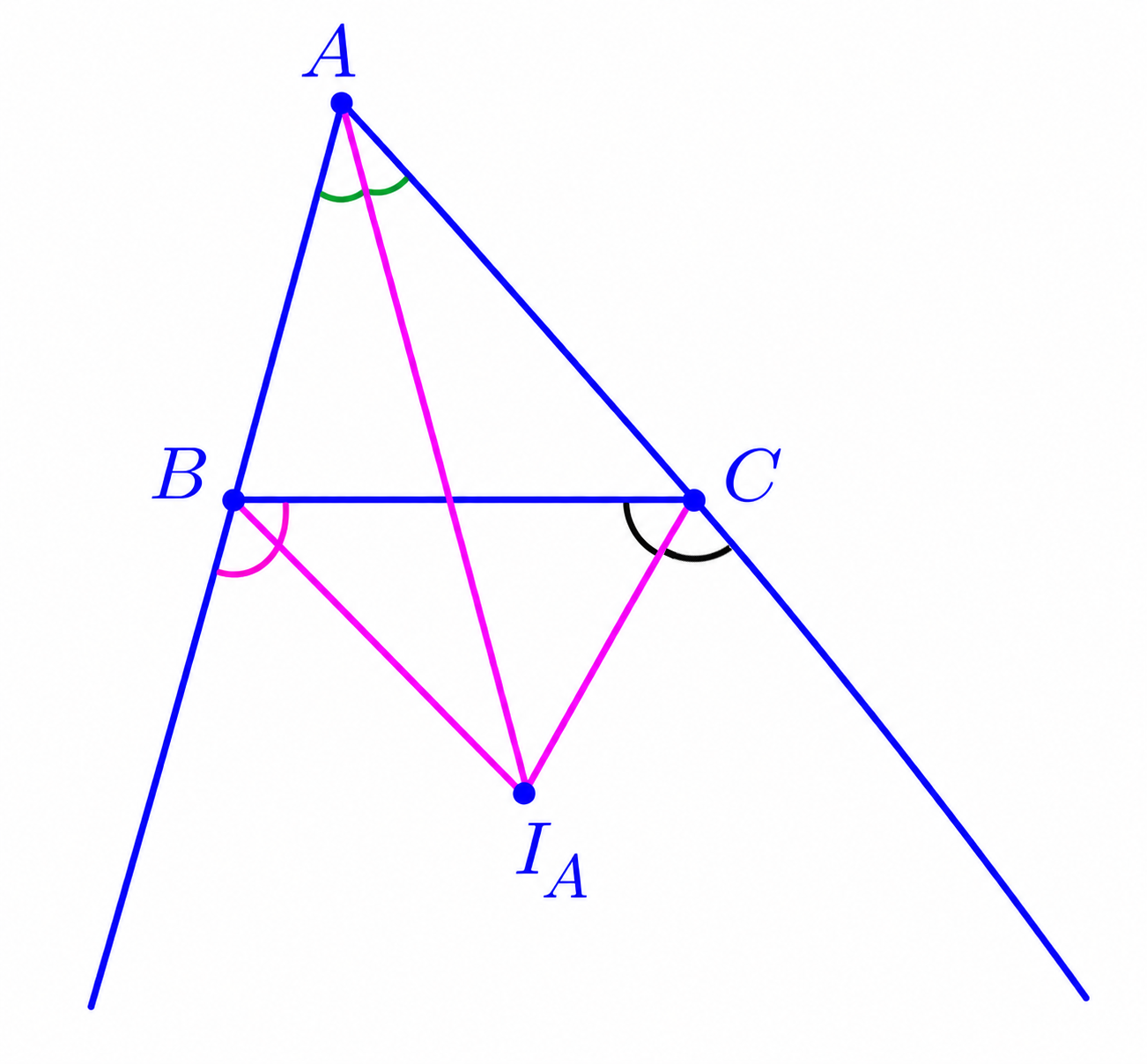
The excircle opposite is the circle centered at that is tangent to side and to the extensions of sides and .
Its radius is called the -exradius, denoted .
Similarly, the other two exradii are denoted and .
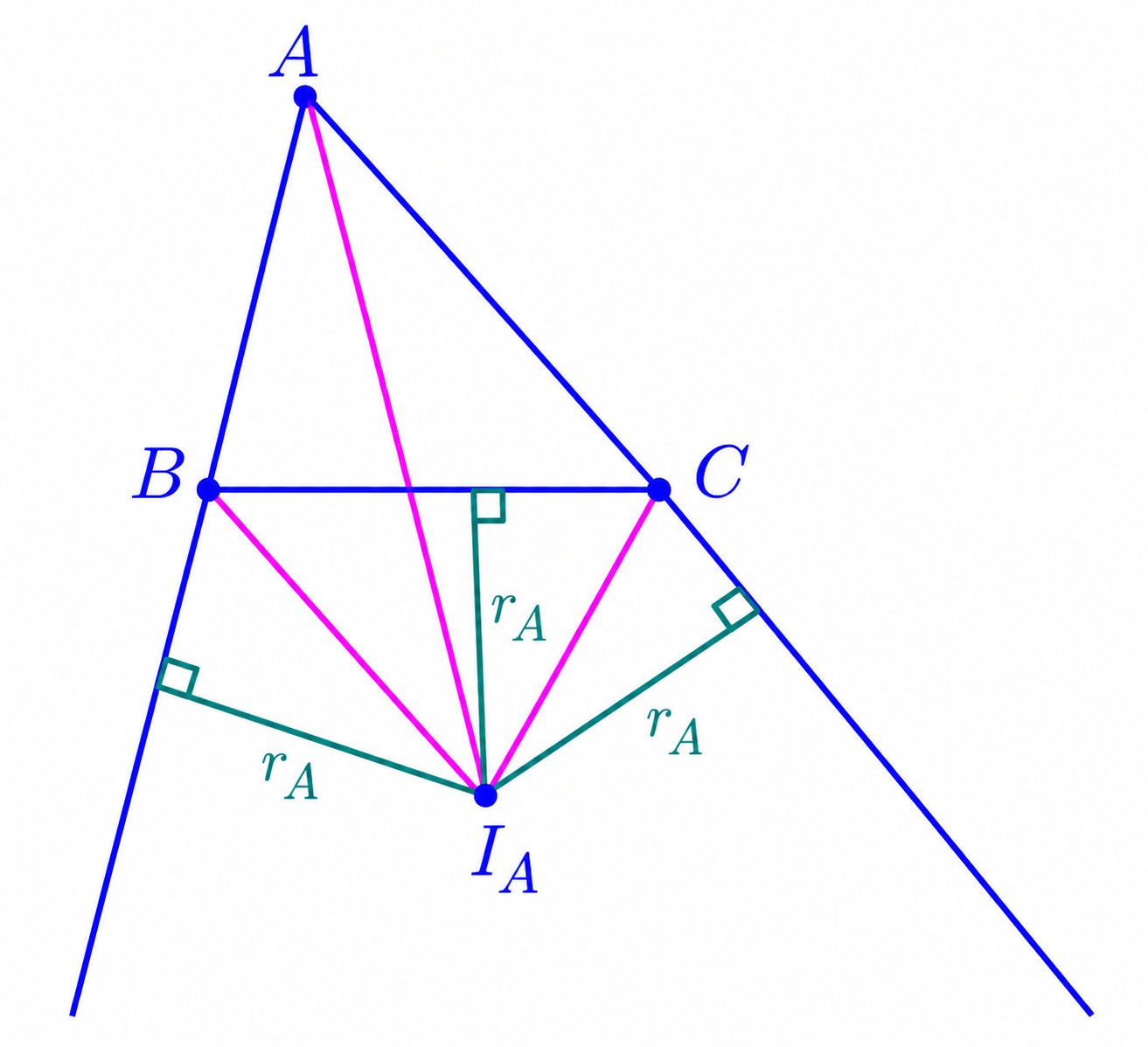
The -excenter is equidistant from the three lines , , and .
In particular, its perpendicular distance to each line is .
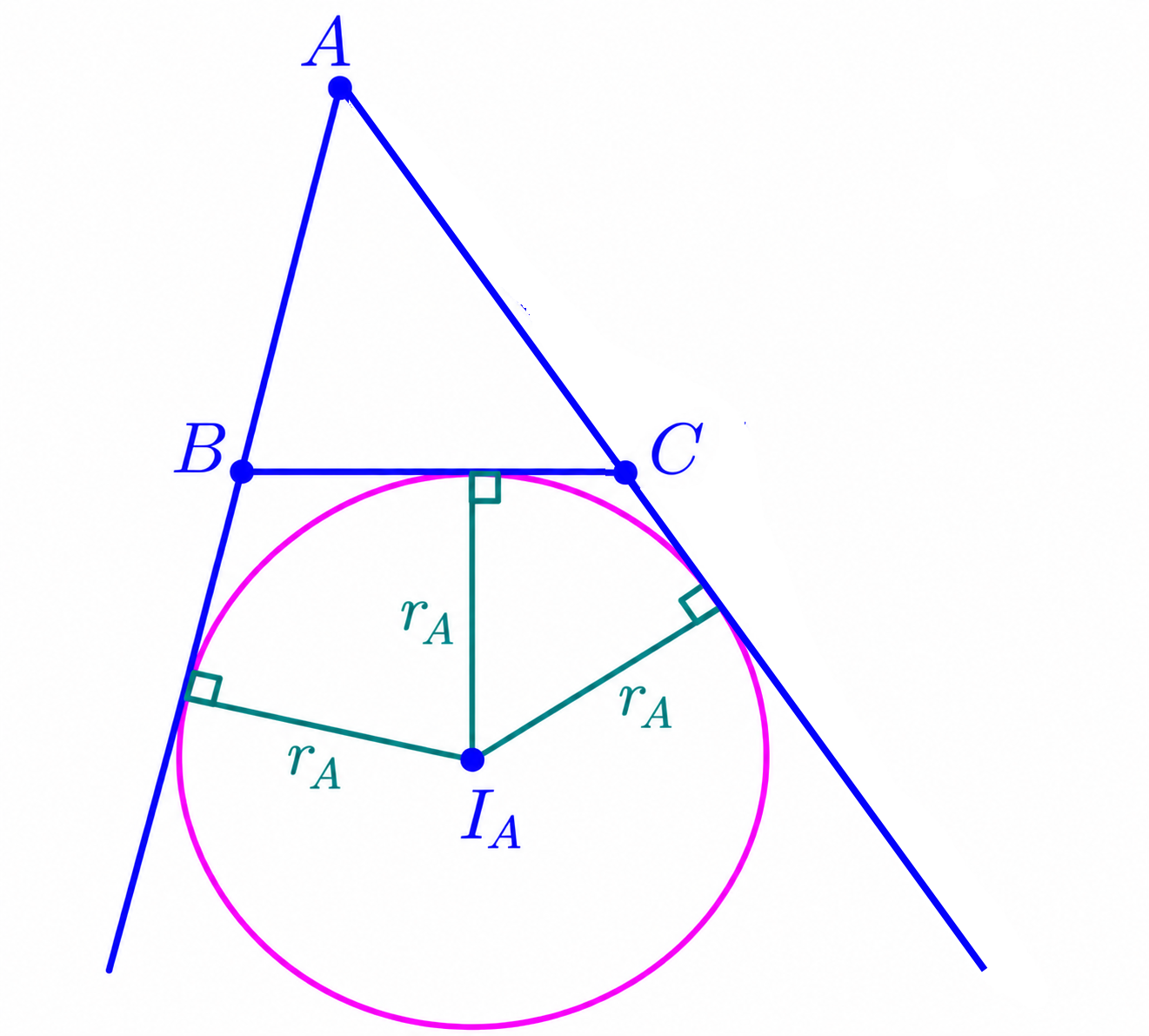
Here [ABC] is the area of triangle ABC, a=BC, b=CA, c=AB, and s=(a+b+c)/2 is its semiperimeter. Similarly,
Let A, B, and C also denote the measures of the corresponding angles of triangle ABC. Then
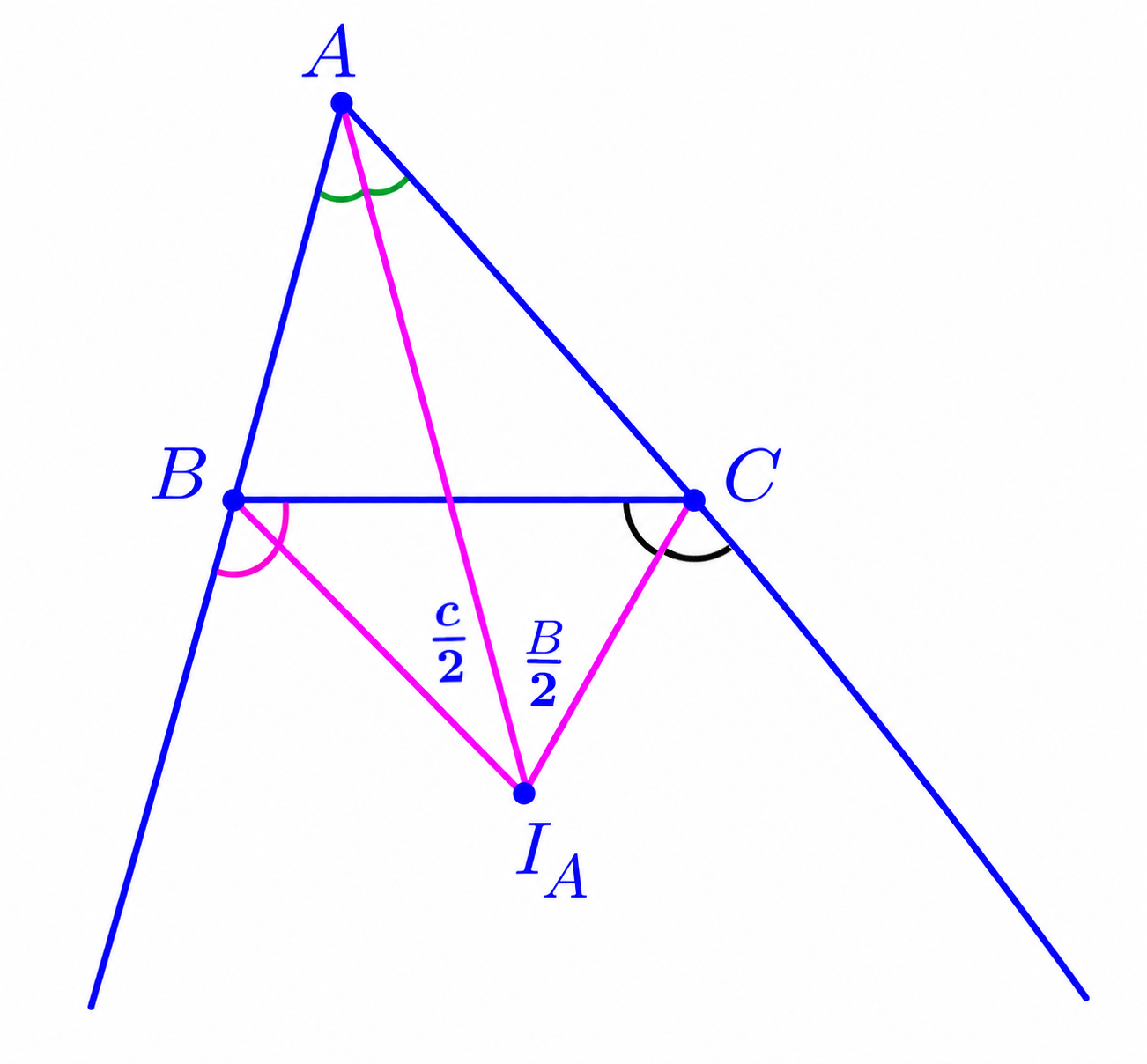
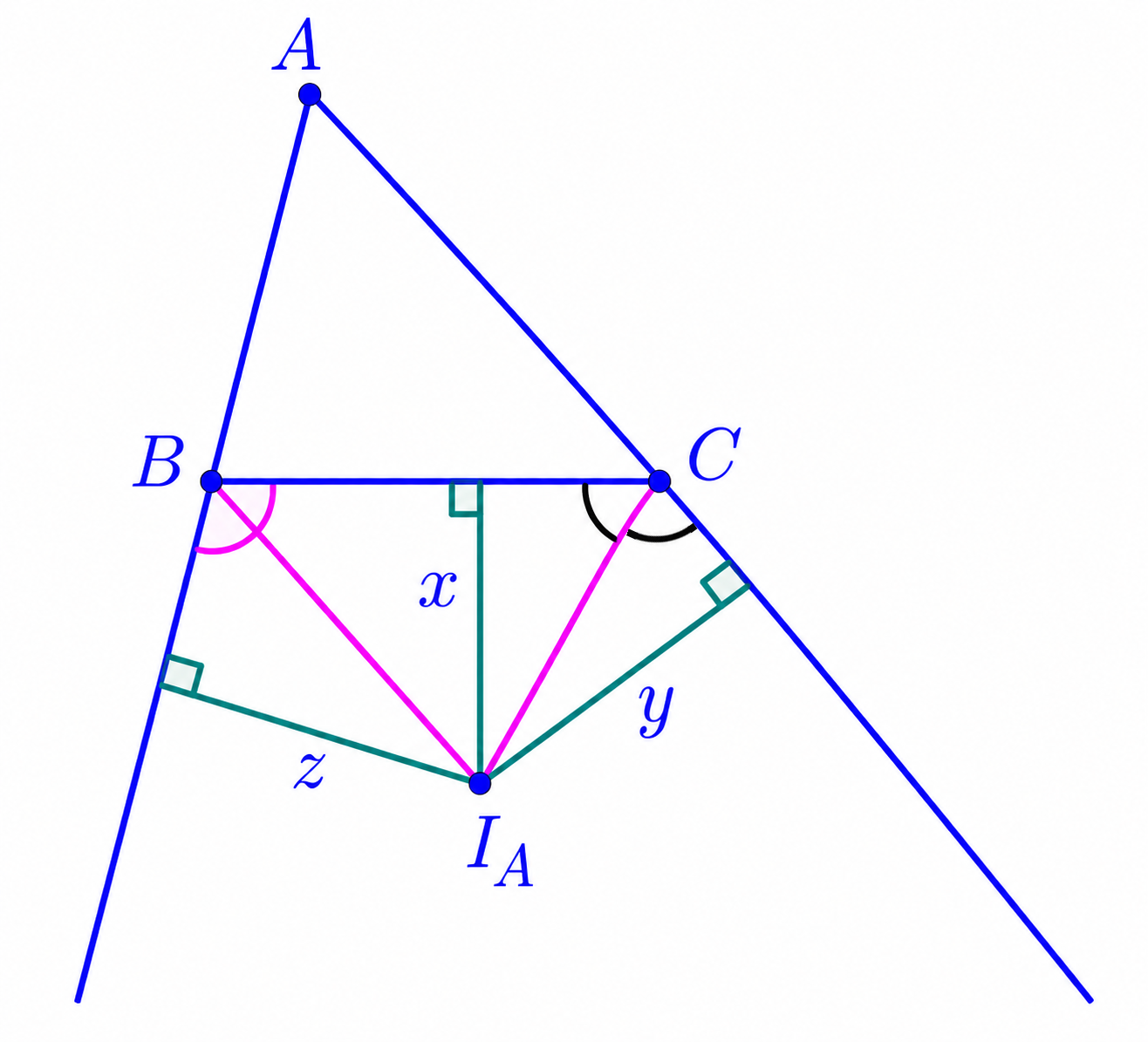
Draw the external angle bisectors at and , and let their intersection be . We prove that also lies on the internal angle bisector at .
Draw perpendiculars from to and to the lines and . Denote their lengths by , , and , respectively.
Since lies on the external angle bisector at , its distances to the lines and are equal. Thus .
Since lies on the external angle bisector at , its distances to the lines and are equal. Thus .
Hence is equidistant from the lines and . Because lies inside angle , it belongs to the internal angle bisector at . Therefore, the three angle bisectors are concurrent.
Set . The circle centered at with radius is tangent to and to the extensions of and . This is the -excircle; is its center and is its exradius.
Therefore,
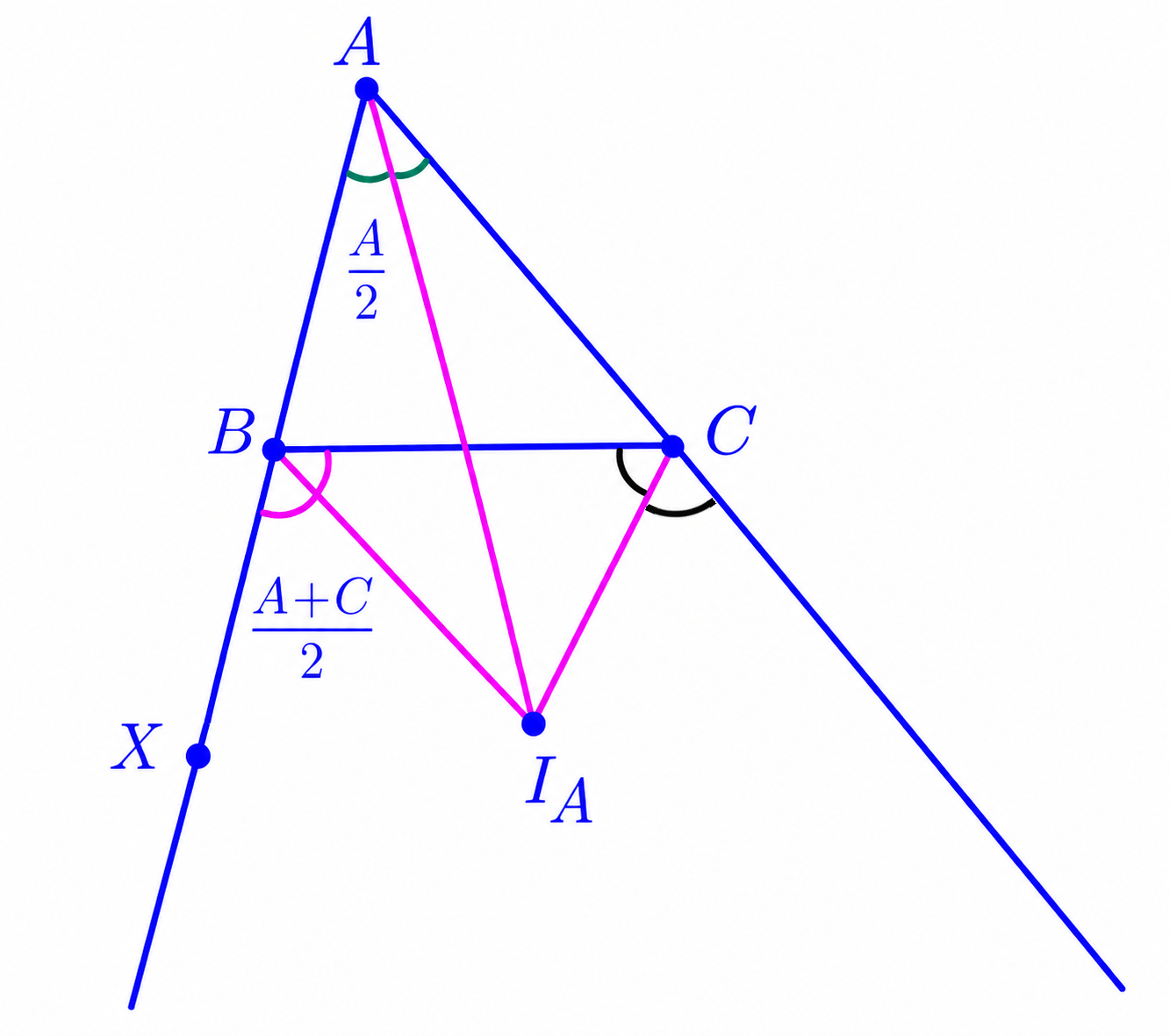
Let lie on the extension of beyond . By the exterior angle theorem,
Since bisects the exterior angle at ,
Since is an extension of , angle is an exterior angle of triangle . Thus,
Similarly,
Since ray lies between rays and ,
Prove that
Using the inradius and exradius formulas,
By Heron's formula,
Therefore,
Taking the positive square root gives
Let be the incenter and the -excenter of triangle . Prove that
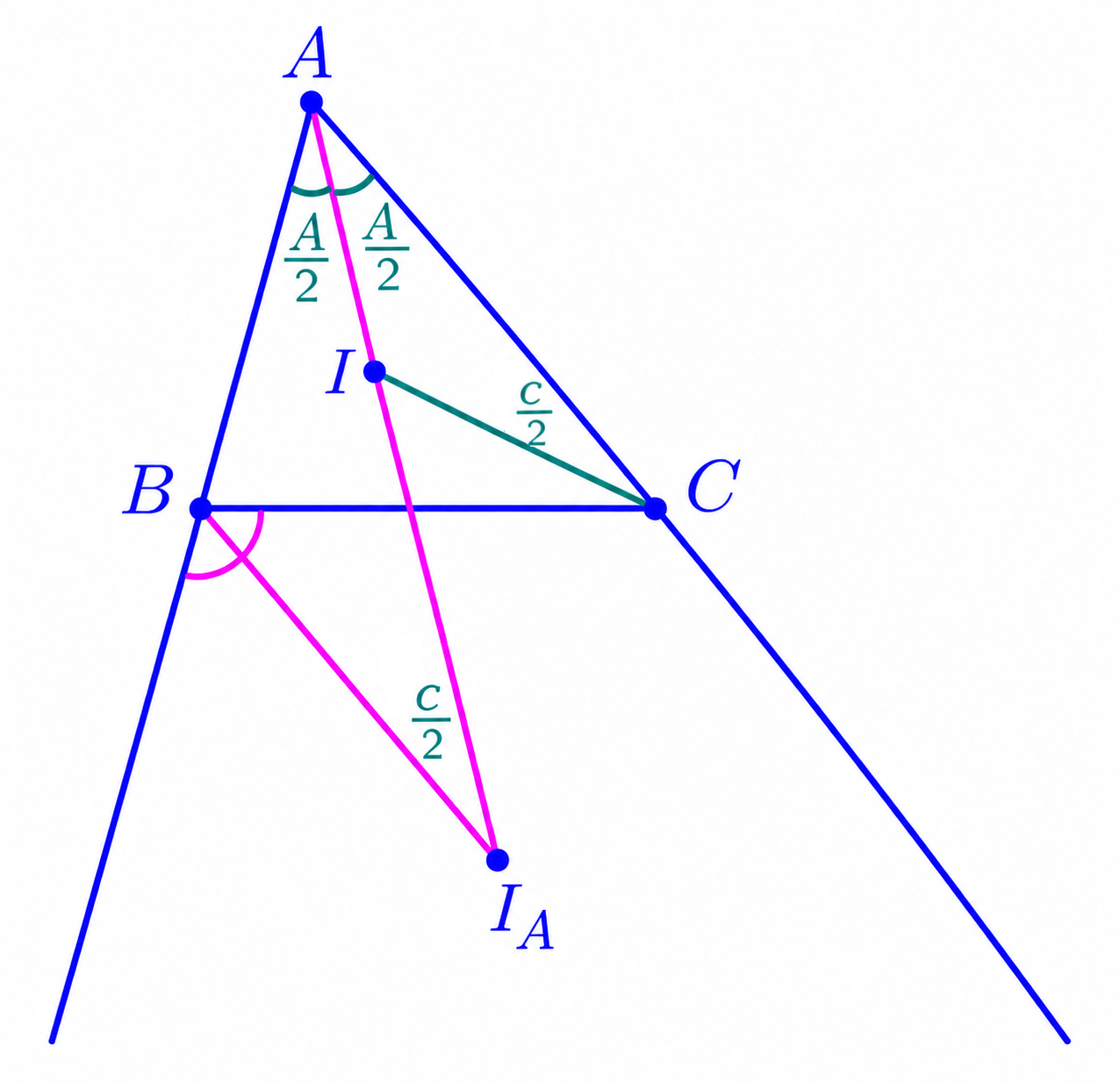
By AA similarity,
Indeed, angles and are both , while angles and are both .
Corresponding sides give
Hence,
The three exradii are equal, and the incenter and excenters form a symmetric configuration.
If AB=AC, the A-excenter lies on the symmetry axis of the triangle. The B-excenter and C-excenter are reflections of each other across this axis.
If C=90 degrees, the exradii have particularly simple expressions in terms of the legs and hypotenuse. For example,
where c=AB is the hypotenuse.
Since a squared plus b squared equals c squared,
The triangle formed by the three excenters is called the excentral triangle.
The original vertices , , and lie on its respective altitude lines, and the incenter of is the orthocenter of the excentral triangle.
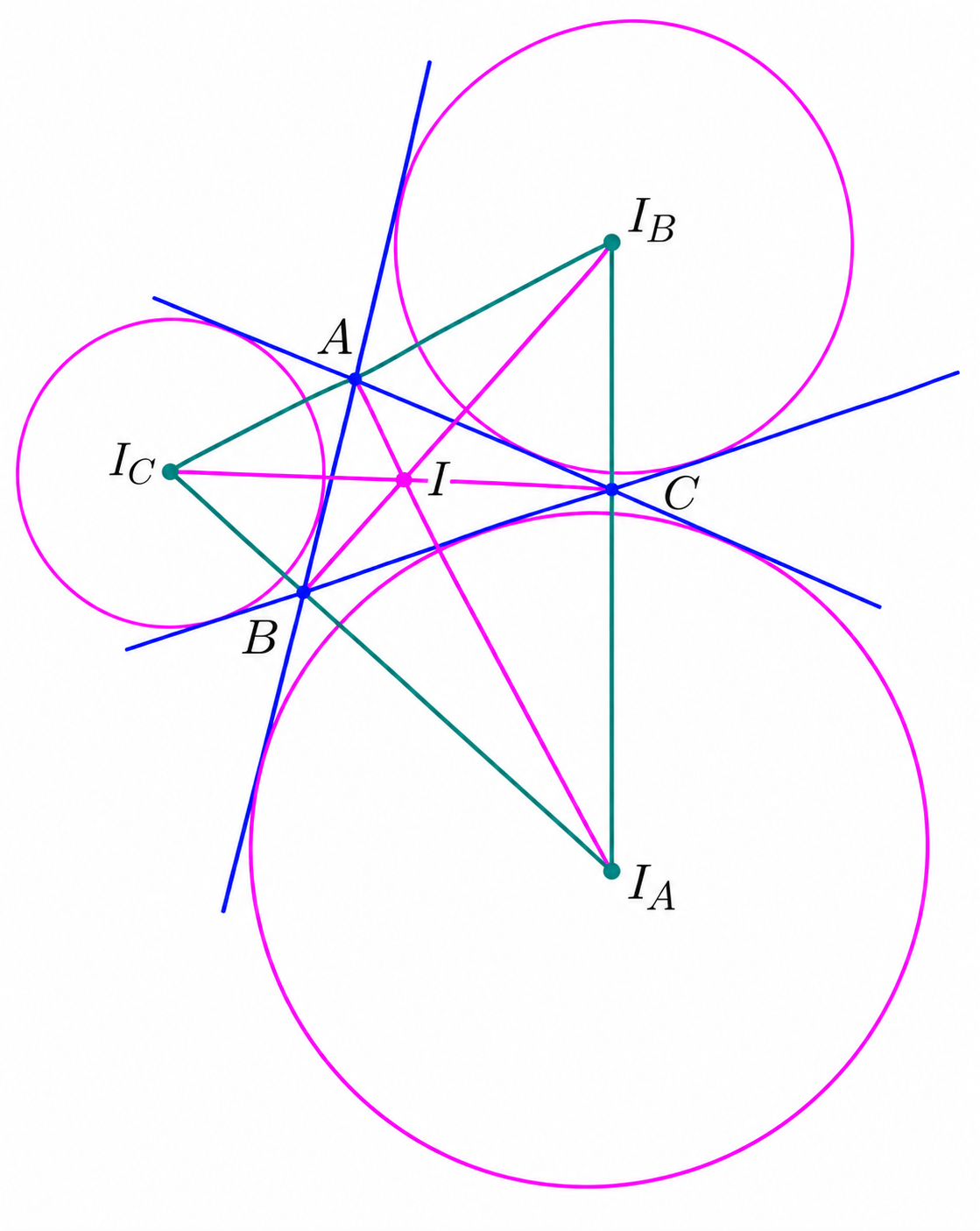
For the incenter and the -excenter ,
whereas
Thus,
Therefore, , , , and are concyclic.
Combining the exradius formula with Heron's formula gives
Similarly,
The inradius satisfies
but the A-exradius satisfies