Extremal Principle
Idea · Intermediate
Combinatorics
The Extremal Principle is a problem-solving technique in which we choose an object with an extreme property, such as the largest, smallest, longest, shortest, earliest, or latest, and use this choice to prove a statement or reach a contradiction.
In a finite simple graph, every vertex has degree at least 2. Prove that the graph contains a cycle.
Solution
Choose a longest simple path
Since this path is longest, every neighbor of v_k must already belong to the path. Otherwise, we could extend the path.
Therefore,
forms a cycle.
Extremal choice: The longest simple path.
There are n red points and n blue points in the plane, with no three points collinear. Prove that we can connect each red point to exactly one blue point so that no two connecting segments intersect.
Solution
Among all possible matchings, choose one minimizing the sum of the lengths of its segments.
Suppose two segments R₁B₁ and R₂B₂ intersect at X.
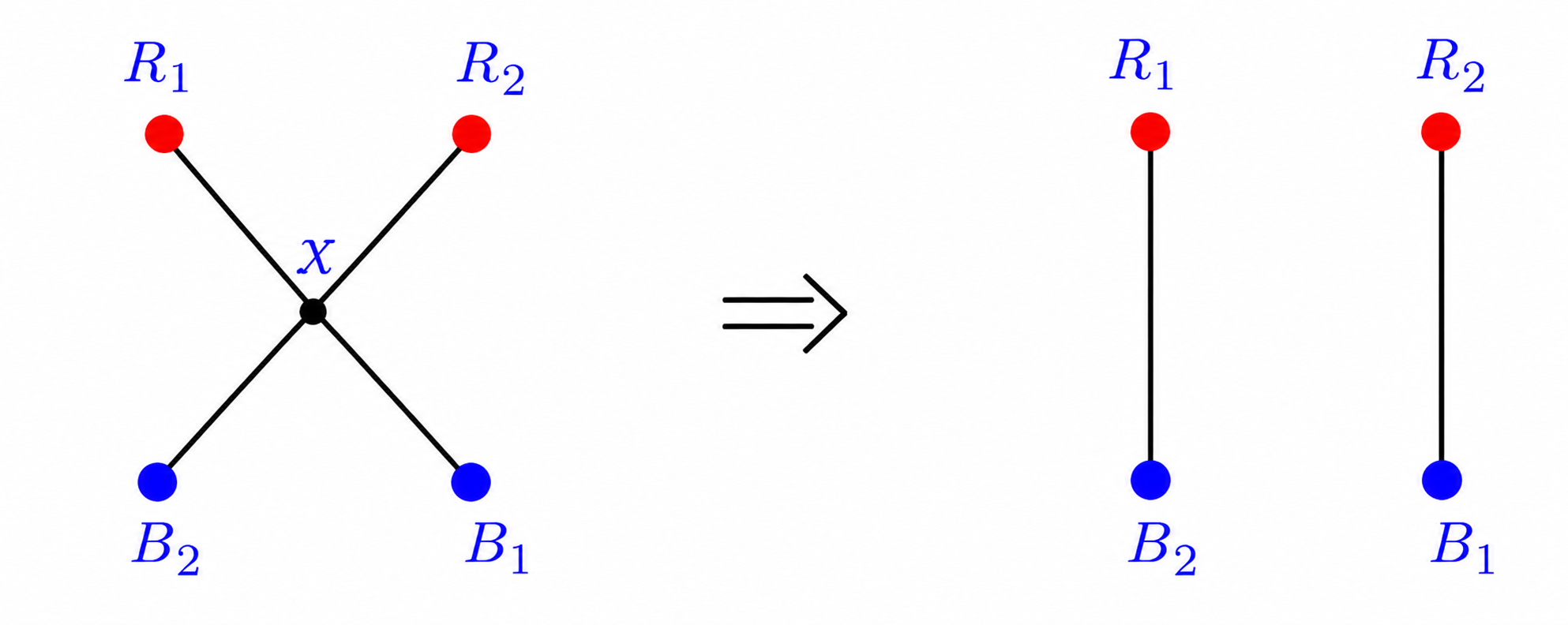
By the triangle inequality,
Adding gives
Replacing the crossing segments with R₁B₂ and R₂B₁ produces a matching with smaller total length, a contradiction. ✗
Therefore, the minimum-length matching has no crossings. ✓
Extremal choice: The matching with minimum total length.
Several real numbers are arranged around a circle. Each number is equal to the average of its two neighboring numbers. Prove that all the numbers are equal.
Solution
Let M be the largest number.
Suppose its neighbors are a and b. Then
But
Therefore,
Applying the same argument to neighboring positions, we conclude that every number equals M.
Extremal choice: The largest number.