Rearrangement Inequality
Idea · Advanced
Algebra
Let
and
be two sequences of real numbers. For any permutation of ,
We first prove that pairing numbers in the same order gives the maximum sum.
Suppose
Compare the two pairings:
and
Their difference is
Therefore,
Pairing two numbers in the same order never gives a smaller sum than pairing them in the opposite order.
Starting with any permutation, we can repeatedly swap inverted pairs until the two sequences are paired in the same order. Each swap does not decrease the sum.
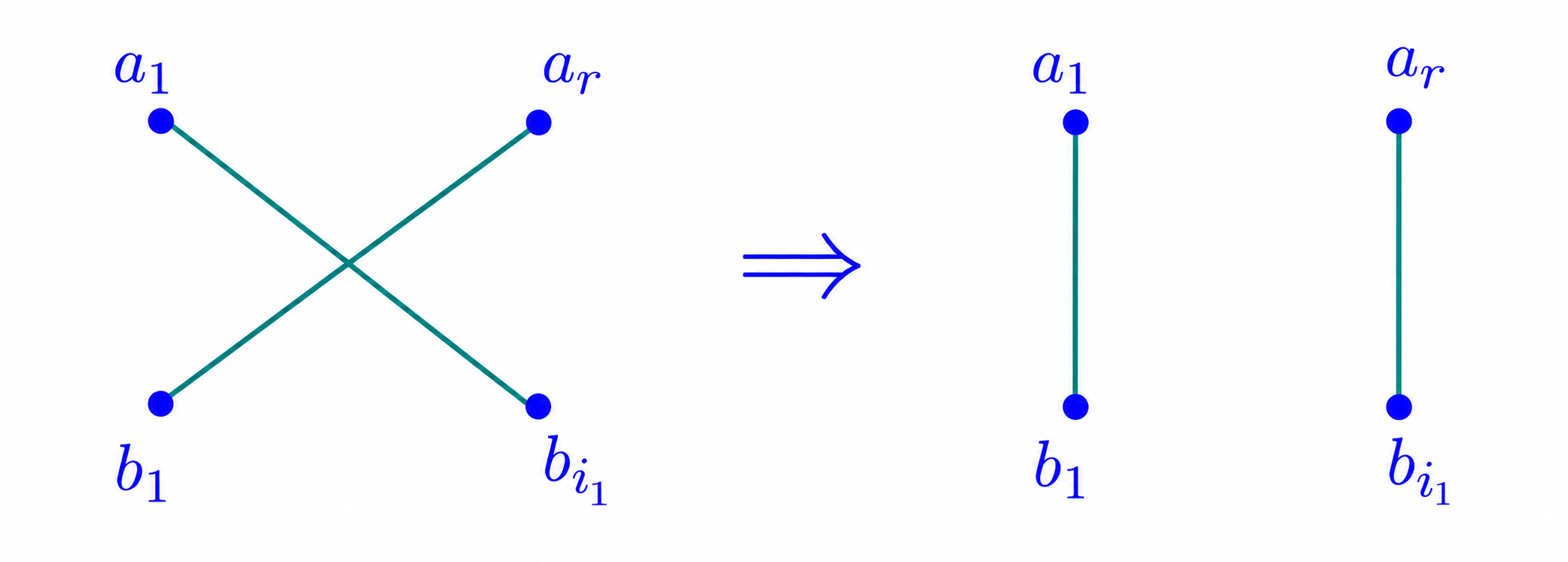
If two pairings are inverted, swapping their endpoints does not decrease the sum. Repeating this process eventually gives the maximum sum.
Hence,
For the minimum, note that
Applying the maximum case to the sequence gives
Multiplying both sides by reverses the inequality. Hence,
If
then for every permutation ,
If
then
⋮
Adding all of them gives
Divide both sides by .
They may contain any real numbers.
Let be nonnegative real numbers. Prove that
Without loss of generality, relabel the variables so that
Thus,
By the Rearrangement Inequality,
Hence,
Let . Prove that
Let be a positive integer. Prove that
Using
the desired inequality becomes
We know that the sequences
are similarly ordered. By Chebyshev's Sum Inequality,
Let . Prove that
Without loss of generality, assume
Then
By the Rearrangement Inequality,
Consequently,
Therefore,
Combining (1) and (2),
Dividing by 3,
Let . Prove that
a)
Set
We need to prove
Without loss of generality, assume
By the Rearrangement Inequality,
b)
Set
Notice that
By the Rearrangement Inequality, the sequences
are oppositely ordered. Therefore, their original pairing gives the minimum:
Hence,
Applying Chebyshev's Sum Inequality to the identical sequences and gives
Since ,
Combining,
Therefore,
Let . Prove that
The two-term Rearrangement Inequality gives
Therefore,
so
Similarly,
Adding,
Notice that
Hence,
Let and . Prove that
Since ,
Set
The original inequality becomes
We prove this using the Rearrangement Inequality.
Without loss of generality, assume
Then
By the Rearrangement Inequality,
Similarly,
Adding (1) and (2),
Therefore,
Returning to the original variables,