AMC 10A 2026 (Problem 23)
In a list of one or more consecutive integers, there are multiples of 2 and multiples of 3. How many ordered pairs are possible for this list if and are between 0 and 100, inclusive?
Let and be the first and last numbers.
Without loss of generality, assume , since shifting both endpoints by a multiple of does not change the number of multiples of or .
Without loss of generality, assume , since shifting both endpoints by a multiple of does not change the number of multiples of or .
Consider all possible values of and .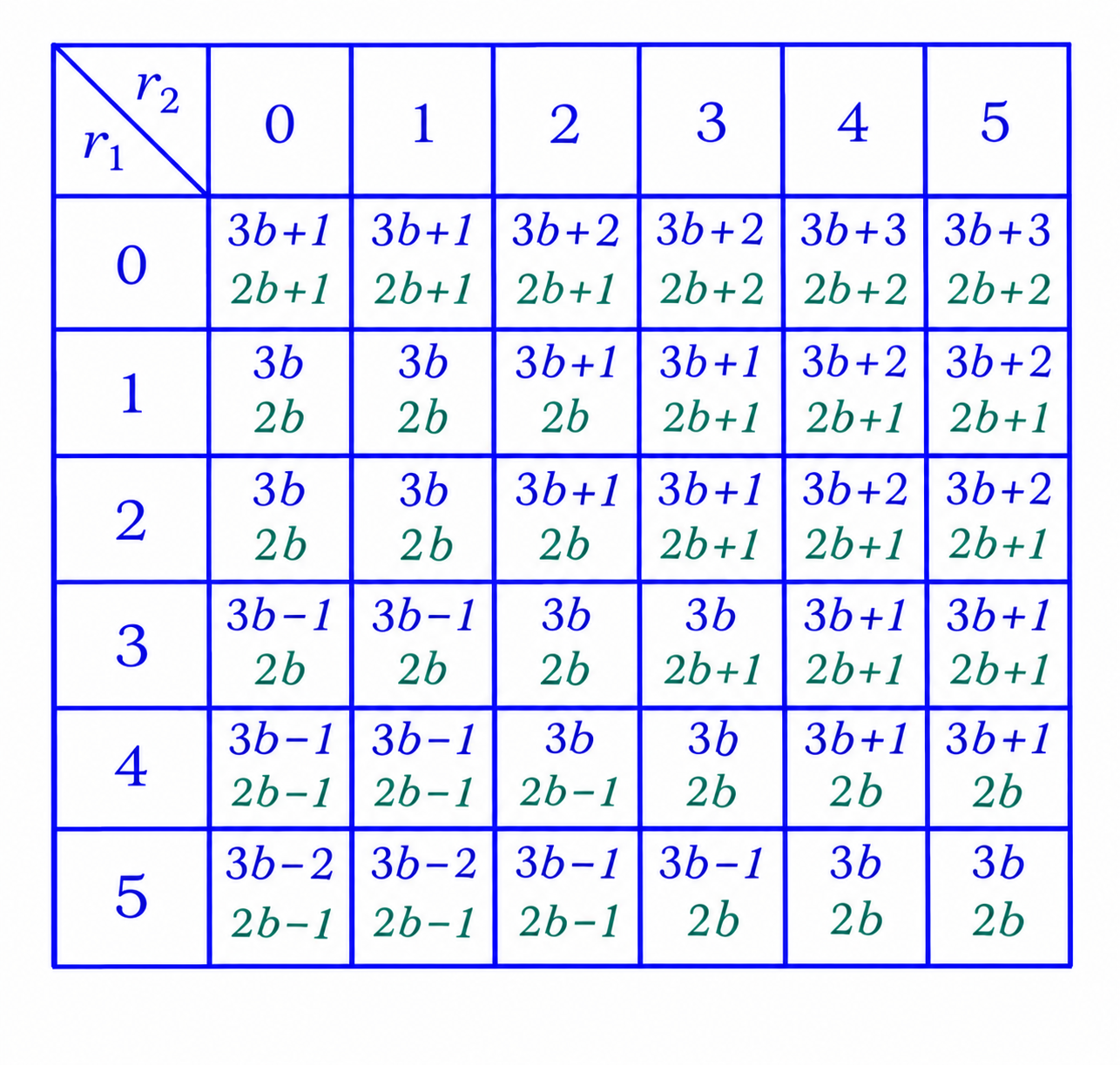
By Hint 2,
So,
33 cases.
(D) 235
- AIME I 2025 (Problem 5)
- AMC 10A/12A 2025 (Problem 8/4)
- AMC 10A 2025 (Problem 12)
- AMC 10A 2025 (Problem 16)
- AMC 10A/12A 2025 (Problem 24/23)
- AMC 12A 2025 (Problem 18)
- AMC 10B 2025 (Problem 9)
- AMC 10B/12B 2025 (Problem 16/13)
- AMC 10B/12B 2025 (Problem 21/17)
- AMC 8 2026 (Problem 17)
- AMC 8 2026 (Problem 21)
- AIME II 2026 (Problem 14)
- AIME II 2026 (Problem 15)
- AMC 10A/12A 2024 (Problem 19/12)
- AMC 10A/12A 2024 (Problem 25/22)
- AMC 10B 2024 (Problem 20)
- AMC 12B 2024 (Problem 22)
- 2024 AMC 12B Problem 25
- AMC 10A/12A 2026 (Problem 21/16)
- AIME I 2026 (Problem 7)
- AMC 10A/12A 2024 (Problem 7/6)
- 2024 AMC 10A Problem 24
- AMC 10B/12B 2024 (Problem 15/10)
- 2024 AMC 10B Problem 17
- AMC 12B 2024 (Problem 24)
- AMC 10A 2026 (Problem 9)
- AMC 10A 2026 (Problem 20)