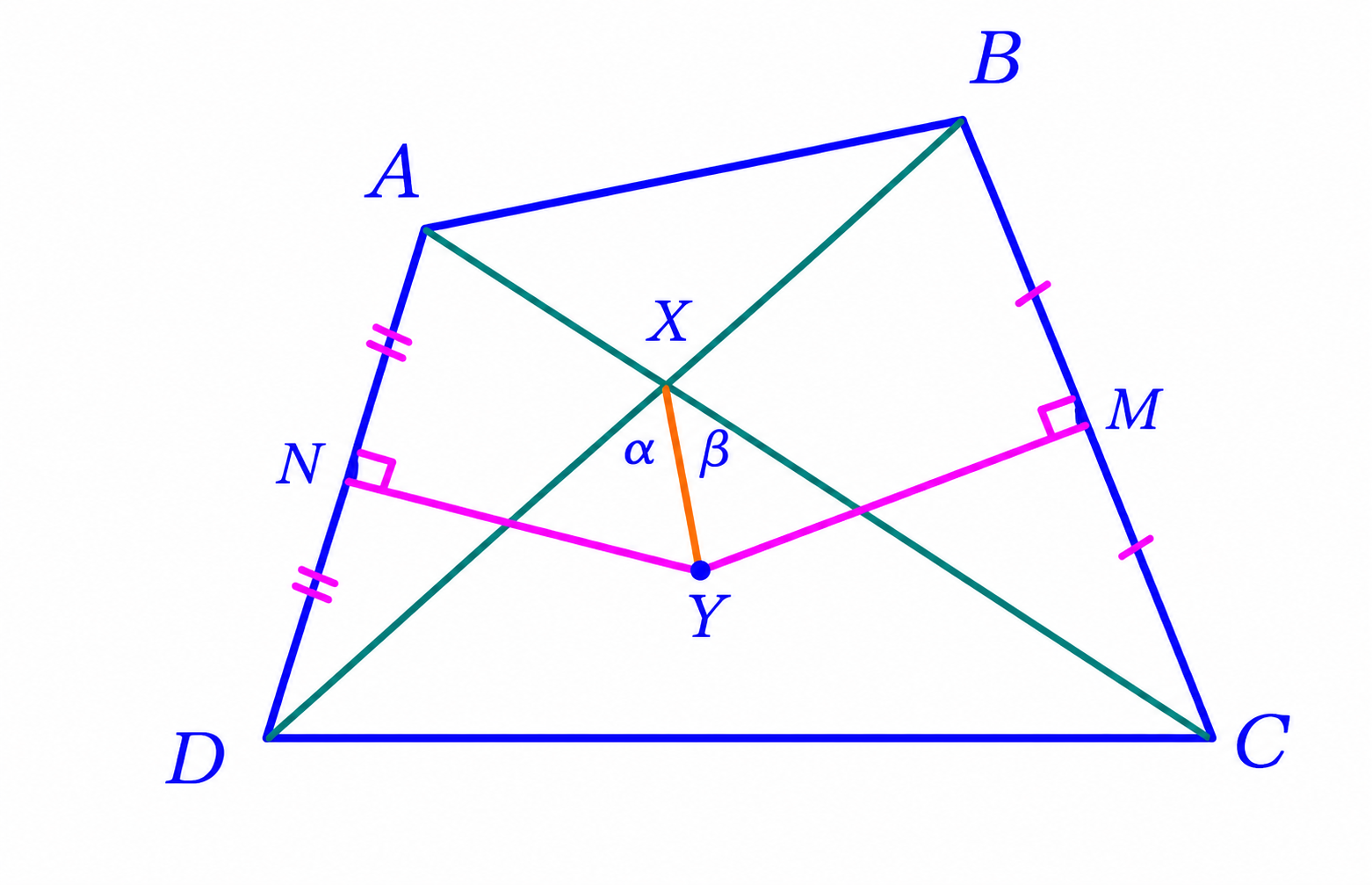
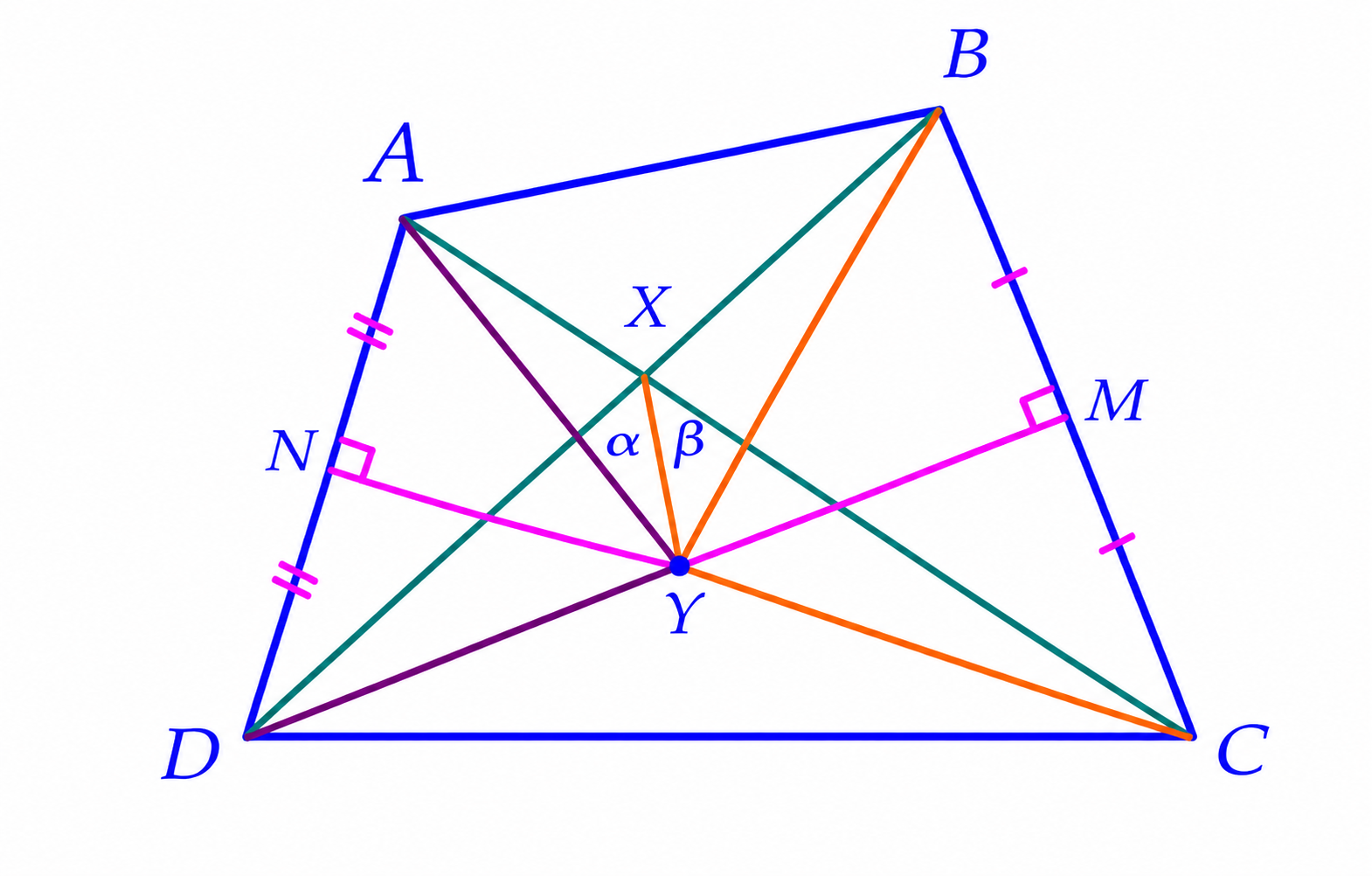
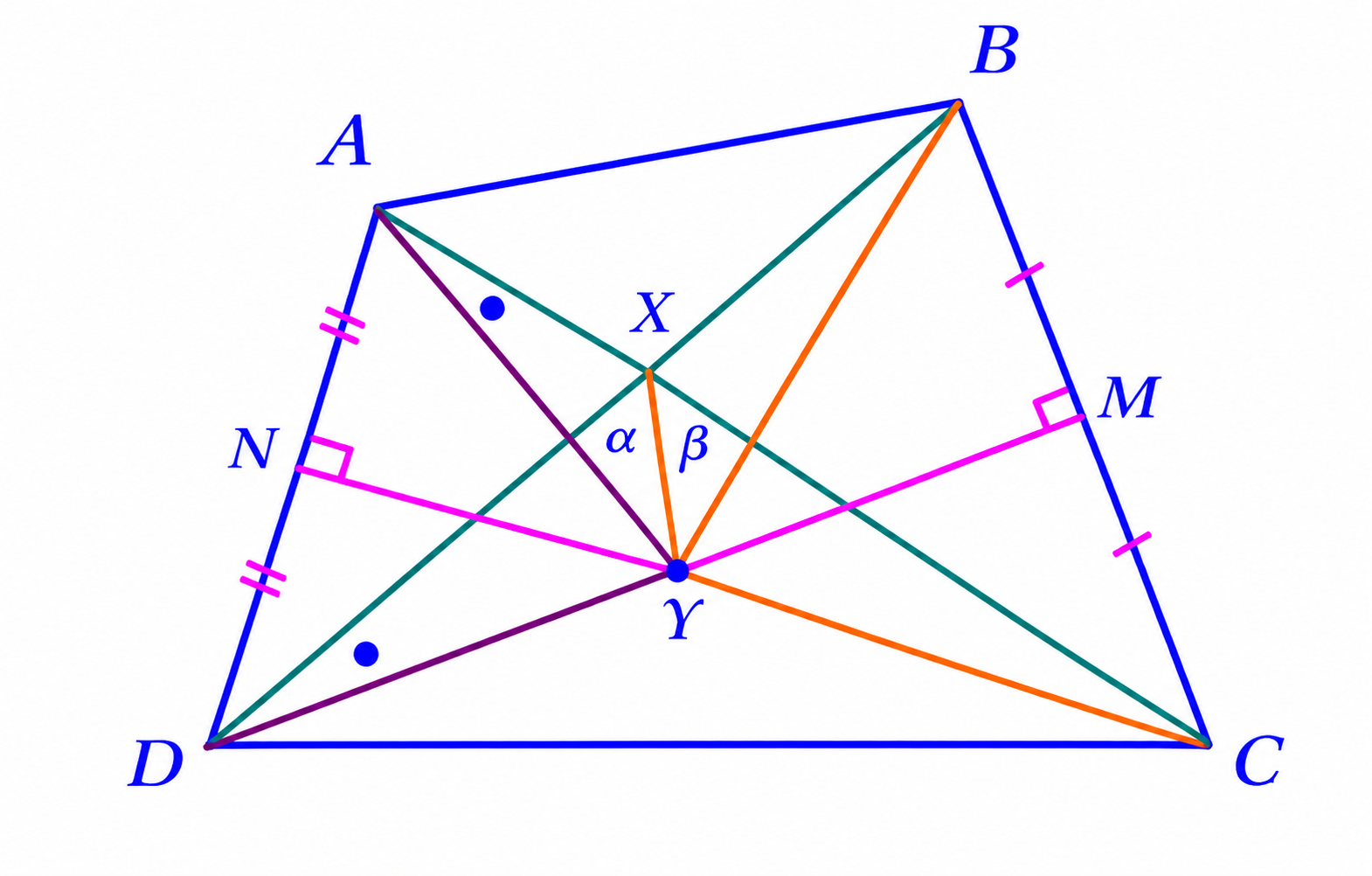
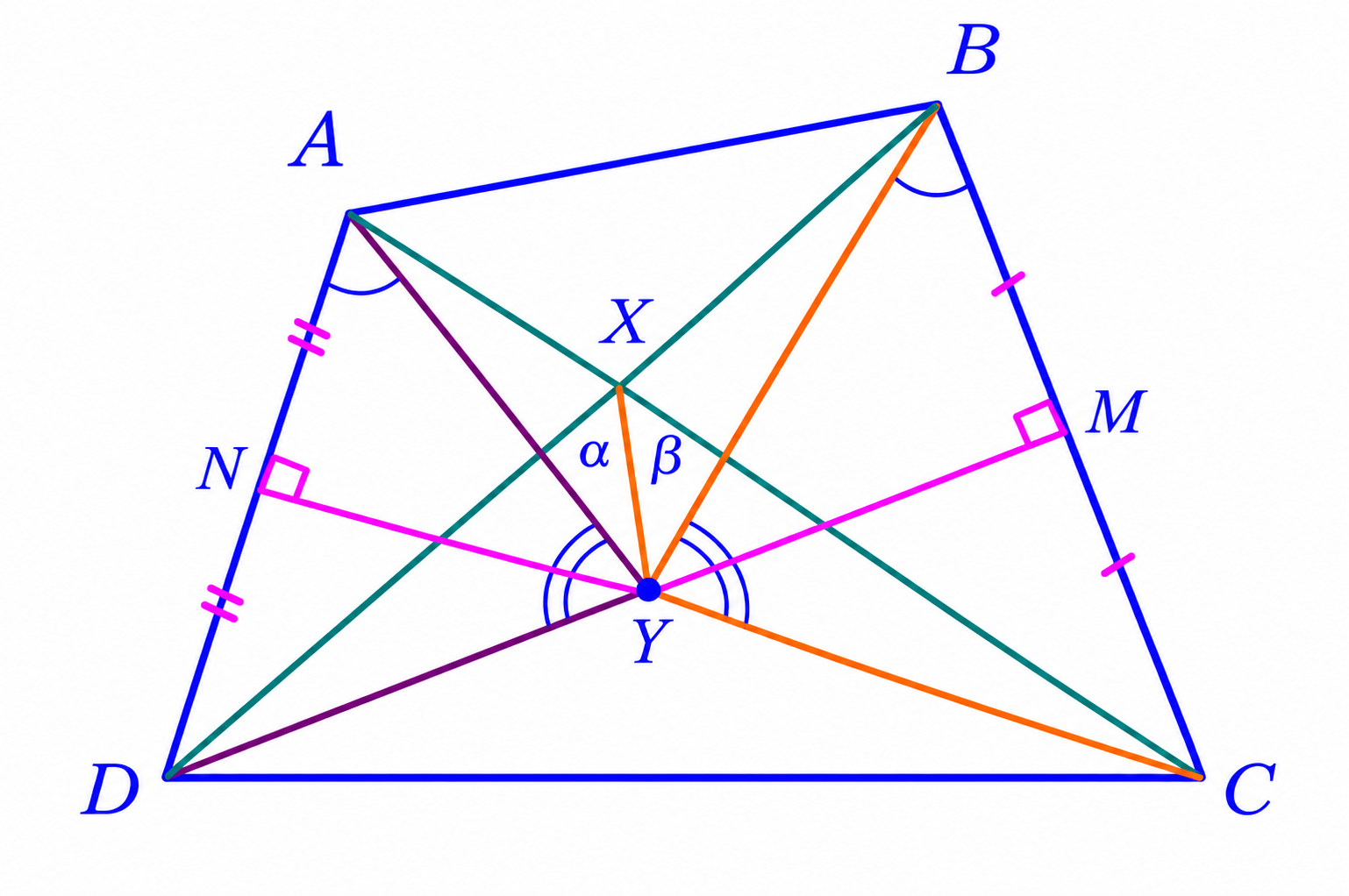
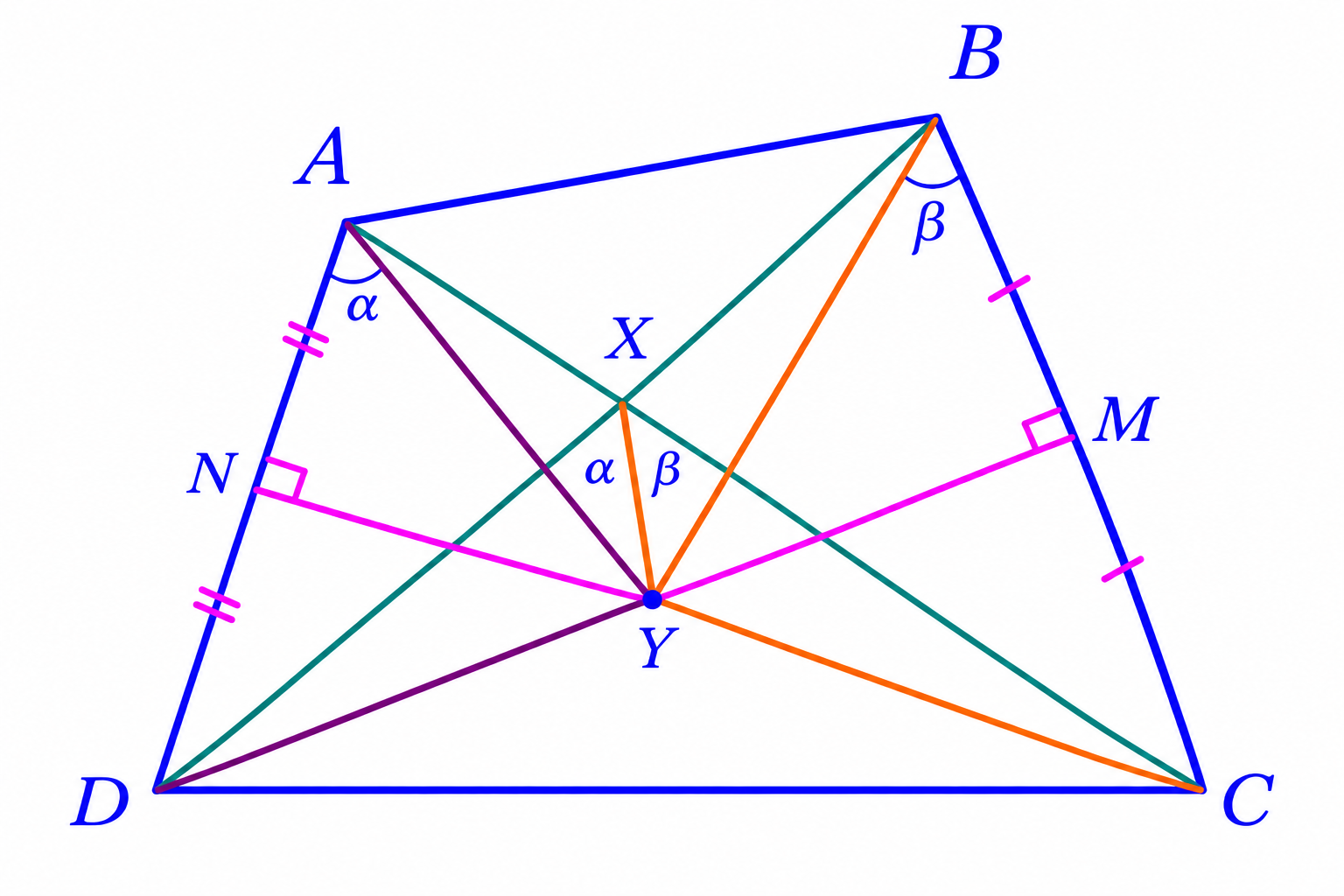
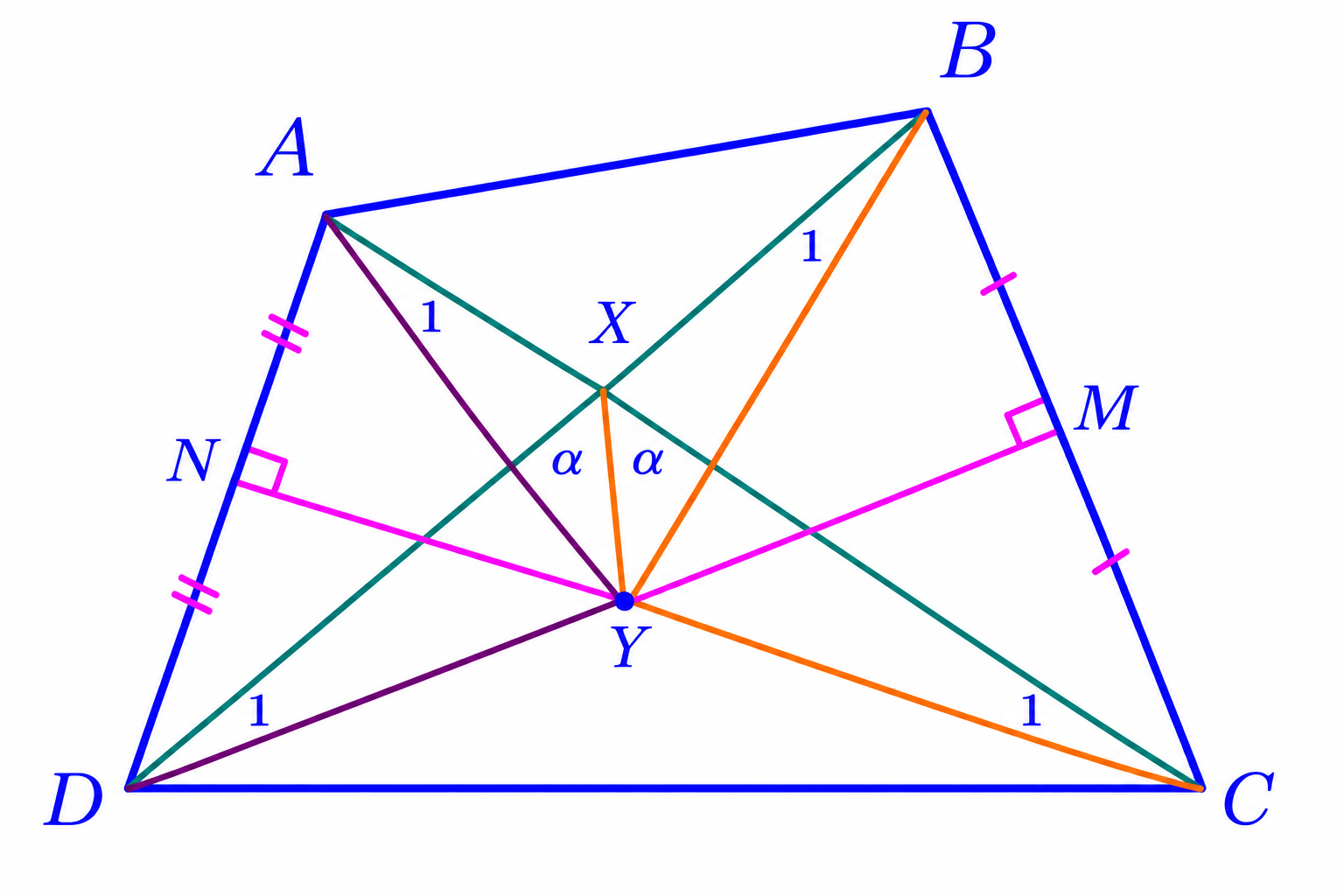
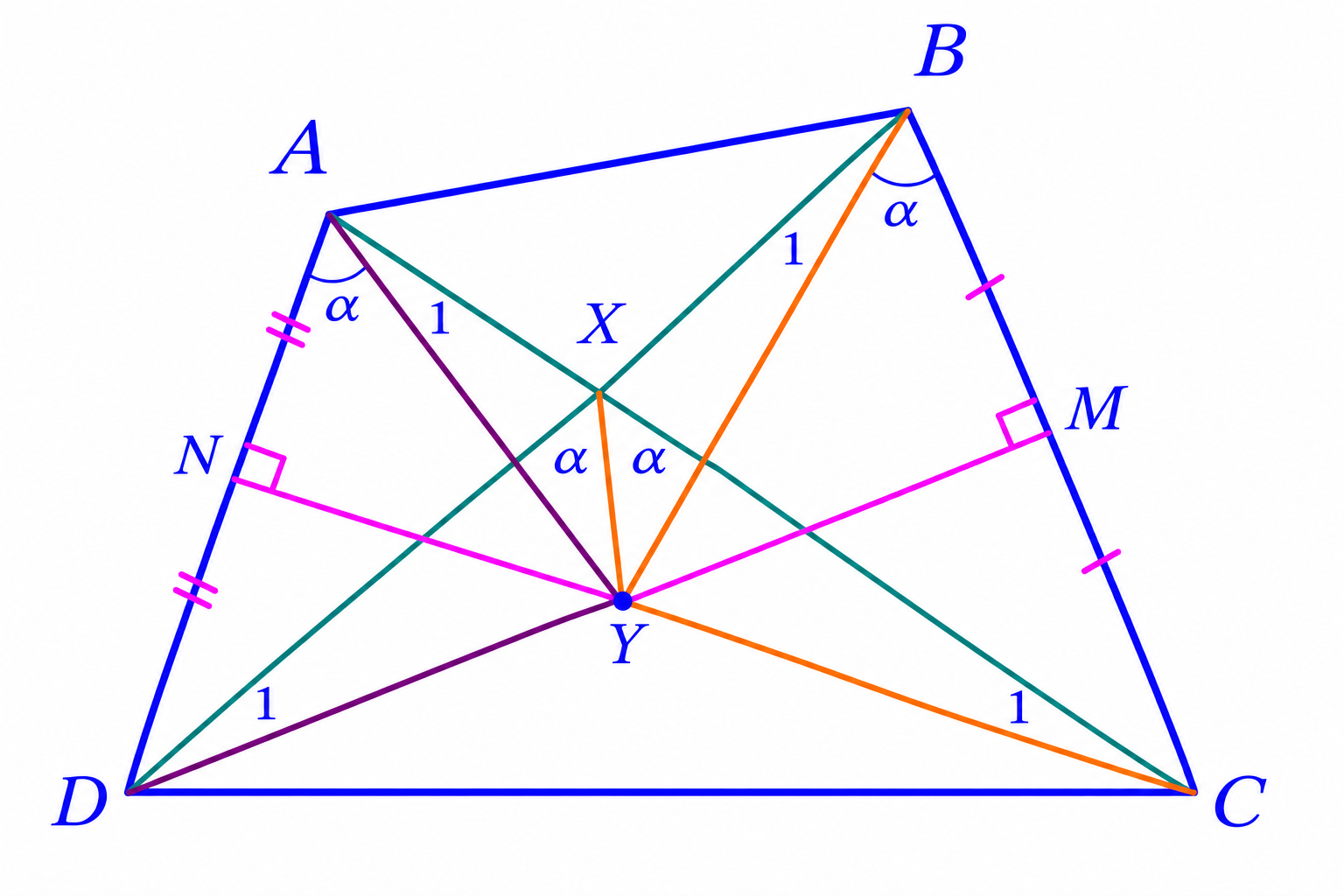
BMO2 2026 (Problem 2)The convex quadrilateral ABCDABCDABCD has sides ADADAD and BCBCBC not parallel. The diagonals ACACAC and BDBDBD intersect at XXX. The perpendicular bisectors of sides ADADAD and BCBCBC meet at YYY. Suppose that YYY lies strictly inside triangle XCDXCDXCD.Prove that AC=BDAC=BDAC=BD if and only if XYXYXY bisects ∠DXC\angle DXC∠DXC.Related TopicsCoreBasic Rules of Cyclic QuadrilateralsMajorLaw of SinesMinorCircumcenters and Perpendicular BisectorsGeneral Solutions of Trigonometric EquationsHints (9)Hint 1α=β ⟺ AC=BD\alpha=\beta\iff AC=BDα=β⟺AC=BDHint 2Assume AC=BDAC=BDAC=BD, and we need to prove α=β\alpha=\betaα=β.YYY lies on the perpendicular bisector of BCBCBC ⇒YB=YC\Rightarrow YB=YC⇒YB=YC.YYY lies on the perpendicular bisector of ADADAD ⇒YA=YD\Rightarrow YA=YD⇒YA=YD.Hint 3YC=YBYA=YDAC=DB\begin{aligned}YC&=YB\\YA&=YD\\AC&=DB\end{aligned}YCYAAC=YB=YD=DBBy SSS,△YCA≅△YBD\triangle YCA\cong\triangle YBD△YCA≅△YBDHint 4By Hint 3,∠YAC=∠YDB\angle YAC=\angle YDB∠YAC=∠YDB∠YAX=∠YDX\angle YAX=\angle YDX∠YAX=∠YDXSo,XYDA is cyclic.XYDA\text{ is cyclic.}XYDA is cyclic.Similarly,XYCB is cyclic.XYCB\text{ is cyclic.}XYCB is cyclic.Hint 5By Hint 3,∠AYC=∠DYB\angle AYC=\angle DYB∠AYC=∠DYB∠AYB+∠BYC=∠AYB+∠DYA\angle AYB+\angle BYC=\angle AYB+\angle DYA∠AYB+∠BYC=∠AYB+∠DYA∠BYC=∠DYA\angle BYC=\angle DYA∠BYC=∠DYA∠YBC=180∘−∠BYC2=180∘−∠DYA2=∠DAY\angle YBC=\frac{180^\circ-\angle BYC}{2}=\frac{180^\circ-\angle DYA}{2}=\angle DAY∠YBC=2180∘−∠BYC=2180∘−∠DYA=∠DAYHint 6By Hints 4 and 5,β=∠YXC=∠YBC=∠DAY=∠DXY=α\beta=\angle YXC=\angle YBC=\angle DAY=\angle DXY=\alphaβ=∠YXC=∠YBC=∠DAY=∠DXY=αHint 7Now assume α=β\alpha=\betaα=β and try to prove AC=BDAC=BDAC=BD.By the law of sines,△DXY:sinD1XY=sinαDY\triangle DXY:\quad \frac{\sin D_1}{XY}=\frac{\sin\alpha}{DY}△DXY:XYsinD1=DYsinα△CXY:sinC1XY=sinαCY\triangle CXY:\quad \frac{\sin C_1}{XY}=\frac{\sin\alpha}{CY}△CXY:XYsinC1=CYsinαDividing,sinD1sinC1=CYDY(1)\frac{\sin D_1}{\sin C_1}=\frac{CY}{DY}\qquad (1)sinC1sinD1=DYCY(1)By the law of sines,△BDY:sinD1sinB1=BYDY=CYDY(2)\triangle BDY:\quad \frac{\sin D_1}{\sin B_1}=\frac{BY}{DY}=\frac{CY}{DY}\qquad (2)△BDY:sinB1sinD1=DYBY=DYCY(2)By (1) and (2),sinD1sinC1=sinD1sinB1\frac{\sin D_1}{\sin C_1}=\frac{\sin D_1}{\sin B_1}sinC1sinD1=sinB1sinD1sinC1=sinB1\sin C_1=\sin B_1sinC1=sinB1B1+C1=180∘orB1=C1B_1+C_1=180^\circ\quad\text{or}\quad B_1=C_1B1+C1=180∘orB1=C1We knowB1+C1<B1+∠YCB=B1+∠YBC=∠XBC<180∘B_1+C_1<B_1+\angle YCB=B_1+\angle YBC=\angle XBC<180^\circB1+C1<B1+∠YCB=B1+∠YBC=∠XBC<180∘So,B1=C1B_1=C_1B1=C1Hint 8By Hint 7,B1=C1⇒XYCB is cyclic⇒∠YBC=∠YXC=α(3)B_1=C_1\Rightarrow XYCB\text{ is cyclic}\Rightarrow\angle YBC=\angle YXC=\alpha\qquad (3)B1=C1⇒XYCB is cyclic⇒∠YBC=∠YXC=α(3)Similarly,A1=D1⇒XYDA is cyclic⇒∠YAD=∠YXD=α(4)A_1=D_1\Rightarrow XYDA\text{ is cyclic}\Rightarrow\angle YAD=\angle YXD=\alpha\qquad (4)A1=D1⇒XYDA is cyclic⇒∠YAD=∠YXD=α(4)Hint 9∠AYD=180∘−2∠DAY=180∘−2α\angle AYD=180^\circ-2\angle DAY=180^\circ-2\alpha∠AYD=180∘−2∠DAY=180∘−2α∠BYC=180∘−2∠YBC=180∘−2α\angle BYC=180^\circ-2\angle YBC=180^\circ-2\alpha∠BYC=180∘−2∠YBC=180∘−2αSo,∠DYB=∠AYD+∠AYB=∠BYC+∠AYB=∠AYC\angle DYB=\angle AYD+\angle AYB=\angle BYC+\angle AYB=\angle AYC∠DYB=∠AYD+∠AYB=∠BYC+∠AYB=∠AYCDY=AYDY=AYDY=AYCY=BYCY=BYCY=BYTherefore, by SAS,△DYB≅△AYC\triangle DYB\cong\triangle AYC△DYB≅△AYC⇒DB=AC\Rightarrow DB=AC⇒DB=ACRelated Problems (6)BMO1 2025/2026 (Problem 4)AMC 12A 2024 (Problem 19)AMC 12A 2025 (Problem 8)AMC 12B 2024 (Problem 22)USAJMO 2026 (Problem 4)AMC 10A 2026 (Problem 19)