Vectors
Lesson · Beginner
Coordinate Geometry
A vector is a quantity that has both magnitude and direction.
A vector from point A to point B is written as
If
then
A vector may also be written as
Unlike a point, a vector describes a displacement, so it does not have a fixed position.
Magnitude of a Vector
The magnitude or length of
is
In three dimensions, if
then
Two vectors are equal if they have the same magnitude and the same direction.
Thus,
if and only if
The vectors can start at different points and still be equal.
The opposite of
is
It has the same magnitude as v, but points in the opposite direction.
In particular,
If
then
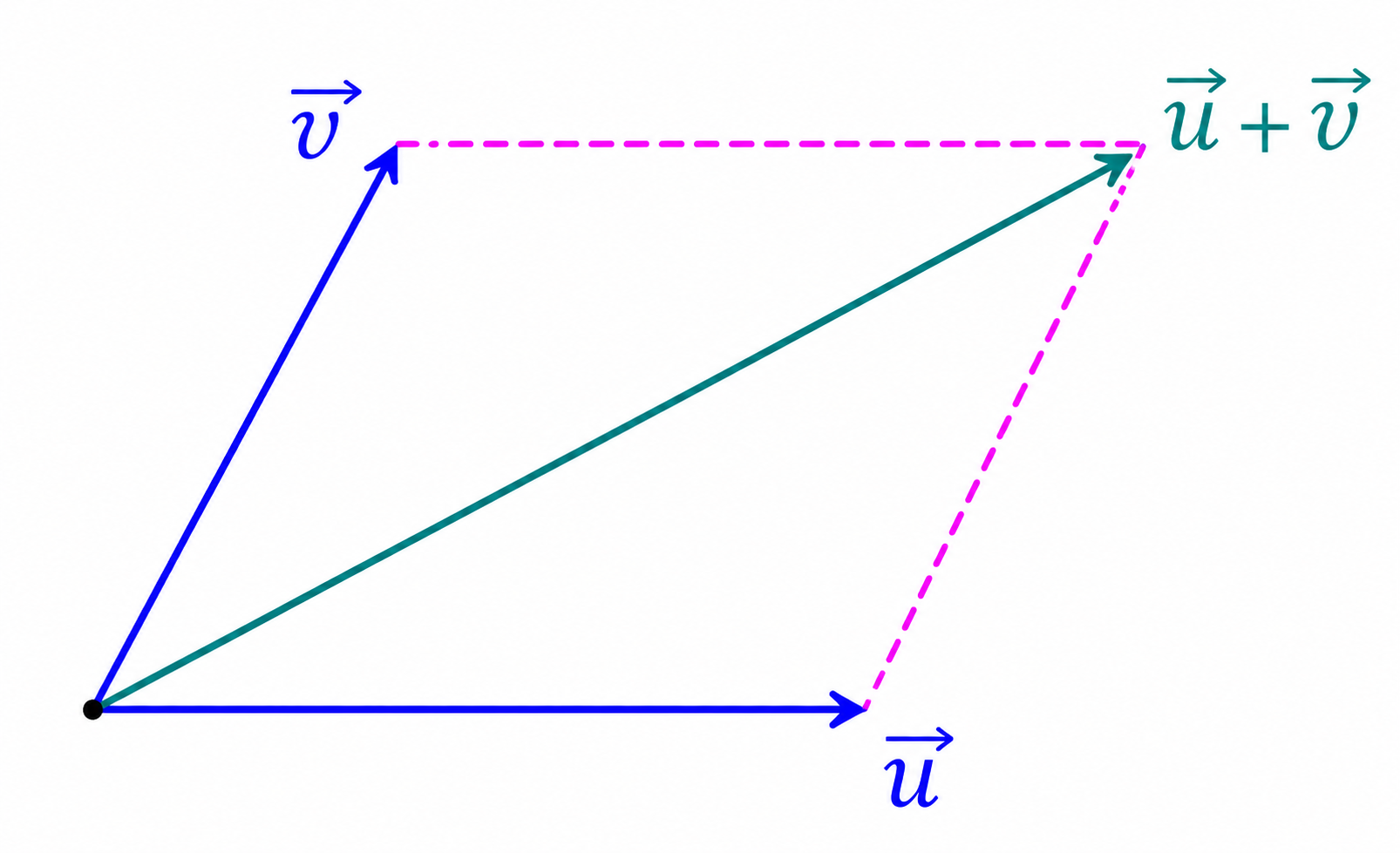
Geometrically, place the tail of v at the head of u. The vector from the starting point to the final point is
This is the head-to-tail rule.
Vector subtraction is addition of the opposite vector:
Therefore,
If
then multiplying by a scalar k gives
Its magnitude becomes
If k > 0, the direction stays the same.
If k < 0, the direction is reversed.
Two nonzero vectors u and v are parallel if one is a scalar multiple of the other:
for some nonzero real number k.
If
they point in the same direction.
If
they point in opposite directions.
A unit vector has magnitude 1.
For any nonzero vector v, the unit vector in the direction of v is
For example, if
then
so the corresponding unit vector is
If
then the vector from the origin O to P is
This is called the position vector of P.
Thus, points can often be represented and manipulated using vectors.
Vectors give a very clean way to describe points on a segment.
If A and B have position vectors a and b, then the midpoint M has position vector
More generally, every point on the line through A and B can be written as
When
the point lies on the segment AB.
For any three points A, B, C,
Indeed,
Thus,
Points A, B, C, D satisfy
Prove that the diagonals AC and BD have the same midpoint.
Let their position vectors be
The given condition implies
Rearranging,
The midpoint of AC has position vector
while the midpoint of BD has position vector
These are equal.
Therefore, AC and BD have the same midpoint.
Points A and B have position vectors a and b. A point P lies on AB and satisfies
Find the position vector of P.
Since
we have
Therefore,
Hence,
Three vertices of a parallelogram are
Given that A, B, C are consecutive vertices, find the fourth vertex D.
In a parallelogram,
Now
Therefore,
In triangle ABC, point M divides BC in the ratio
and point N divides AC in the ratio
The lines AM and BN intersect at P.
Find
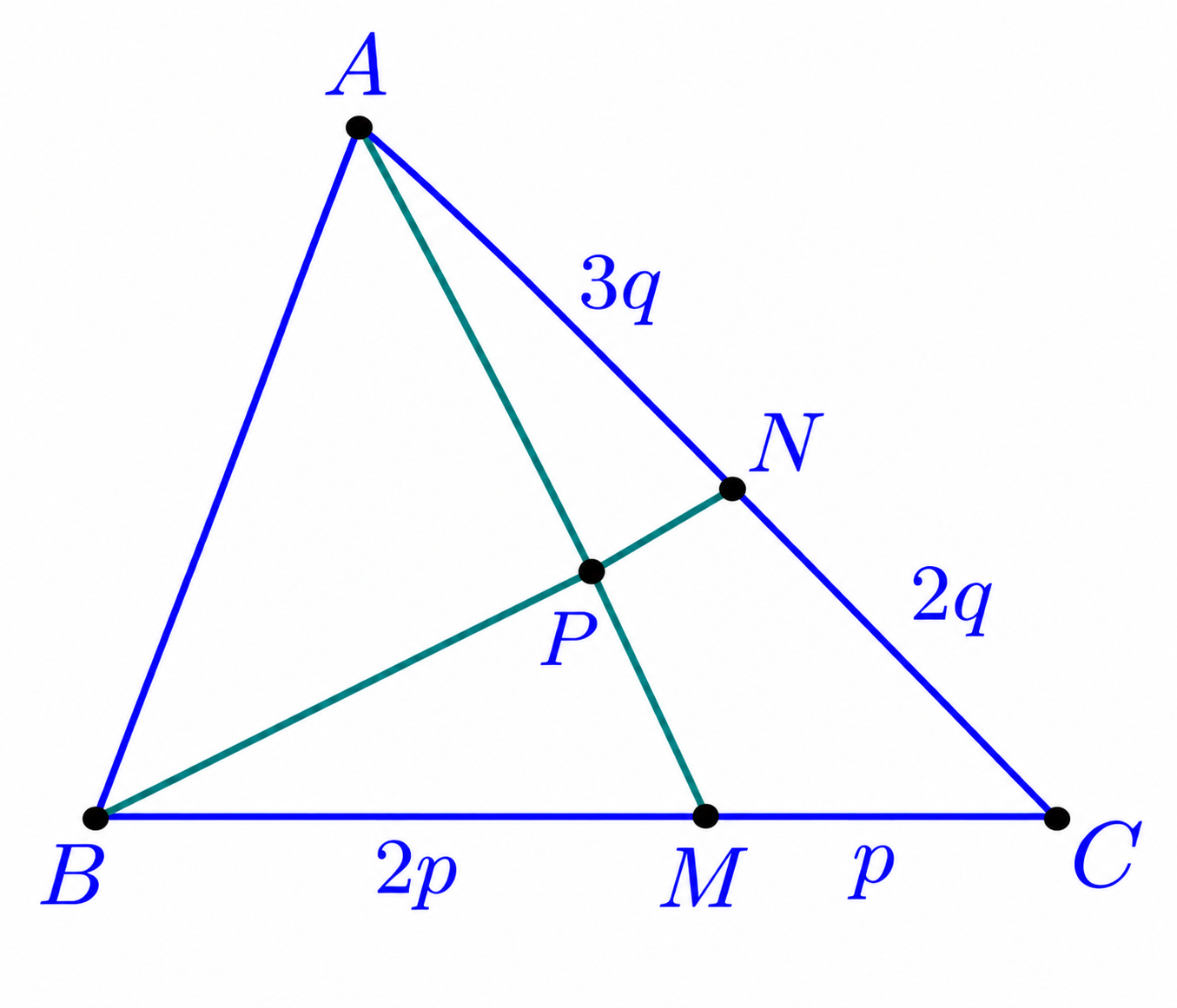
Take A as the origin and let the position vectors of B and C be
Since
we have
Also,
so
Since P lies on AM, write
Since P also lies on BN,
Thus,
Comparing coefficients,
and
The second equation gives
Hence,
Multiplying by 9,
so
Therefore,
Thus,