Olympiad Toolkit

A growing collection of essential formulas, identities, and techniques for mathematical olympiad problem solving.

Showing 51–100 of 166 toolkits
  1. 51.
    φ(n)=∣{1≤i≤n∣gcd⁡(i,n)=1}∣\varphi(n)=|\{1\le i\le n\mid\gcd(i,n)=1\}|

    φ(n)\varphi(n) is the number of integers from 11 to nn that are relatively prime to nn.

    If n=p1α1p2α2⋯pkαkn=p_1^{\alpha_1}p_2^{\alpha_2}\cdots p_k^{\alpha_k},

    φ(n)=n(1−1p1)(1−1p2)⋯(1−1pk)\varphi(n)=n\left(1-\frac{1}{p_1}\right)\left(1-\frac{1}{p_2}\right)\cdots\left(1-\frac{1}{p_k}\right)
  2. 52.

    Let nn be a positive integer. If gcd⁡(n,a)=1\gcd(n,a)=1,

    aφ(n)≡1(modn)a^{\varphi(n)}\equiv1\pmod n
  3. 53.
    TransformationExample
    Horizontal Shift Right 3y=f(x−3)y=f(x-3)
    Horizontal Shift Left 3y=f(x+3)y=f(x+3)
    Vertical Shift Up 3y=f(x)+3y=f(x)+3
    Vertical Shift Down 3y=f(x)−3y=f(x)-3
    Horizontal Stretch by Factor 2y=f(x/2)y=f(x/2)
    Horizontal Compression by Factor 2y=f(2x)y=f(2x)
    Vertical Stretch by Factor 2y=2f(x)y=2f(x)
    Vertical Compression by Factor 2y=12f(x)y=\frac{1}{2}f(x)
    Reflection in x-axisy=−f(x)y=-f(x)
    Reflection in y-axisy=f(−x)y=f(-x)
  4. 54.

    Triangle Area Formulas

    1.1.
    [ABC]=12Base⋅Height[ABC]=\frac12\text{Base}\cdot\text{Height}
    2.2.
    [ABC]=12bcsin⁡A[ABC]=\frac12 bc\sin A
    3.3.
    s=a+b+c2,[ABC]=s(s−a)(s−b)(s−c)s=\frac{a+b+c}{2},\qquad [ABC]=\sqrt{s(s-a)(s-b)(s-c)}
    4.4.
    [ABC]=a234(equilateral triangle)[ABC]=\frac{a^2\sqrt3}{4}\qquad\text{(equilateral triangle)}

    Quadrilateral Area Formulas

    1.1.
    [ABCD]=12AC⋅BDsin⁡α[ABCD]=\frac12 AC\cdot BD\sin\alpha
    2.2.
    [ABCD]=h(AB+CD)2(trapezoid)[ABCD]=\frac{h(AB+CD)}{2}\qquad\text{(trapezoid)}
    3.3.
    [ABCD]=bh(parallelogram)[ABCD]=bh\qquad\text{(parallelogram)}

    Circle Formulas

    1.1.
    A=πr2,C=2πrA=\pi r^2,\qquad C=2\pi r
    2.2.
    Asector=α360πr2A_{\text{sector}}=\frac{\alpha}{360}\pi r^2
    3.3.
    ℓarc=α360⋅2πr\ell_{\text{arc}}=\frac{\alpha}{360}\cdot2\pi r
  5. 55.
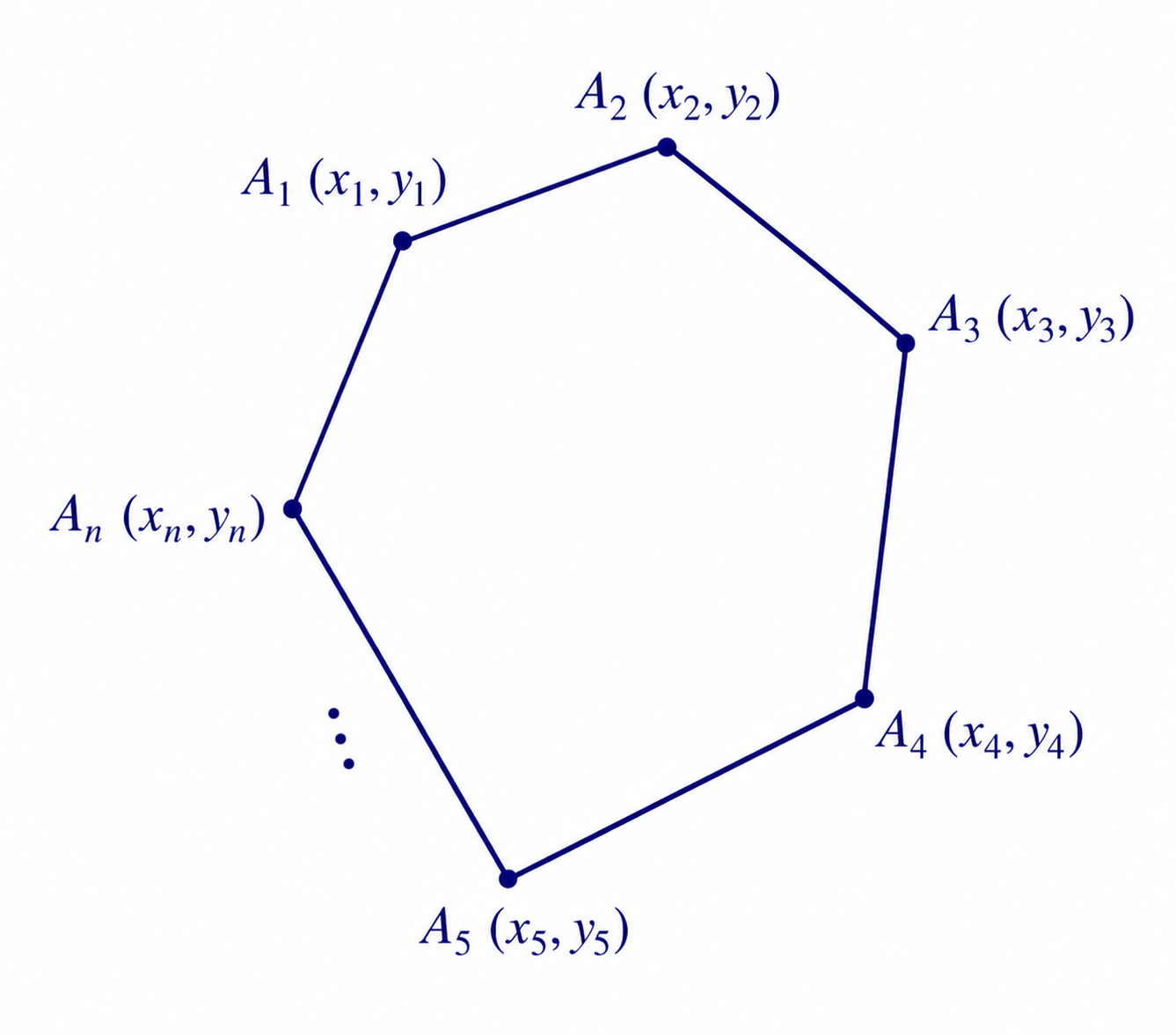
    Polygon with vertices A_1 through A_n
    Area=12∣x1y2+x2y3+⋯+xn−1yn+xny1−y1x2−y2x3−⋯−yn−1xn−ynx1∣\text{Area}=\tfrac{1}{2}\bigl|x_1y_2+x_2y_3+\cdots+x_{n-1}y_n+x_ny_1-y_1x_2-y_2x_3-\cdots-y_{n-1}x_n-y_nx_1\bigr|
  6. 56.

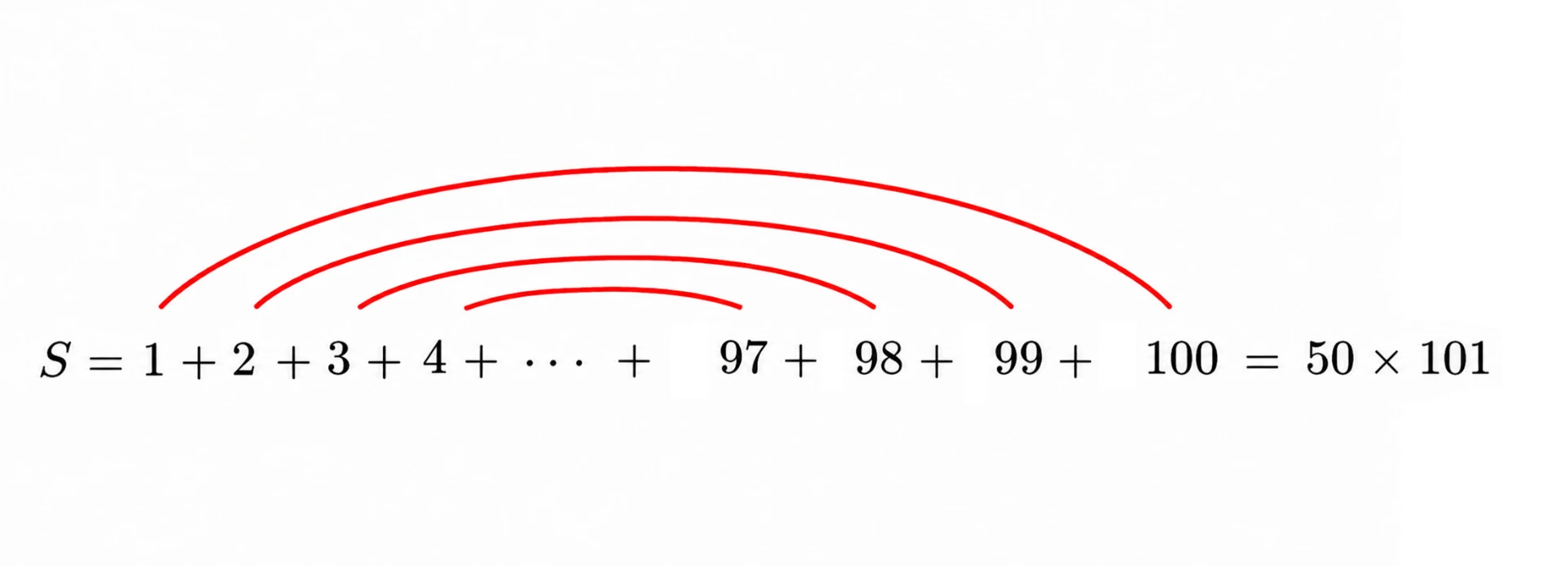
    Pair up the elements:

    Gauss pairing 1+100, 2+99, ... equals 50 x 101

    or

    S=1+2+3+⋯+98+99+100S=1+2+3+\cdots+98+99+100
    S=100+99+98+⋯+3+2+1S=100+99+98+\cdots+3+2+1
    2S=101+101+⋯+1012S=101+101+\cdots+101
    2S=100×1012S=100\times101

    Therefore:

    S=100×1012S=\frac{100\times101}{2}
  7. 57.
    θ\thetasin⁡θ\sin\thetacos⁡θ\cos\thetatan⁡θ\tan\thetacot⁡θ\cot\theta
    0∘0^\circ001100Undefined
    30∘30^\circ12\tfrac{1}{2}32\tfrac{\sqrt3}{2}33\tfrac{\sqrt3}{3}3\sqrt3
    45∘45^\circ22\tfrac{\sqrt2}{2}22\tfrac{\sqrt2}{2}1111
    60∘60^\circ32\tfrac{\sqrt3}{2}12\tfrac{1}{2}3\sqrt333\tfrac{\sqrt3}{3}
    90∘90^\circ1100Undefined00
    180∘180^\circ00−1-100Undefined
    270∘270^\circ−1-100Undefined00

    15° and 75°

    Anglesin⁡θ\sin\thetacos⁡θ\cos\thetatan⁡θ\tan\thetacot⁡θ\cot\theta
    15∘15^\circ6−24\dfrac{\sqrt{6}-\sqrt{2}}{4}6+24\dfrac{\sqrt{6}+\sqrt{2}}{4}2−32-\sqrt{3}2+32+\sqrt{3}
    75∘75^\circ6+24\dfrac{\sqrt{6}+\sqrt{2}}{4}6−24\dfrac{\sqrt{6}-\sqrt{2}}{4}2+32+\sqrt{3}2−32-\sqrt{3}

    18°, 36°, 54°, and 72°

    Anglesin⁡θ\sin\thetacos⁡θ\cos\thetatan⁡θ\tan\thetacot⁡θ\cot\theta
    18∘18^\circ5−14\dfrac{\sqrt{5}-1}{4}10+254\dfrac{\sqrt{10+2\sqrt{5}}}{4}15+25\dfrac{1}{\sqrt{5+2\sqrt{5}}}5+25\sqrt{5+2\sqrt{5}}
    36∘36^\circ10−254\dfrac{\sqrt{10-2\sqrt{5}}}{4}1+54\dfrac{1+\sqrt{5}}{4}5−25\sqrt{5-2\sqrt{5}}15−25\dfrac{1}{\sqrt{5-2\sqrt{5}}}
    54∘54^\circ1+54\dfrac{1+\sqrt{5}}{4}10−254\dfrac{\sqrt{10-2\sqrt{5}}}{4}15−25\dfrac{1}{\sqrt{5-2\sqrt{5}}}5−25\sqrt{5-2\sqrt{5}}
    72∘72^\circ10+254\dfrac{\sqrt{10+2\sqrt{5}}}{4}5−14\dfrac{\sqrt{5}-1}{4}5+25\sqrt{5+2\sqrt{5}}15+25\dfrac{1}{\sqrt{5+2\sqrt{5}}}
  8. 58.
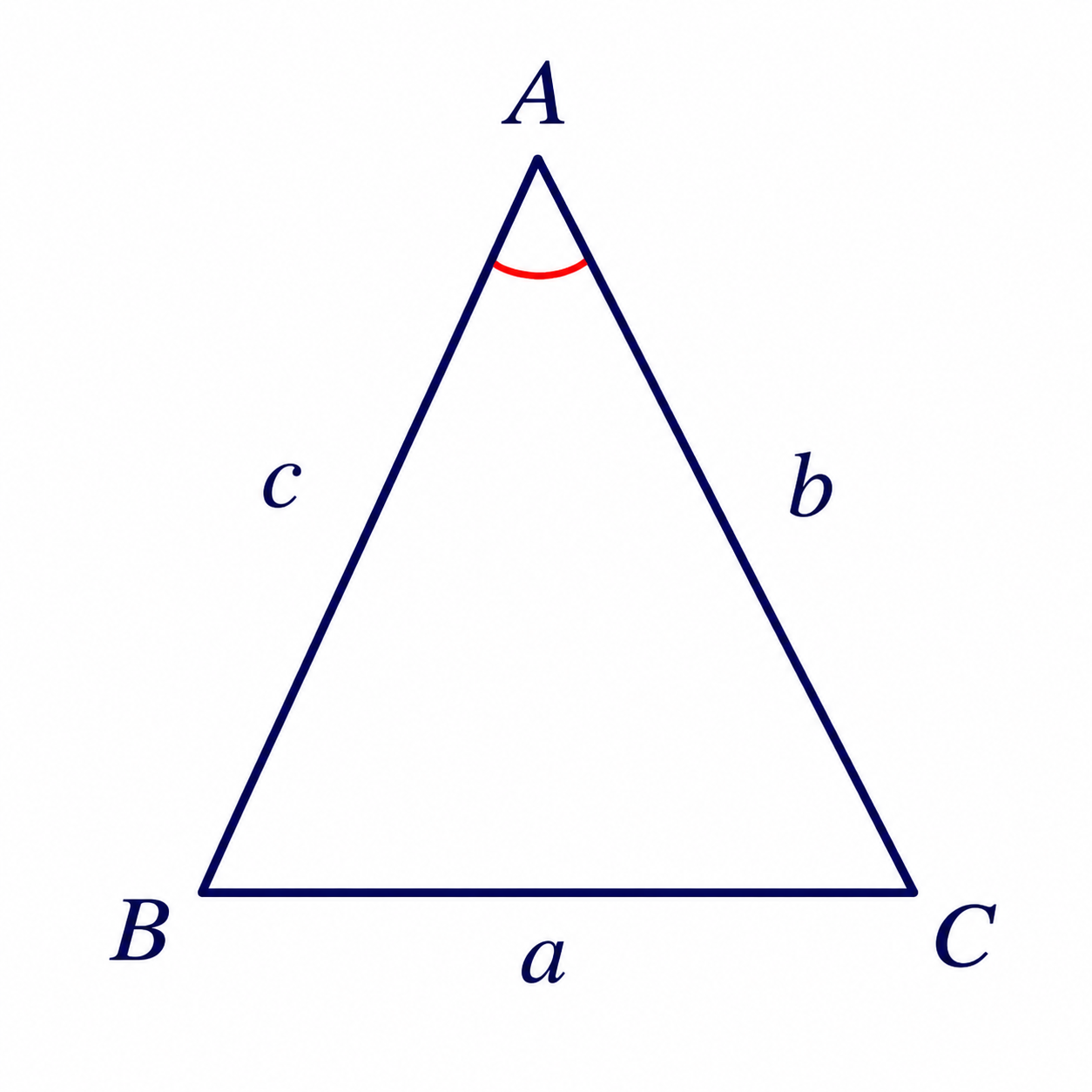
    Triangle ABC with sides a, b, c
    a2=b2+c2−2bccos⁡Aa^2=b^2+c^2-2bc\cos A
  9. 59.
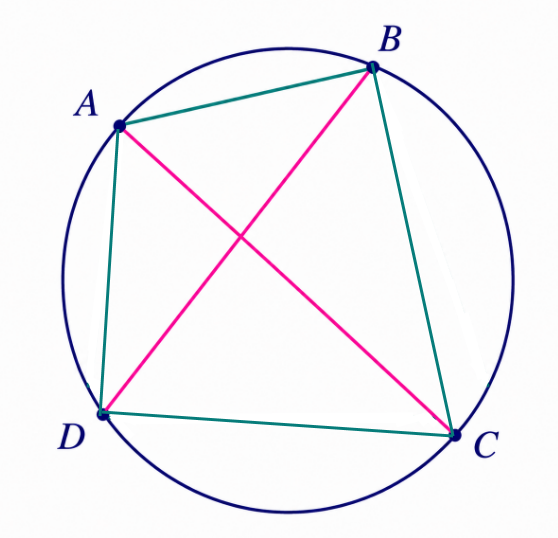
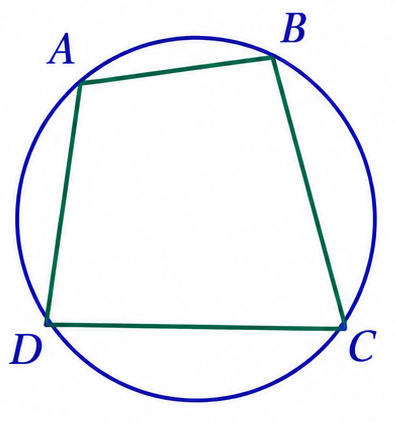
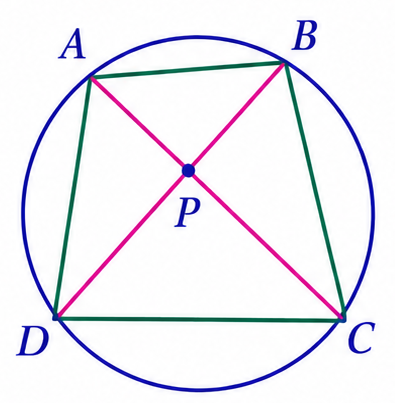
    Cyclic quadrilateral ABCD with diagonals

    A quadrilateral ABCDABCD is cyclic if and only if:

    AB⋅CD+AD⋅BC=AC⋅BDAB\cdot CD+AD\cdot BC=AC\cdot BD
  10. 60.
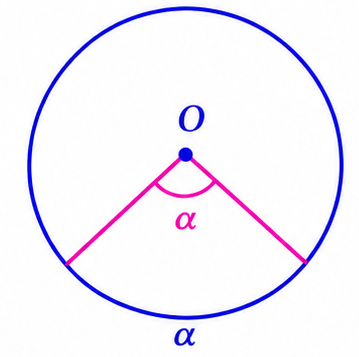
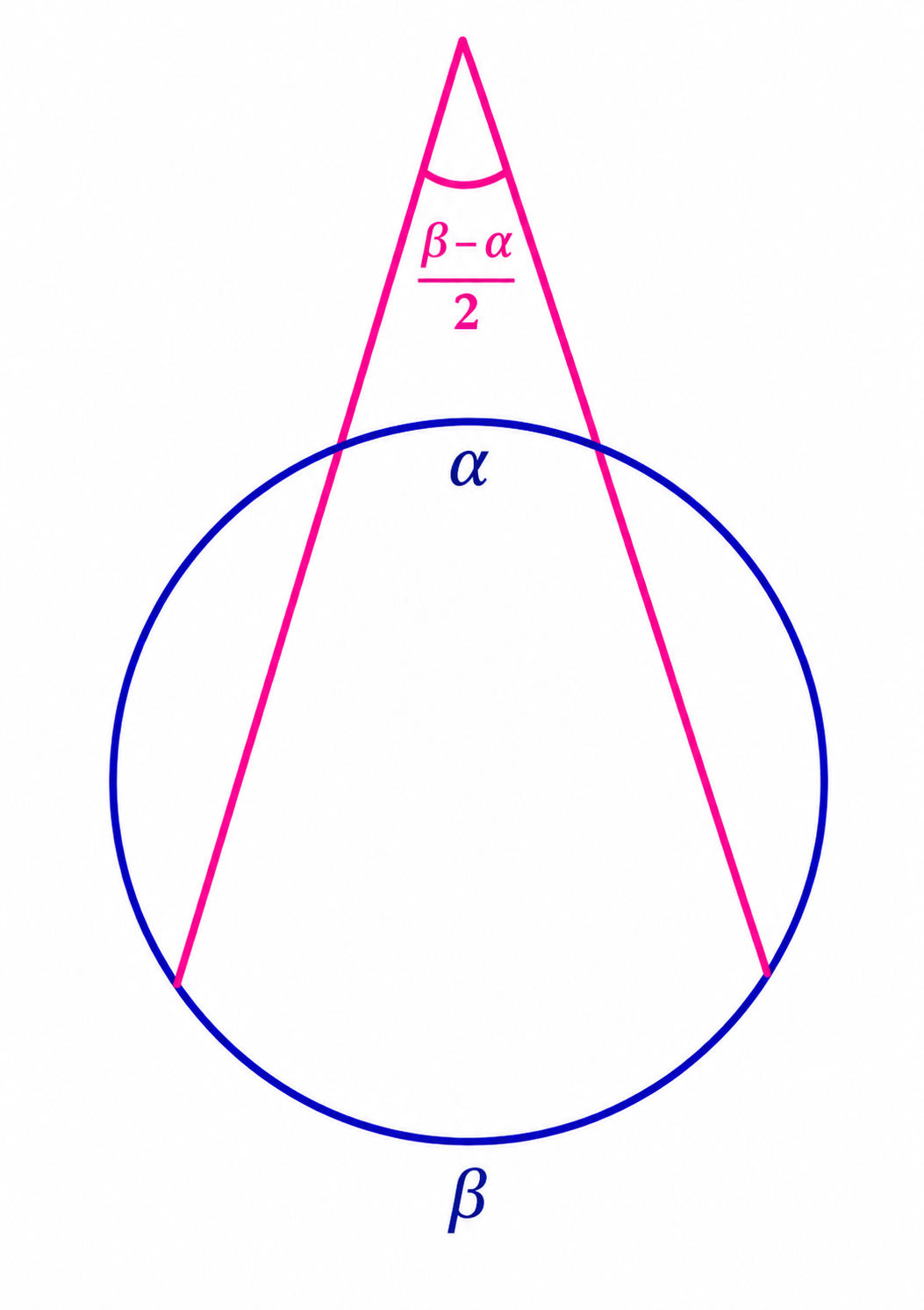
    Central angle
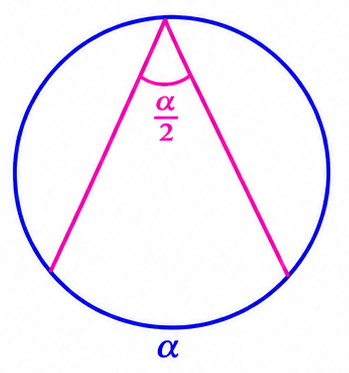
    Inscribed angle
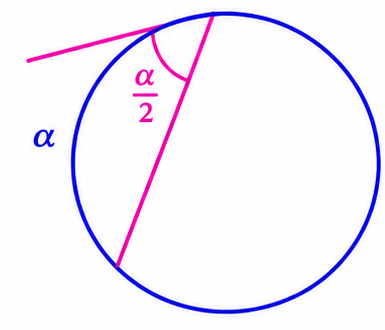
    Tangent-chord angle
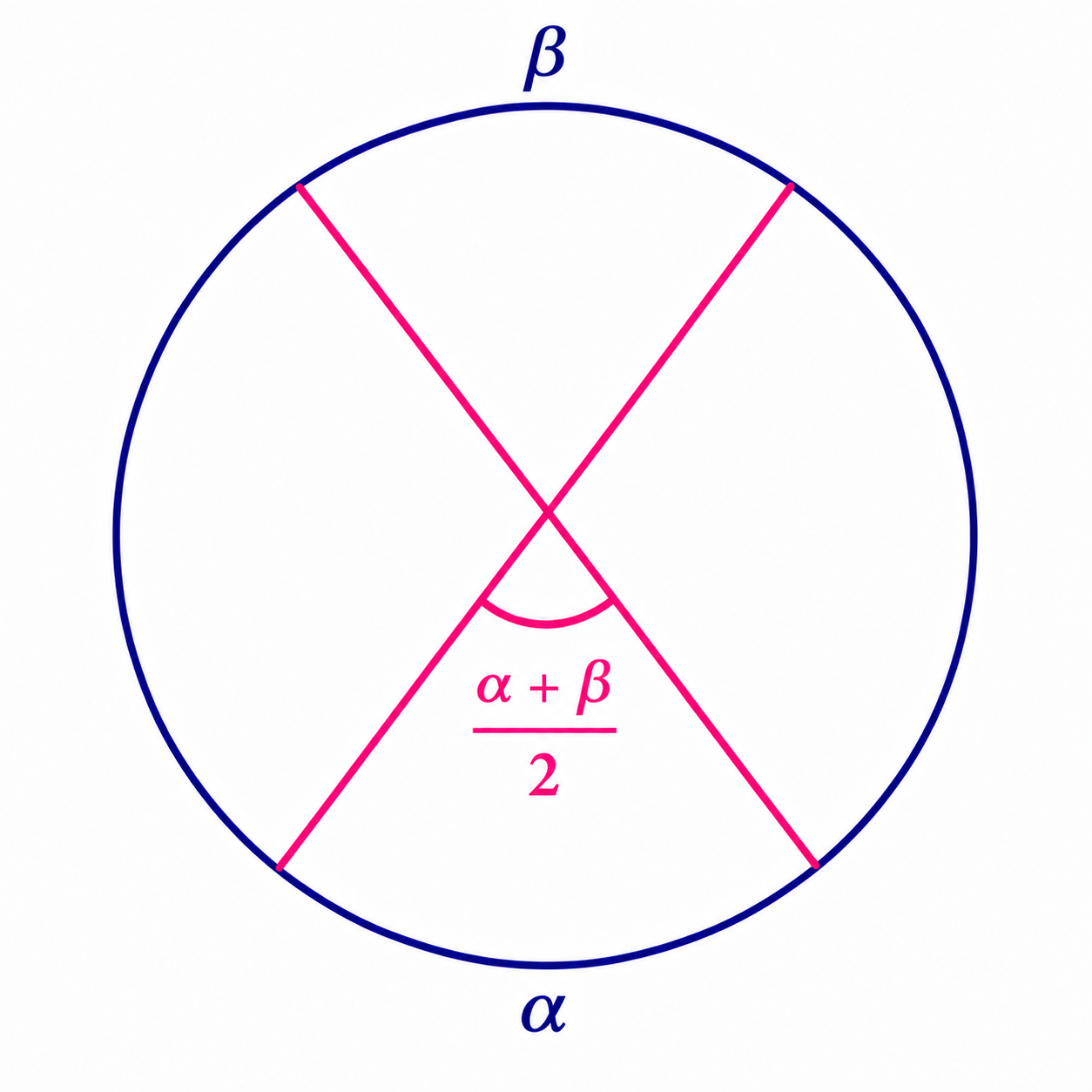
    Interior angle
    Exterior angle
  11. 61.
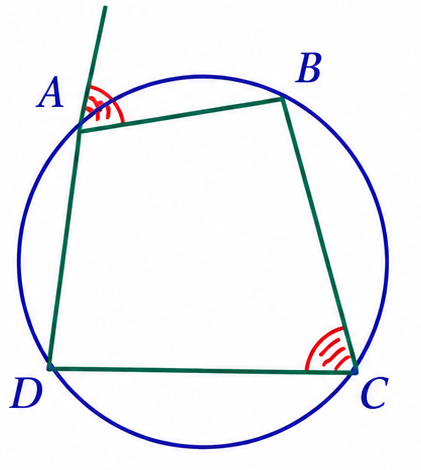
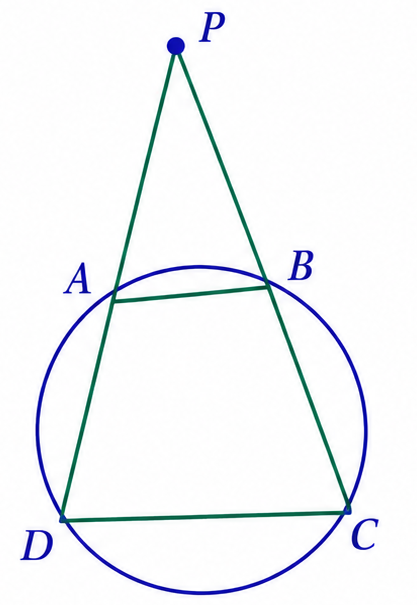
    Opposite angles
    Opposite angles
    1.∠A+∠C=180∘1.\quad \angle A+\angle C=180^\circ
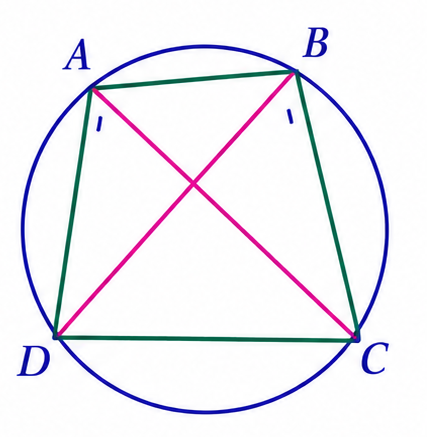
    Equal angles
    2.∠A1=∠C12.\quad \angle A_1=\angle C_1
    Intersecting chords
    3.PA⋅PC=PB⋅PD3.\quad PA\cdot PC=PB\cdot PD
    Power of a point
    4.PA⋅PD=PB⋅PC4.\quad PA\cdot PD=PB\cdot PC
  12. 62.
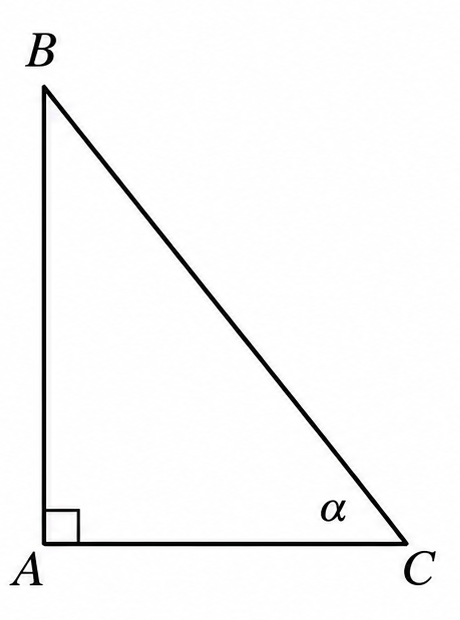
    Right triangle ABC with right angle at A and angle alpha at C
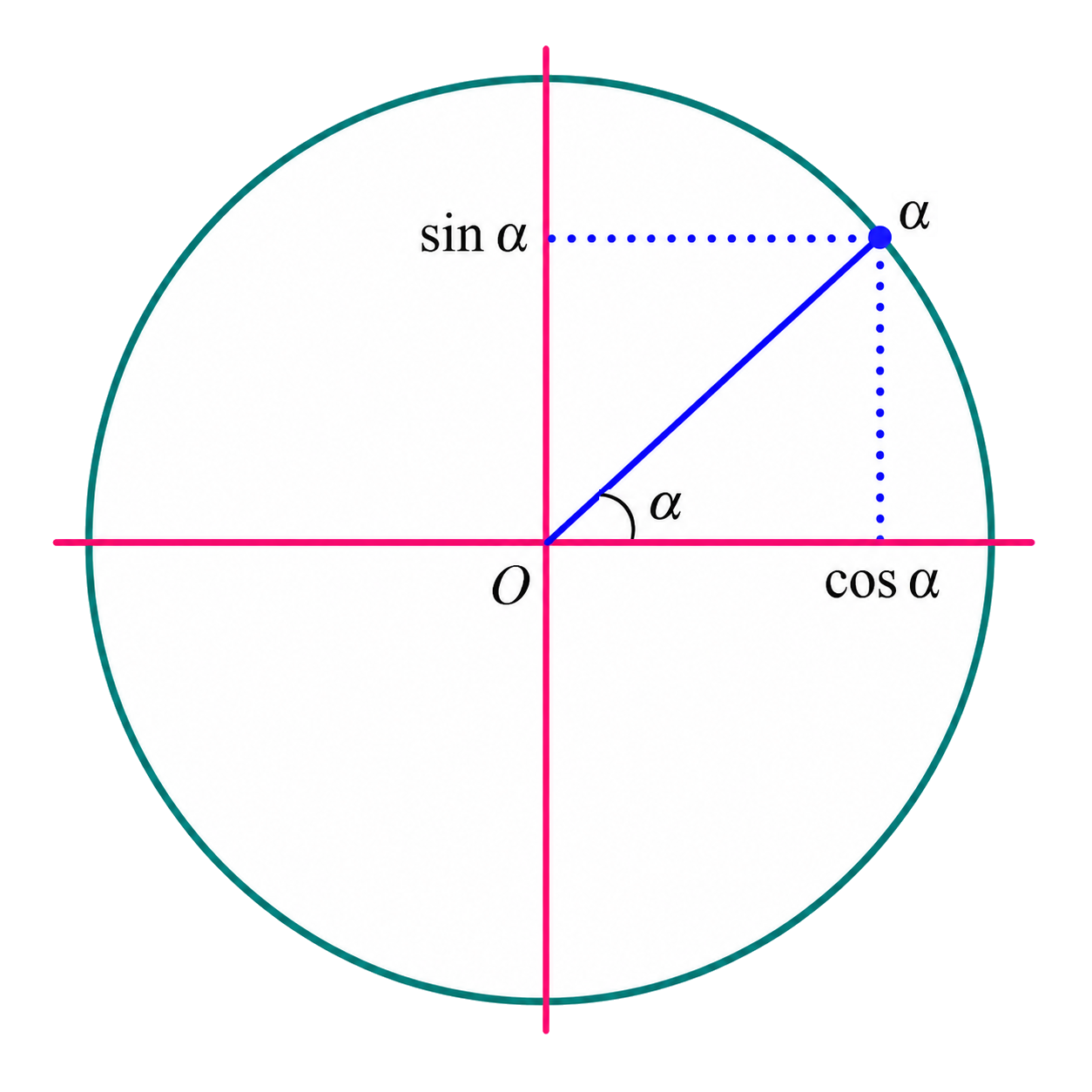
    sin⁡α=Opposite SideHypotenuse=ABBC\sin\alpha=\frac{\text{Opposite Side}}{\text{Hypotenuse}}=\frac{AB}{BC}
    cos⁡α=Adjacent SideHypotenuse=ACBC\cos\alpha=\frac{\text{Adjacent Side}}{\text{Hypotenuse}}=\frac{AC}{BC}
    tan⁡α=Opposite SideAdjacent Side=ABAC\tan\alpha=\frac{\text{Opposite Side}}{\text{Adjacent Side}}=\frac{AB}{AC}
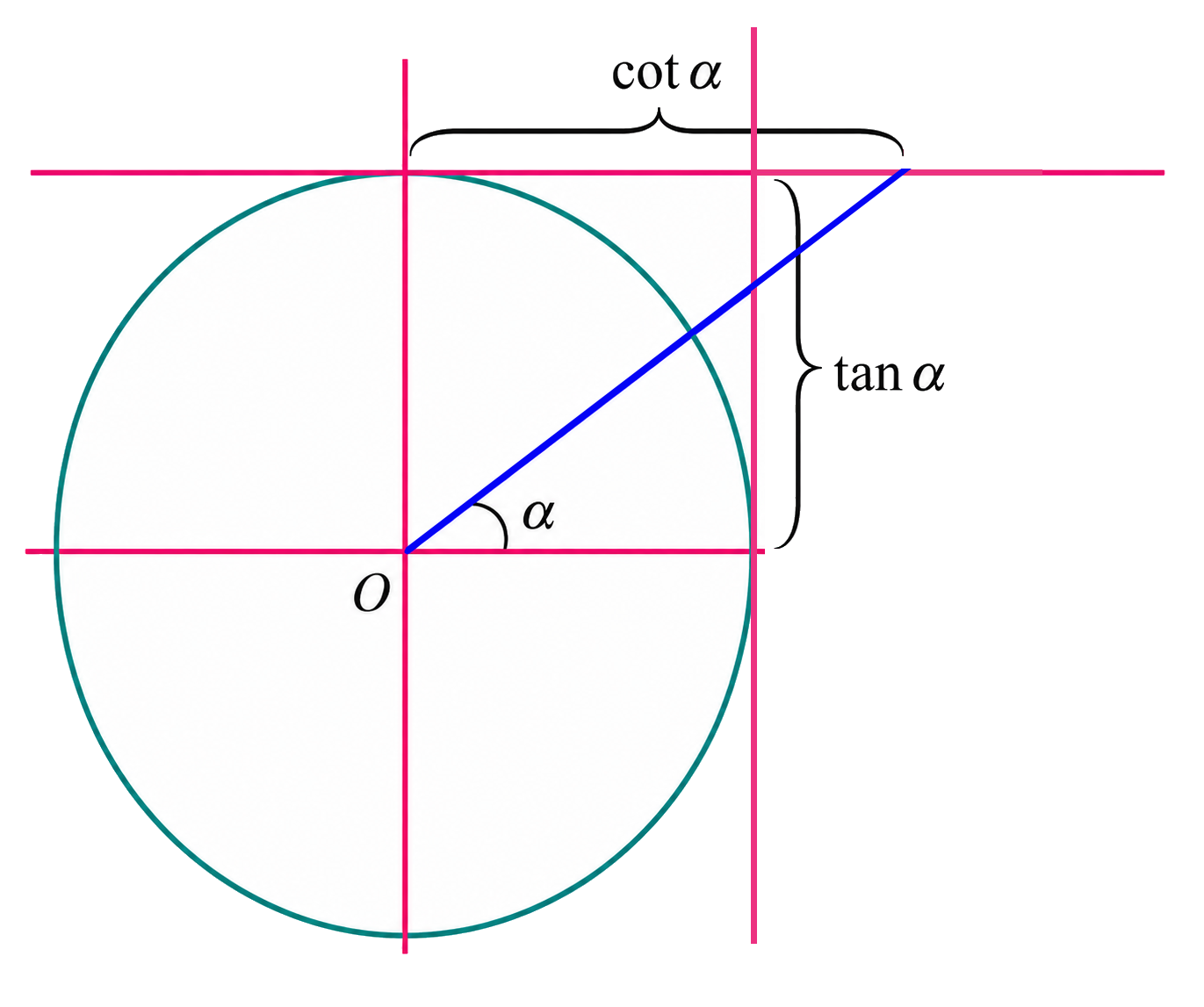
    cot⁡α=Adjacent SideOpposite Side=ACAB\cot\alpha=\frac{\text{Adjacent Side}}{\text{Opposite Side}}=\frac{AC}{AB}
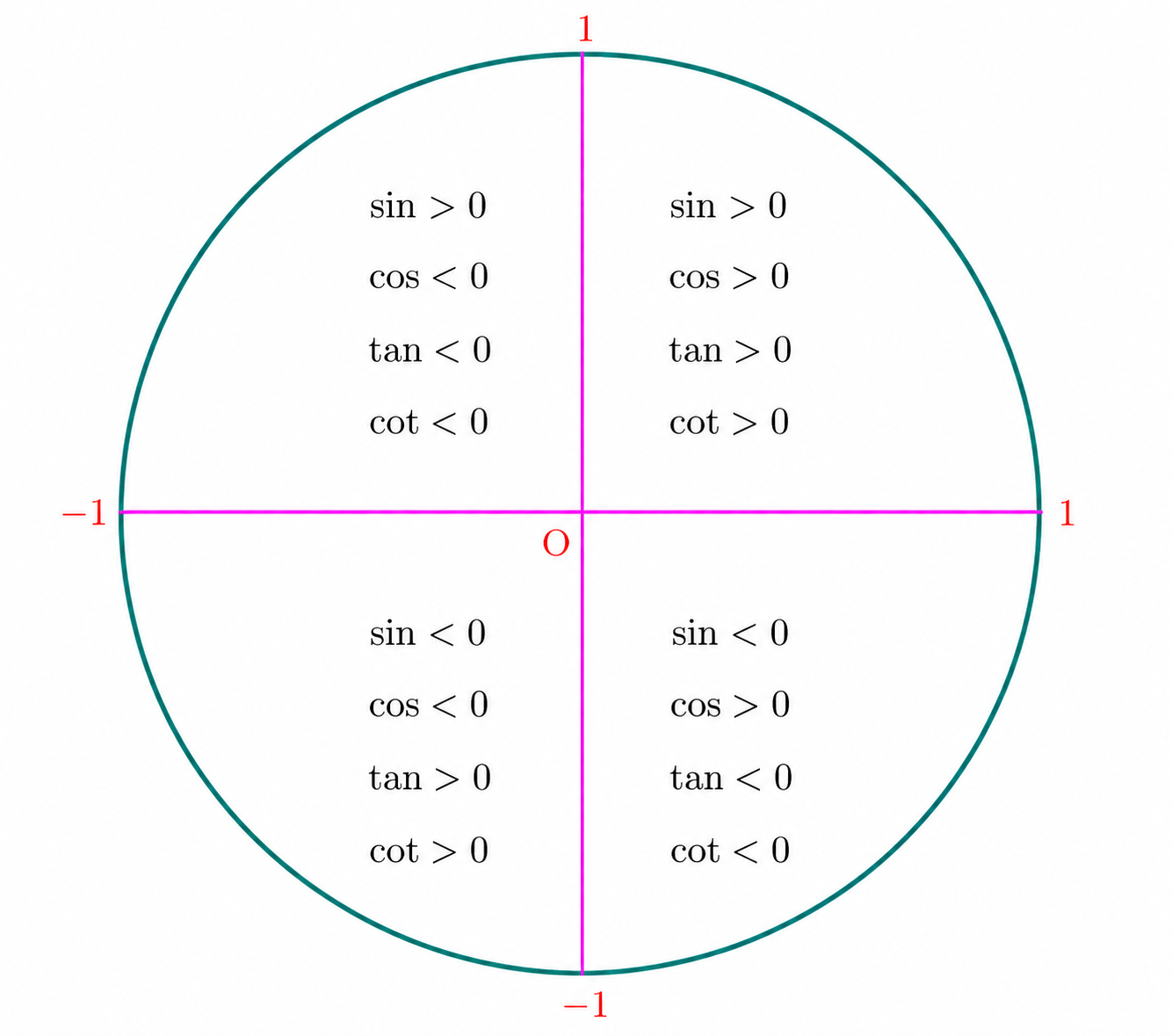
    Unit circle showing sin alpha and cos alpha
    Unit circle showing tan alpha and cot alpha
    Unit circle showing tan alpha and cot alpha
  13. 63.
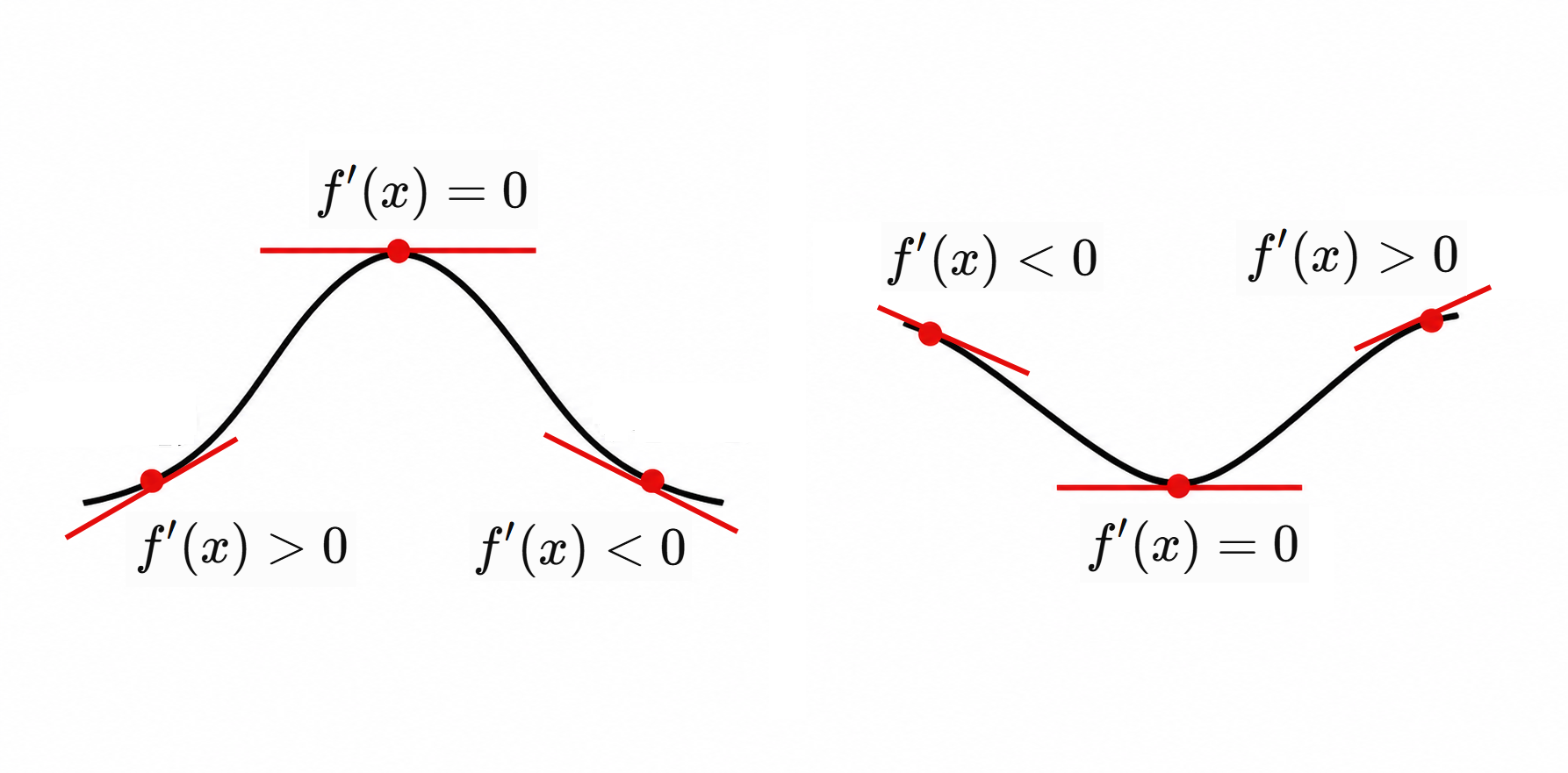
    Derivative
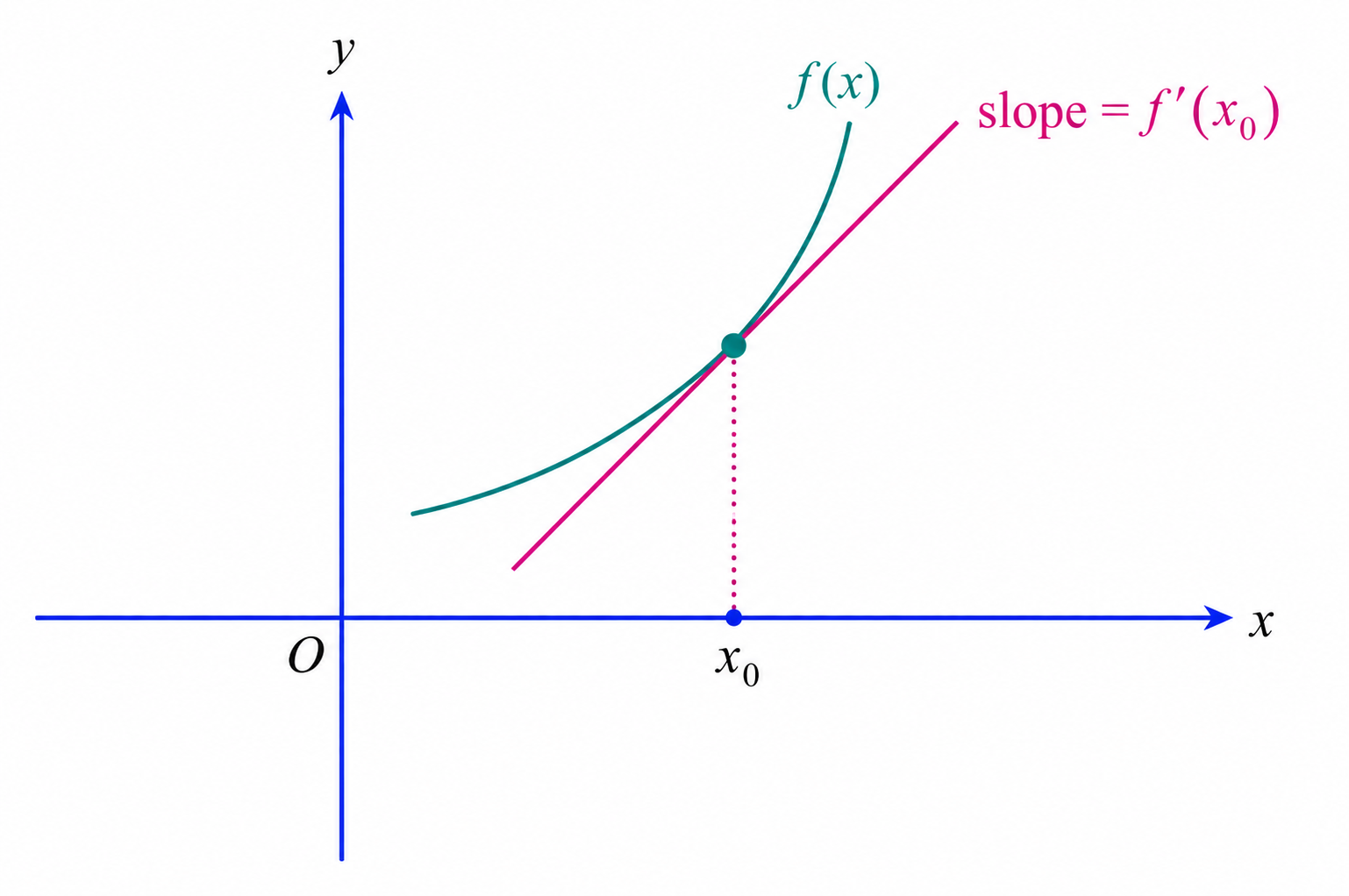
    f′(x0)=lim⁡h→0f(x0+h)−f(x0)hf'(x_0)=\lim_{h\to0}\frac{f(x_0+h)-f(x_0)}{h}
    Critical points
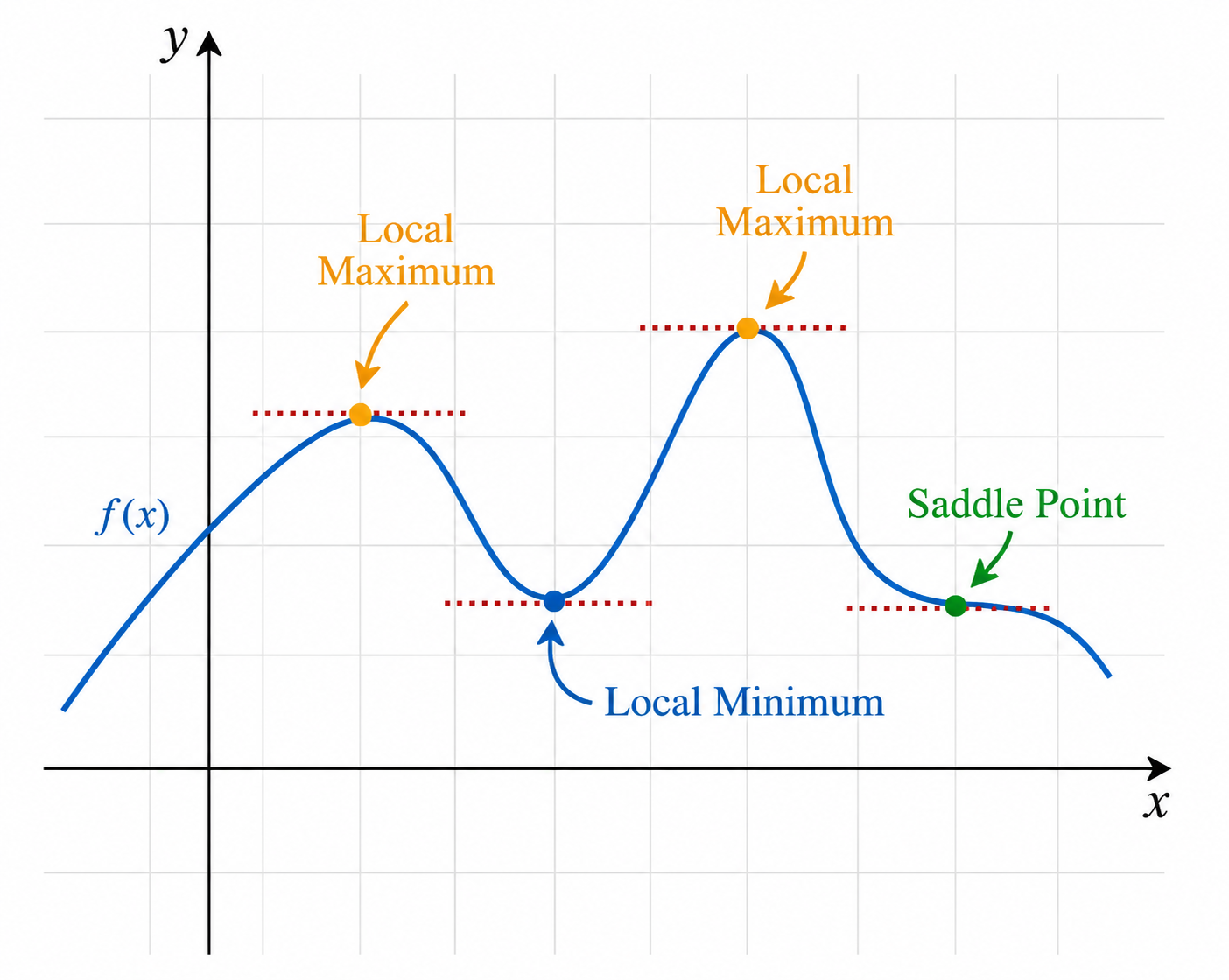
    f′(x)=0(critical points)f'(x)=0\qquad\text{(critical points)}
    Increasing and decreasing
    f′(x)>0⇒f(x)↑f′(x)<0⇒f(x)↓f'(x)>0\Rightarrow f(x)\uparrow\qquad f'(x)<0\Rightarrow f(x)\downarrow
  14. 64.
    3,9:n≡(sum of digits)3,9:\quad n\equiv\text{(sum of digits)}
    11:n≡(alternating sum of digits)11:\quad n\equiv\text{(alternating sum of digits)}
    2,5,10:last digit2,5,10:\quad \text{last digit}
    4,25,100:last 2 digits4,25,100:\quad \text{last 2 digits}
    8,125,1000:last 3 digits8,125,1000:\quad \text{last 3 digits}
  15. 65.

    Constraints can be based on the number of elements, on the size of the elements, or on other conditions.

    But usually, if you base your answer on the most limiting case, it will make the problem easier to solve.

  16. 66.
    ∣ ∣ ∣a∣−∣b∣+∣c∣−∣d∣ ∣ ∣≡a+b+c+d(mod2)\bigl|\,|\,|a|-|b|+|c|-|d|\,|\,\bigr|\equiv a+b+c+d\pmod{2}
  17. 67.
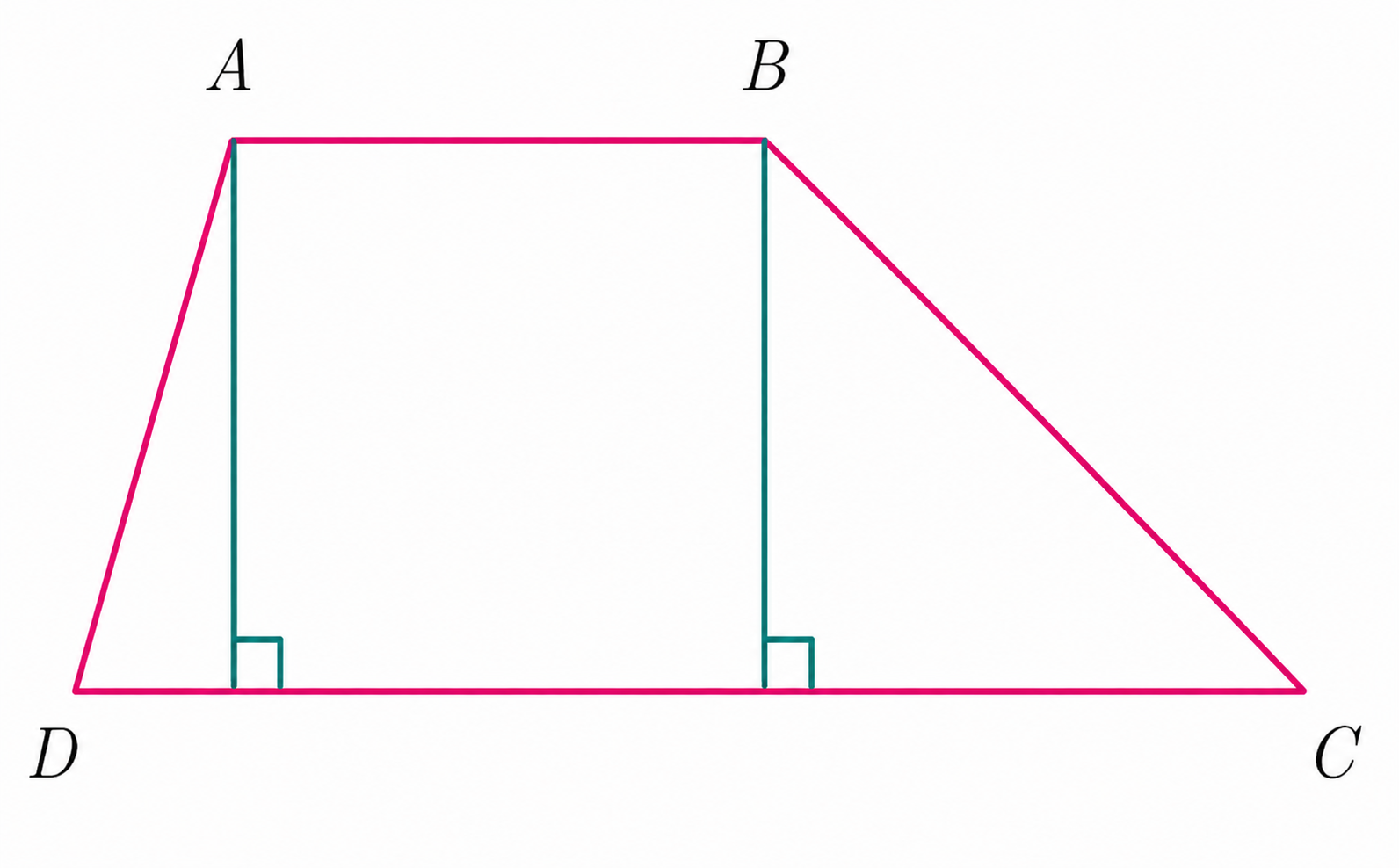
    Trapezoid ABCD with altitudes drawn from A and B to base DC

    When working with a trapezoid, drawing the altitudes creates right triangles and often simplifies the problem.
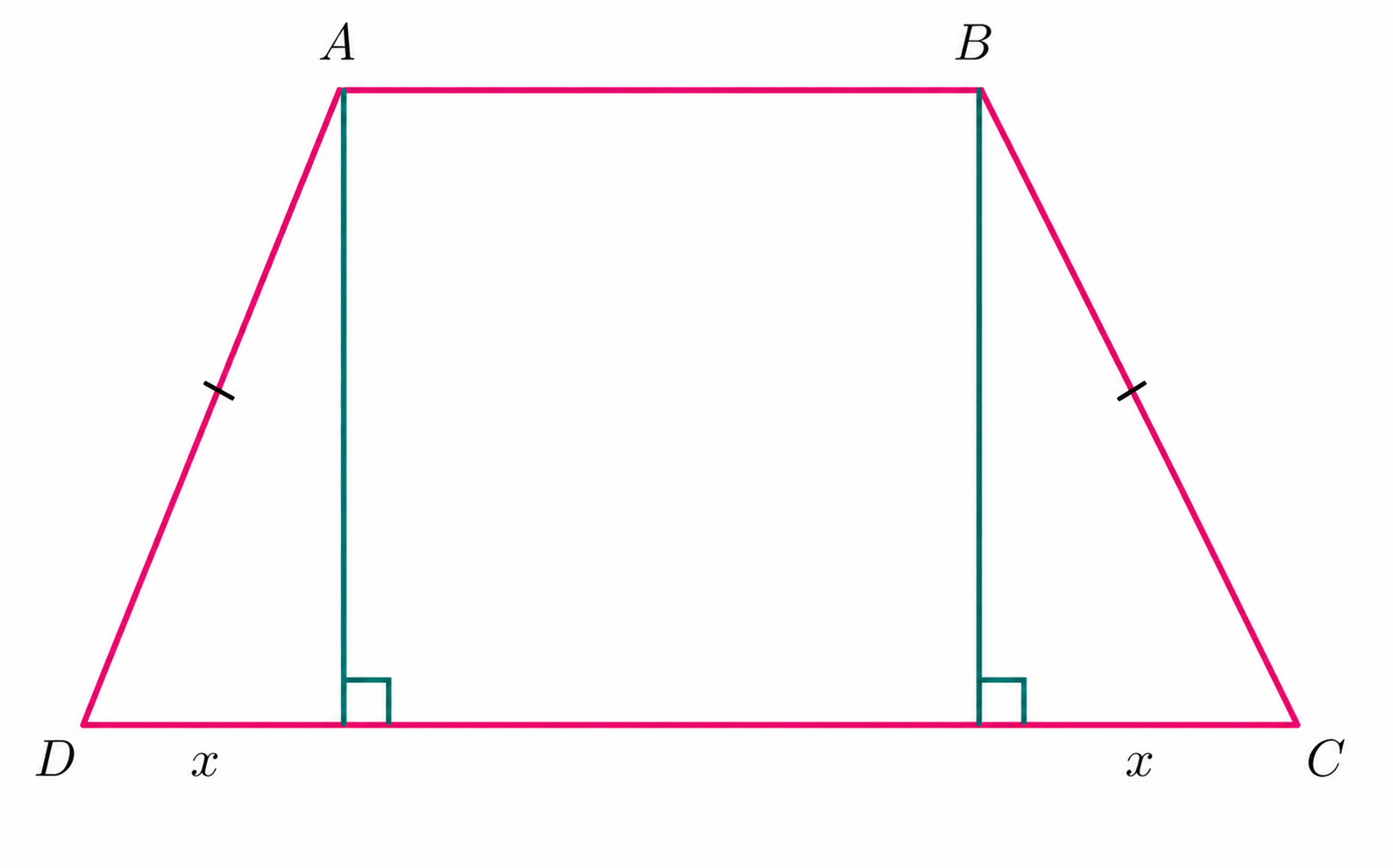
    Isosceles trapezoid with altitudes and equal side lengths
    x=CD−AB2x=\frac{CD-AB}{2}
  18. 68.
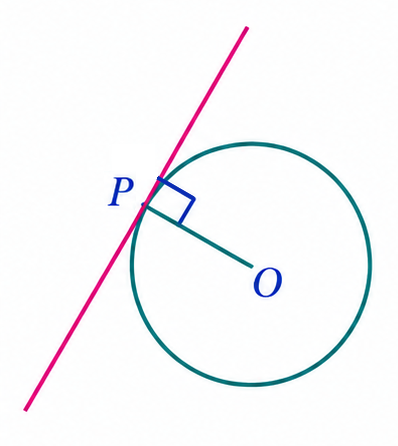
    Tangent and radius
    1.OP⊥tangent1.\quad OP\perp\text{tangent}
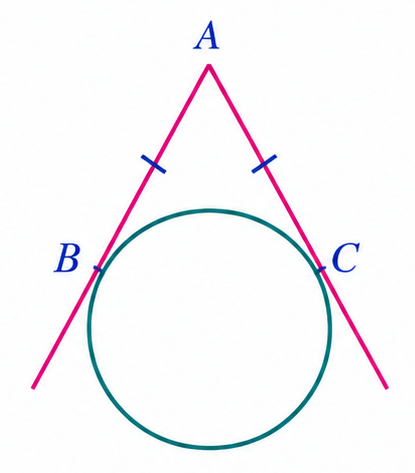
    Two tangents
    2.AB=AC2.\quad AB=AC
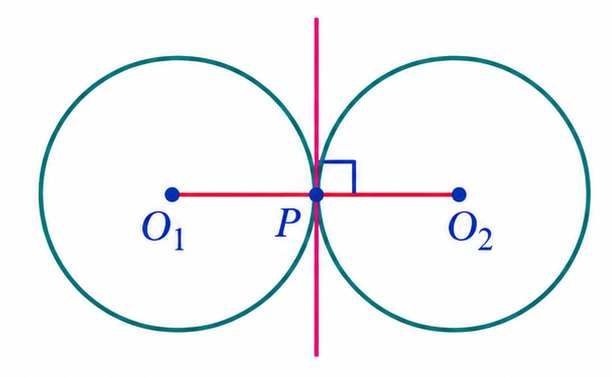
    Externally tangent circles
    3.O1O2=R1+R23.\quad O_1O_2=R_1+R_2
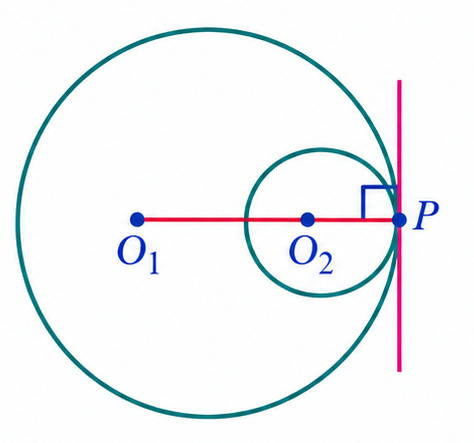
    Internally tangent circles
    4.O1O2=R2−R14.\quad O_1O_2=R_2-R_1
  19. 69.

    1) Square it.

    2) Use a changing variable.

  20. 70.

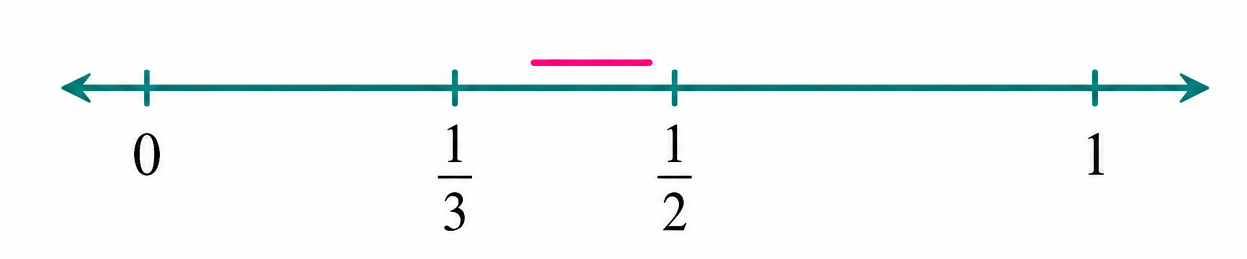
    1 dimension

    0≤x≤10\le x\le 1
    P ⁣(13<x<12)=12−13=16P\!\left(\tfrac{1}{3}<x<\tfrac{1}{2}\right)=\tfrac{1}{2}-\tfrac{1}{3}=\tfrac{1}{6}
    Number line from 0 to 1 with segment between 1/3 and 1/2 highlighted

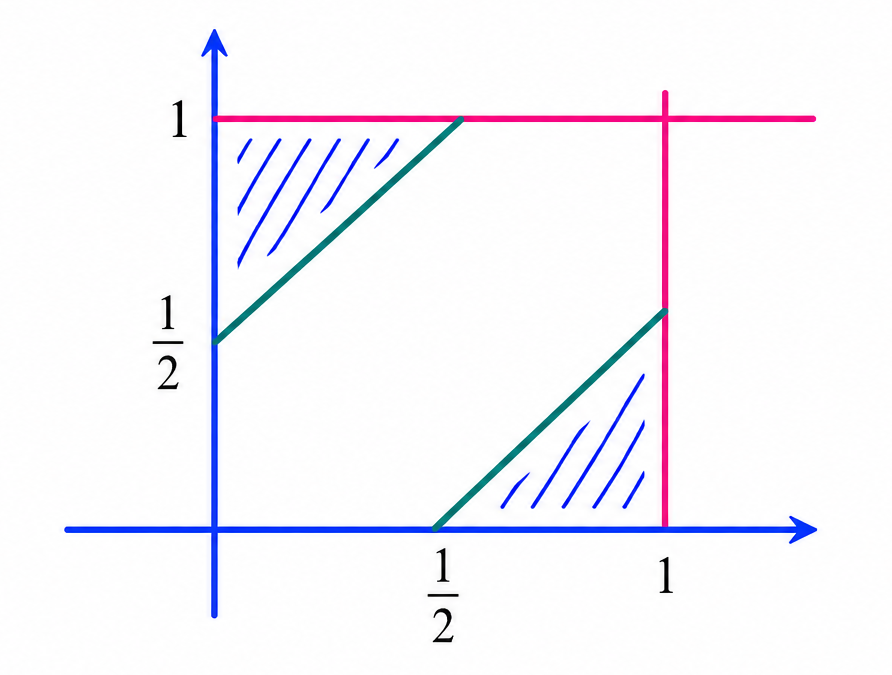
    2 dimensions

    0≤x,y≤10\le x,y\le 1
    P(∣x−y∣≥12)=2×12×122=14P(|x-y|\ge \tfrac{1}{2})=2\times\frac{\tfrac{1}{2}\times\tfrac{1}{2}}{2}=\tfrac{1}{4}
    Unit square with two shaded triangles representing |x-y| >= 1/2

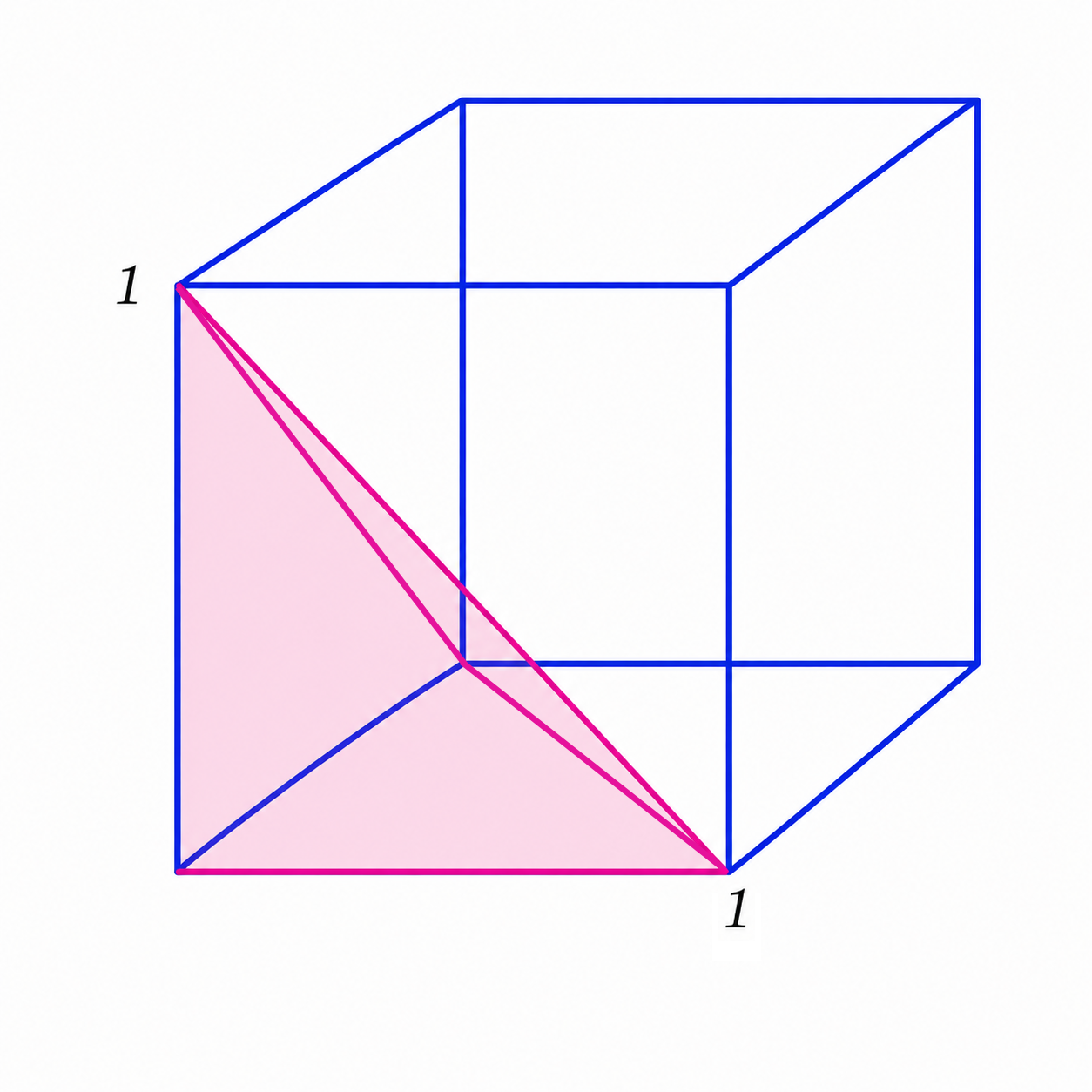
    3 dimensions

    0≤x,y,z≤10\le x,y,z\le 1
    P(x+y+z≤1)=12×12×123=16P(x+y+z\le 1)=\frac{\tfrac{1}{2}\times\tfrac{1}{2}\times\tfrac{1}{2}}{3}=\tfrac{1}{6}
    Unit cube with tetrahedron representing x+y+z <= 1 shaded
  21. 71.
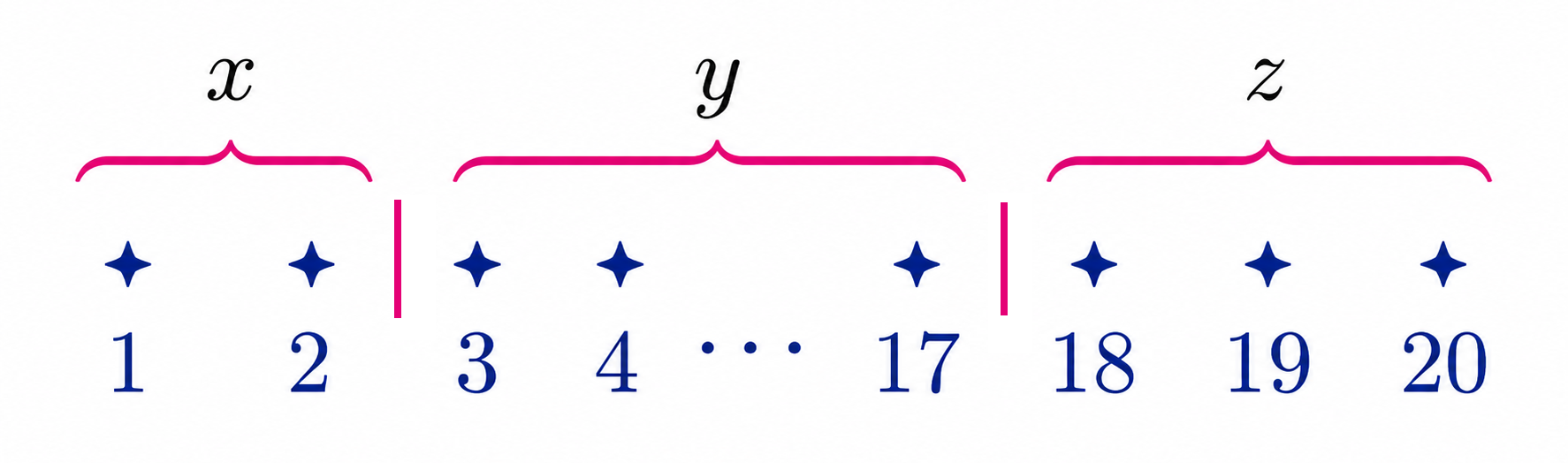
    Stars and Bars
    x1+x2+⋯+xk=n,xi≥1x_1+x_2+\cdots+x_k=n,\qquad x_i\ge1
    (n−1k−1)\binom{n-1}{k-1}
    x1+x2+⋯+xk=n,xi≥aix_1+x_2+\cdots+x_k=n,\qquad x_i\ge a_i
    xi′=xi−ai+1x_i'=x_i-a_i+1
    (n−∑ai+k−1k−1)\binom{n-\sum a_i+k-1}{k-1}
    x1+x2+⋯+xk≤n,xi≥1x_1+x_2+\cdots+x_k\le n,\qquad x_i\ge1
    (nk)\binom{n}{k}
    xi≤M  ⇒  Total−Badx_i\le M\;\Rightarrow\;\text{Total}-\text{Bad}
  22. 72.
    A,B⊆{1,2,…,n}A,B\subseteq\{1,2,\ldots,n\}
    A∩B=∅A\cap B=\varnothing

    Instead of considering the subsets, we should consider the elements.

    Each element has 3 possible choices for AA and BB:

    AB✓✓✓××✓\begin{array}{c|c} A & B\\ \hline \checkmark & \checkmark\\ \checkmark & \times\\ \times & \checkmark \end{array}

    Therefore,

    3⋅3⋅3⋯3⏟n times=3n.\underbrace{3\cdot 3\cdot 3\cdots 3}_{n\text{ times}}=3^n.
  23. 73.
    1.an=an−1+f(n)1.\quad a_n=a_{n-1}+f(n)
    Write an−an−1=f(n) and telescope.\text{Write }a_n-a_{n-1}=f(n)\text{ and telescope.}
    2.an=can−1+f(n)2.\quad a_n=ca_{n-1}+f(n)
    bn=ancnb_n=\frac{a_n}{c^n}
    Then telescope bn.\text{Then telescope }b_n.
    3.an=nan−1+f(n)3.\quad a_n=na_{n-1}+f(n)
    bn=ann!b_n=\frac{a_n}{n!}
    Then telescope bn.\text{Then telescope }b_n.
  24. 74.

    Start with:

    1⋅21+2⋅22+3⋅23+⋯+(n−1)2n−1+n 2n.1\cdot 2^1+2\cdot 2^2+3\cdot 2^3+\cdots+(n-1)2^{n-1}+n\,2^n.

    Write the following equations in a triangular arrangement:

    21+22+23+⋯+2n−1+2n ⟶ 2n+1−21  22+23+⋯+2n−1+2n ⟶ 2n+1−22  23+⋯+2n−1+2n ⟶ 2n+1−23  ⋮  2n−1+2n ⟶ 2n+1−2n−1 2n ⟶ 2n+1−2n\begin{array}{l} 2^1+2^2+2^3+\cdots+2^{n-1}+2^n\ \longrightarrow\ 2^{n+1}-2^1\\[2pt] \qquad\ \ 2^2+2^3+\cdots+2^{n-1}+2^n\ \longrightarrow\ 2^{n+1}-2^2\\[2pt] \qquad\qquad\ \ 2^3+\cdots+2^{n-1}+2^n\ \longrightarrow\ 2^{n+1}-2^3\\[2pt] \qquad\qquad\qquad\qquad\ \ \vdots\\[2pt] \qquad\qquad\qquad\qquad\qquad\ \ 2^{n-1}+2^n\ \longrightarrow\ 2^{n+1}-2^{n-1}\\[2pt] \qquad\qquad\qquad\qquad\qquad\qquad\qquad\ 2^n\ \longrightarrow\ 2^{n+1}-2^n \end{array}

    Then add them:

    =n 2n+1−(21+22+23+⋯+2n−1+2n).=n\,2^{n+1}-\left(2^1+2^2+2^3+\cdots+2^{n-1}+2^n\right).

    Since

    21+22+⋯+2n−1+2n=2n+1−21,2^1+2^2+\cdots+2^{n-1}+2^n=2^{n+1}-2^1,

    we get

    =n 2n+1−(2n+1−21)=n\,2^{n+1}-(2^{n+1}-2^1)
    =(n−1)2n+1+21.=\boxed{(n-1)2^{n+1}+2^1}.
  25. 75.
  26. 76.
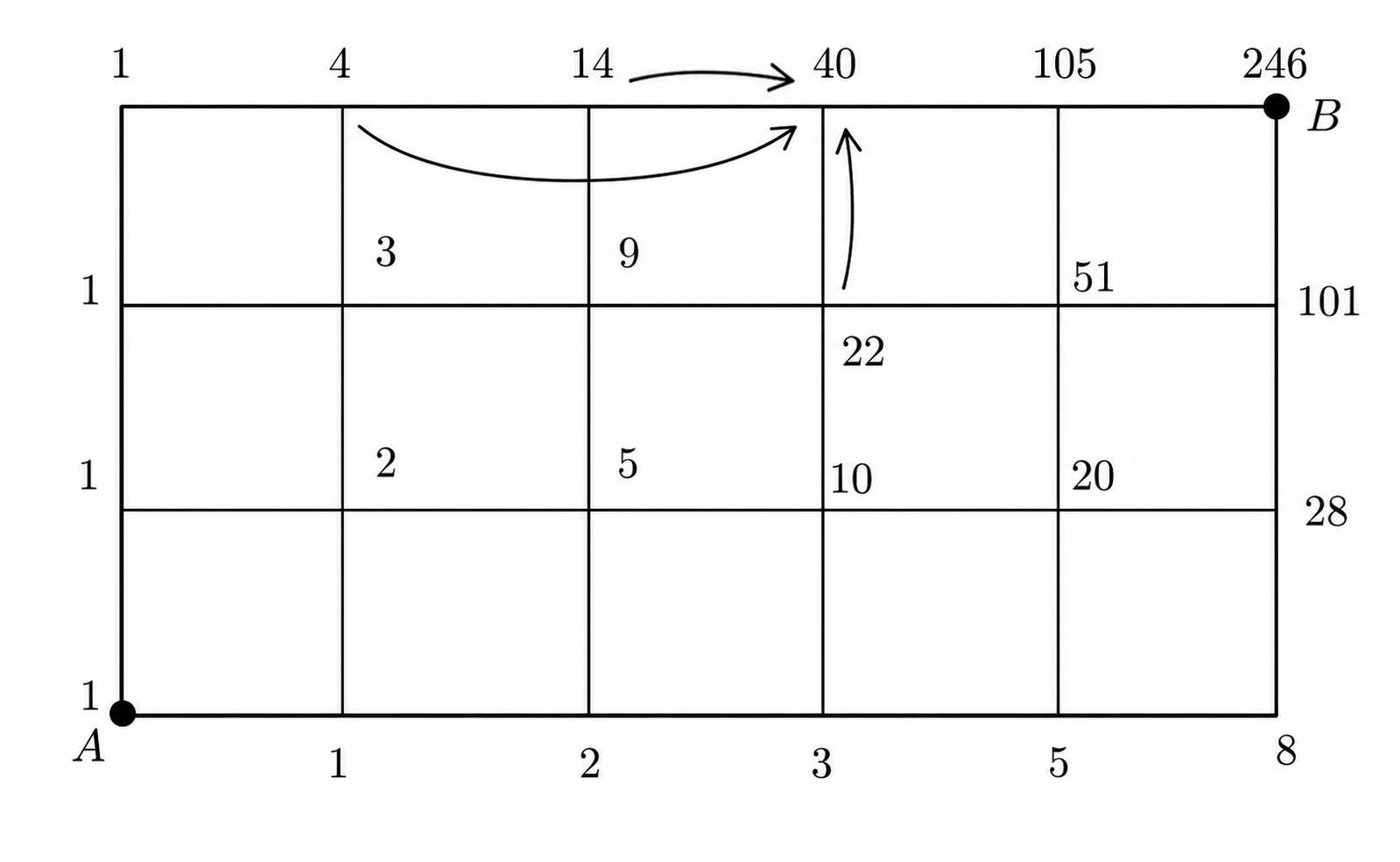
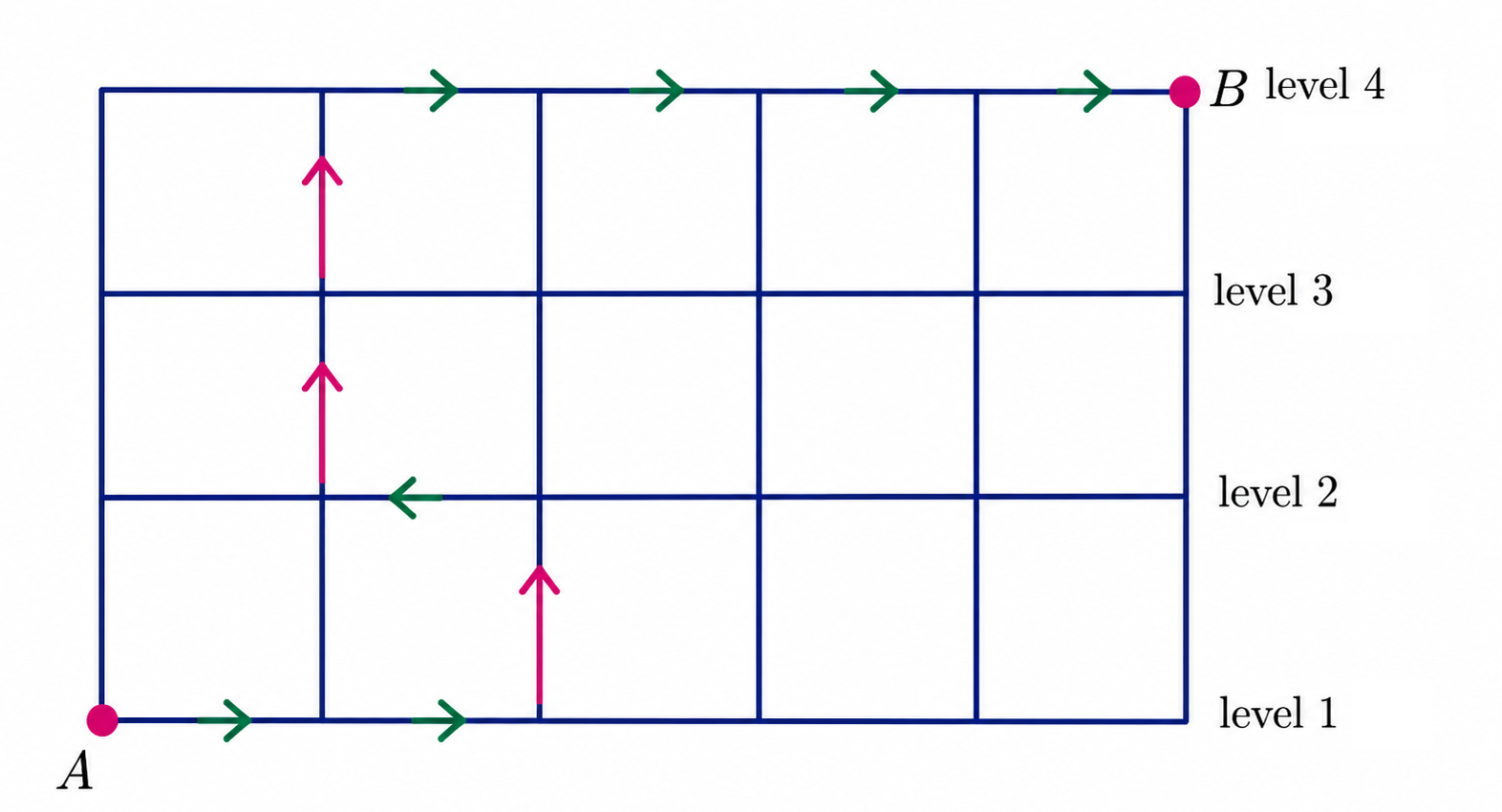
    Placing numbers
    1.Each point =sum of its predecessor(s).1.\quad \text{Each point }=\text{sum of its predecessor(s).}
    Permutation
    2.#paths=(R+U)!R! U!2.\quad \#\text{paths}=\frac{(R+U)!}{R!\,U!}
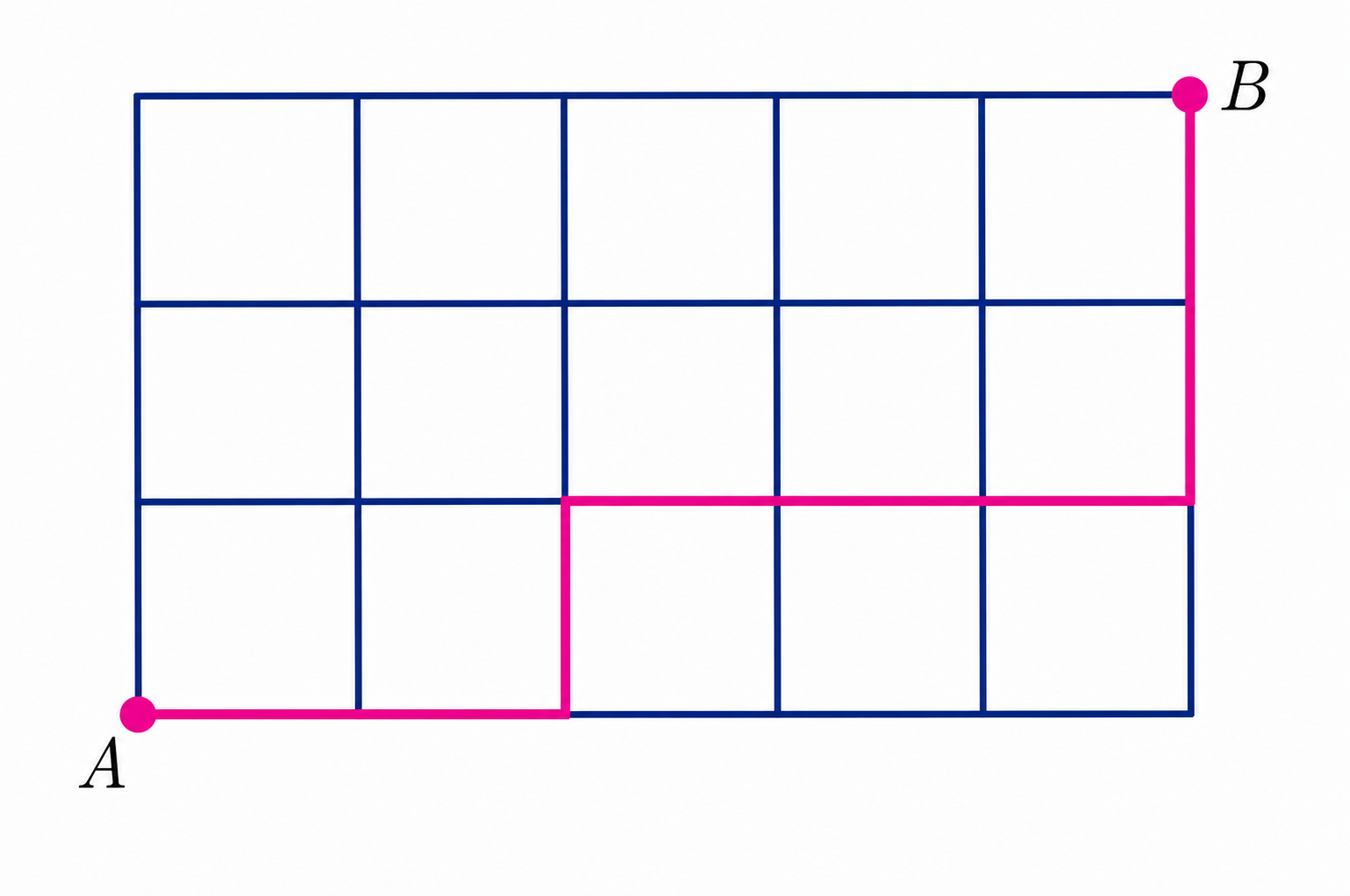
    Levels
    3.Choose the transition point at each level.3.\quad \text{Choose the transition point at each level.}
  27. 77.

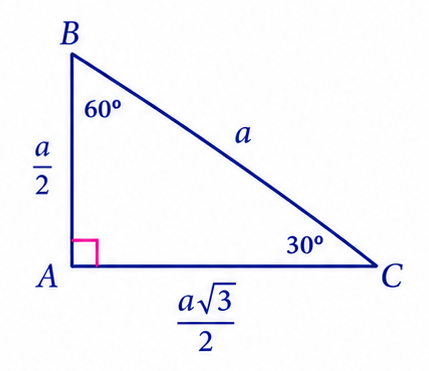
    30-60-90 Triangle

    30-60-90 right triangle
    Sides are a, a32, a2\text{Sides are } a,\ \frac{a\sqrt3}{2},\ \frac{a}{2}

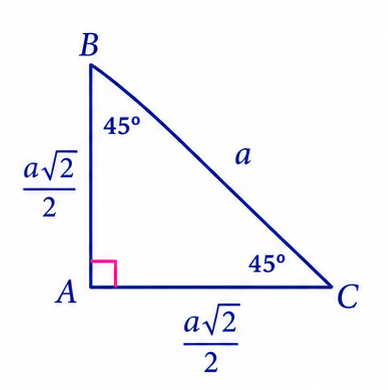
    45-45-90 Triangle

    45-45-90 right isosceles triangle
    Sides are a22, a22, a\text{Sides are }\frac{a\sqrt2}{2},\ \frac{a\sqrt2}{2},\ a
  28. 78.

    aa and bb are positive integers.

    78.1

    If ab=x2ab=x^2 and gcd⁡(a,b)=1\gcd(a,b)=1, then a=y2, b=z2a=y^2,\ b=z^2.

    78.2

    If ab=x2ab=x^2 and gcd⁡(a,b)=d\gcd(a,b)=d, then a=dy2, b=dz2a=dy^2,\ b=dz^2.


    pp is a prime number.

    78.3

    If ab=px2ab=px^2 and gcd⁡(a,b)=1\gcd(a,b)=1, then a=py2, b=z2a=py^2,\ b=z^2 or a=y2, b=pz2a=y^2,\ b=pz^2.

    78.4

    If ab=px2ab=px^2 and gcd⁡(a,b)=d\gcd(a,b)=d, then a=dpy2, b=dz2a=dpy^2,\ b=dz^2 or a=dy2, b=dpz2a=dy^2,\ b=dpz^2.

  29. 79.
    gcd⁡(a+kb,b)=gcd⁡(a,b)\gcd(a+kb,b)=\gcd(a,b)
    gcd⁡(a,b)=gcd⁡(a mod b,b)\gcd(a,b)=\gcd(a\bmod b,b)
  30. 80.

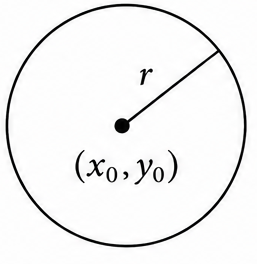
    Equation of a Circle

    Circle with center and radius
    A circle with center (x0,y0) and radius r:\text{A circle with center }(x_0,y_0)\text{ and radius }r:
    (x−x0)2+(y−y0)2=r2(x-x_0)^2+(y-y_0)^2=r^2

    Finding the Equation of a Tangent Line
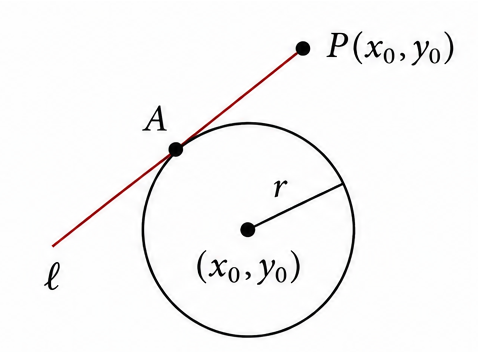
    Tangent line through an external point to a circle

    Let the tangent line through the point P(x₀, y₀) have slope m.

    ℓ: y−y0=m(x−x0)\ell:\ y-y_0=m(x-x_0)
    (x−x1)2+(y−y1)2=r2(x-x_1)^2+(y-y_1)^2=r^2

    Substitute the line equation into the circle equation. Since a tangent line intersects the circle at exactly one point, set the discriminant equal to zero and solve for m.

    Δ=0\Delta=0
  31. 81.

    Example

    3ab+2=6b,3bc+2=5c,3ca+2=4a3ab+2=6b,\qquad 3bc+2=5c,\qquad 3ca+2=4a

    Express two variables in terms of the third:

    c=4a−23a,b=26−3ac=\frac{4a-2}{3a},\qquad b=\frac{2}{6-3a}

    Substitute into the remaining equation:

    (7a−8)(a−1)=0(7a-8)(a-1)=0

    Substitute the solutions back:

    a=1⇒abc=49a=1\Rightarrow abc=\frac49
    a=87⇒abc=23a=\frac87\Rightarrow abc=\frac23
  32. 82.

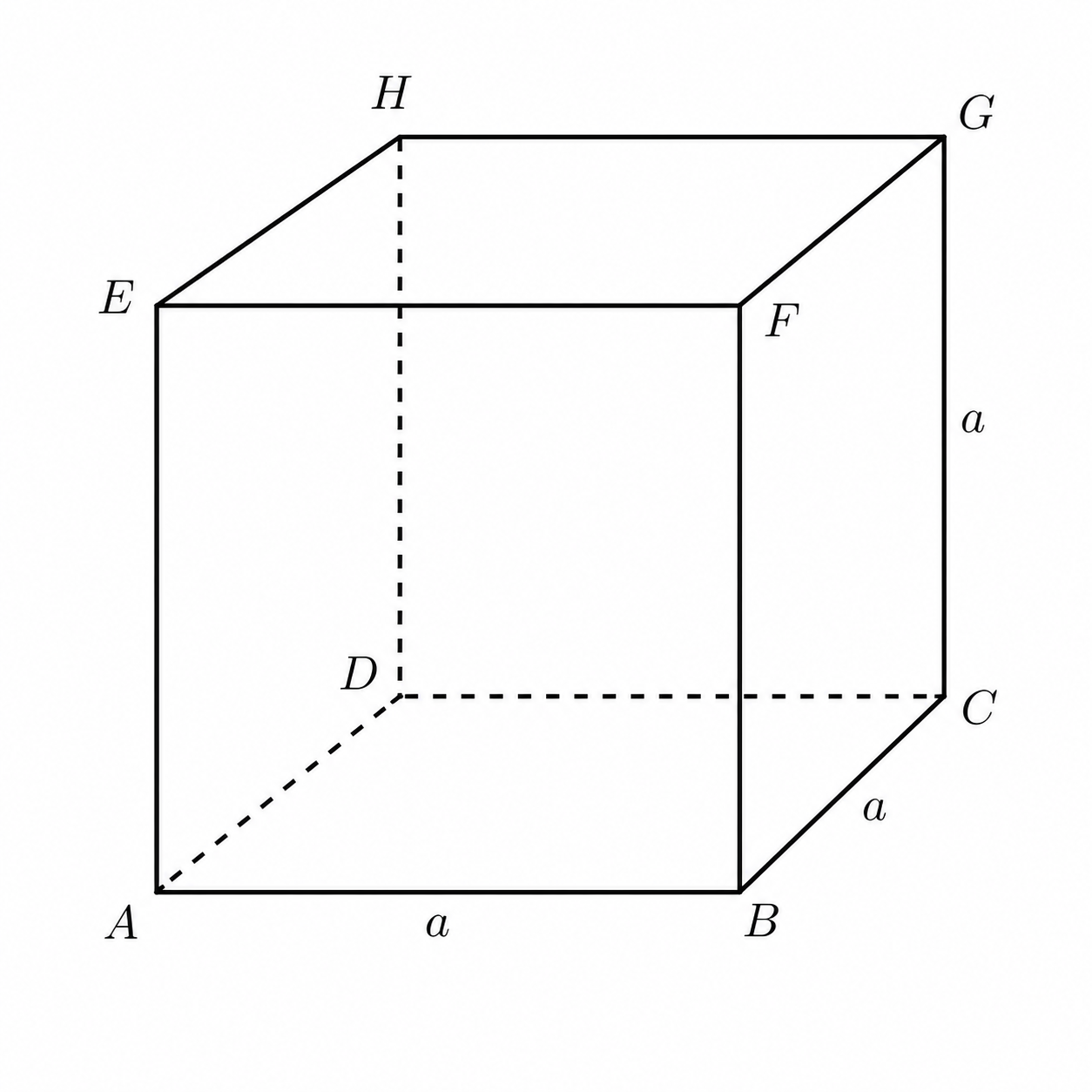
    Cube

    Cube
    TSA=6a2\mathrm{TSA}=6a^2
    V=a3V=a^3

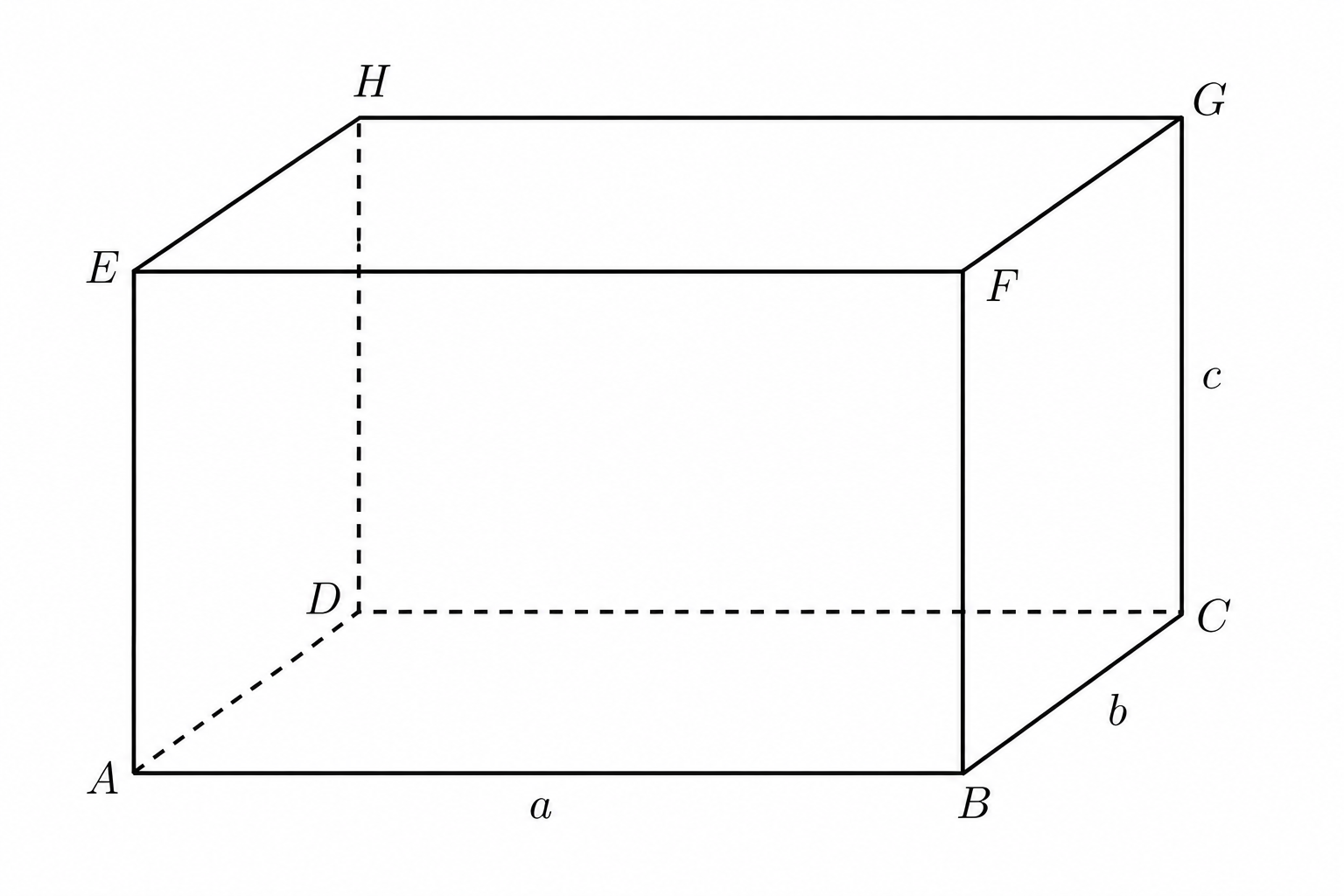
    Rectangular Prism

    Cuboid
    TSA=2(ab+ac+bc)\mathrm{TSA}=2(ab+ac+bc)
    V=abcV=abc

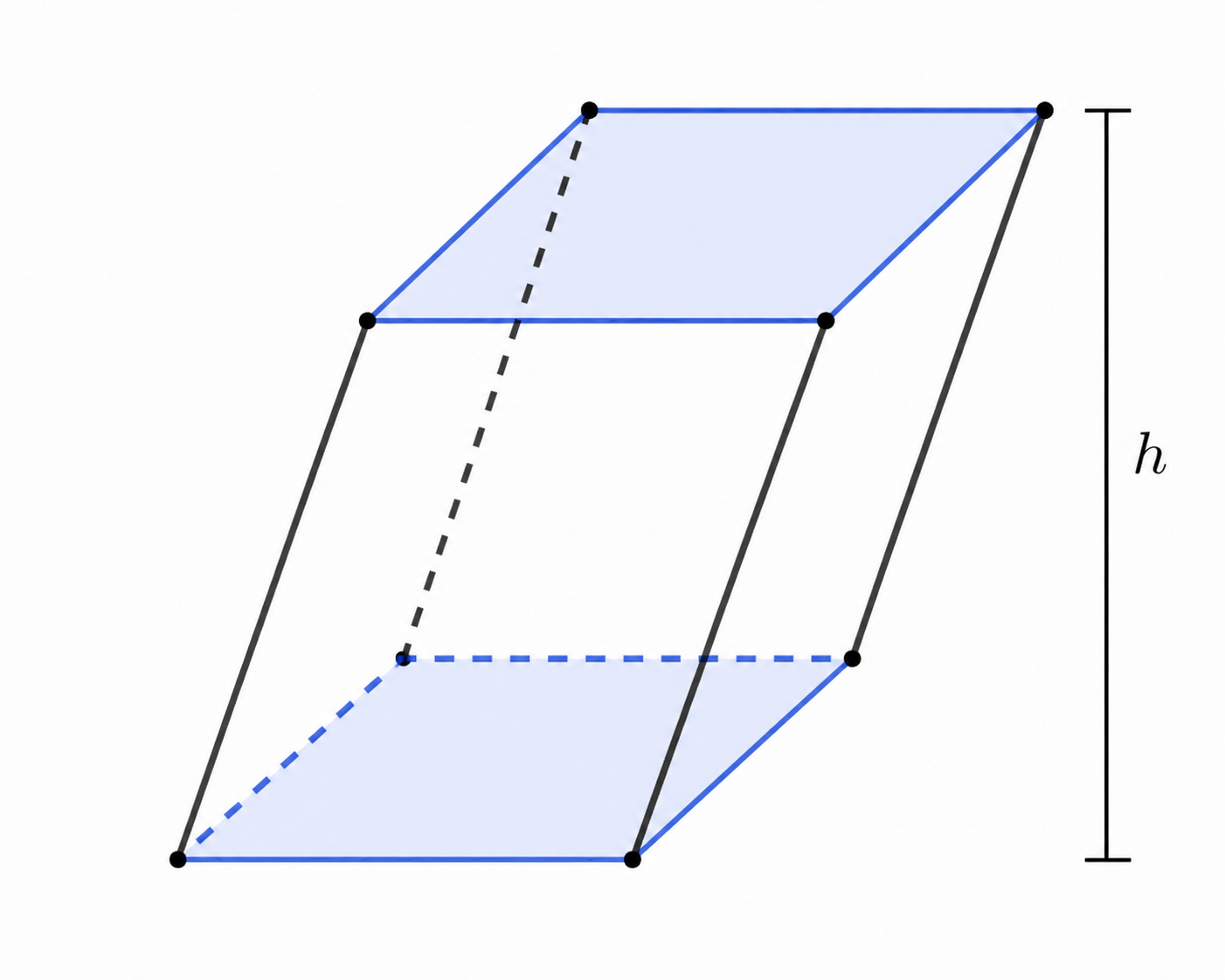
    Prism

    Prism
    V=h⋅AreabaseV=h\cdot\mathrm{Area}_{\mathrm{base}}

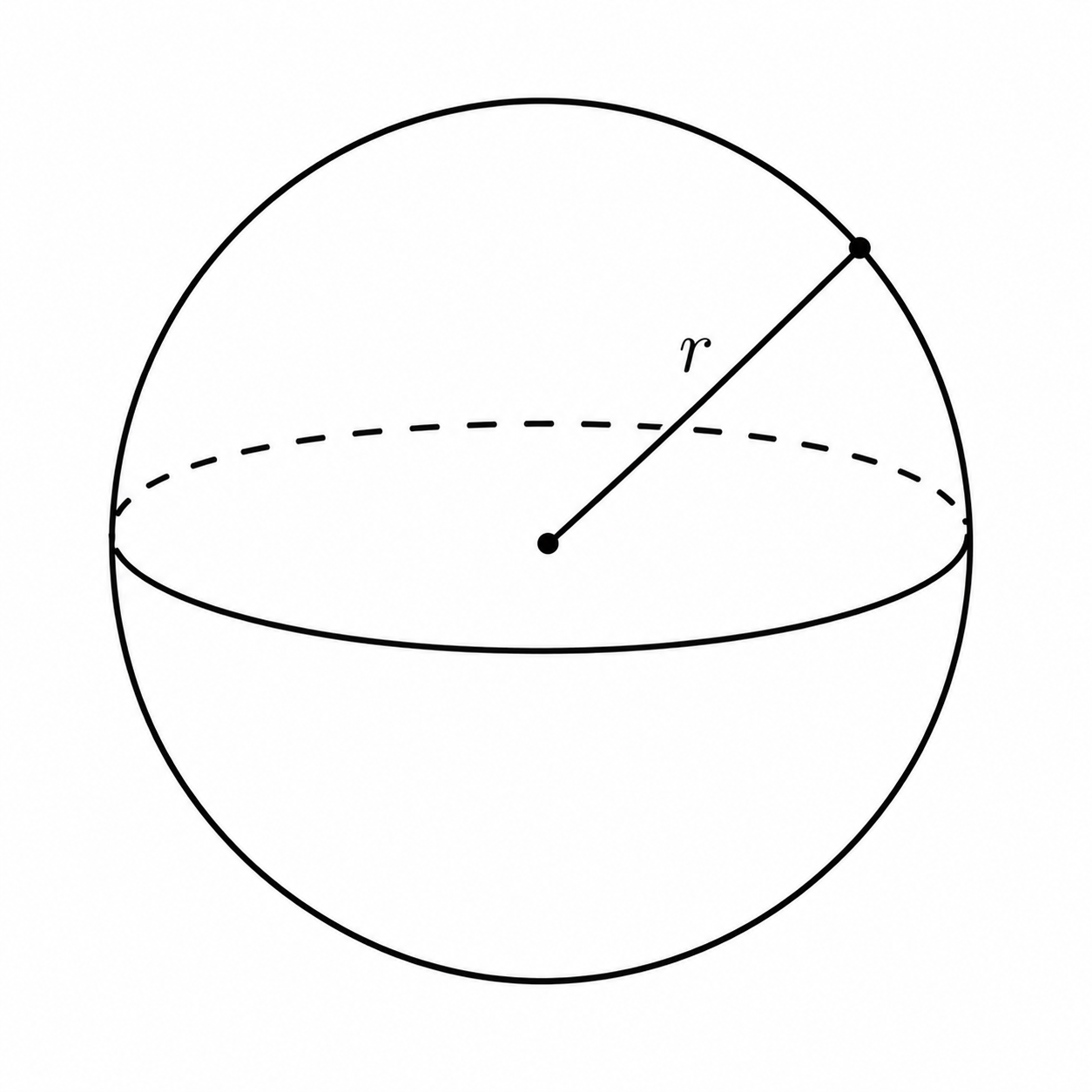
    Sphere

    Sphere
    TSA=4πr2\mathrm{TSA}=4\pi r^2
    V=43πr3V=\frac43\pi r^3

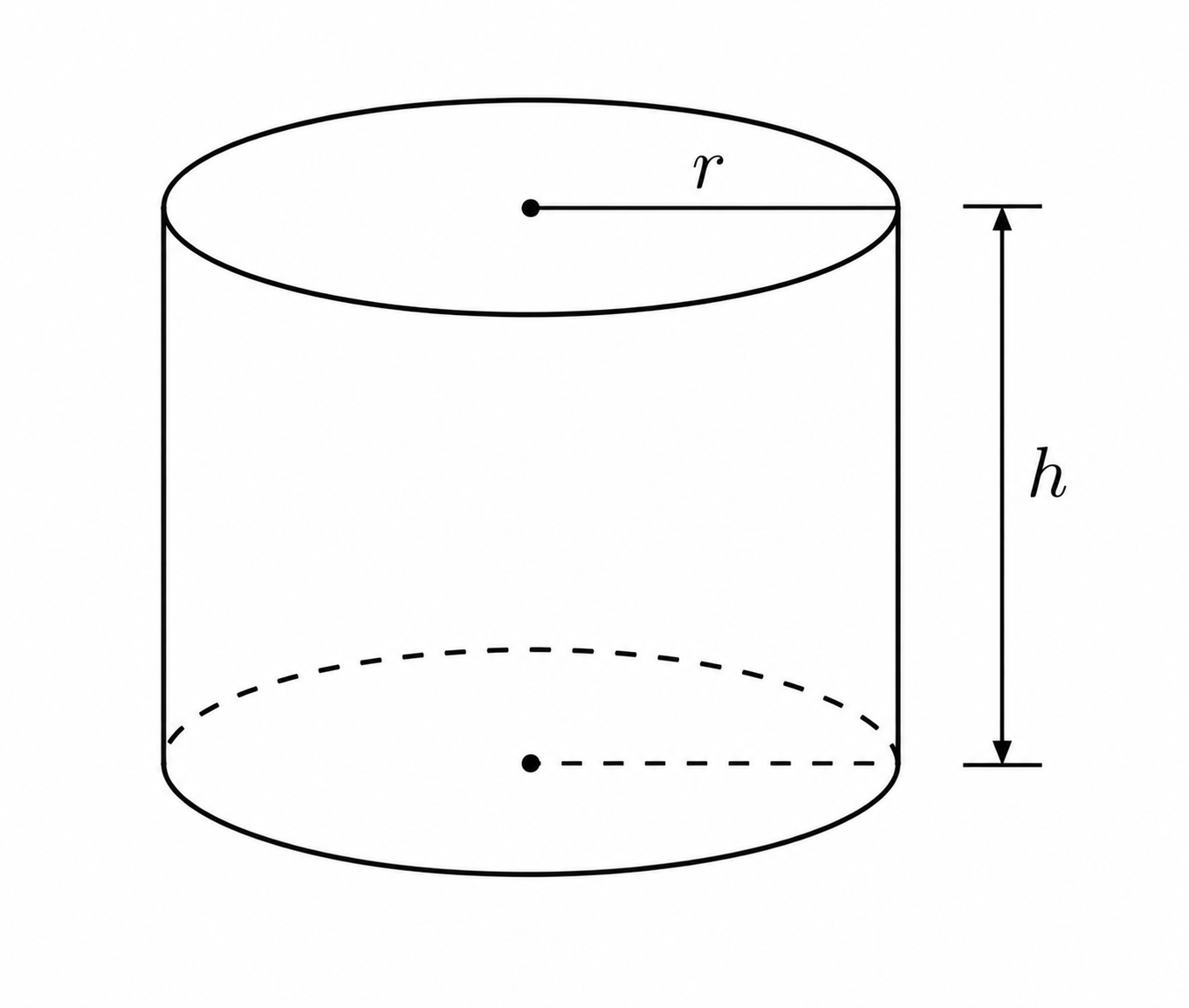
    Cylinder

    Cylinder
    TSA=2πr(r+h)\mathrm{TSA}=2\pi r(r+h)
    V=πr2hV=\pi r^2h

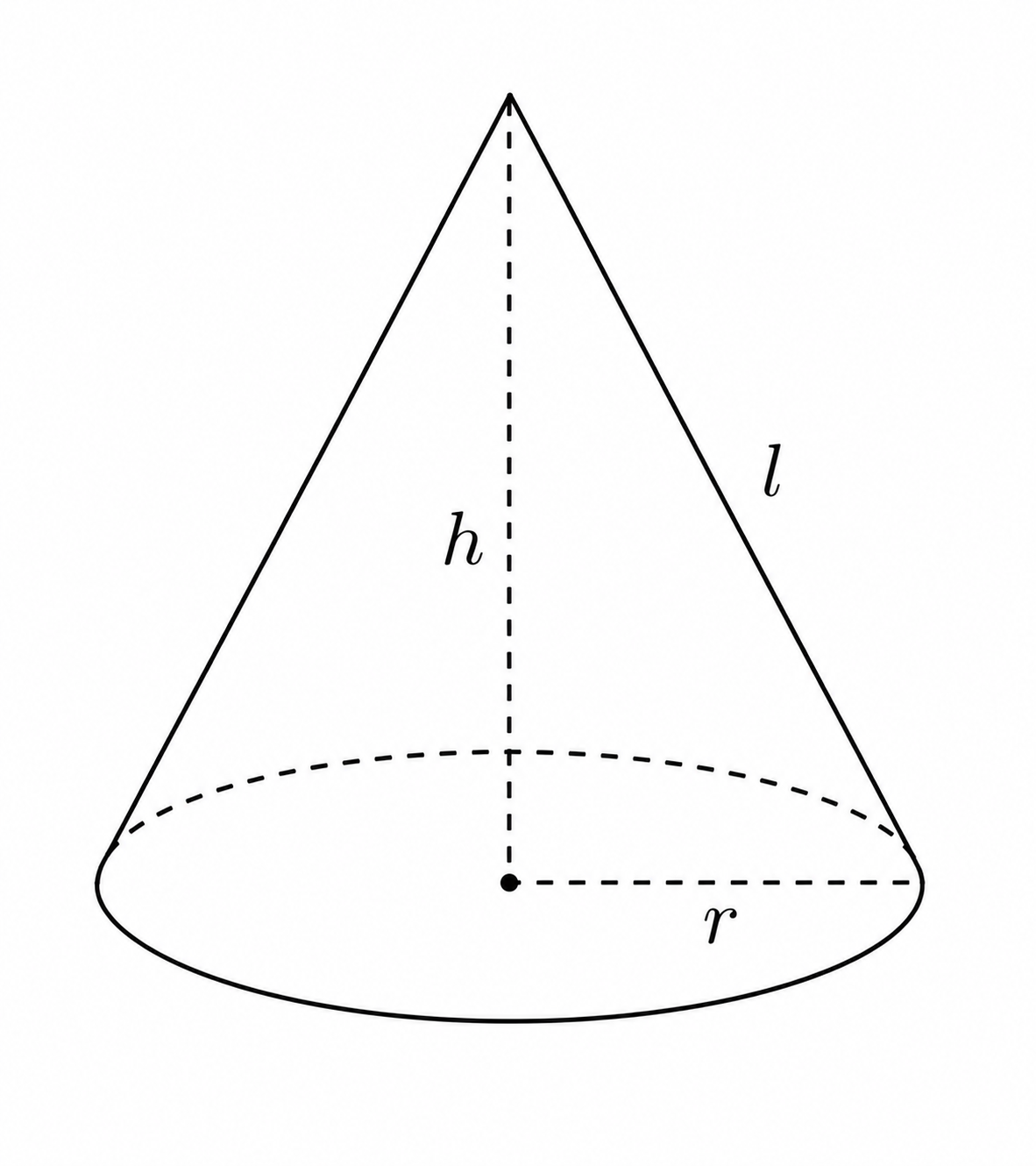
    Cone

    Cone
    TSA=πr(r+l)\mathrm{TSA}=\pi r(r+l)
    l=r2+h2l=\sqrt{r^2+h^2}
    V=13πr2hV=\frac13\pi r^2h

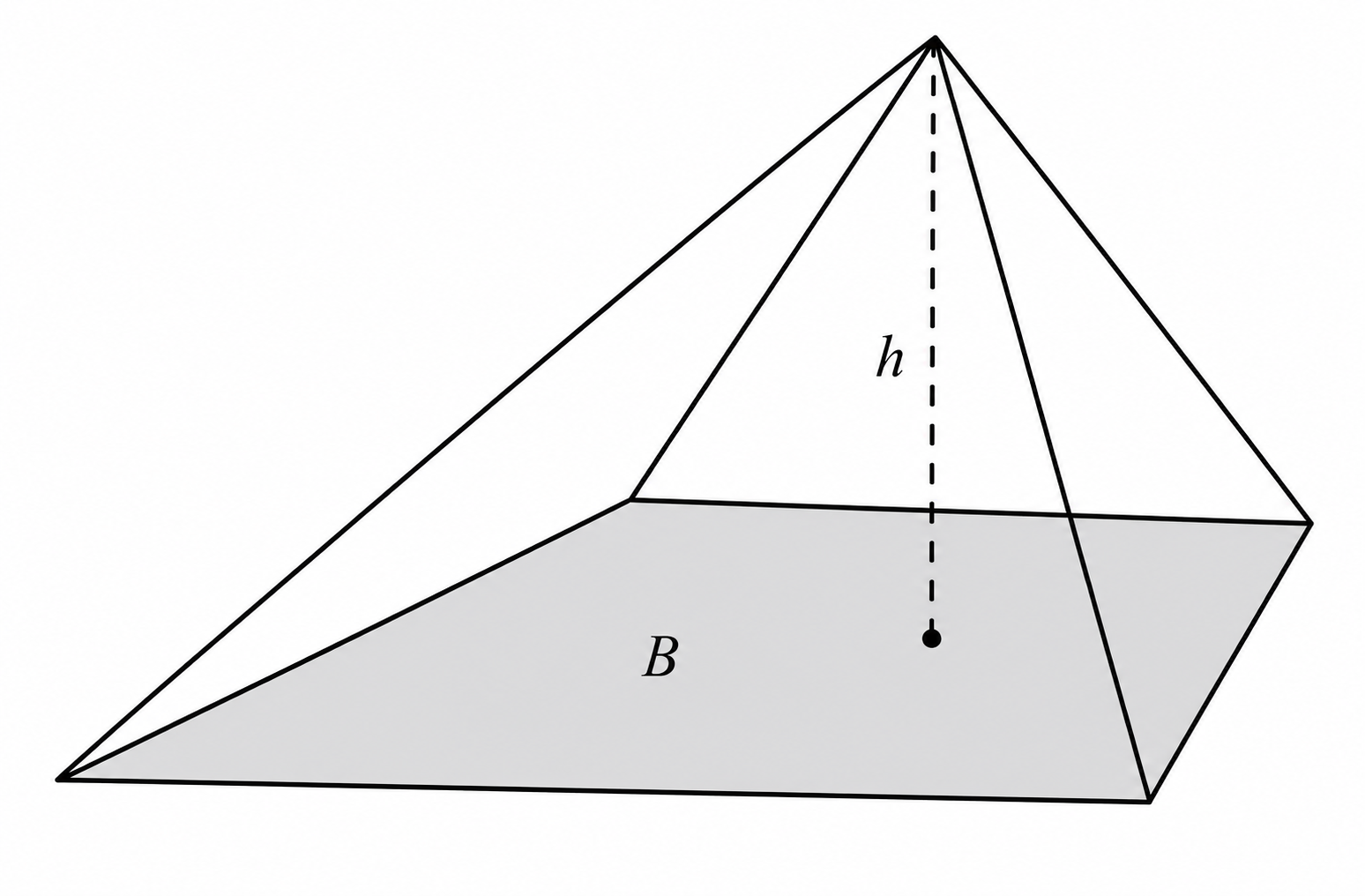
    Pyramid

    Pyramid
    V=13Areabase⋅hV=\frac13\mathrm{Area}_{\mathrm{base}}\cdot h

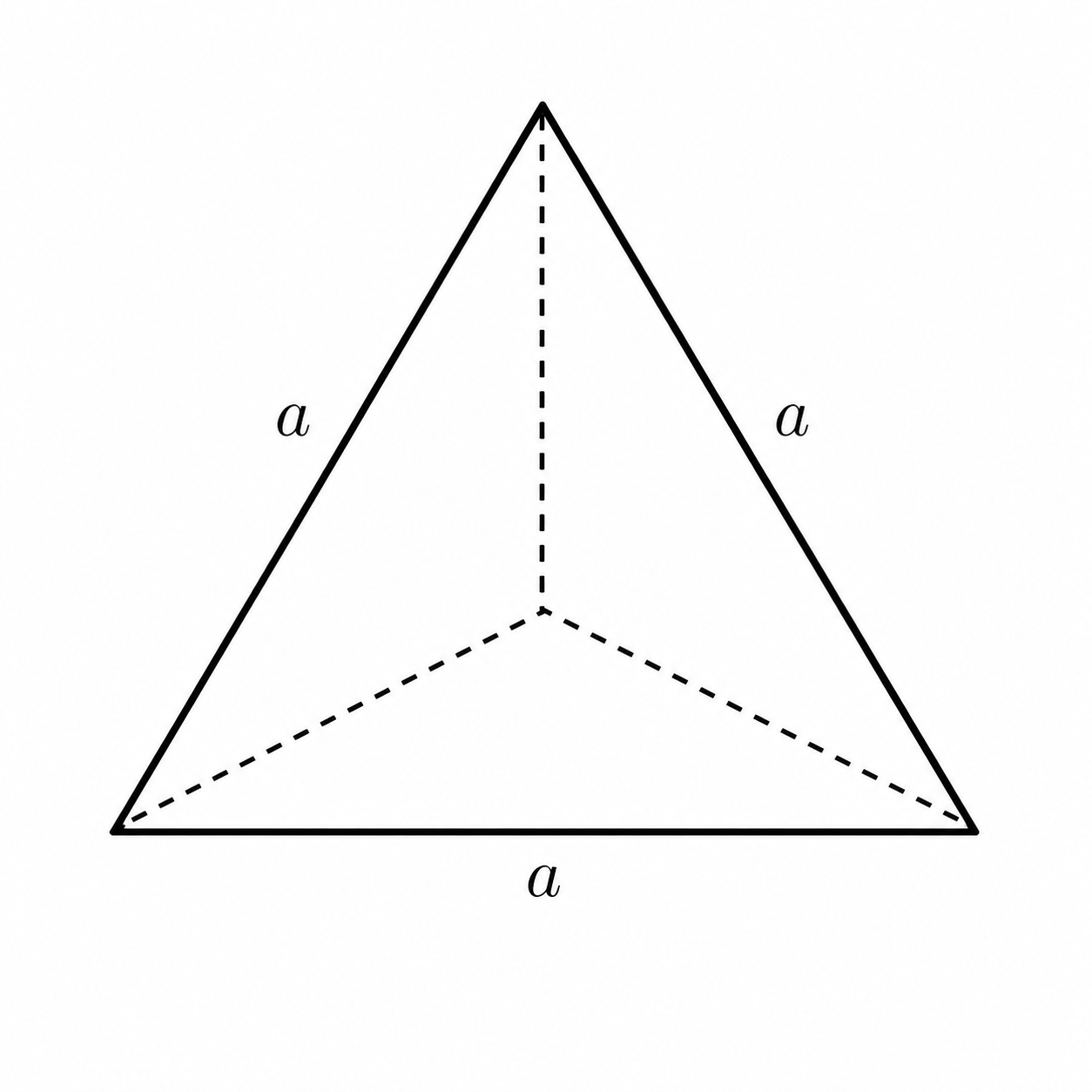
    Regular Tetrahedron

    Regular tetrahedron
    TSA=a23\mathrm{TSA}=a^2\sqrt3
    V=a3212V=\frac{a^3\sqrt2}{12}

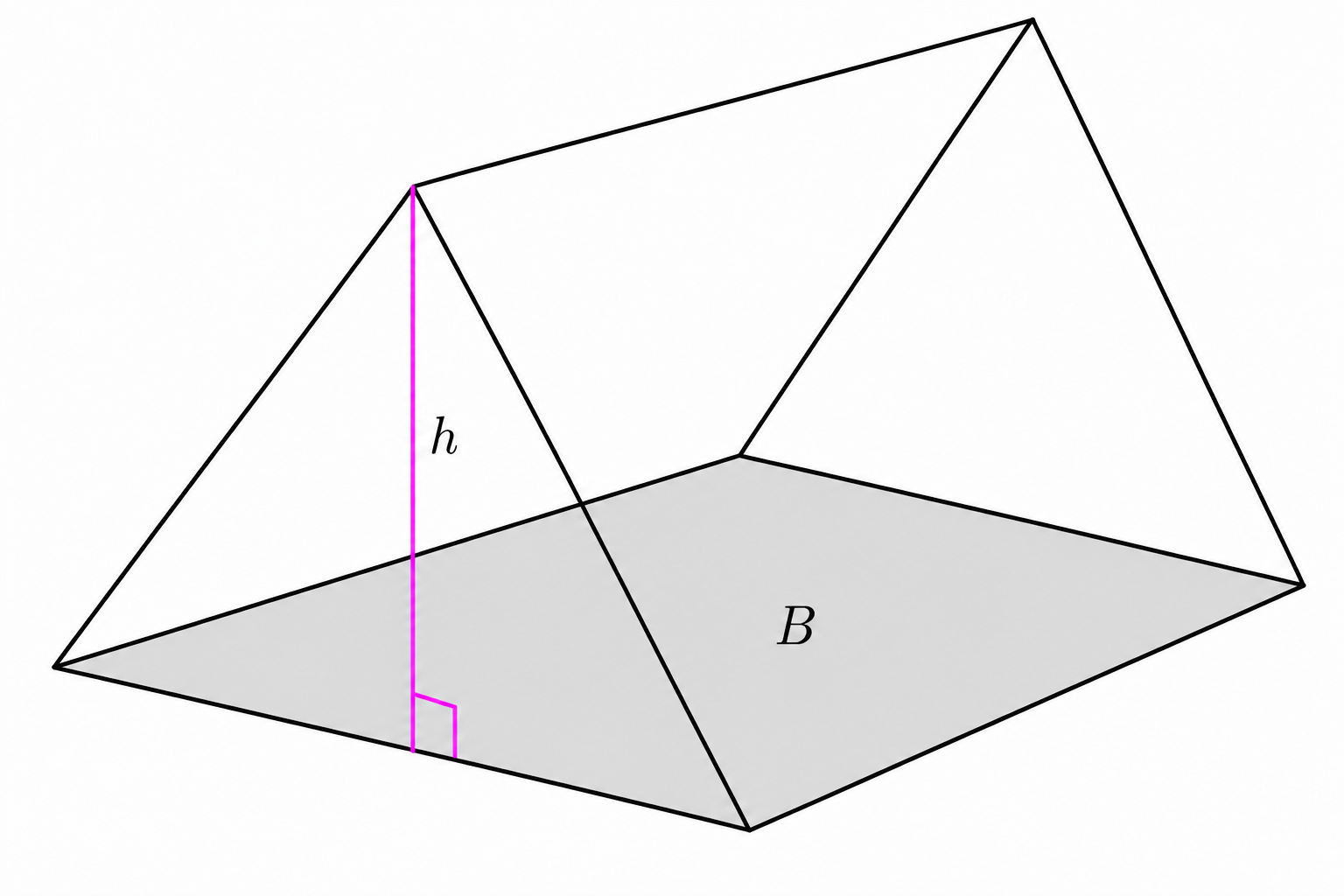
    Triangular Prism

    Triangular prism with triangular base and height
    V=12Areabase×LV=\frac12\text{Area}_{\text{base}}\times L
  33. 83.
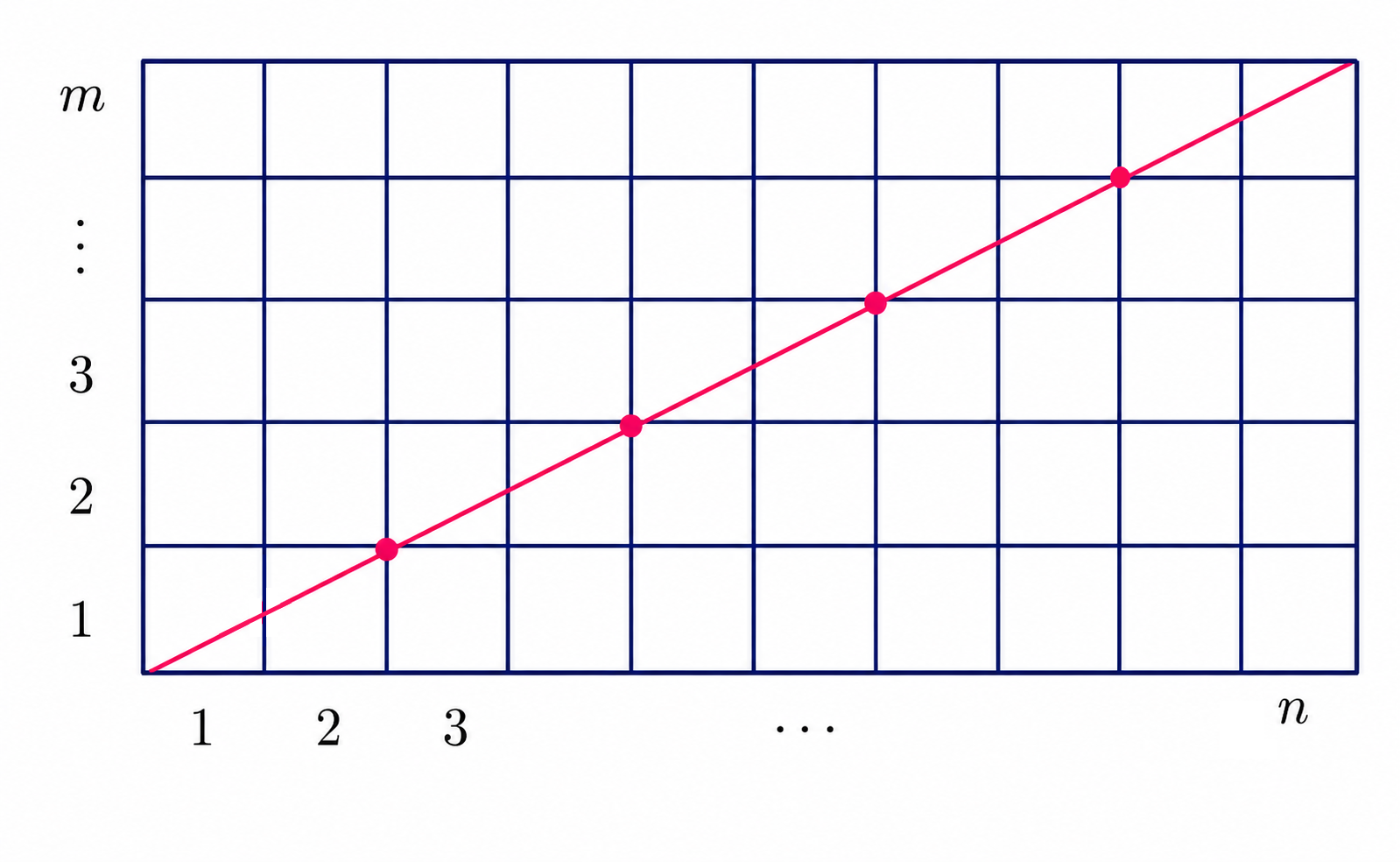
    Diagonal of an m by n grid crossing lattice lines

    If you draw the diagonal of an m×nm\times n grid, then the diagonal is split into m+n−gcd⁡(m,n)m+n-\gcd(m,n) parts.

  34. 84.
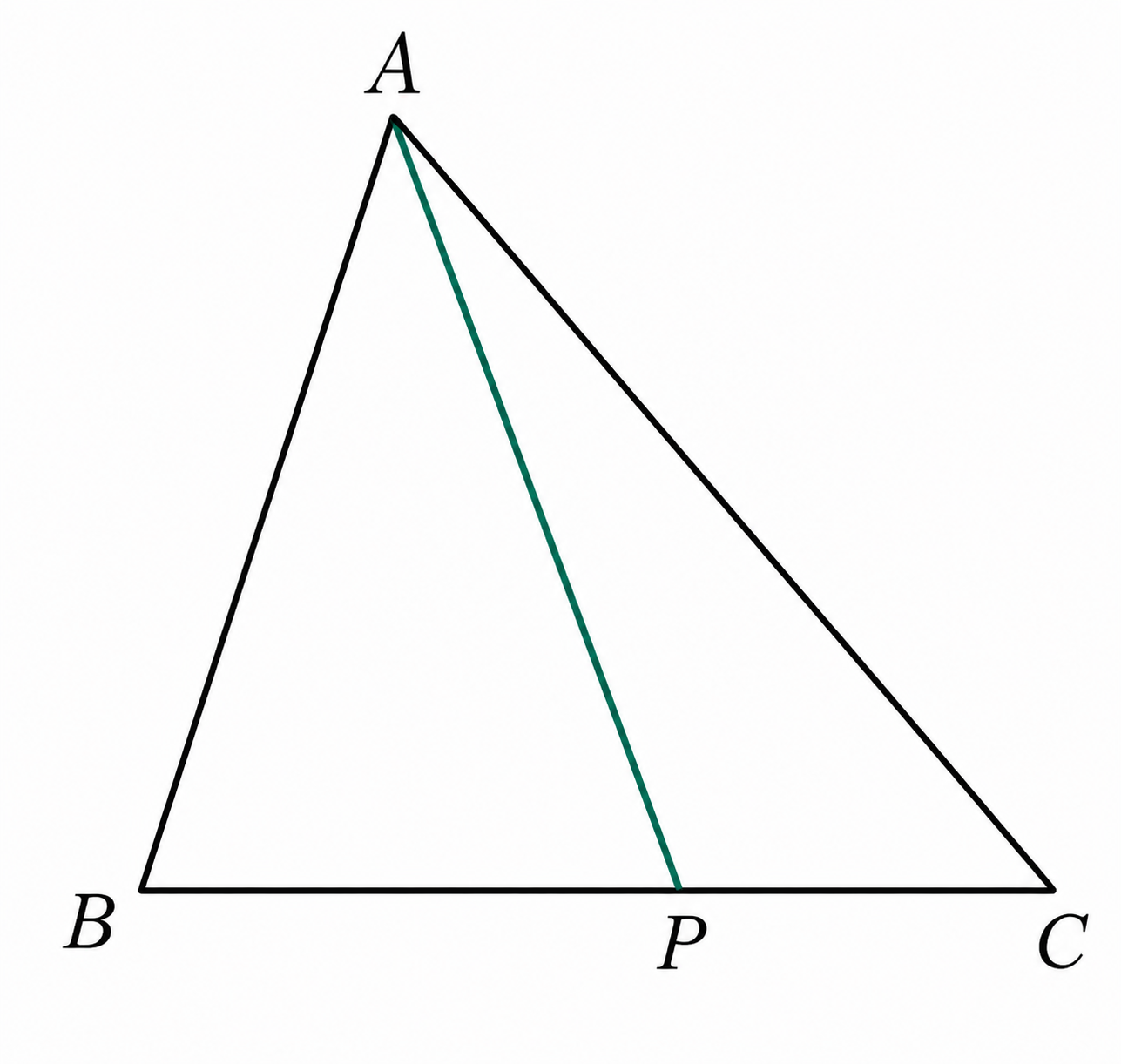
    Triangle ABC with cevian AP
    [APB][APC]=BPPC\frac{[APB]}{[APC]}=\frac{BP}{PC}
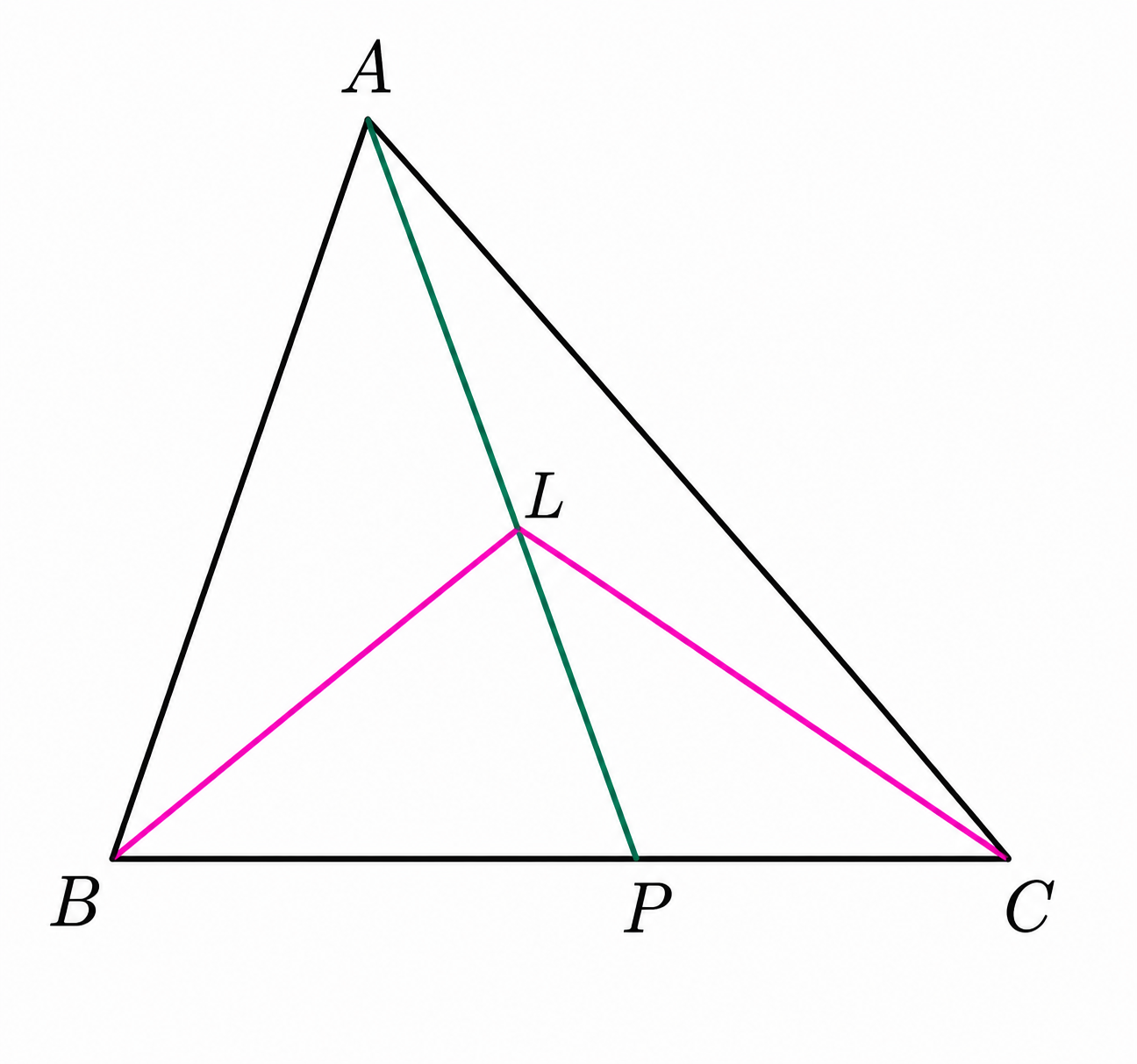
    Triangle ABC with point L on cevian AP
    [ALB][ALC]=BPPC\frac{[ALB]}{[ALC]}=\frac{BP}{PC}
  35. 85.
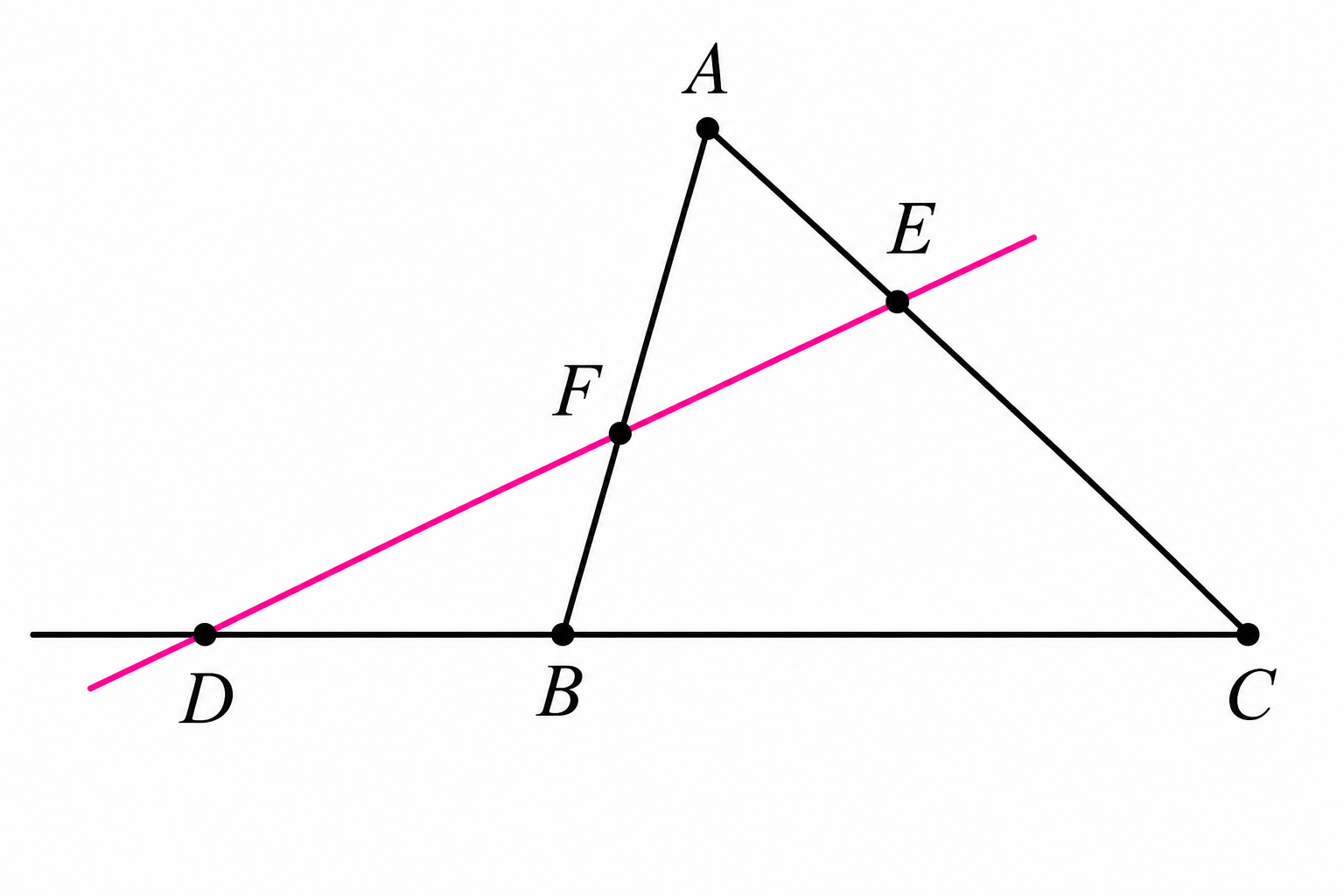
    Menelaus configuration with transversal cutting triangle ABC
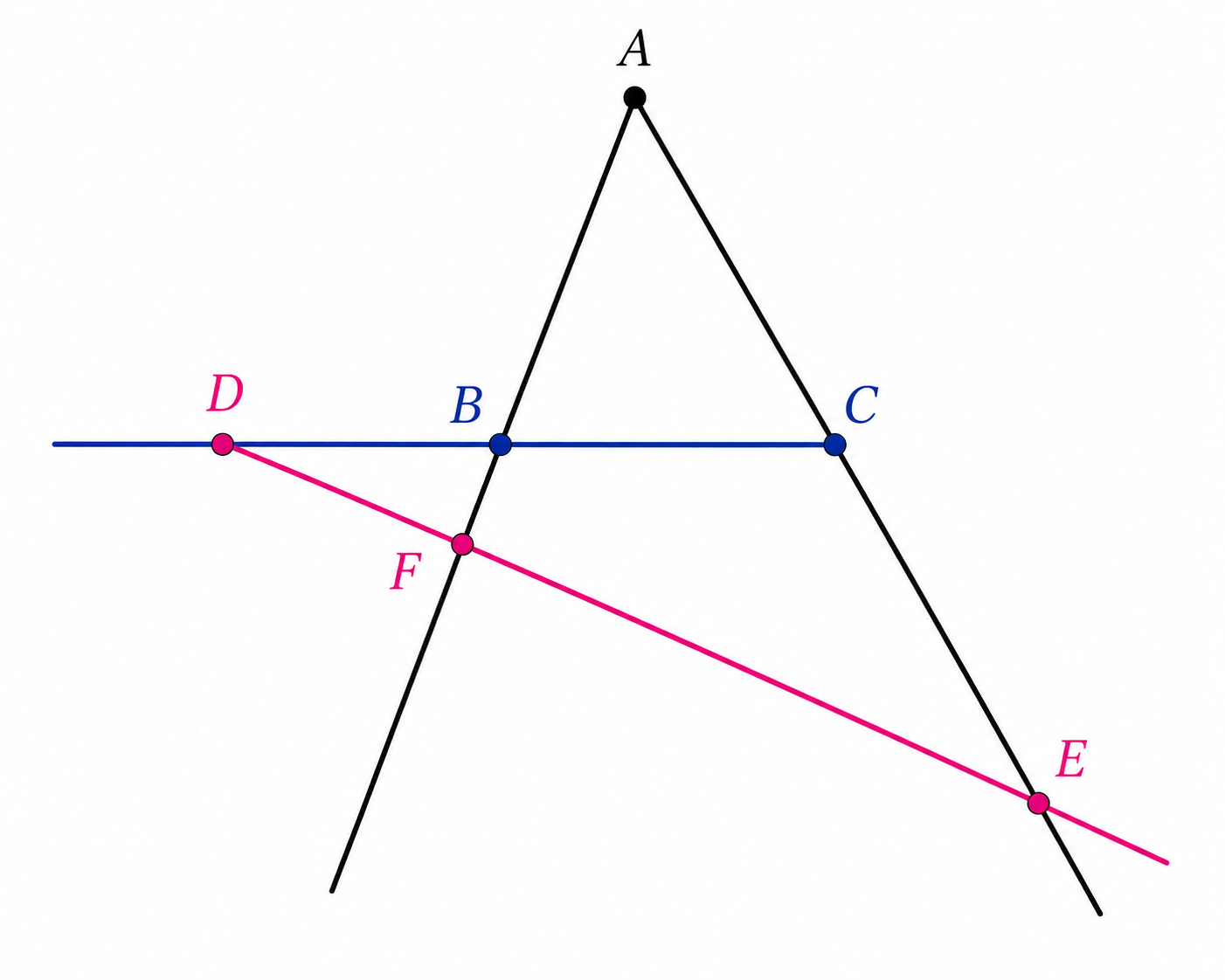
    Menelaus configuration with transversal cutting extensions
    DBDC⋅ECEA⋅FAFB=1\frac{DB}{DC}\cdot\frac{EC}{EA}\cdot\frac{FA}{FB}=1

    if and only if D,E,FD,E,F are collinear.

  36. 86.

    For an nn-sided polygon,

    Sum of interior angles=180∘(n−2)\text{Sum of interior angles}=180^\circ(n-2)

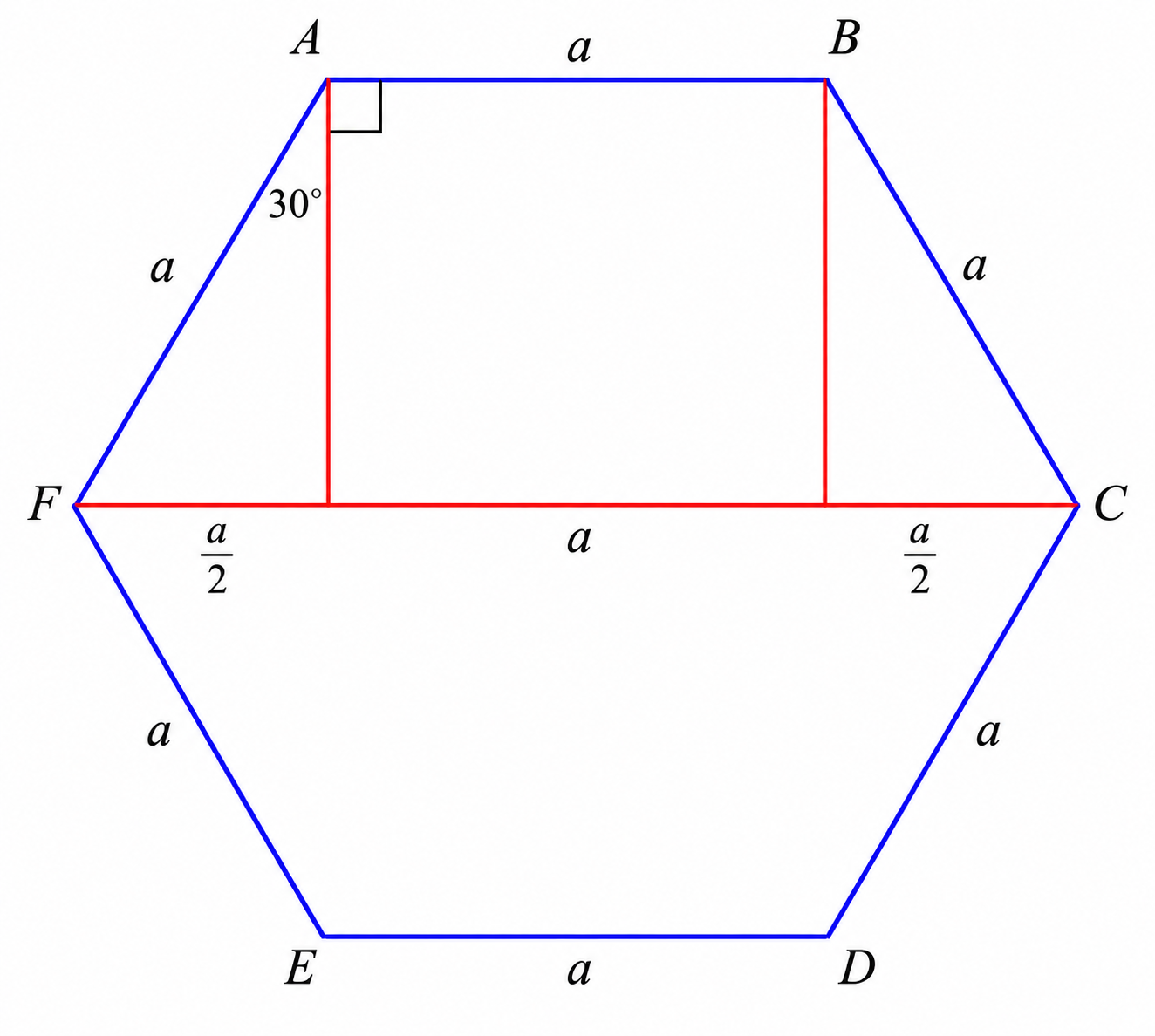
    Regular Hexagon

    For a regular hexagon with side length aa:

    a)

    ∠A=180∘(6−2)6=120∘\angle A=\frac{180^\circ(6-2)}{6}=120^\circ

    b)

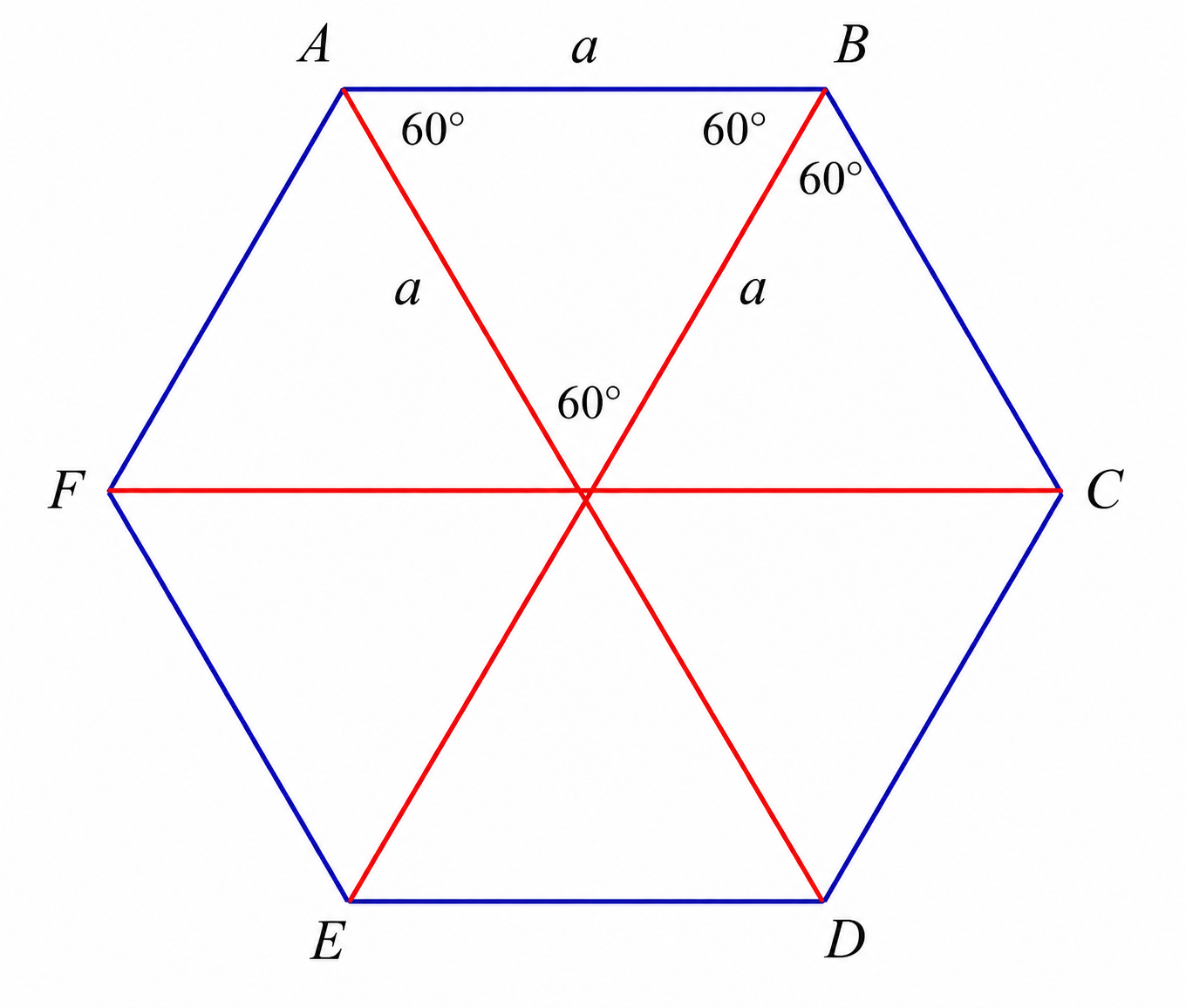
    Regular hexagon divided into six equilateral triangles
    [ABCDEF]=6(a234)=3a232[ABCDEF]=6\left(\frac{a^2\sqrt{3}}{4}\right)=\frac{3a^2\sqrt{3}}{2}

    c)

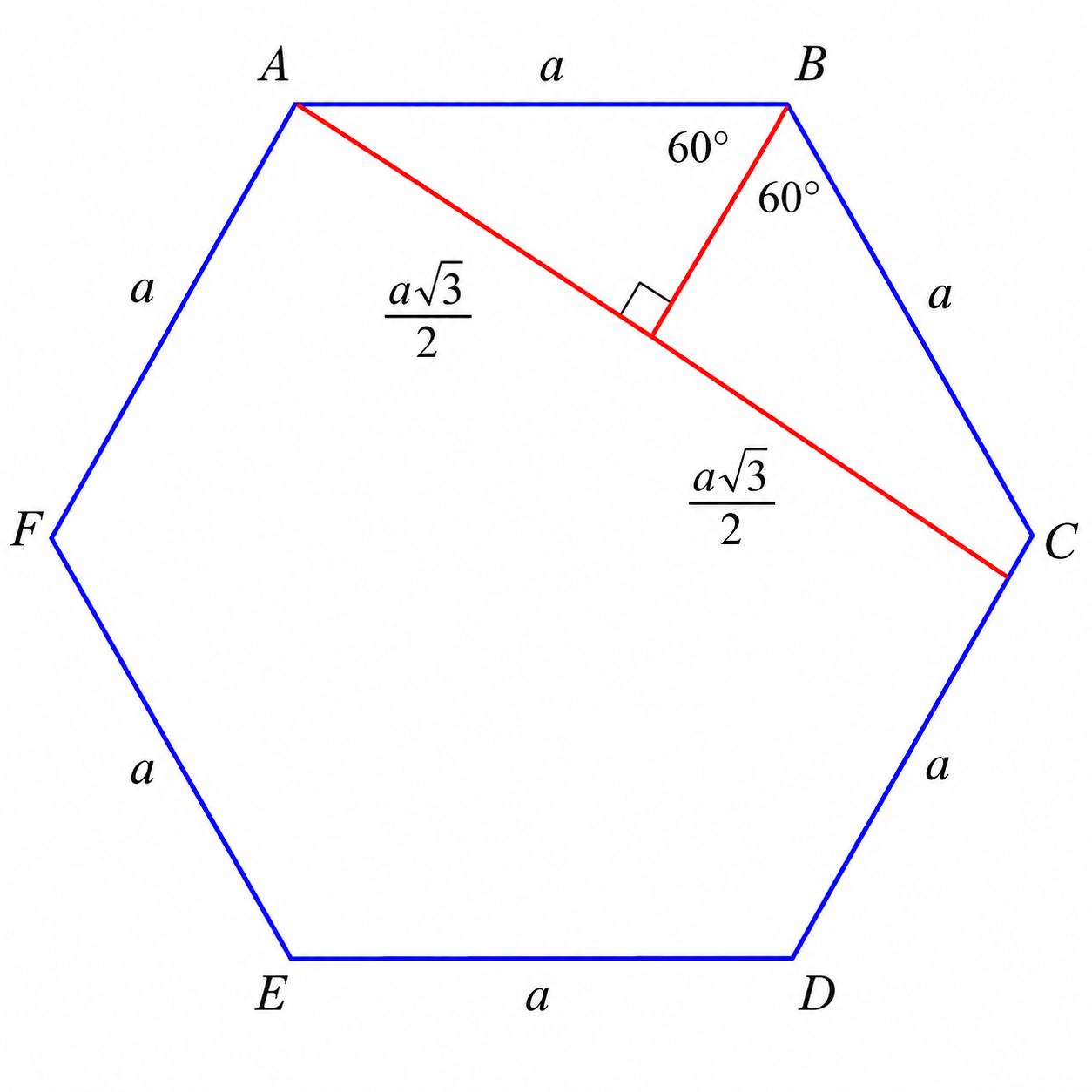
    Regular hexagon with diagonal AC of length a√3
    AC=a3AC=a\sqrt{3}

    d)

    Regular hexagon with long diagonal AD of length 2a
    AD=2aAD=2a

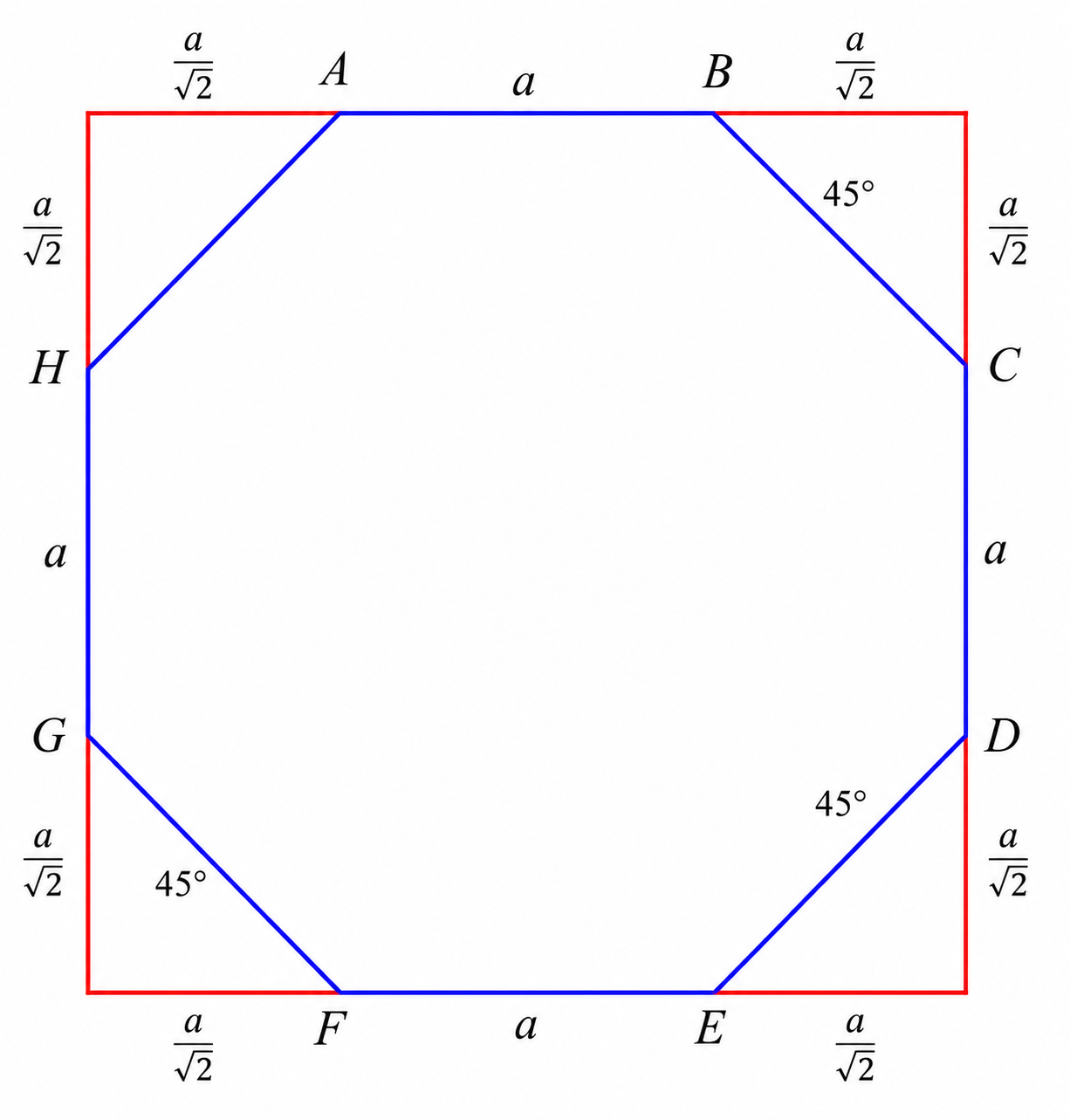
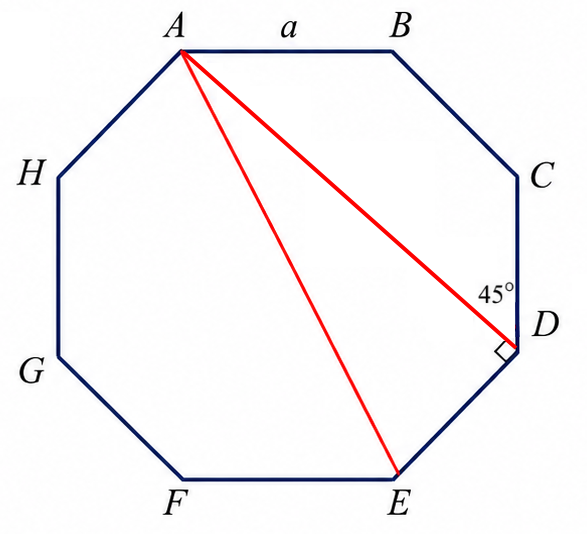
    Regular Octagon

    For a regular octagon with side length aa:

    a)

    ∠A=180∘(8−2)8=135∘\angle A=\frac{180^\circ(8-2)}{8}=135^\circ

    b)

    Regular octagon inscribed in a square of side a+a√2
    [ABCDEFGH]=(a+a2)2−4(a2/22)[ABCDEFGH]=(a+a\sqrt{2})^2-4\left(\frac{a^2/2}{2}\right)
    =a2+2a2+2a22−a2=2a2(1+2)=a^2+2a^2+2a^2\sqrt{2}-a^2=2a^2(1+\sqrt{2})

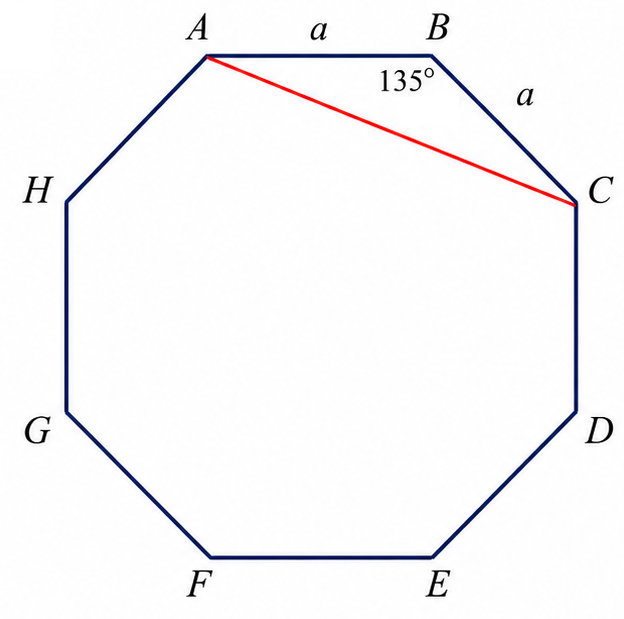
    c)

    Regular octagon with diagonal AC and 135° angle at B
    AC=a2+2AC=a\sqrt{2+\sqrt{2}}
    AC2=a2+a2−2a2cos⁡135∘=2a2+2a222AC^2=a^2+a^2-2a^2\cos 135^\circ=2a^2+2a^2\frac{\sqrt{2}}{2}
    =2a2+a22=a2(2+2)=2a^2+a^2\sqrt{2}=a^2(2+\sqrt{2})

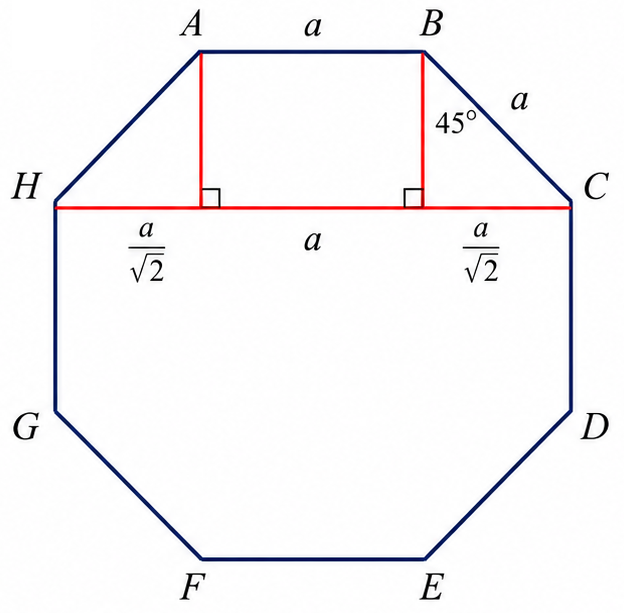
    d)

    Regular octagon with diagonal AD of length a(√2+1)
    AD=a2+a=a(2+1)AD=a\sqrt{2}+a=a(\sqrt{2}+1)

    e)

    Regular octagon with diagonal AE and right triangle ADE
    AE=a4+22AE=a\sqrt{4+2\sqrt{2}}
    AE2=a2+AD2=a2+(a(2+1))2AE^2=a^2+AD^2=a^2+\left(a(\sqrt{2}+1)\right)^2
    =a2+a2(3+22)=a2(4+22)=a^2+a^2(3+2\sqrt{2})=a^2(4+2\sqrt{2})
  37. 87.
    v=dtv=\frac{d}{t}
    v: speedd: distancet: timev:\text{ speed}\qquad d:\text{ distance}\qquad t:\text{ time}
  38. 88.
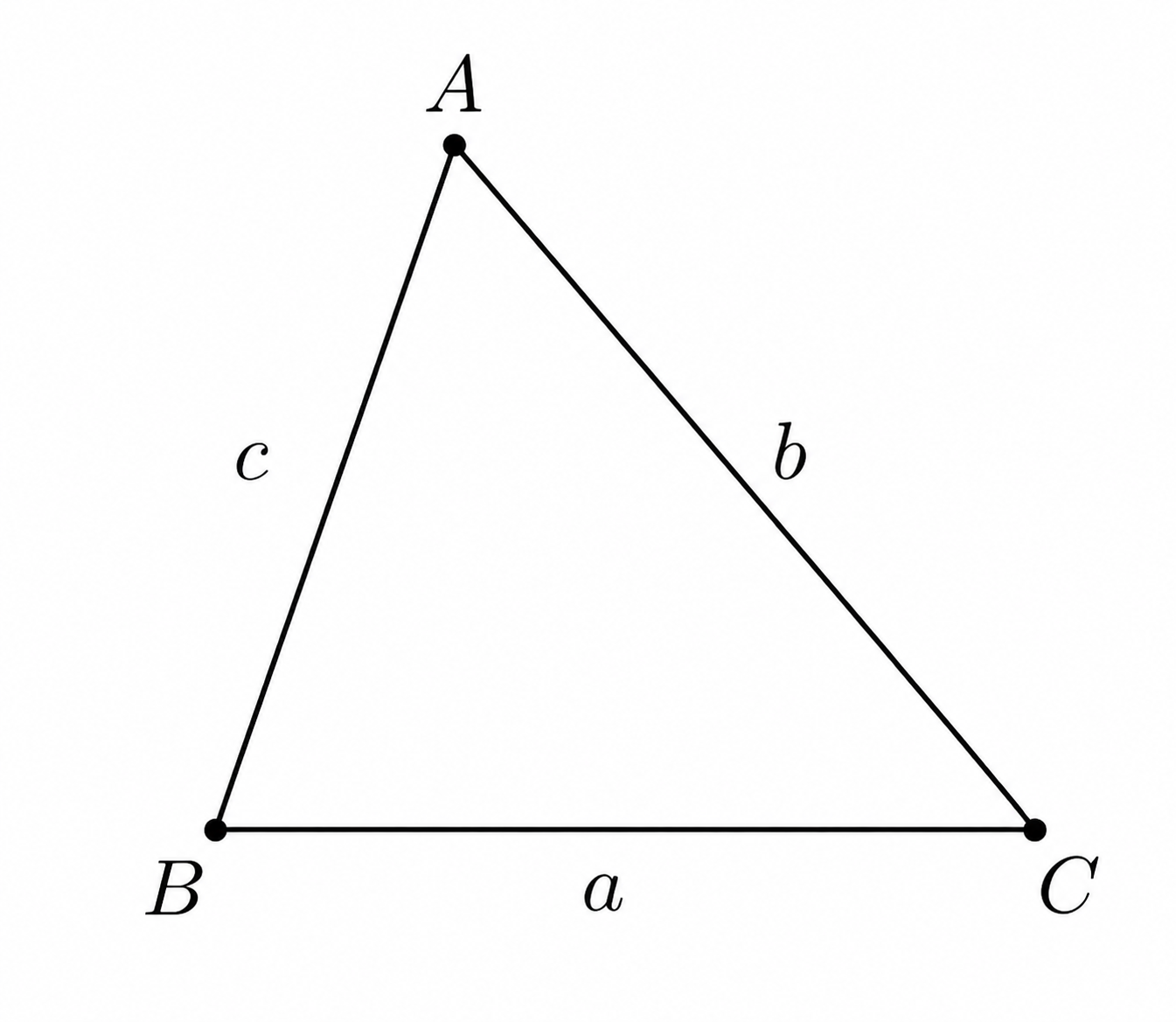
    Triangle ABC with side lengths a, b, and c
    a<b+ca<b+c
    b<a+cb<a+c
    c<a+bc<a+b
  39. 89.

    Mean

    Mean=Sum of ValuesNumber of Values\text{Mean}=\frac{\text{Sum of Values}}{\text{Number of Values}}
    Sum=Mean×Number of Values\text{Sum}=\text{Mean}\times\text{Number of Values}

    Median, Mode, and Range

    Median: the middle value after sorting

    Mode: the value that occurs most frequently

    Range=Maximum−Minimum\text{Range}=\text{Maximum}-\text{Minimum}

    Effect of Transforming Every Value

    OperationMeanMedianModeRange
    +k+k+k+k+k+k+k+kSame
    −k-k−k-k−k-k−k-kSame
    ×k\times k×k\times k×k\times k×k\times k×∣k∣\times |k|
    ÷k, k≠0\div k,\ k\ne0÷k\div k÷k\div k÷k\div k÷∣k∣\div |k|
  40. 91.
    If f is continuous on [a,b] and f(a)f(b)<0, then ∃ c∈(a,b) such that f(c)=0.\text{If }f\text{ is continuous on }[a,b]\text{ and }f(a)f(b)<0,\text{ then }\exists\,c\in(a,b)\text{ such that }f(c)=0.
  41. 92.
    A polynomial of degree n with real coefficients has at most n real roots.\text{A polynomial of degree }n\text{ with real coefficients has at most }n\text{ real roots.}
  42. 93.
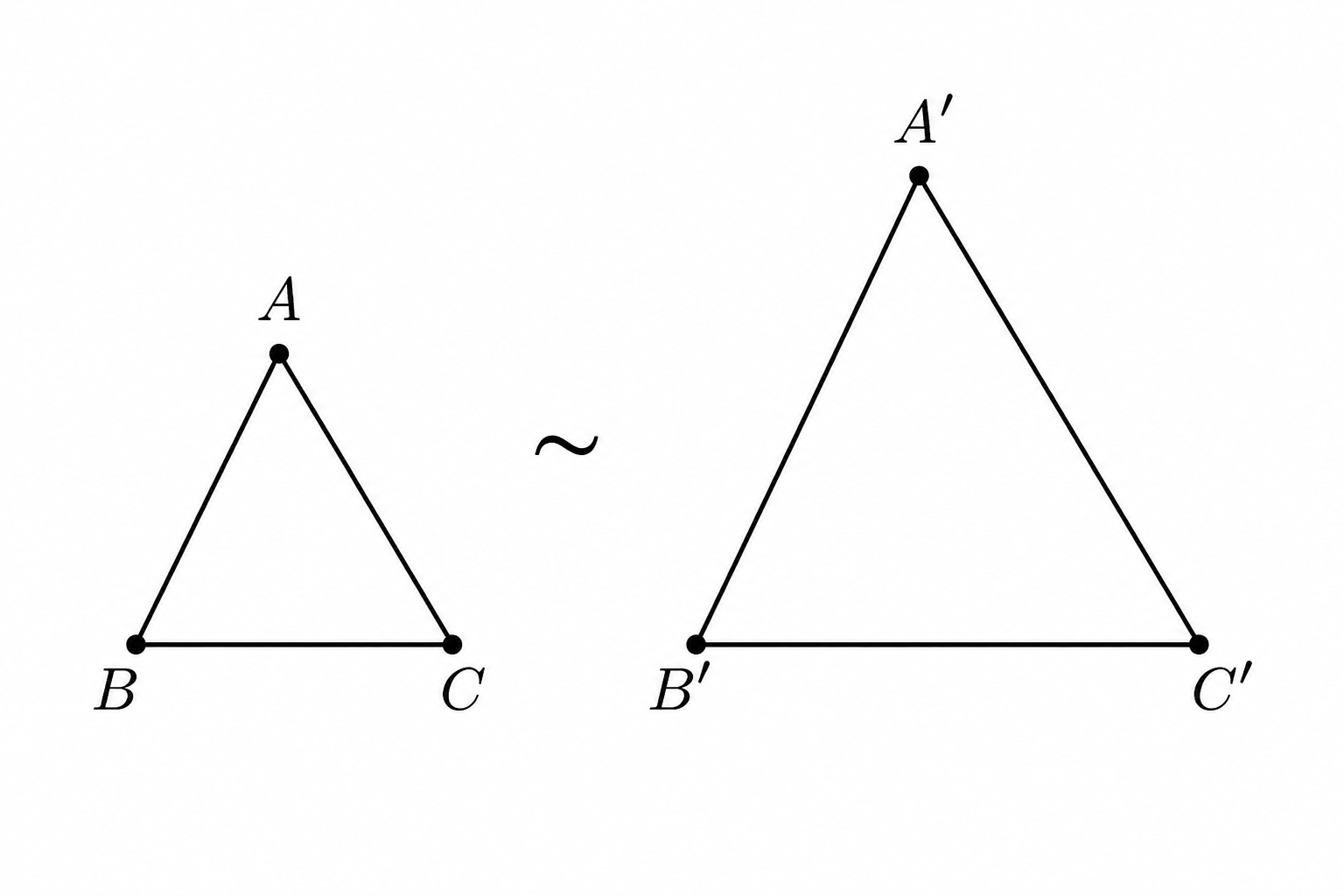
    Similar triangles
    △ABC∼△A′B′C′\triangle ABC\sim\triangle A'B'C'
    AA\text{AA}
    SAS\text{SAS}
    SSS\text{SSS}
  43. 94.
    E(X)=∑xx Pr⁡(X=x)E(X)=\sum_x x\,\Pr(X=x)
  44. 95.

    Slope, Line Equation, and Distance
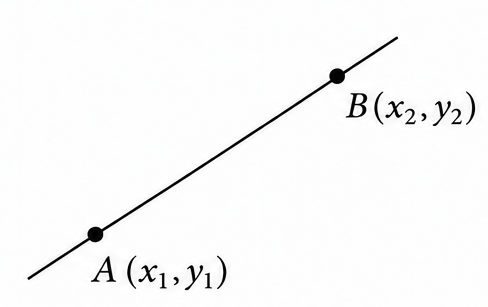
    Two points on a line with slope, line equation, and distance formulas
    mAB=y2−y1x2−x1m_{AB}=\frac{y_2-y_1}{x_2-x_1}
    y−y1=m(x−x1)y-y_1=m(x-x_1)
    AB=(x2−x1)2+(y2−y1)2AB=\sqrt{(x_2-x_1)^2+(y_2-y_1)^2}
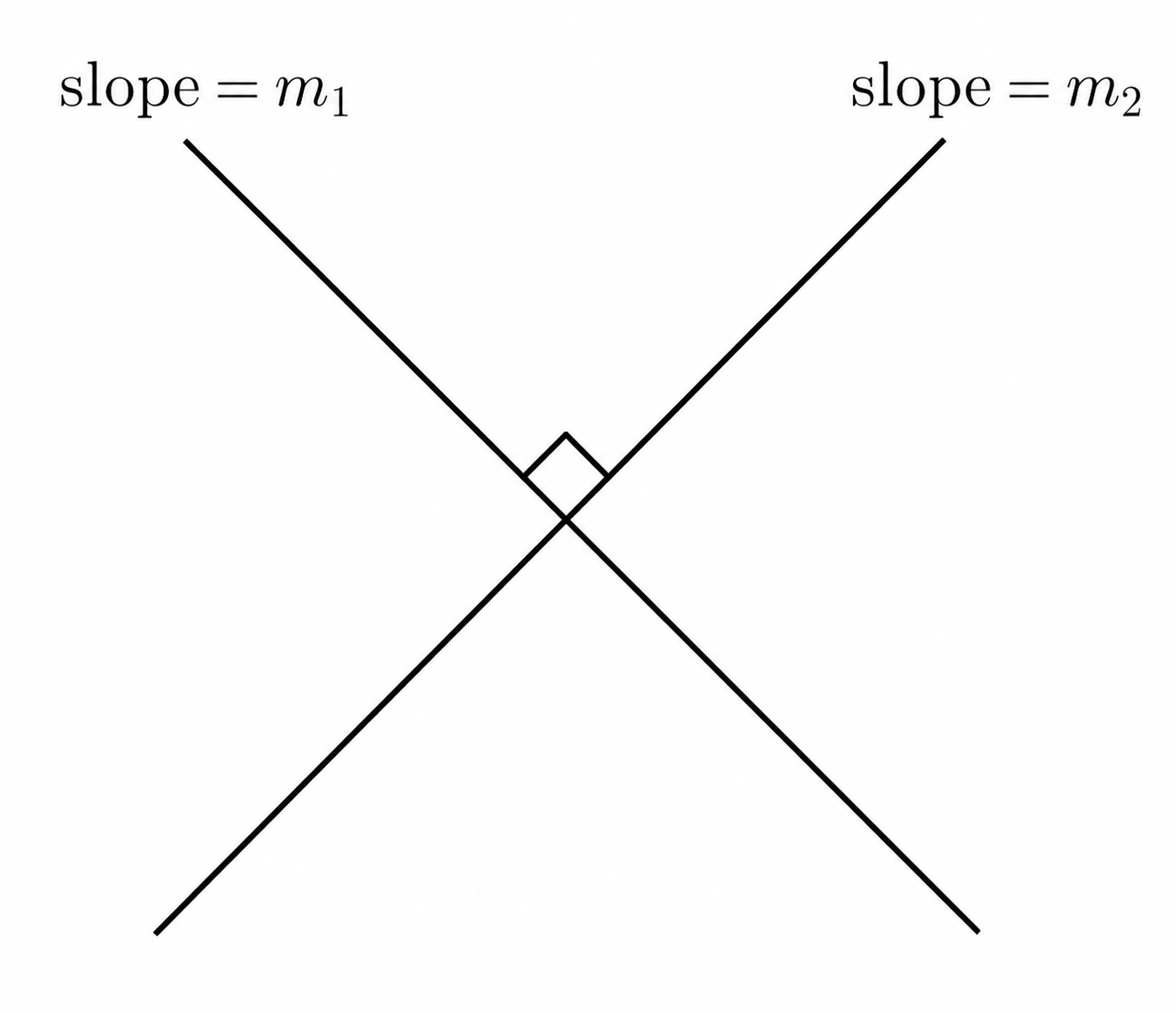
    Perpendicular lines with slopes m1 and m2
    Perpendicular lines:m1m2=−1\text{Perpendicular lines:}\qquad m_1m_2=-1

    Distance from a Point to a Line

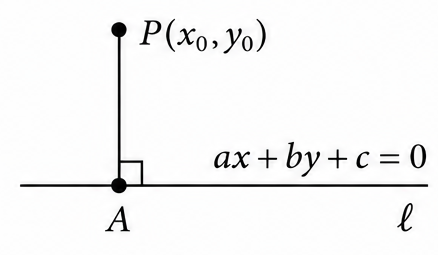
    Perpendicular distance from a point to a line
    For P(x0,y0) and ℓ:ax+by+c=0,\text{For }P(x_0,y_0)\text{ and }\ell:ax+by+c=0,
    d(P,ℓ)=∣ax0+by0+c∣a2+b2d(P,\ell)=\frac{|ax_0+by_0+c|}{\sqrt{a^2+b^2}}

    Distance Between Two Parallel Lines

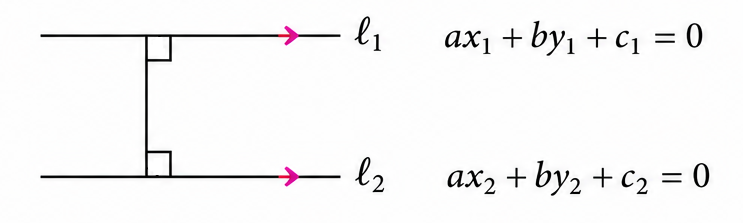
    Distance between two parallel lines
    ℓ1:ax+by+c1=0,ℓ2:ax+by+c2=0\ell_1:ax+by+c_1=0,\qquad \ell_2:ax+by+c_2=0
    d(ℓ1,ℓ2)=∣c1−c2∣a2+b2d(\ell_1,\ell_2)=\frac{|c_1-c_2|}{\sqrt{a^2+b^2}}

    Distance from a Point to a Plane

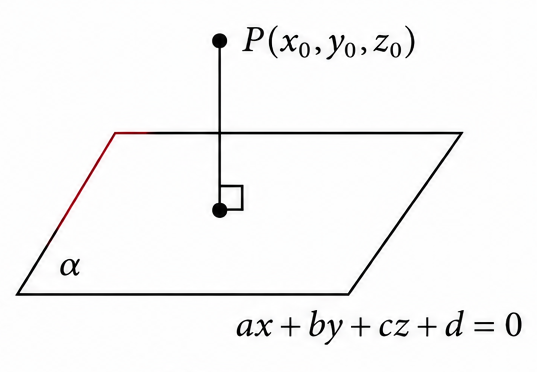
    Perpendicular distance from a point to a plane
    For P(x0,y0,z0) and α:ax+by+cz+d=0,\text{For }P(x_0,y_0,z_0)\text{ and }\alpha:ax+by+cz+d=0,
    d(P,α)=∣ax0+by0+cz0+d∣a2+b2+c2d(P,\alpha)=\frac{|ax_0+by_0+cz_0+d|}{\sqrt{a^2+b^2+c^2}}
  45. 96.
    ab=cd\frac{a}{b}=\frac{c}{d}
    a+bb=c+dd\frac{a+b}{b}=\frac{c+d}{d}
    aa+b=cc+d\frac{a}{a+b}=\frac{c}{c+d}
    ab−a=cd−c\frac{a}{b-a}=\frac{c}{d-c}
    a−ba+b=c−dc+d\frac{a-b}{a+b}=\frac{c-d}{c+d}
    a1b1=a2b2=⋯=anbn=k⟹λ1a1+λ2a2+⋯+λnanλ1b1+λ2b2+⋯+λnbn=k\frac{a_1}{b_1}=\frac{a_2}{b_2}=\cdots=\frac{a_n}{b_n}=k\quad\Longrightarrow\quad\frac{\lambda_1a_1+\lambda_2a_2+\cdots+\lambda_na_n}{\lambda_1b_1+\lambda_2b_2+\cdots+\lambda_nb_n}=k
  46. 97.
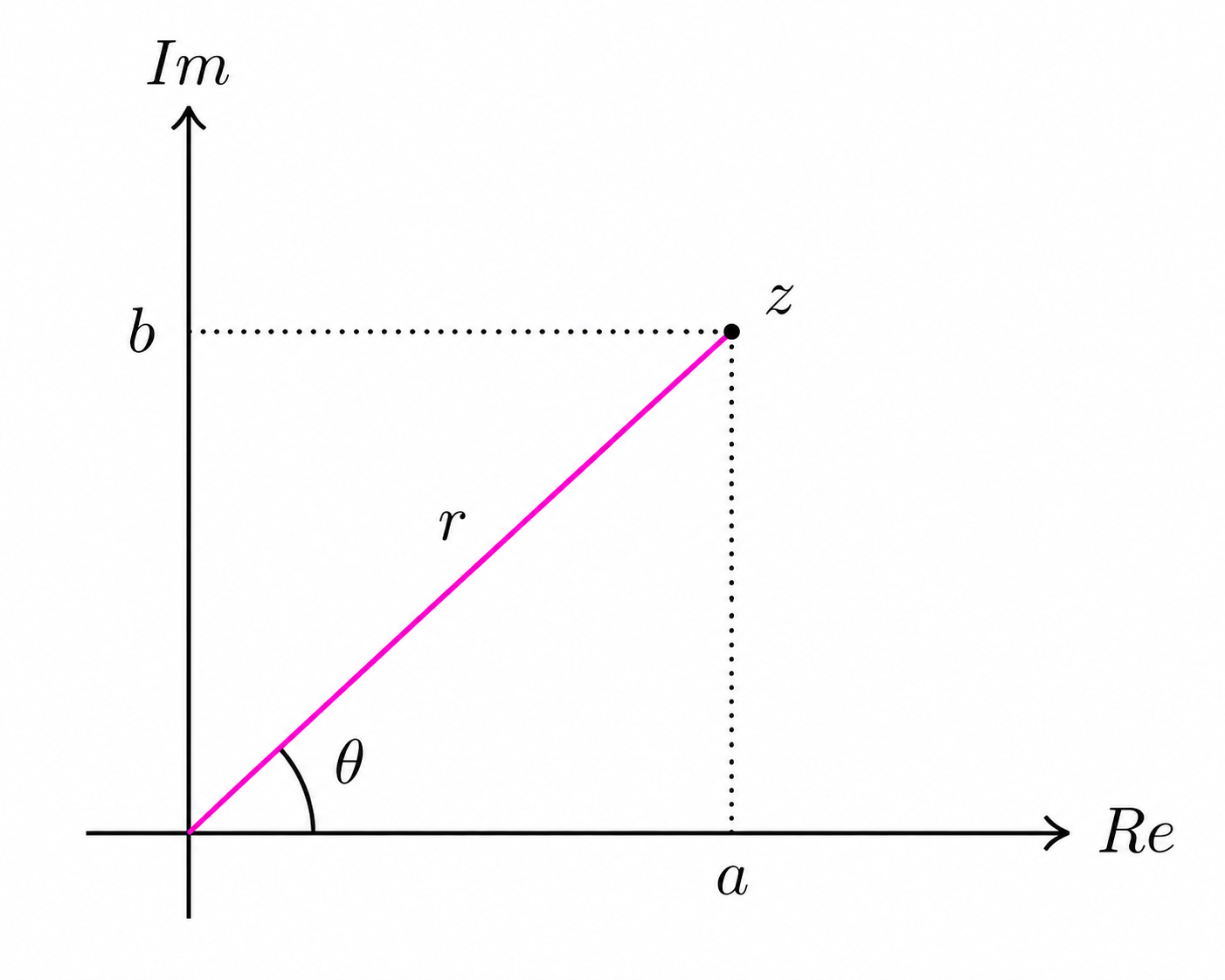
    Complex number on the complex plane
    z=a+bi=reiθz=a+bi=re^{i\theta}
    r=∣z∣=a2+b2r=|z|=\sqrt{a^2+b^2}
    a=rcos⁡θ,b=rsin⁡θa=r\cos\theta,\qquad b=r\sin\theta
    (a+bi)(c+di)=(ac−bd)+(ad+bc)i(a+bi)(c+di)=(ac-bd)+(ad+bc)i
    (reiθ)n=rneinθ(re^{i\theta})^n=r^ne^{in\theta}
  47. 98.
    L≤Answer≤UL\leq \text{Answer}\leq U
    L=U⟹Answer=LL=U\Longrightarrow\text{Answer}=L
  48. 99.
    (x−h)2a2+(y−k)2b2=1\frac{(x-h)^2}{a^2}+\frac{(y-k)^2}{b^2}=1
    c2=a2−b2c^2=a^2-b^2
    e=cae=\frac ca
    Area=πab\text{Area}=\pi ab
  49. 100.
    P(r)=0⟹(x−r)∣P(x)P(r)=0\Longrightarrow (x-r)\mid P(x)