Olympiad Toolkit

Master the ideas behind AMC 8, AMC 10, AMC 12, AIME, USA(J)MO, and Olympiad problems through structured toolkits, prerequisites, worked examples, and related competition problems.

Showing 101–126 of 126 toolkits
  1. 101.

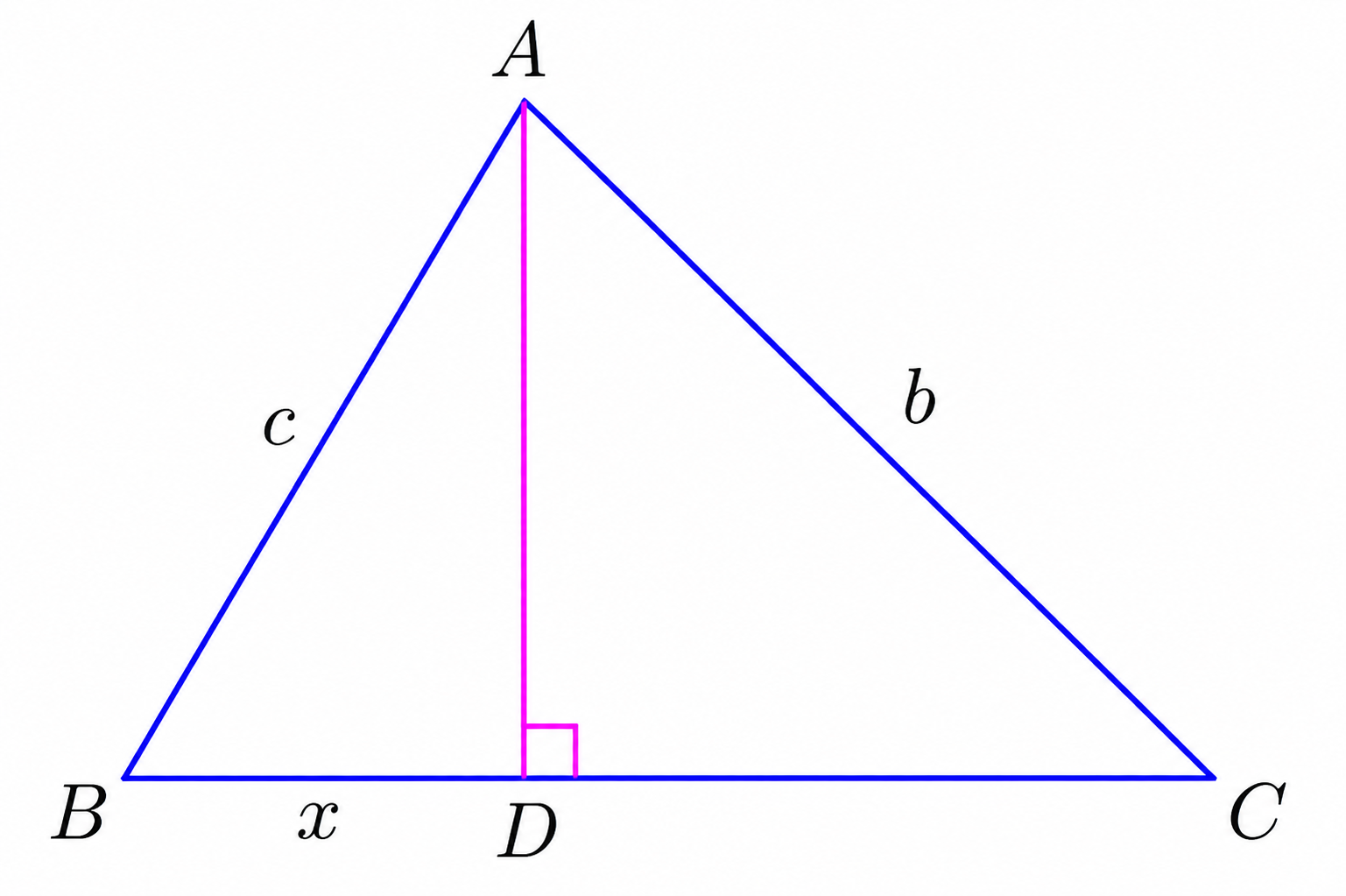
    Let BD=xBD=x, then

    x=a2+c2−b22ax=\frac{a^2+c^2-b^2}{2a}
    Triangle ABC with altitude AD to BC, where BD = x, BC = a, AC = b, and AB = c
  2. 102.

    Coloring can reveal patterns or invariants in problems involving boards, tilings, and moves.

    Checkerboard Coloring

    Color the squares alternately black and white, so squares sharing a side have different colors.
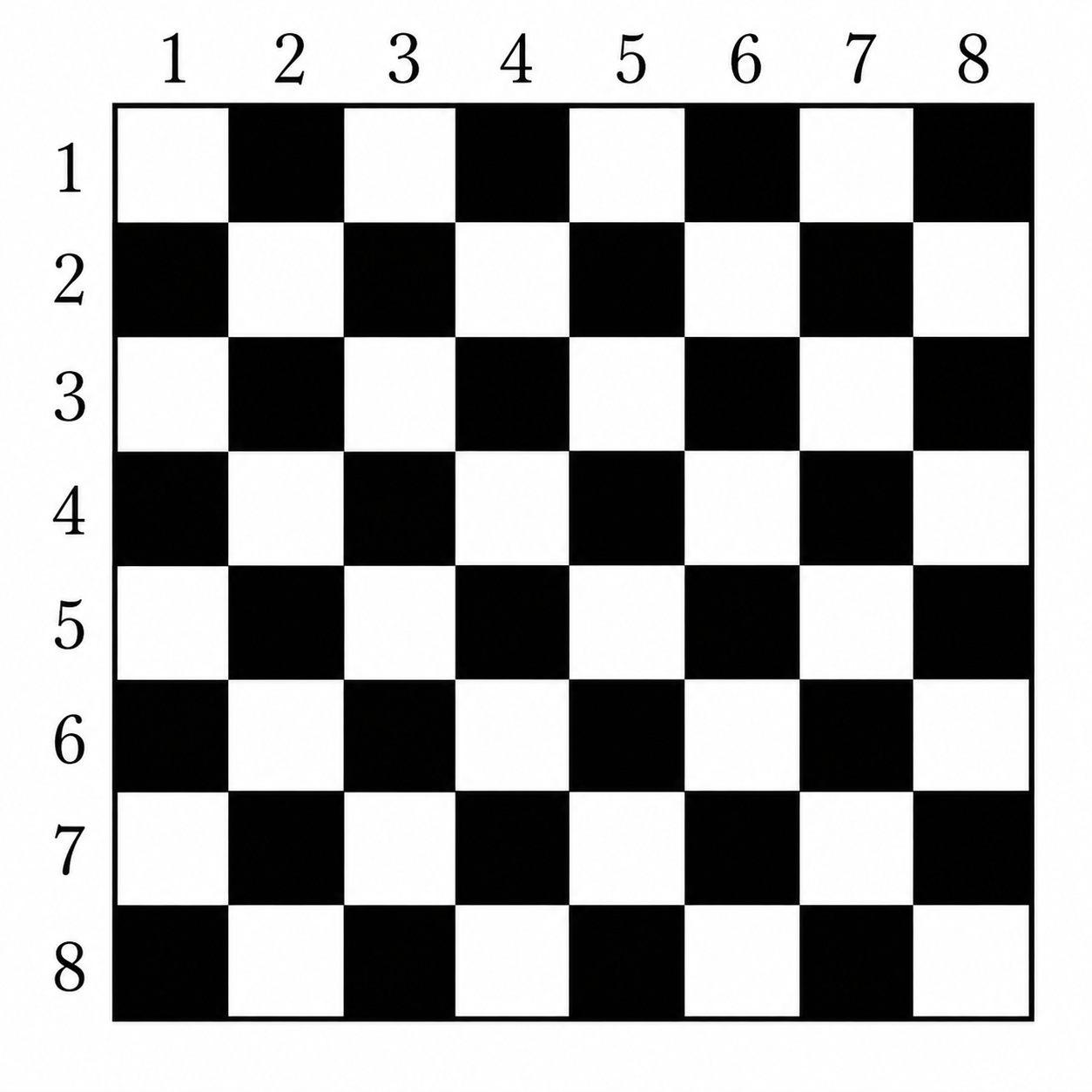
    An 8 by 8 checkerboard with alternating black and white squares and rows and columns numbered from 1 to 8

    A square in row rr and column cc can be colored according to the parity of

    r+cr+c

    • r+cr+c even → white
    • r+cr+c odd → black

  3. 103.

    When we want to prove that some selected objects must have a certain relationship, it can be useful to split all possible objects into carefully chosen groups.

    Key Idea

    1. Determine the relationship you want to force.
    2. Split the objects into groups based on that relationship.

  4. 104.

    For example, this applies to:

    • a subset and its complement
    • a graph and its complement
    • selected and unselected objects
    • an event and its complementary event

  5. 105.

    The centroid of a triangle is the point where its three medians intersect.

    If G is the centroid of △ABC and M is the midpoint of BC, then
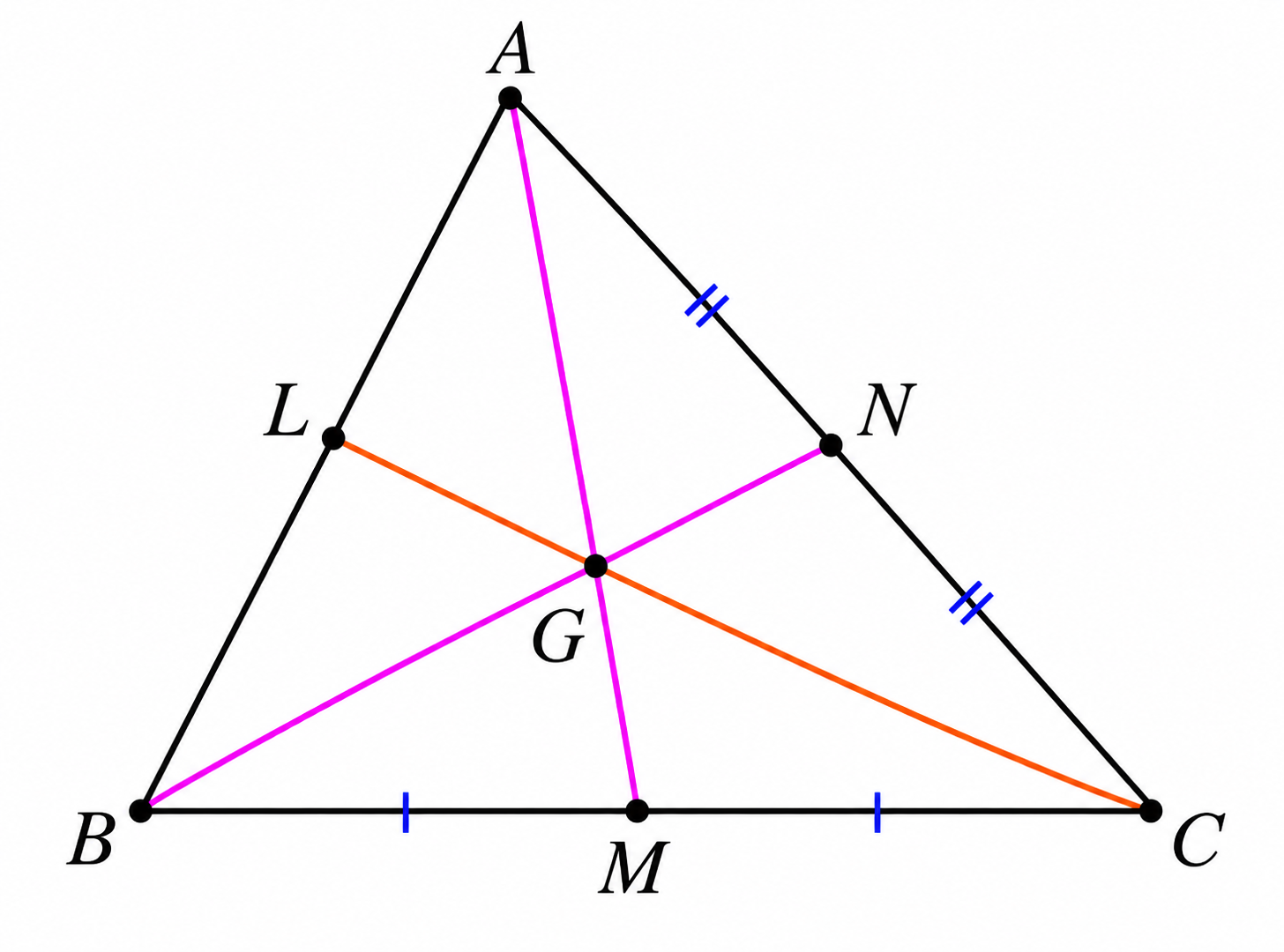
    Triangle ABC with medians AM and BN intersecting at G
    AG:GM=2:1AG:GM=2:1
    AG=23AMGM=13AMAG=\frac23 AM \qquad GM=\frac13 AM

    The three medians divide the triangle into six equal-area triangles.

    G=(x1+x2+x33,y1+y2+y33)G=\left(\frac{x_1+x_2+x_3}{3},\frac{y_1+y_2+y_3}{3}\right)
  6. 106.
    Section Formula
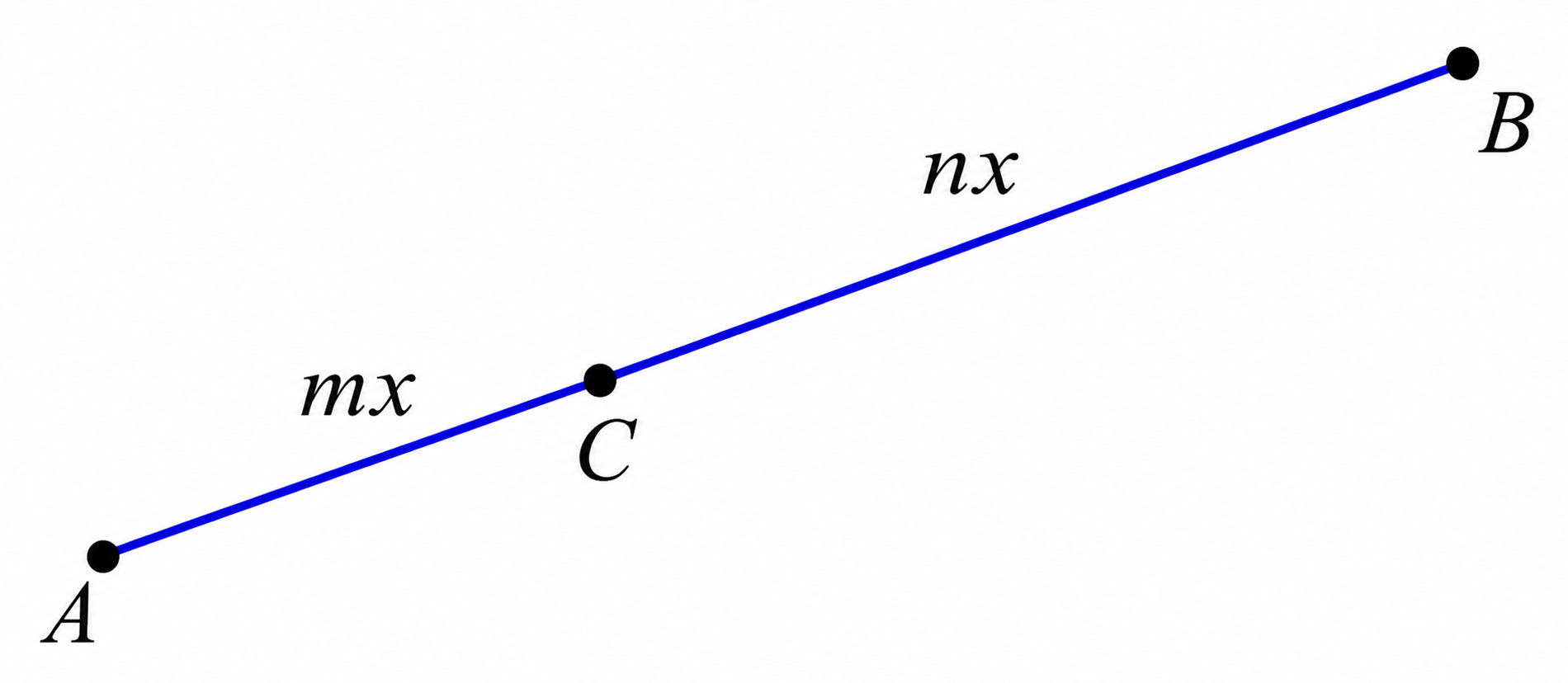
    ACCB=mn\frac{AC}{CB}=\frac{m}{n}
    C=mB+nAm+nC=\frac{mB+nA}{m+n}

    A=(x1,y1),B=(x2,y2)A=(x_1,y_1),\qquad B=(x_2,y_2)
    C=(nx1+mx2m+n,ny1+my2m+n)C=\left(\frac{nx_1+mx_2}{m+n},\frac{ny_1+my_2}{m+n}\right)

    Midpoint Formula

    C=A+B2C=\frac{A+B}{2}
    C=(x1+x22,y1+y22)C=\left(\frac{x_1+x_2}{2},\frac{y_1+y_2}{2}\right)
  7. 107.

    Homogeneous Expressions

    An expression is homogeneous if every term has the same total degree

    2ax2+x2b=b2a2ax^2+x^2b=b^2a

    When all terms have the same degree, divide by a suitable power of one variable and introduce ratios

    r=ax,t=bxr=\frac{a}{x},\qquad t=\frac{b}{x}

    Key Idea

    When all terms have the same total degree:

    1. Divide by a suitable power of one nonzero variable
    2. Replace ratios of variables by new variables
    3. Solve the simpler problem involving fewer variables

  8. 108.

    Symmetry and Fixed Cases Principle

    When a set of cases has a symmetry, we can often pair each case with another case that behaves in the opposite or corresponding way.

    The cases that are unchanged by the symmetry are called fixed cases. These must be considered separately.


    Key Idea

    Pair cases that are transformed into each other by a symmetry. Handle fixed cases separately.


    Applications

    Counting problems with opposite pairs, sign choices, and symmetry arguments

  9. 109.

    Sum of Binomial Coefficients

    (n0)+(n1)+(n2)+⋯+(nn)=2n\binom{n}{0}+\binom{n}{1}+\binom{n}{2}+\cdots+\binom{n}{n}=2^n

    Sums of Even and Odd Binomial Coefficients

    (n0)+(n2)+(n4)+⋯=(n1)+(n3)+(n5)+⋯=2n−1\binom{n}{0}+\binom{n}{2}+\binom{n}{4}+\cdots=\binom{n}{1}+\binom{n}{3}+\binom{n}{5}+\cdots=2^{n-1}

    Applications

    Simplifying binomial sums and solving combinatorial counting problems

  10. 110.

    Definition

    A function assigns exactly one output to each input.
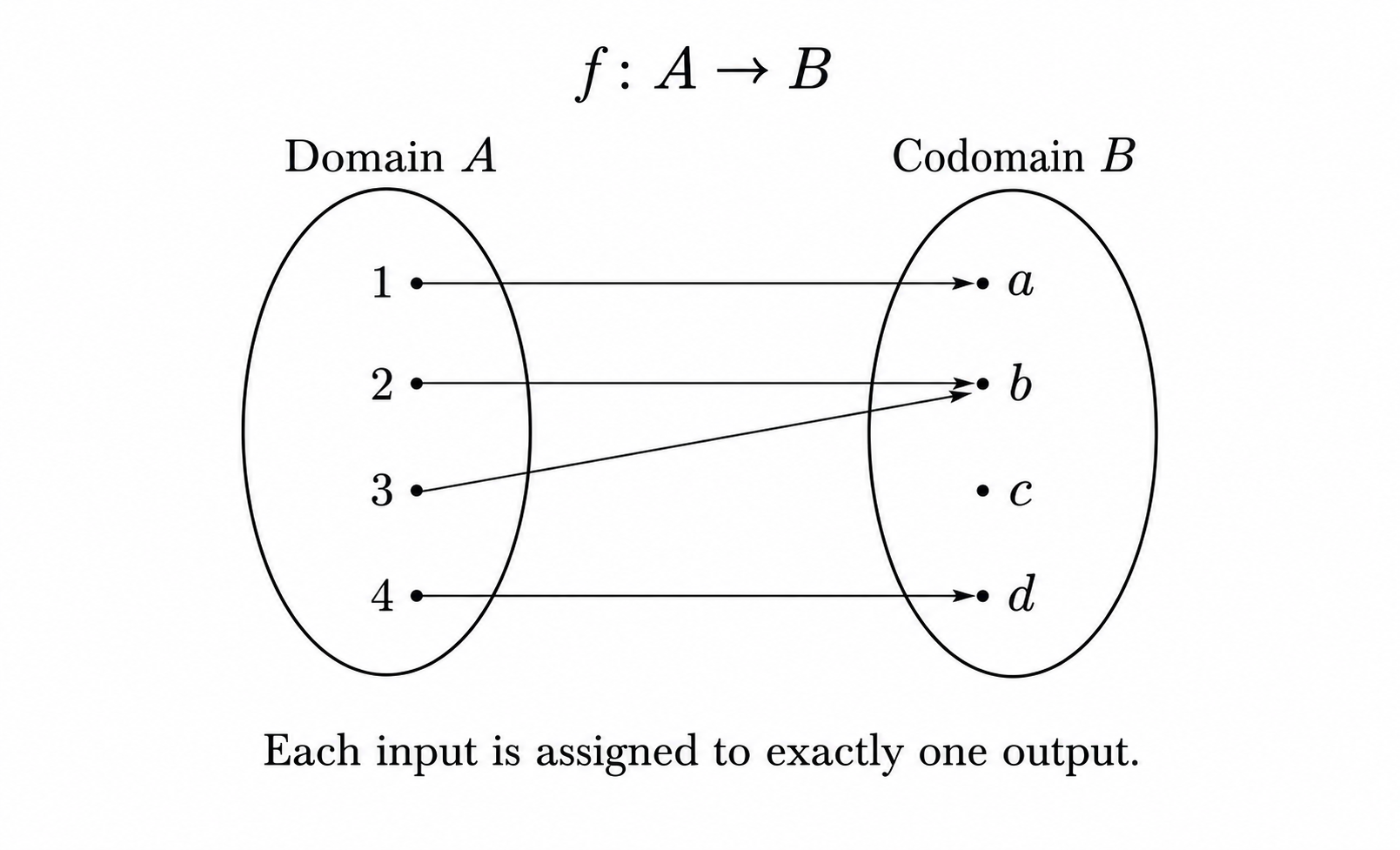
    f:A→Bf:A\to B
    Function mapping from domain A to codomain B

    Domain and Range

    Domain⁡(f)={x:f(x) is defined}\operatorname{Domain}(f)=\{x:f(x)\text{ is defined}\}
    Range⁡(f)={f(x):x∈Domain⁡(f)}\operatorname{Range}(f)=\{f(x):x\in\operatorname{Domain}(f)\}

    One-to-One Functions

    f(x1)=f(x2)⟹x1=x2f(x_1)=f(x_2)\Longrightarrow x_1=x_2

    Inverse Functions

    f(a)=b⟺f−1(b)=af(a)=b\Longleftrightarrow f^{-1}(b)=a
  11. 111.

    A rate compares how much of something is completed with the amount of time required.

    If aa units are completed in bb units of time, the rate is

    ab.\frac{a}{b}.

    Combined Rates

    When several people or machines work at the same time, their rates can be added:

    rcombined=r1+r2+⋯+rn.r_{\text{combined}}=r_1+r_2+\cdots+r_n.

    Amount Completed

    amount=rate×time.\text{amount}=\text{rate}\times\text{time}.
  12. 112.

    Geometric transformations map points in the plane to new points.

    Translation

    (x,y)⟼(x+a,y+b)(x,y)\longmapsto(x+a,y+b)

    Rotation

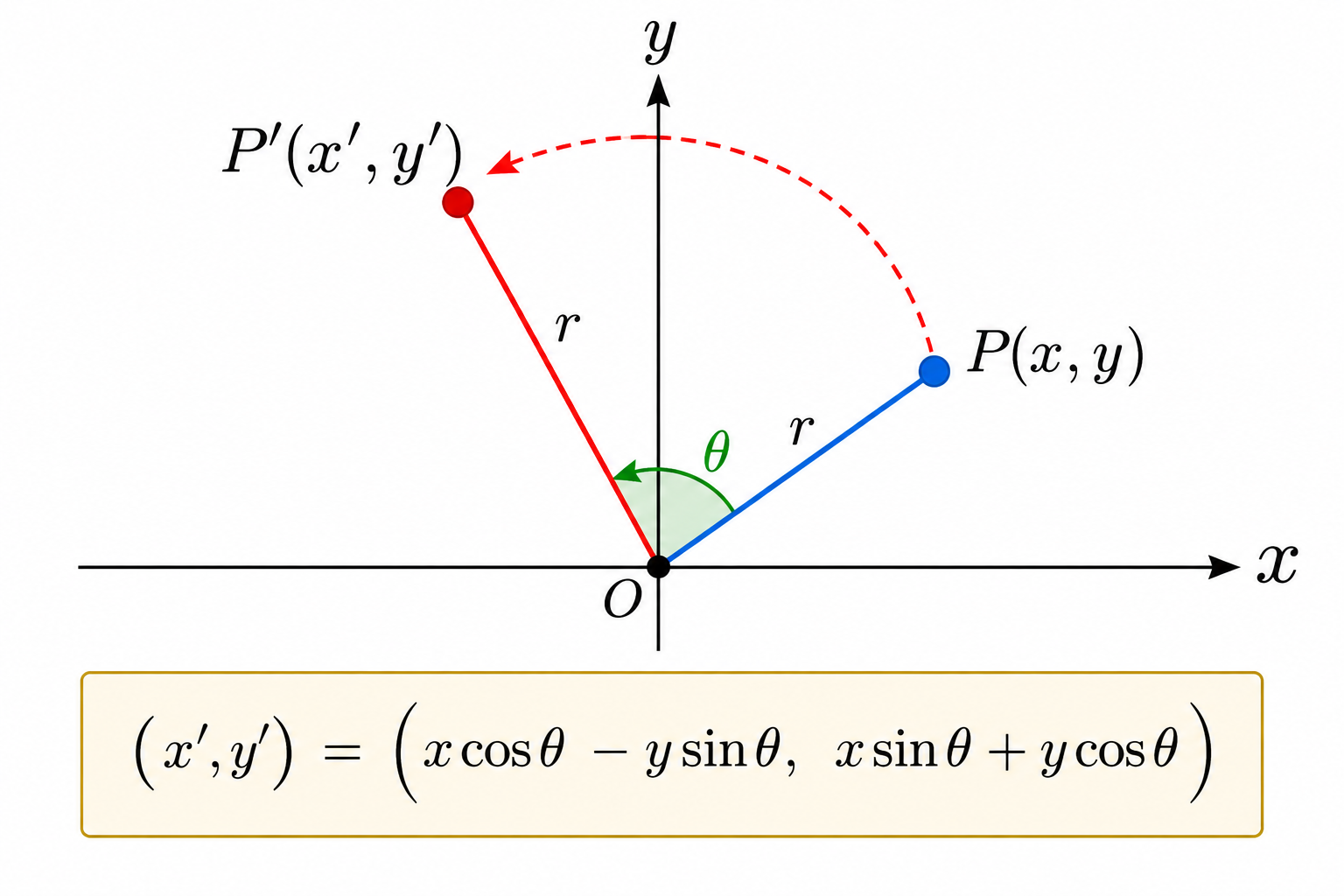
    (x,y)⟼(xcos⁡θ−ysin⁡θ, xsin⁡θ+ycos⁡θ)(x,y)\longmapsto(x\cos\theta-y\sin\theta,\ x\sin\theta+y\cos\theta)
    Counterclockwise rotation of a point about the origin

    Reflection

    (x,y)⟼(y,x)across y=x(x,y)\longmapsto(y,x)\qquad\text{across }y=x

    Dilation

    (x,y)⟼(kx,ky)(x,y)\longmapsto(kx,ky)
  13. 113.

    A vector is a quantity that has both magnitude and direction.

    If

    A=(x1,y1),B=(x2,y2),A=(x_1,y_1),\qquad B=(x_2,y_2),

    then

    AB→=(x2−x1,y2−y1).\overrightarrow{AB}=(x_2-x_1,y_2-y_1).

    Magnitude

    v=(a,b)⟹∣v∣=a2+b2.\mathbf{v}=(a,b)\qquad\Longrightarrow\qquad |\mathbf{v}|=\sqrt{a^2+b^2}.

    Vector Addition

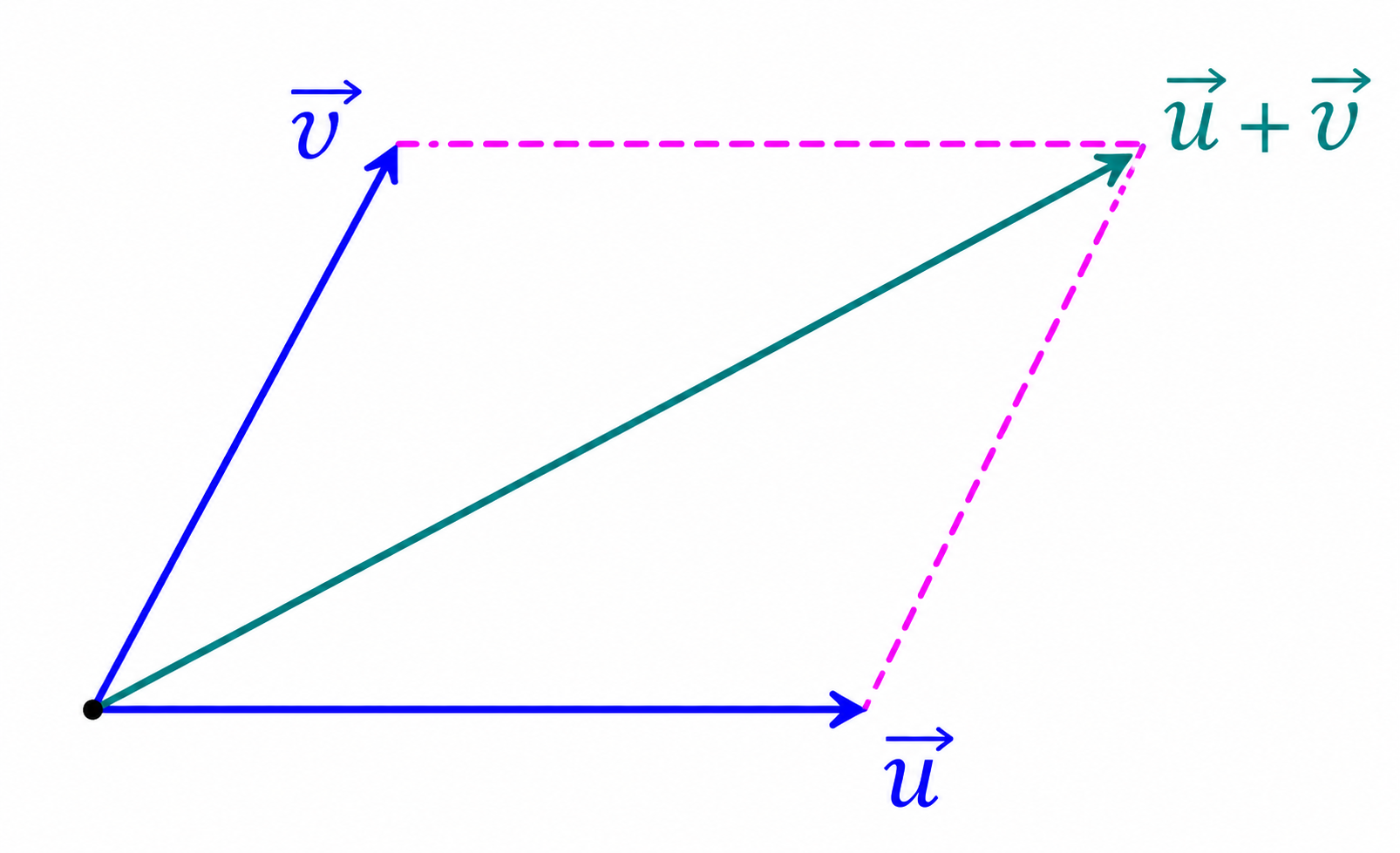
    (a,b)+(c,d)=(a+c,b+d).(a,b)+(c,d)=(a+c,b+d).
    Geometric interpretation of vector addition

    Scalar Multiplication

    k(a,b)=(ka,kb),∣kv∣=∣k∣ ∣v∣.k(a,b)=(ka,kb),\qquad |k\mathbf{v}|=|k|\,|\mathbf{v}|.

    Points on a Segment

    p=(1−t)a+tb,0≤t≤1.\mathbf{p}=(1-t)\mathbf{a}+t\mathbf{b},\qquad 0\le t\le1.
  14. 114.

    Floor Function

    The floor of x is the greatest integer less than or equal to x.
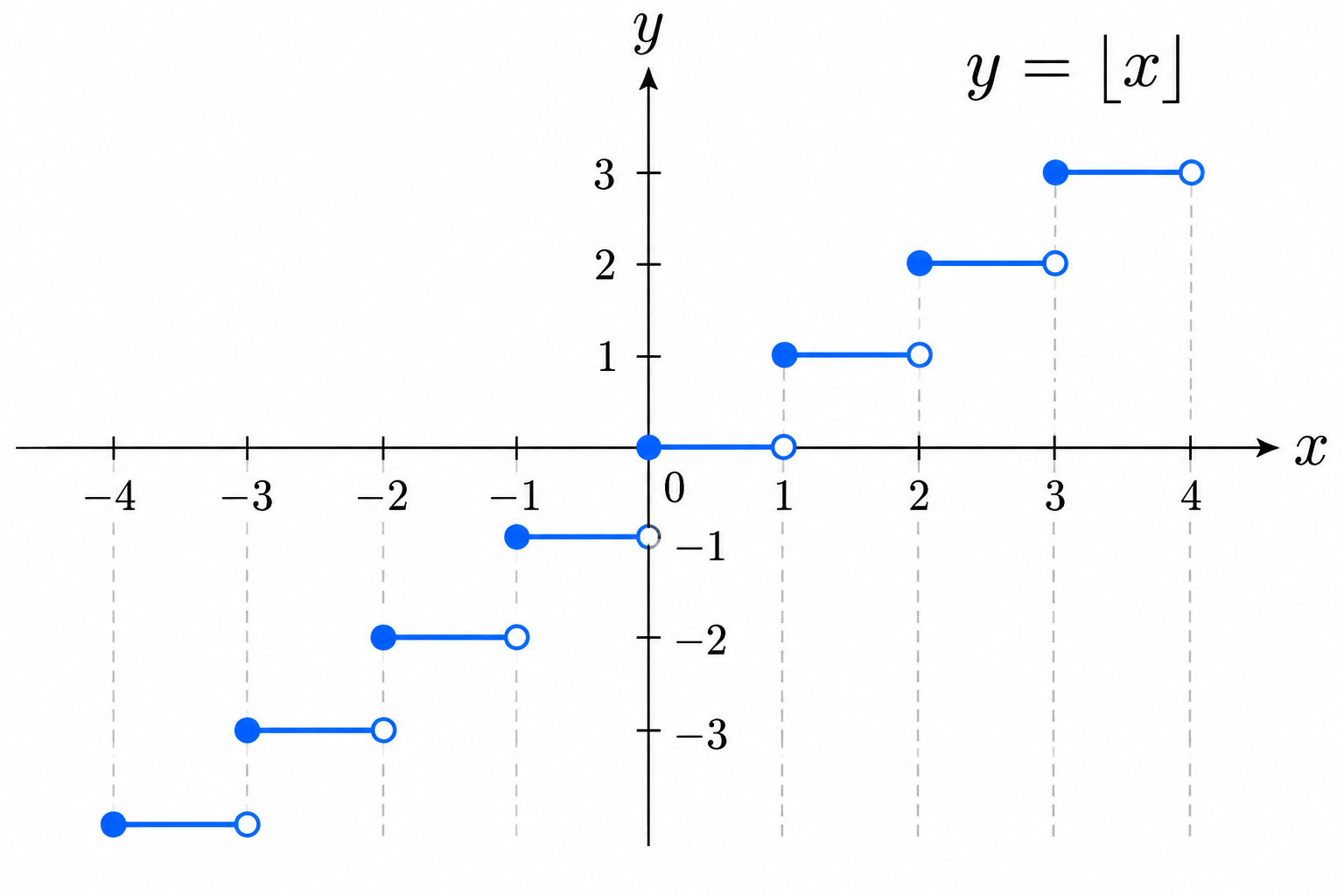
    ⌊x⌋≤x<⌊x⌋+1\boxed{\lfloor x\rfloor\le x<\lfloor x\rfloor+1}
    Graph of the floor function

    Ceiling Function

    The ceiling of x is the smallest integer greater than or equal to x.
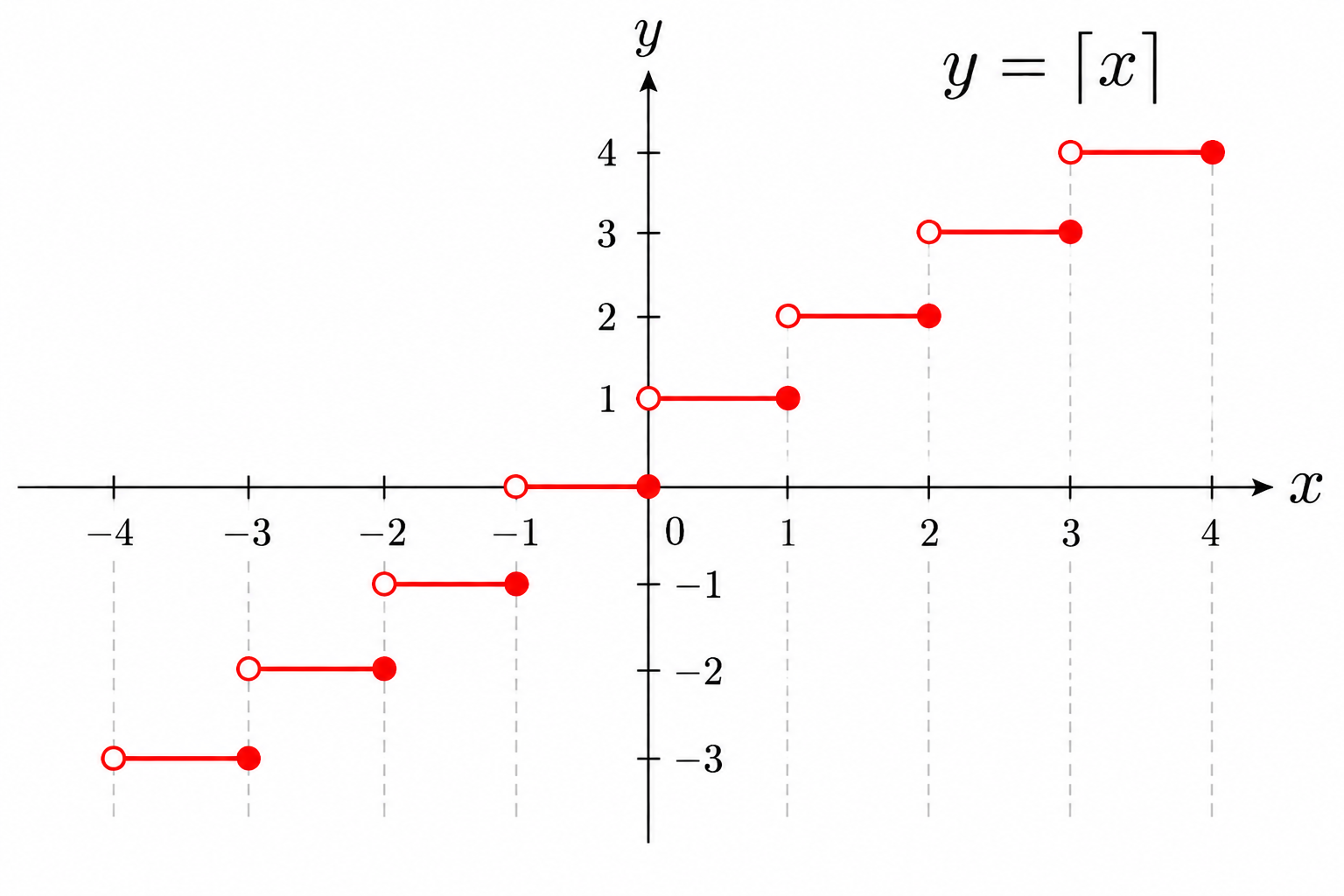
    ⌈x⌉−1<x≤⌈x⌉\boxed{\lceil x\rceil-1<x\le\lceil x\rceil}
    Graph of the ceiling function

    x∉Z⟹⌈x⌉=⌊x⌋+1x\notin\mathbb Z\Longrightarrow\lceil x\rceil=\lfloor x\rfloor+1
  15. 115.

    Addition Principle

    For mutually exclusive cases, add the numbers of possibilities.

    n1+n2+⋯+nkn_1+n_2+\cdots+n_k

    Multiplication Principle

    For successive choices, multiply the numbers of possibilities.
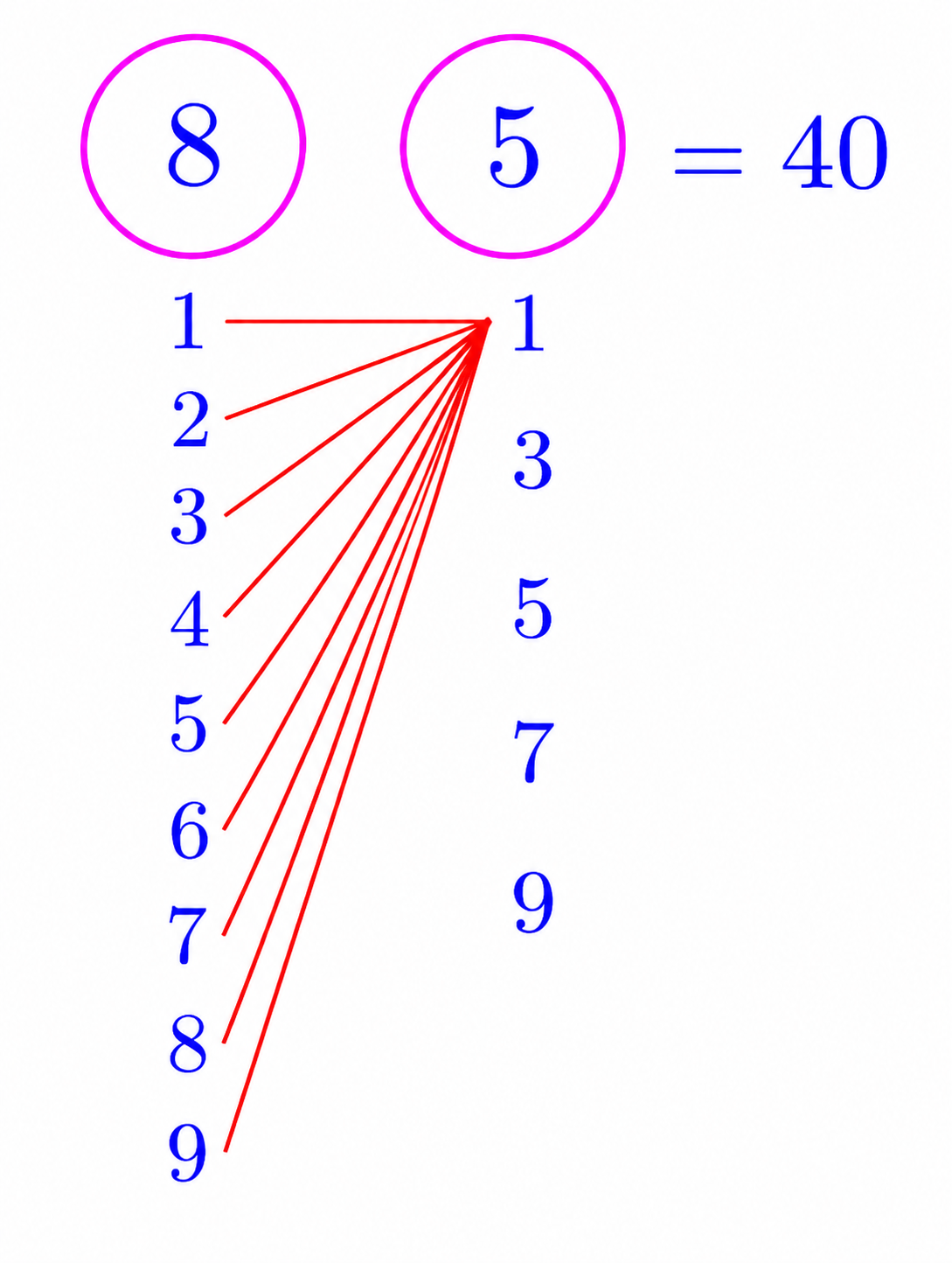
    n1n2⋯nkn_1n_2\cdots n_k
    Counting choices using the Multiplication Principle

    Complement Principle

    Desired=Total−Undesired\text{Desired}=\text{Total}-\text{Undesired}
  16. 116.

    A permutation is an arrangement of objects in which order matters.

    Arranging All Objects

    n!n!

    Arranging Some of the Objects

    P(n,r)=n!(n−r)!P(n,r)=\frac{n!}{(n-r)!}

    Identical Objects

    n!n1!n2!⋯nk!\frac{n!}{n_1!n_2!\cdots n_k!}
  17. 117.

    A combination is a selection of objects in which order does not matter.

    (nr)=n!r!(n−r)!\binom{n}{r}=\frac{n!}{r!(n-r)!}

    The notation (nr)\binom{n}{r} is read as “n choose r”.


    Symmetry Identity

    (nr)=(nn−r)\binom{n}{r}=\binom{n}{n-r}

    Choosing the objects to include is equivalent to choosing the objects to exclude.


    Pascal's Identity

    (nr)=(n−1r)+(n−1r−1)\binom{n}{r}=\binom{n-1}{r}+\binom{n-1}{r-1}

    Faster Calculation

    (107)=(103)=10⋅9⋅83⋅2⋅1=120\binom{10}{7}=\binom{10}{3}=\frac{10\cdot9\cdot8}{3\cdot2\cdot1}=120
  18. 118.

    Probability measures how likely an event is to occur.

    0≤P(A)≤10\le P(A)\le1

    Sample Space and Events

    The sample space SS is the set of all possible outcomes, and an event AA is a collection of outcomes from the sample space.


    Equally Likely Outcomes

    P(A)=∣A∣∣S∣P(A)=\frac{|A|}{|S|}

    Complement

    P(Ac)=1−P(A)P(A^c)=1-P(A)

    Probability of A or B

    P(A∪B)=P(A)+P(B)−P(A∩B)P(A\cup B)=P(A)+P(B)-P(A\cap B)

    Independent Events

    P(A∩B)=P(A)P(B)P(A\cap B)=P(A)P(B)
  19. 119.

    A step-by-step algorithm for finding square roots by grouping digits into pairs, subtracting squares, and determining each successive digit.
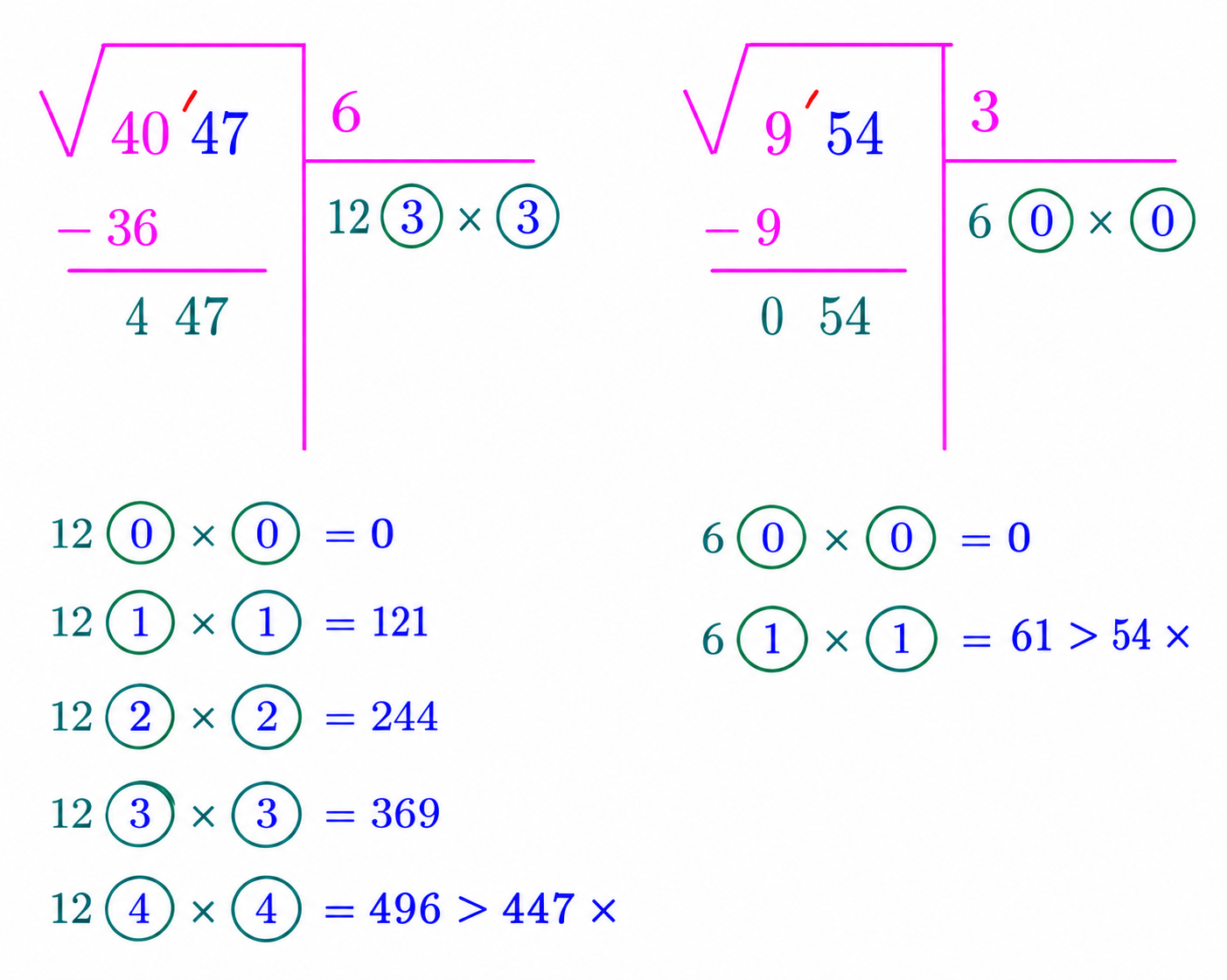
    Square-root long-division algorithm illustrated with 4047 and 954.
  20. 120.

    For two nonnegative numbers with a fixed sum, their product increases and the sum of their squares decreases as the numbers become closer together.
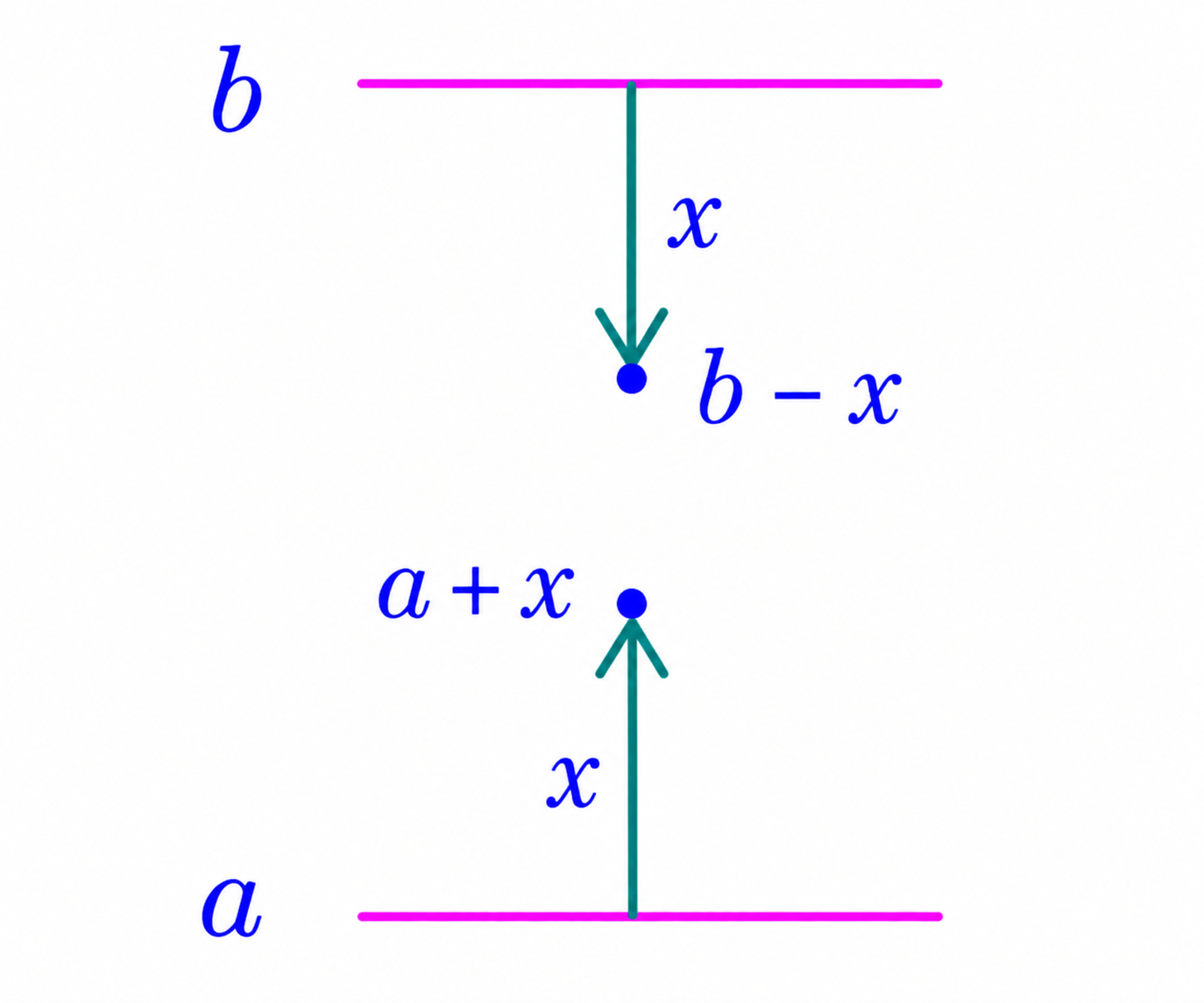
    Moving two numbers closer together while keeping their sum fixed.
    a+b=S⟹ab≤S24\boxed{a+b=S\Longrightarrow ab\le\frac{S^2}{4}}
  21. 121.

    If x and y are nonnegative integers, d is squarefree, and

    x+y=kd,\sqrt{x}+\sqrt{y}=k\sqrt{d},

    then for some nonnegative integers a and b,

    x=da2,y=db2,a+b=k\boxed{x=da^2,\quad y=db^2,\quad a+b=k}
  22. 122.

    An invariant is a quantity or property that remains unchanged throughout a process.

    I(S0)=I(S1)=I(S2)=⋯I(S_0)=I(S_1)=I(S_2)=\cdots

    If the initial and target configurations have different invariant values, the target is impossible to reach.

    I(initial)≠I(target)⟹impossible\boxed{I(\text{initial})\ne I(\text{target})\Longrightarrow\text{impossible}}
  23. 123.

    A rational number can be written as

    ab,a,b∈Z,b≠0.\frac ab,\qquad a,b\in\mathbb Z,\quad b\ne0.

    A real number that cannot be written in this form is irrational.

    37, 0, 0.125⏟Rational2, π⏟Irrational\underbrace{\frac37,\ 0,\ 0.125}_{\text{Rational}}\qquad\underbrace{\sqrt2,\ \pi}_{\text{Irrational}}
    xxyyx+yx+yxyxy
    RationalRationalRationalRational
    RationalIrrationalIrrationalMay be either
    IrrationalIrrationalMay be eitherMay be either
  24. 124.

    Every real square is nonnegative. This helps prove inequalities and find minimum values.

    x2≥0(x∈R)x^2\ge0\qquad(x\in\mathbb{R})
    a2+b2−2ab=(a−b)2≥0a^2+b^2-2ab=(a-b)^2\ge0
    x2−6x+13=(x−3)2+4≥4x^2-6x+13=(x-3)^2+4\ge4
  25. 125.
    π=3.14159…\pi=3.14159\ldots
    2=1.41421…\sqrt{2}=1.41421\ldots
    3=1.73205…\sqrt{3}=1.73205\ldots
    e=2.71828…e=2.71828\ldots
  26. 126.

    Choose an object with an extreme property, such as the largest, smallest, longest, or shortest, and use it to prove a statement or reach a contradiction.
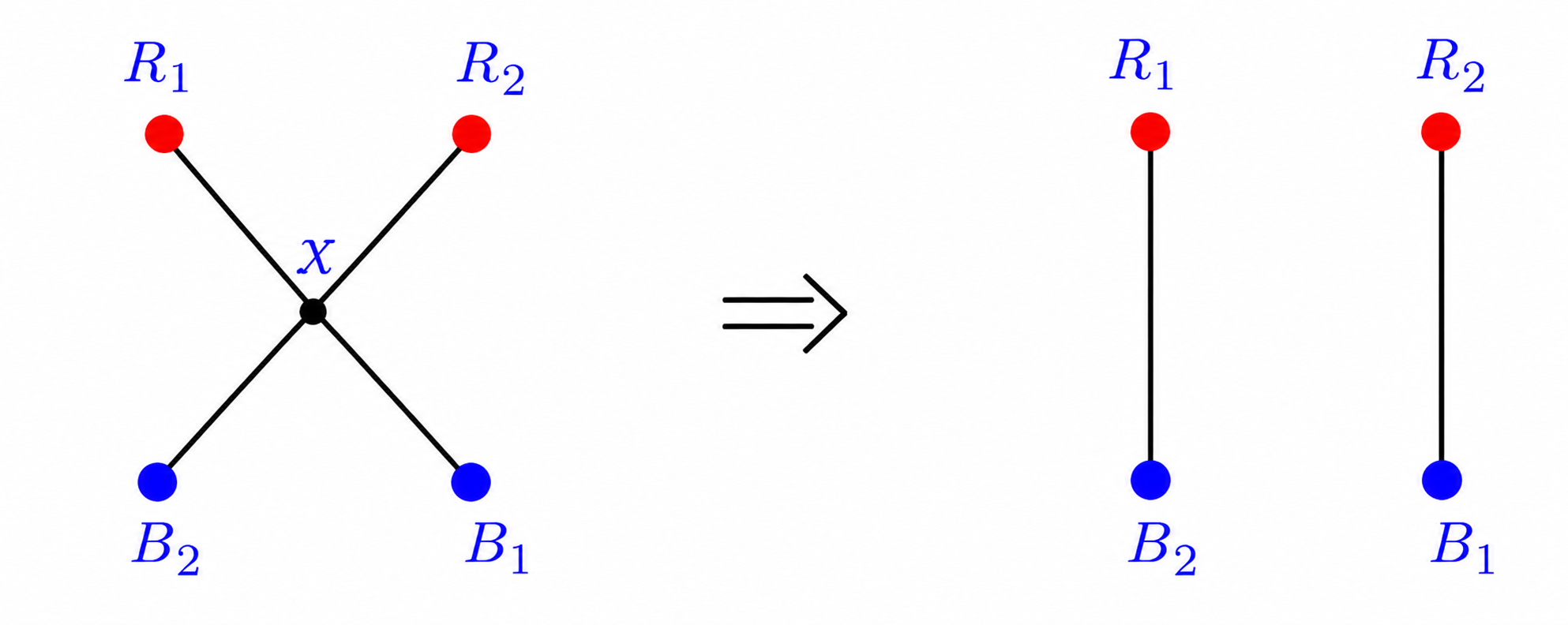
    Extremal principle: replacing crossing segments to reduce total length